Fender Design - Wheel Arch Challenge
AIM:
To determine whether the design complies with European requirements.
GIVEN DESIGN:
WHEEL ARCH: The semi-circular portion of a vehicle's wheel that is above it is called the wheel arch. The front wheel arch was raised into the fender, which was the most significant body modification. Around the splash plate at the rear of the wheel arch, corrosion had taken place.
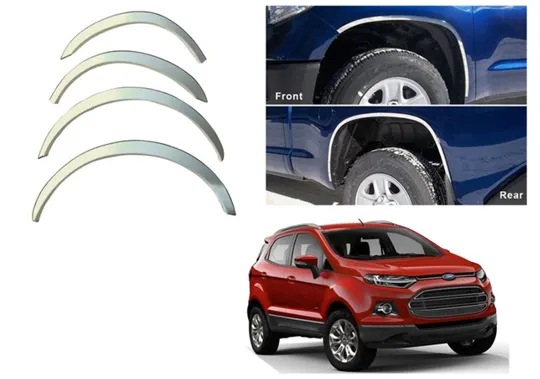
FENDER:
A car's fender is a component that shields and frames the wheels while also preventing mud splashes. On their front wheels, most modern cars have fenders. It refers to the portion of a vehicle that encloses the wheel hub. The main purpose of a fender is to stop the tyre from launching dirt and other debris into the air. Above the car's wheels is where the fender is situated. As a result, a normal car has four fenders: the front right, front left, rear right, and rear left.
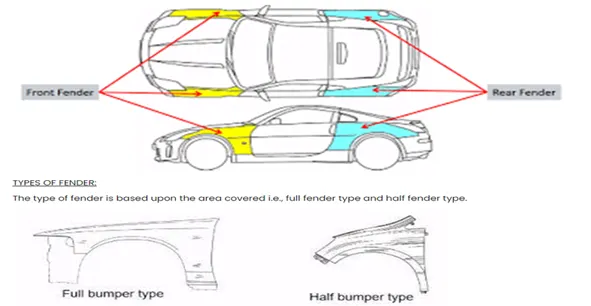
- FULL FENDER TYPE:
The full fender type is a more conventional fender style that uses more material. This type is utilised in older automotive designs where it adds to overall weight and lowers performance. Because to increased surf, maintenance costs have also increased.
- HALF FENDER TYPE:
Half fenders are a modern design that uses less material and boosts productivity by allowing for a smaller blank size. In comparison to full bumper types, maintenance is also comparatively low.
Using the European Standards Discussed:
Fig: (2) European Standards
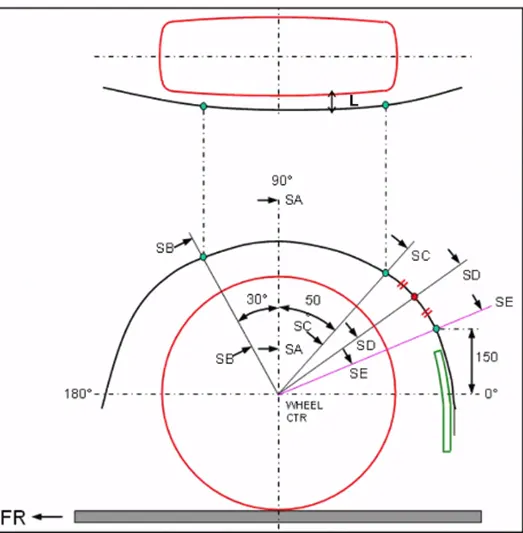
Wheel Arc Verification Using European Standards:
The clearance between the wheel and the fender during vehicle bump circumstances is a crucial factor that is taken into account when building a wheel arch or wheel. The minimum required wheel arc distance from the wheel for safety has been proposed as requirements by the vehicle and road safety community.
Rules -
- The sections SA, SB, SC, SD, and SE are used to measure CL L.
- The value of CL L should be more than 10mm at all parts.
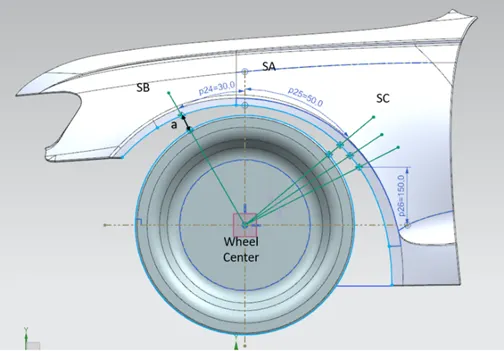
- The need for a wheel guard: The value of a must be more than 5mm at 30 degrees forward and 50 degrees back from the wheel's centre.
The below fig shown the sketch is drawn on the wheel face as per the European Standards,
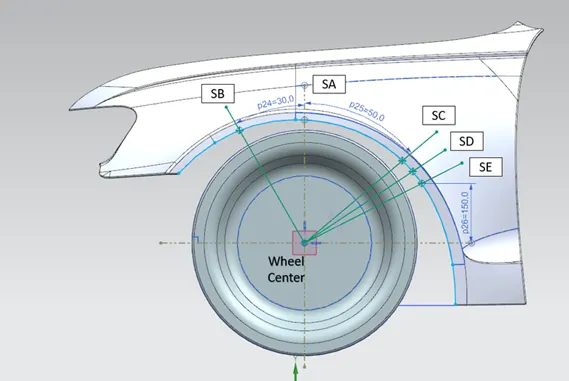
Fig: (3) Wheel Arch
In the above fig- we have opened the given file on Siemens NX CAD 12. Firstly, create the point on the centre of wheel and then create the centre reference line. project the on the wheel arch at section SA, SB, SC, SD and SE to measure the distance / clearance 'L', 'a' and the wheel arch area.
Calculation of the clearance value "L" as following:
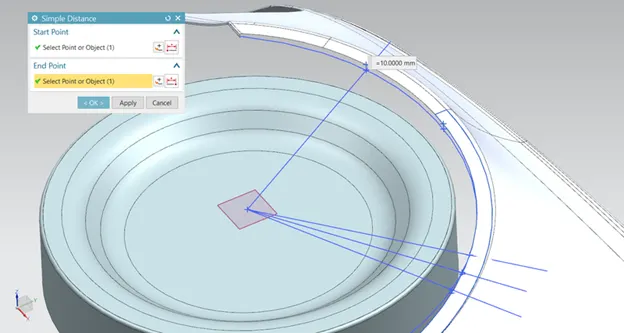
1] The Measuring 'L' for the given wheel and fender at SB- The value of 'L' at SB= 10.0000 mm.
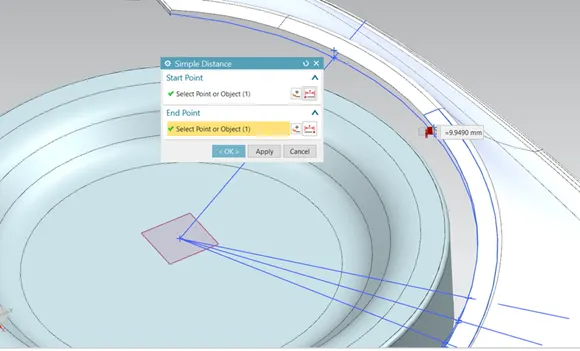
2] The Measuring 'L' for the given wheel and fender at SA- The value of 'L' at SA= 9.9490 mm.
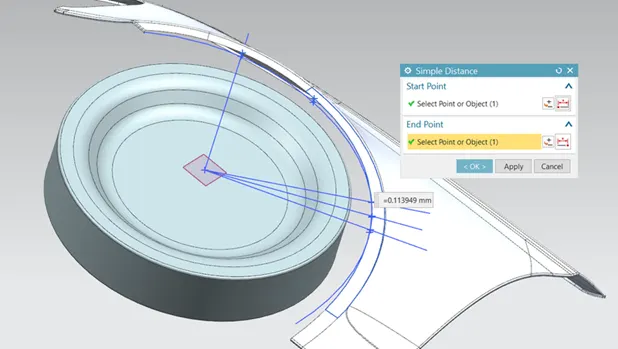
3] The Measuring 'L' for the given wheel and fender at SC- The value of 'L' at SC= 0.113949 mm
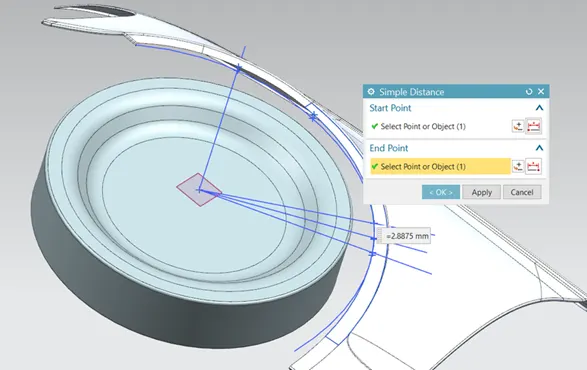
4] The Measuring 'L' for the given wheel and fender at SD- The value of 'L' at SD= 2.8875 mm.
5] The Measuring 'L' for the given wheel and fender at SE- The value of 'L' at SE= 5.9973 mm.
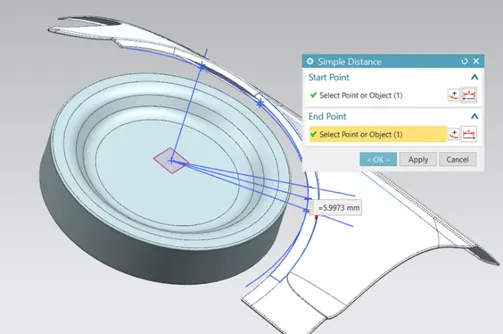
|
Sl no. |
Section |
Distance/clearance “l” (mm) |
Result |
|
1. |
SB |
10.000 = 10 |
Pass |
|
2. |
SA |
9.9490 < 10 |
Fail |
|
3. |
SC |
-0.113949 |
Fail |
|
4. |
SD |
-2.8875<10 |
Fail |
|
5. |
SE |
-5.9973<10 |
Fail |
From the comparing above four section (like SA, SC, SD and SE) the fender doesn't pass the European standards for the wheel arch.
From the below fig- the Obtaining the value of clearance 'a' from the wheel guard requirement.
CONCLUSION:
- A negative indicator signifies that the wheel arc is in the rear-view mirror.
- All the section doesn’t have the CL L value at least 10mm, only SA is seen to have value 10mm
- I have study from the above results, we have conclusion that the fender does not pass the European Regulations, as the Minimum Clearance value of 'L' between the fender wheel arch and wheel for vehicle and Safety is 10 mm and this design doesn’t meet the requirement.