Section Modulus calculation and optimization
Aim:
To find the section modulus of the hood and optimization to improve the overall section modulus.
Objective:
Use the section from your Hood design and calculate the section modulus using the formula S= I/y.
SECTION MODULUS
- Ratio of total moment resisted by the section to the stress in the extreme fibre.
- It gives us an idea about how much of load the given structure can take.
- If the section modulus increases the moment of resistence increases and hence its load bearing capacity.
S = I/y
where, S - Section modulus
I - moment of inertia
y - distance from neutral axis to the extreme end of the object.
Calculation:
Case 1: Before Optimization
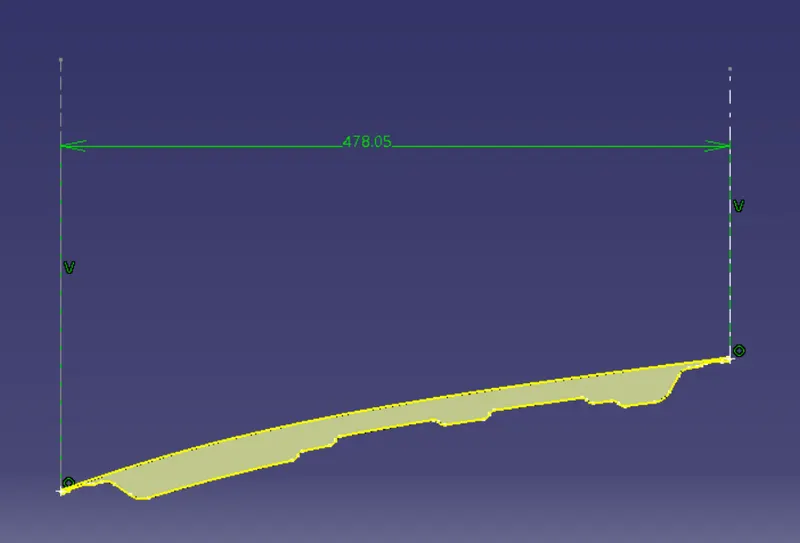
- The below image shows the distance between the ends of the hood.
- From this in order to find the value of y, we have to take the half of the distance between the ends of the hood.
- Hence the value of the y is 239.05mm
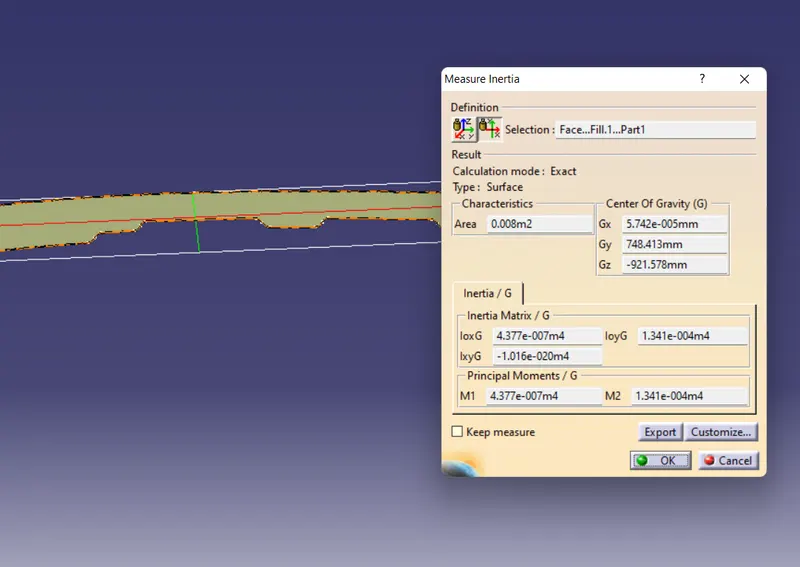
- Here, we found the moment of inertia of the hood which we have design.
- The value of moment of inertia I:-
-
I (MAX) = 4.377e+05 (mm^4)
I (MIN) = 1.341e+08 (mm^4)
As per the section modulus equation,
S = I/y
I = MOI (min) Value is considered
y = Total distance / 2, Total distance = 478.05 mm
y = 478.05 / 2
= 239.025 mm
Therefore, S = 437700mm^4 /239.025 mm
S = 1831.189 mm^3
Case 2: After Optimization
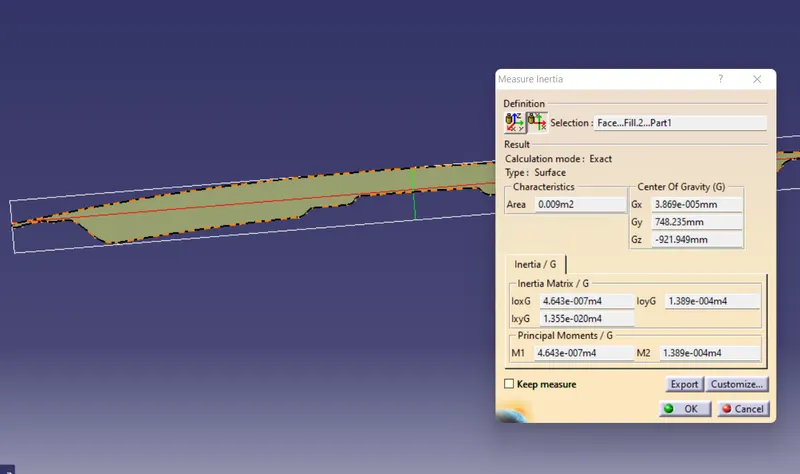
The hood inner panel’s curve is offset by 0.5mm outwards and section inertia analysis is done same as case 1 for a closed curve.
I (MAX) = 4.643e+05 (mm^4)
I (MIN) = 1.389e+08 (mm^4)
As per the section modulus equation,
S = I/y
I = MOI (min) Value is considered
y = Total distance / 2, Total distance = 478.05 mm
y = 478.05 / 2
y = 239.025 mm
Therefore, S = 464300 mm^4 / 239.025 mm
S = 1942.474 mm^3
Conclusion:
Resulting by comparing case 1 & case 2,
- The section modulus value of case 2 is higher than the case 1
- As we increase the section area, the moment of inertia & section modulus increase which means strength and load material also increase. Which the moment of inertia directly proportional to the strength of the material.