Section Modulus calculation and optimization
Aim:
To find the section modulus of the hood and optimization to improve the overall section modulus.
Objective:
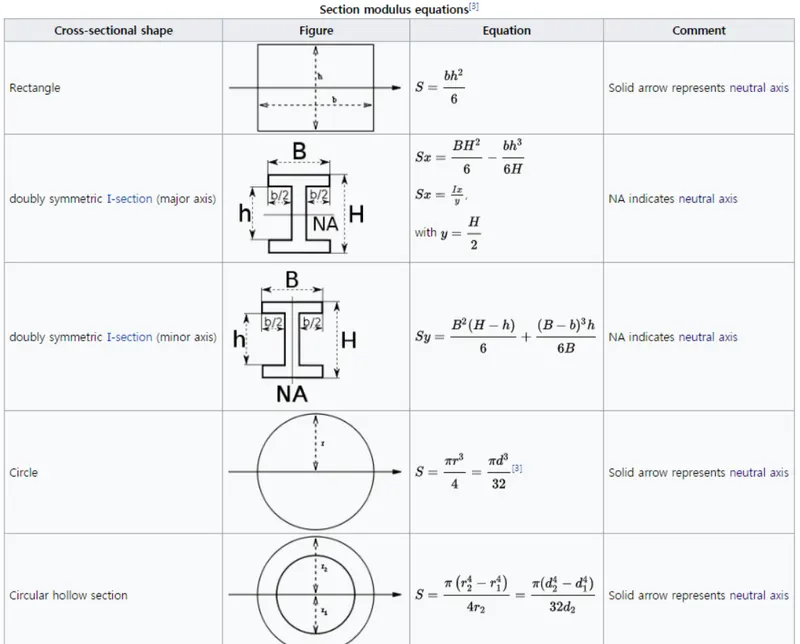
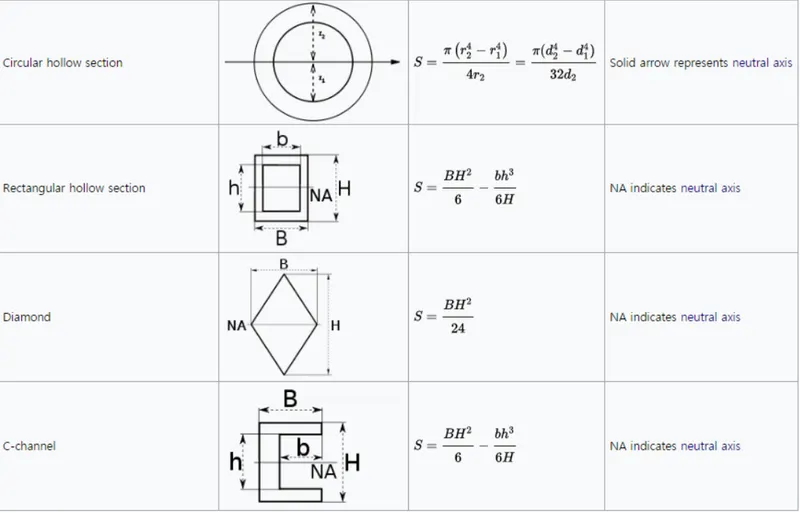
Use the section from your Hood design and calculate the section modulus using the formula S= I/y.
Section Modulus:
The section modulus (S) is geometry property of the cross section used for designing beams and flexural members. It does not represent anything physically.
Formula of section Modulus: It may be defined as the ratio of total moment resisted by the section to the stress in the extreme fibre which is equal to yield stress.
Which is equal to yield stress.
Therefore
S=I/y, Where
S= Section modulus (mm^3)
I = Moment of inertia of the section to the stress in the extreme end of the object (mm^4)
Y= Distance between the neutral axis and extreme end of the object (mm).
Moment of inertia is defined as the quantity expressed by the body resisting angular acceleration which is the sum of the product of the mass of every particle with its square of a distance from the axis of rotation. Or in more simple terms, it can be described as a quantity that decides the amount of torque needed for a specific angular acceleration in a rotational axis. Moment of Inertia is also known as the angular mass or rotational inertia. The SI unit of moment of inertia is kg m2.
Moment of inertia is usually specified with respect to a chosen axis of rotation. It mainly depends on the distribution of mass around an axis of rotation. MOI varies depending on the axis that is chosen.
In General form,
Moment of Inertia is expressed as I = m × r2
where,
m = Sum of the product of the mass.
r = Distance from the axis of the rotation.
Area Moment of Inertia:
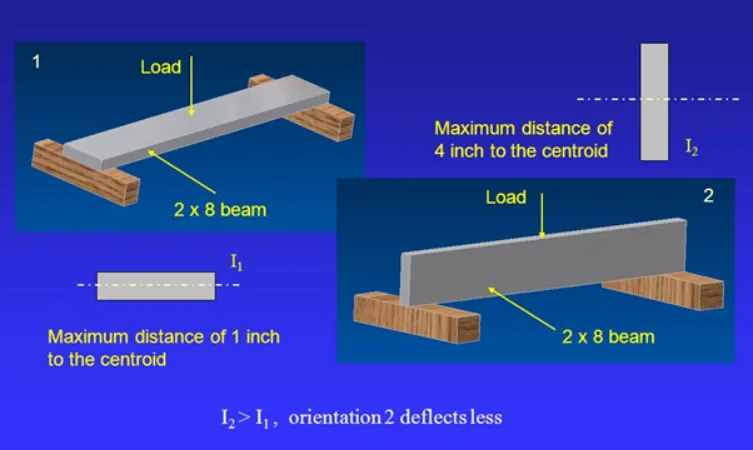
The area moment of inertia of a beam cross section area measures the beam ability to resist bending. The larger the moment of inertia less will be the bend.
Where,
M = Bending Moment
I = Area moment of Inertia
E = Young modulus
R = Radius of gyration
Neutral Axis: When beam is subjected to pure bending the top most fibres of the beam are subjected to maximum compression, while the bottom most fibre of the beams are subjected to maximum tension.
Calculation:
Section Modulus :
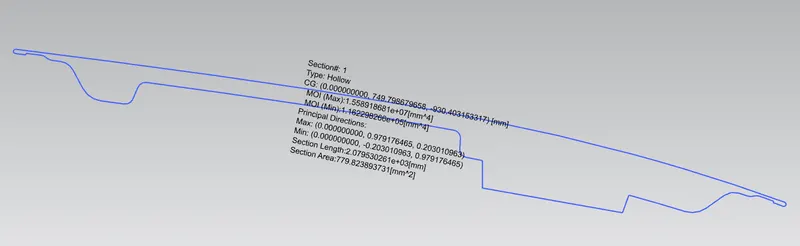
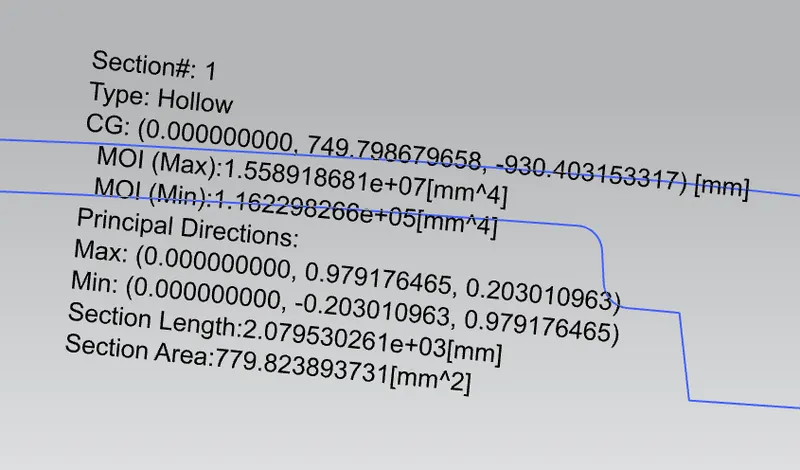
>Here we are considered the innerpannel section of the to analysis the section inertia analysis after doing the we got the desired results shown in the above image
Imax – 1.558918681 x 10^7 (mm^4)
Imin – 1.162298266 x 10^5 (mm^4)
As per the section modulus equation,
S = I/Y
I = MOI (min) Value is considered
Y = Total distance / 2
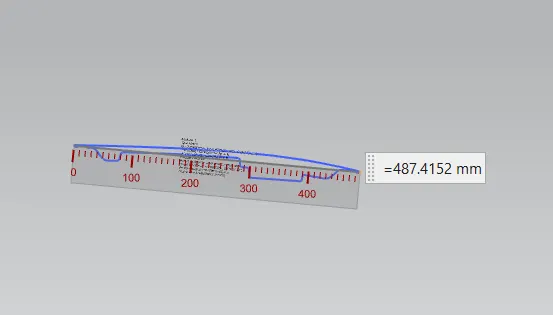
Y=487.4152/2
Y=243.7076
Therefore,
section modulus for max. = 1.558918681 x 10^7 / 243.7076
= 0.00639667651 x 10^7
section modulus for min. = 1.162298266 x 10^5 / 243.7076
= 0.00476923274 x 10^5
So for this hood design section modulus range from 0.00639667651 x 10^7 to 0.00476923274 x 10^5 mm^3
Optimized design
In order to increase the sectional modulus, cross sectional area has to be increased. So here the optmized design:-
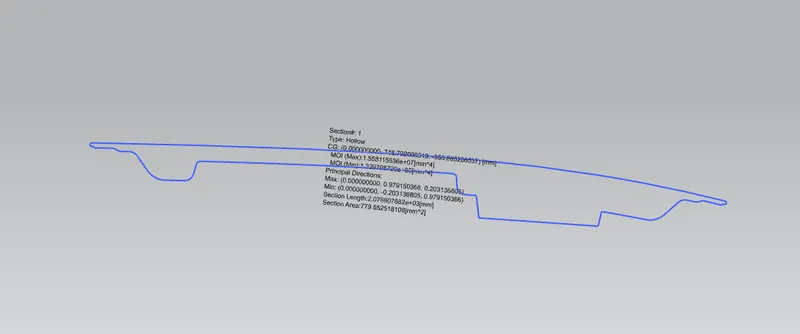
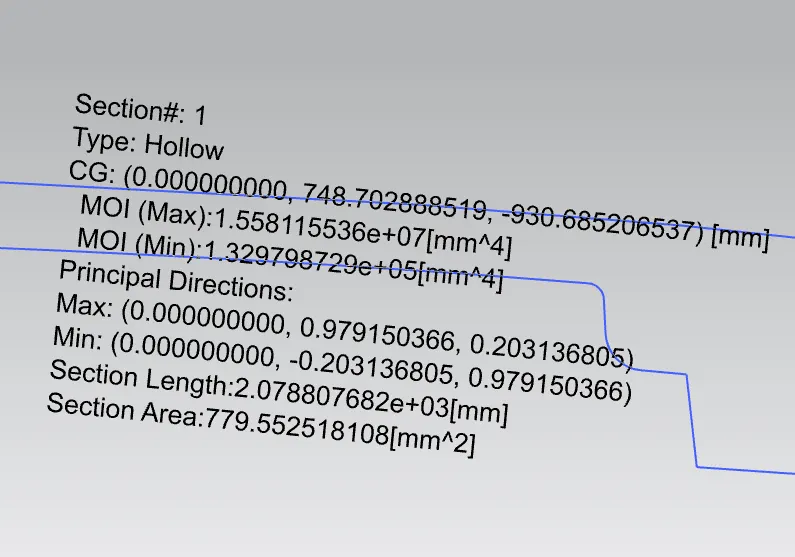
Imax – 1.558115536 x 10^7 (mm^4)
Imin – 1.329798729 x 10^5 (mm^4)
Y = Total length / 2
Y=487.4152/2
Y=243.7076
section modulus for max. = 1.558115536 x 10^7 / 243.7076
= 0.00639338999 x 10^7
section modulus for min. = 1.329798729 x 10^5 / 243.7076
= 0.00545653369 x 10^5
So for this hood design section modulus range from 0.00639338999 x 10^7 mm^3 to 0.00545653369 x 10^5 mm^3
Conclusion:
Strength of material is directly proportional to the moment of interia, thus increasing the sectional area increase the increases strength of component. Thus sectional modulus for hood design is calculated and optimized design is also done to increase the section modulus of the hood.