Section Modulus calculation and optimization
Aim:-
To find the section modulus of the hood and optimization to improve the overall section modulus.
Section modulus:-
section modulus is a geometric property for a given cross-section used in the design of beam and flexural members. by finding the section modulus we can find the resistance to remain unchanged when the force is applying to the object or substances.
Section modulus is a direct measure of a strength of any cross sectional area of an object about an reference axis.
The formula of section modulus is given by,
S=I / Ymax
Where,
I = Moment of inertia (mm^4)
Y = Distance between neutral axes and outermost fiber (mm)
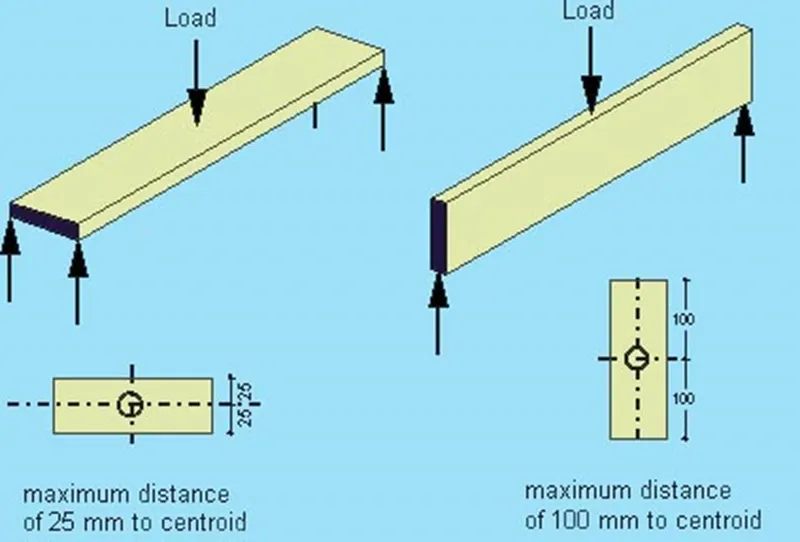
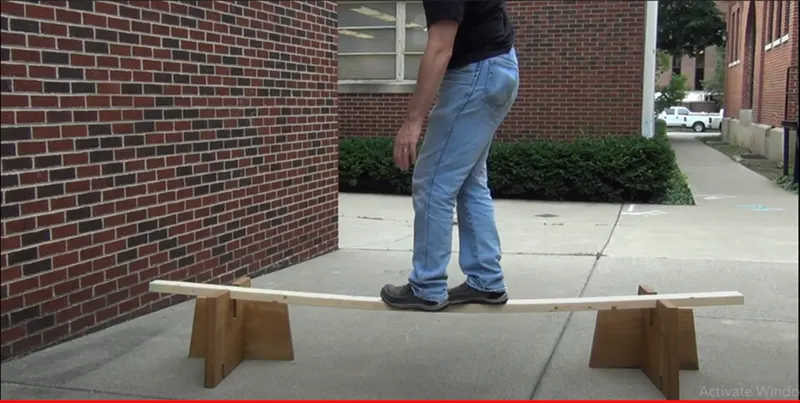
Changing the position can show the difference in bending which is because of the centroid distance from extreme fiber end.
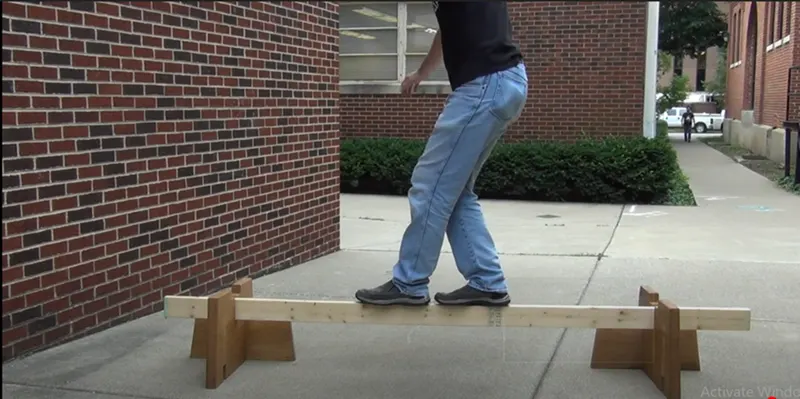
In Layman's terms, in this position there is more material from axis to the specific direction, to resist the load which makes less bend amd improves the strength.
Moment of inertia
here we are considering the area moment of inertia also known as the second moment of inertia. it is used in a sectional mechanical application, usually involving a section of any structure. the shape of the object and the plane of the section will give us the 2d part it is called the section.
when the area of the section increases the moment of inertia also increases. so the final result which is the section modulus also increases.
so we could say section modulus is proportional to the moment of inertia.
Neutral axis:
When beam is subjected to pure bending the top most fibres of the beam are subjected to maximum compression, while the bottom most fibres of the beams are subjected to maximum tension.
Material Data: Stainless steel AISI 302 – cold rolled
Where yield strength of stainless steel is 520MPa = 520 N/mm^2
Section modulus calculation of the hood design: -
case:-1 (Before optimization)
The Hood which was already created is imported and the section inertia analysis is done.
We have to make sure that the curve obtained is a single/closed curve.
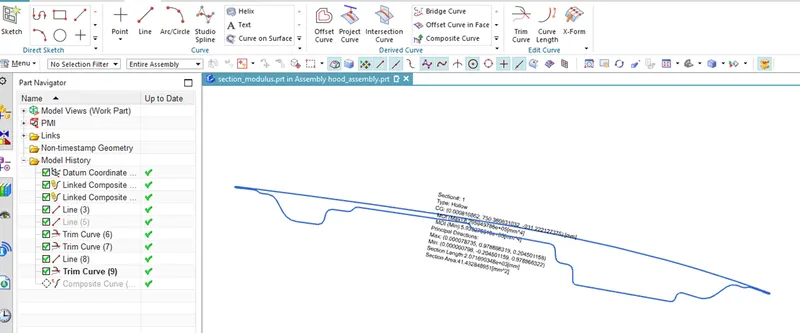
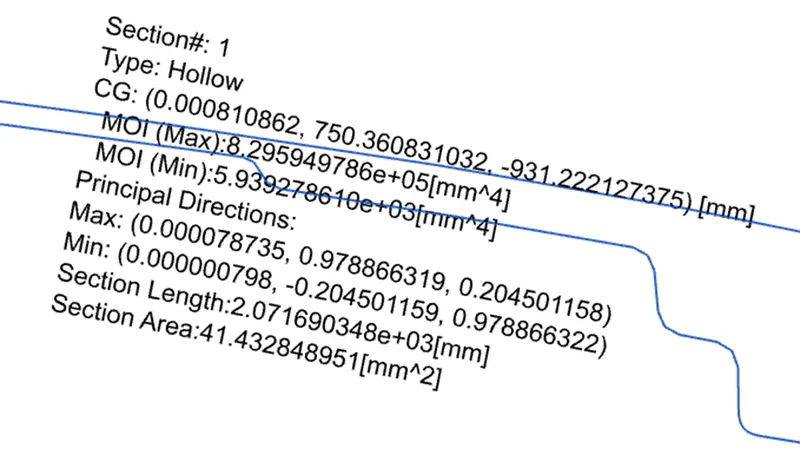
Imax – 8.295949786 x 10^5 (mm^4)
Imin – 5.9392786 x 10^3 (mm^4)
Y = Total length / 2
= 479.35/2
=239.675 mm
section modulus for max. = 8.295949786 x 10^5 / 239.675
= 3.461 x 10^3
section modulus for min. = 5.9392786 x 10^3 / 239.675
= 0.0247 x 10^3 So for this hood design section modulus range from 3.461 x 10^3 mm^3 to 0.0247 x 10^3 mm^3
CASE 2: (After optimization)
The hood inner panel’s curve is offset by 0.5mm outwards and section inertia analysis is done same as case 1 for a closed curve.
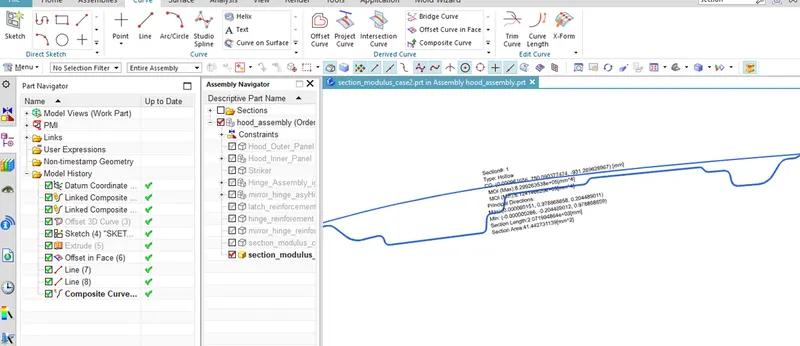
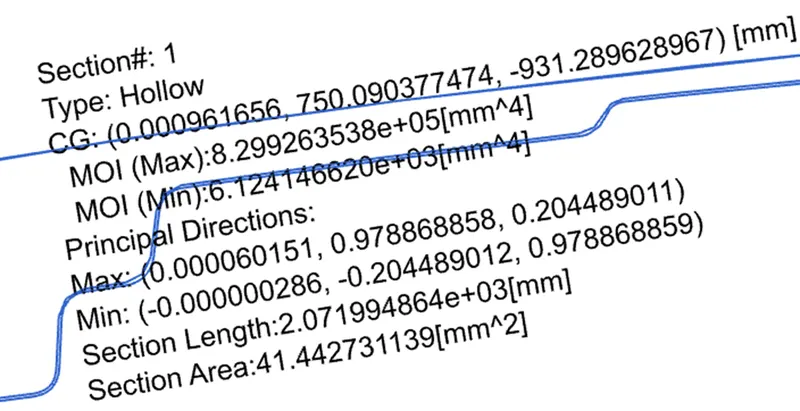
Imax – 8.299263538 x 10^5 (mm^4)
Imin – 6.124146620 x 10^3 (mm^4)
Y = Total length / 2
= 479.35/2s
=239.675 mm
section modulus for max. = 8.299263538 x 10^5 / 239.675
= 3.462 x 10^3
section modulus for min. = 6.124146620 x 10^3 / 239.675
= 0.0255 x 10^3
So for this hood design section modulus range from 3.462 x 10^3 mm^3 to 0.0255 x 10^3 mm^3
Conclusion:
Hence when comparing case 1 & case 2,
1. The section modulus value of case 2 is higher than the case 1
2. As we increase the section area, the moment of inertia & section modulus increases which means strength and load material also increase