Hood design-Week 2
AIM:-
In this project , to do the hood design of BIW using given master section drawing and follow the design parameter hood like opening angle, NVH, safety
HOOD :-
Hood is the engine cover hinged to the car's body (front-engine automobile). It gives you access to the vehicle's engine and is also vital for the safety against the frontal impact of the car.
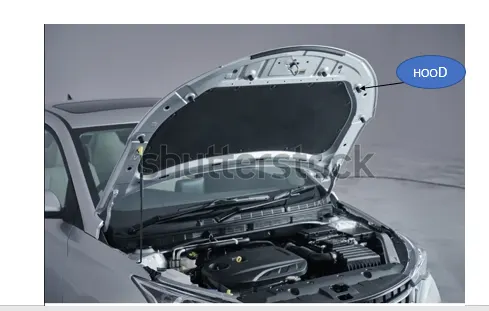
The hood (North American English) or bonnet (Commonwealth English) is the hinged cover over the engine of motor vehicles. Hoods can open to allow access to the engine compartment or trunk on rear-engine and some mid-engine vehicles for maintenance and repair. Generally, the passenger car hood may be held down by concealed Latch. But in a race car or car in aftermarket, the hoods may be held down hoods pin. Hoods sometimes also contain a hood scoop, wiper jets, power bulge, and/or hood ornament. Car hoods are typically constructed from steel and sometimes from aluminium. Aftermarket car hoods may be formed from other materials, including carbon fibre, fibreglass, or dry carbon. The hood design may vary from one make and model to another SUV. The hood is also designed for several requirements. A car hood is meant to protect the performance parts of your vehicle, including the engine, while also providing easy access for repairs and maintenance. They serve a great deal of purpose in protecting the passenger inside the car and the pedestrian in the event of an accident. The hood can incur damage as well.
DESIGN parameters -
- Head clearance zone -
Head clearance zone is the clearance such that when the hood is in fully open condition it does not hurt the head of the person that is standing next to the hood . this is controlled by the opening angle of the hood . the opening angle of the hood is decided for the region the car is manufactured . some region may have people with average height of 5.5 ft and another region may have people with average height of 6 ft . so deciding the right opening angle for the hood is an important criteria.
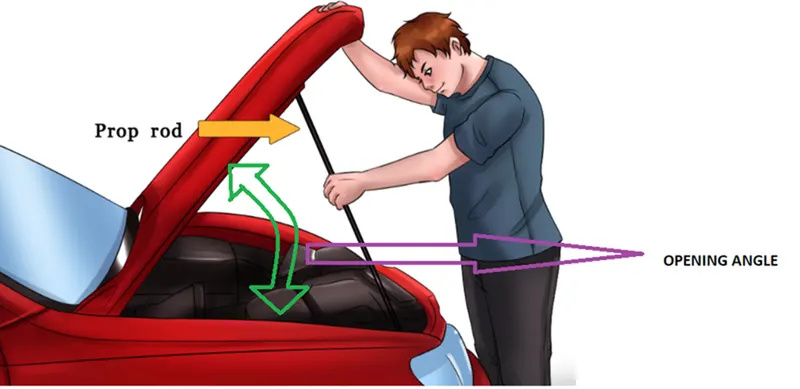
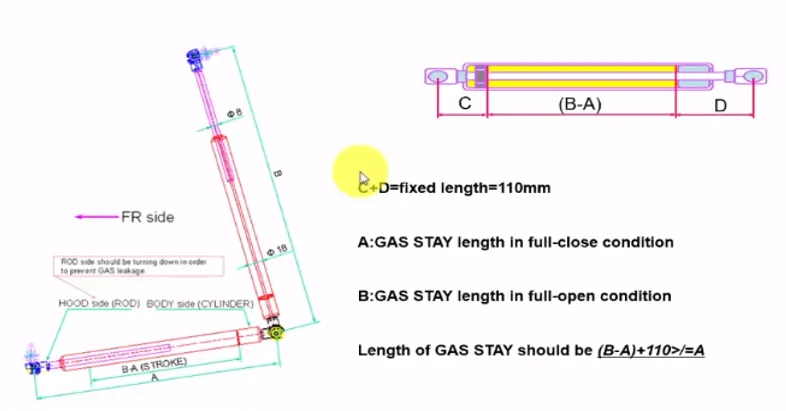
A hood stay is an device which is used to keep the hood in an open position . there are two types of hood stays which are given below –
- A. Gas stay
- Support rod
A.GAS STAY:-
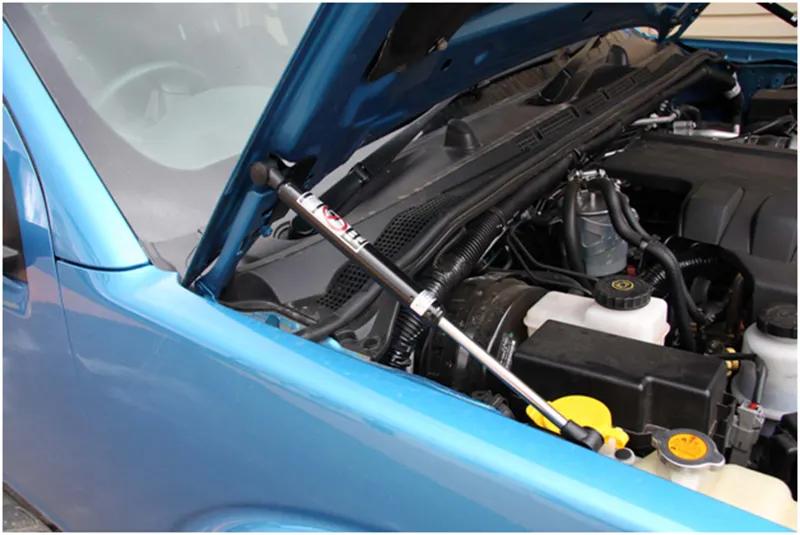
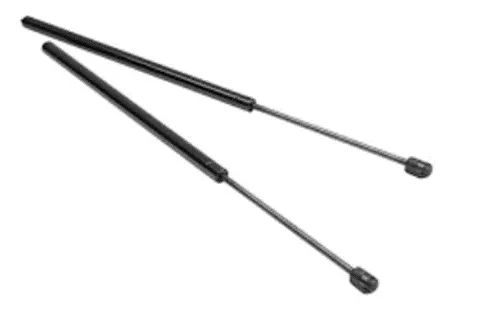
A gas stay is used to open the hood , keep it in a opened state and then closing the hood . this is a automatic process , that is the gas stay uses an actuator to open and close the hood . one side of gas stay is mounted on body side and other side is mounted on the hood . gas stay for the front hood are mainly used in high end performance cars
- Support rod:-
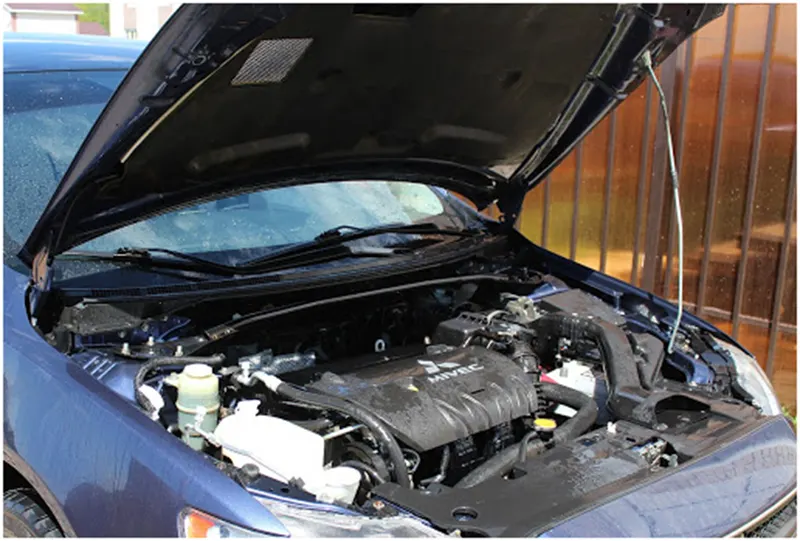
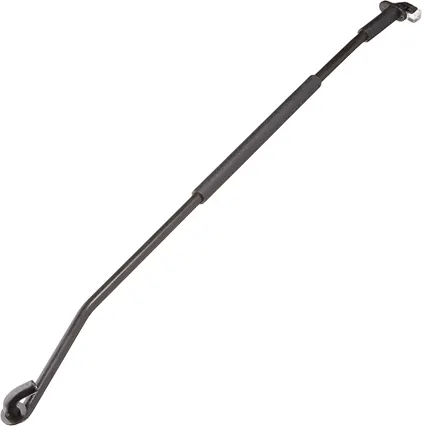
Support rod is usually inside the engine compartment , when we open the hood and keep it in open condition , one end of the support rod attaches to the hood and supports it . this support rod has to be fixed manually onto the hood . design of support rod is not linear but it should have some bends to increase the rigidity and strength of the rod . the support rod shoud be mounted such that it does not collided with other parts , also the support rod should be mounted on opposite side of battery to avoid interference with each other
- Noise Vibration Harshness(NVH) -
NVH plays an important role in car design . the noise and vibration produced by the car should be minimized. in the hood , to avoid vibrations stiffner pads are provided . mastic sealants also reduce the nvh . stiffnerpads and mastic are added between inner and outer panel of the hood .
- Pedestrian safety-(NCAP (New car assessment program) standards -
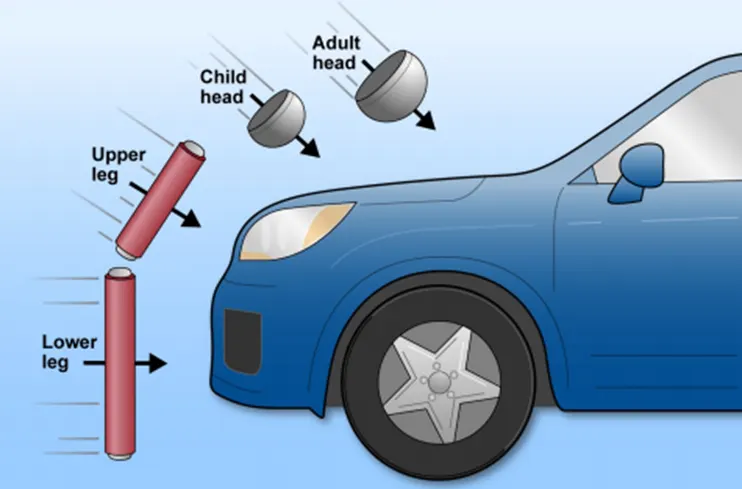
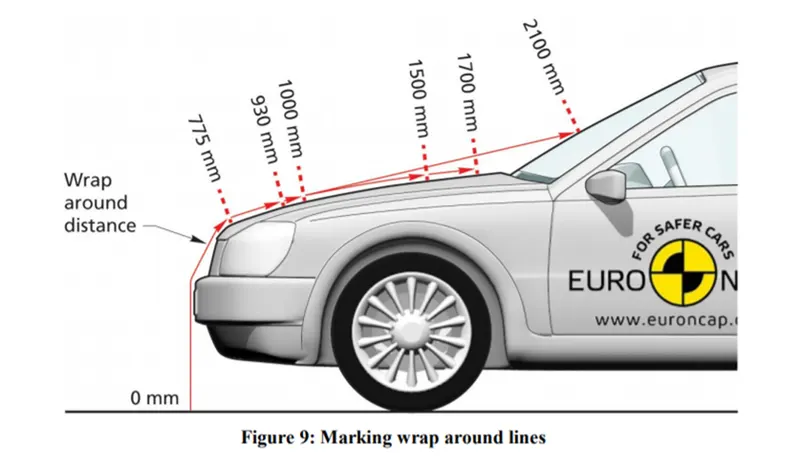
Pedestrian safety is also another important factor that is to be considered while designing a hood .EURO NCAP (New Car assesement programme ) has devised some regulations . It carries out test on the car to check if it passes those regulations.
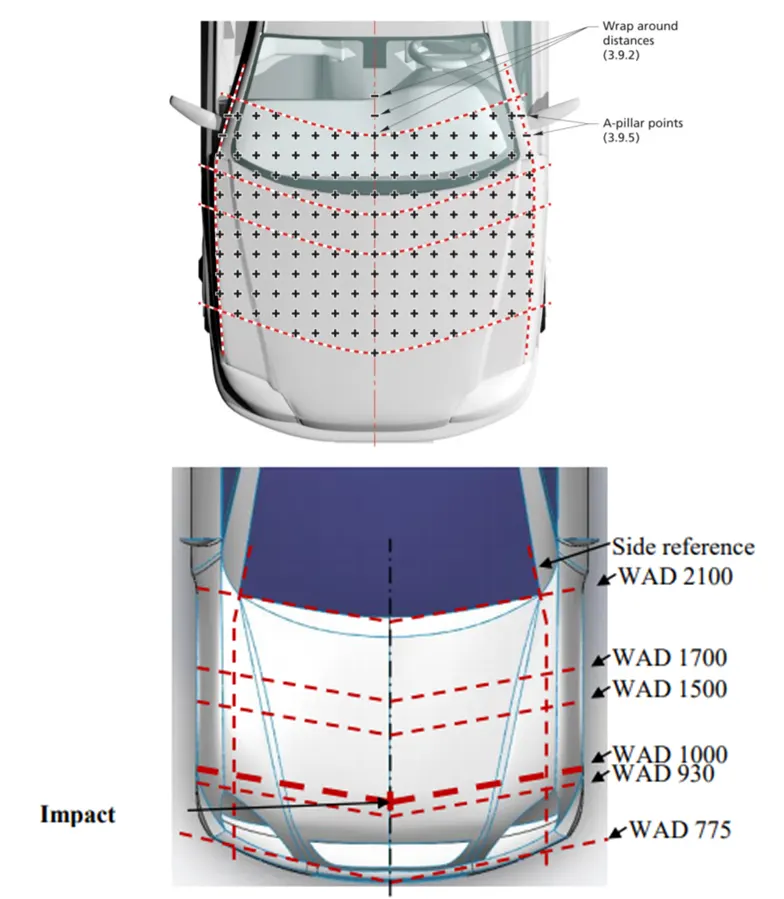
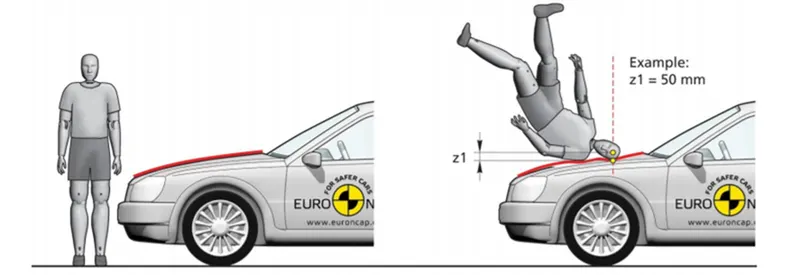
So , in the above image it can be seen that there are some points marked on the hood of the car , so this are the regions of head impact area of a pedestrian on the hood of car . if the pedestrian gets hit very badly , he may cause a very terrible or a fatal concussion on head , this can even lead to the pedestrians demise . so our hood is designed in a way such that it has some cutouts on structure of inner panel of hood where there is high possibilty of pedestrian head hitting on the hood .
design procedure:-
In this project , let we see the hood thickness details,
- Outer Panel Thickness = 0.75mm
- Inner Panel Thickness = 0.75mm
- Reinforcement Thickness = 1.5mm
main component of hood assembly:-
1) Hood outer Panel
2) Hood Inner Panel
3) Hinges
4) Latch and Striker
5) Reinforcements
Require comment for nx 12.0 by making the hood
1.offset face
2.offset curve
3.trim sheet
4.bridge curve
5. extrude
6.face blend(fillet)
7.wave geomentry
8.mirror assembly
9.emboss, etc..
Hood outer Panel
Outer panels are the aesthetic elements of a car. It is the styling team who provides the skin for the outer panel. The shape, position and size of the hood should satisfy the safety norms. So while designing the hood we should give more importance to pedestrian safety. The outer panel is attached to the inner panel by hemming. So, it is necessary to provide required hemming flange and reliefs for the hemming operation. We also provide mastic sealants between outer panel and inner panel to reduce vibration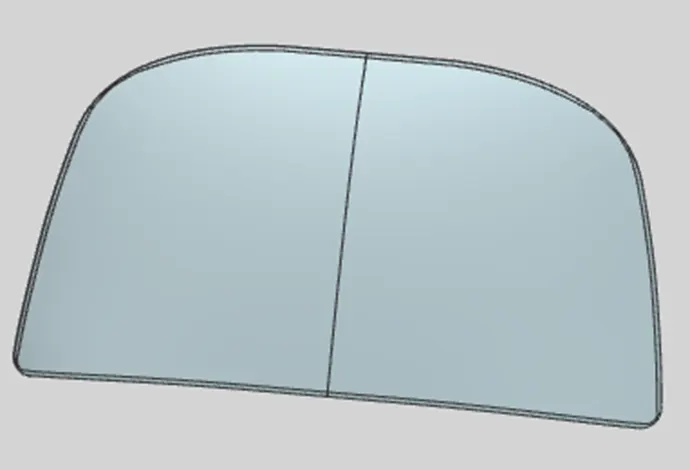
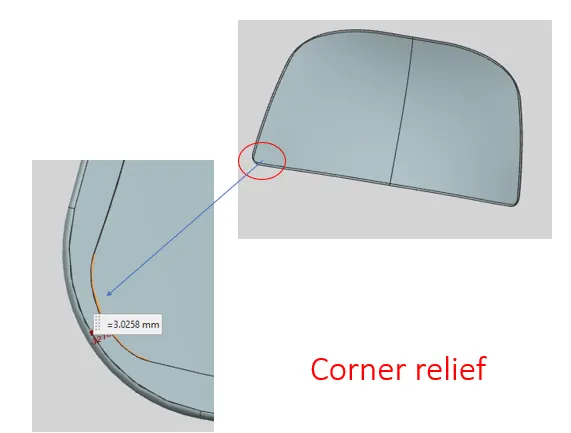
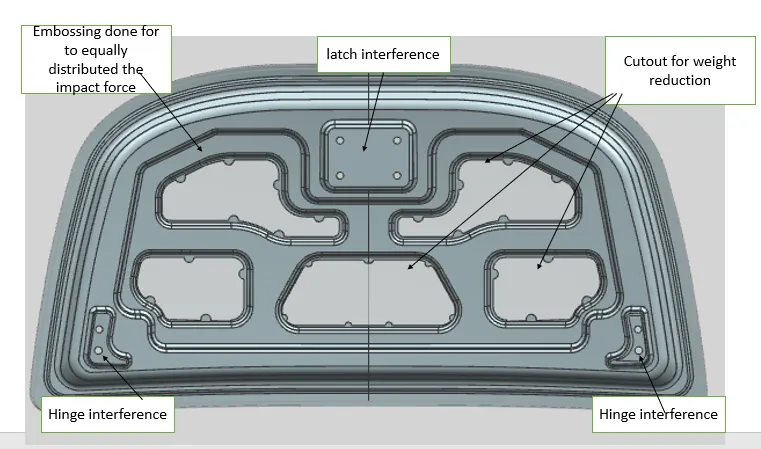
HOOD INNER PANEL
Hood Inner panel is the main structure of the hood assembly. This part adds stiffness to the Vehicle to with stand the frontal crash and has provision to hold hinge, Stopper and striker. It has embossing to add more stiffness to the part and cutout to reduce the overall weight. It has mastics to be fixed to the Hood Outer panel.
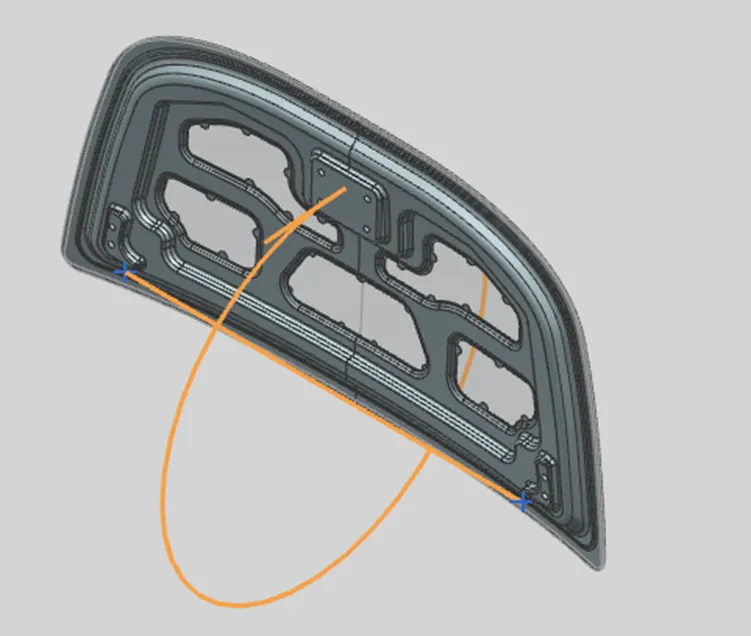
Latch Trajectory
Latch trajectory is given by the circle drawn from the hinge axis point. Hinge axis point is the centre point of the hinge axis. First, we can fix either the latch or the hinge. If we have fixed the hinge position then we should plot the Trajectory circle for the latch. For proper mating condition the striker axis through the tip of the striker should be tangential to the latch trajectory.
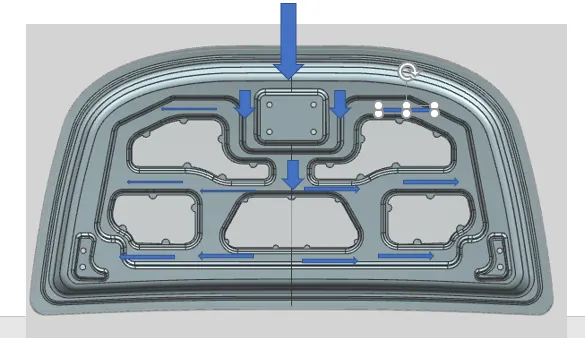
Emboss definitions
Throughout the inner panel we provide different embosses. We can increase the stiffness of the inner panel through these embosses. The shape and size of the embosses also determines the direction of the force distribution resulted from frontal collision. The force should be always distributed away from the passengers. Here in the figure the embosses are designed in such a way that the force is directed to either sides of the car.
Reinforcement
Reinforcements are provided according to the design requirements. Mainly it is provided at the hinge and latch regions to improve the strength locally. Usually thickness of reinforcements will be higher than that of the inner panels and the value varies according to cost and requirement. According to the design requirement here it is given 1.5mm thickness to both hinge and latch reinforcements.
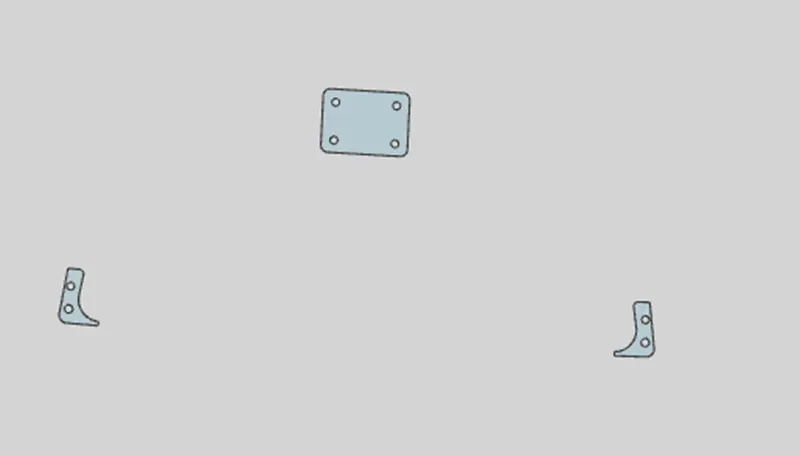
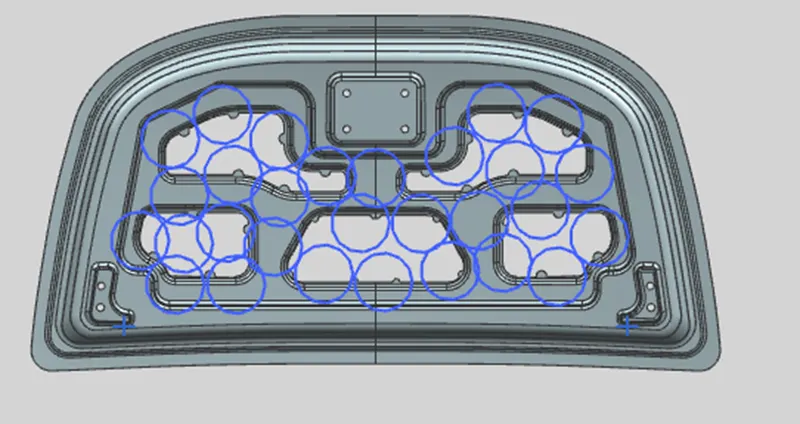
Mastic Data
Hood commonly possess large surface area and hemming can only be provided through its boundary. We cannot use other joining techniques like welding, riveting etc because they leave marks on the outer panel which spoil its aesthetic appearance. So, mastic sealants are used to stick the inner surfaces of outer panel and inner panel. Mastic sealants are elastic compound that behave like rubber. It is applied between the inner and outer panels at specified spots. Each spot of mastic sealants has its effect around a circular region of 80mm diameter. Thus, the mastic points are arranged in such a way that it covers the areas away from the hemming which are more vulnerable to vibrate.
Manufacturing Aspects
The most important design consideration of any component is manufacturing aspect. In sheet metal, the component is manufactured by press tool dies. The Press tool is stamping which includes cutting operations like shearing, piercing etc. and forming operations like bending, Deep drawing, hemming etc. The main focus of manufacturing aspect is to manufacture hood assembly with minimum operation sequence and process time.
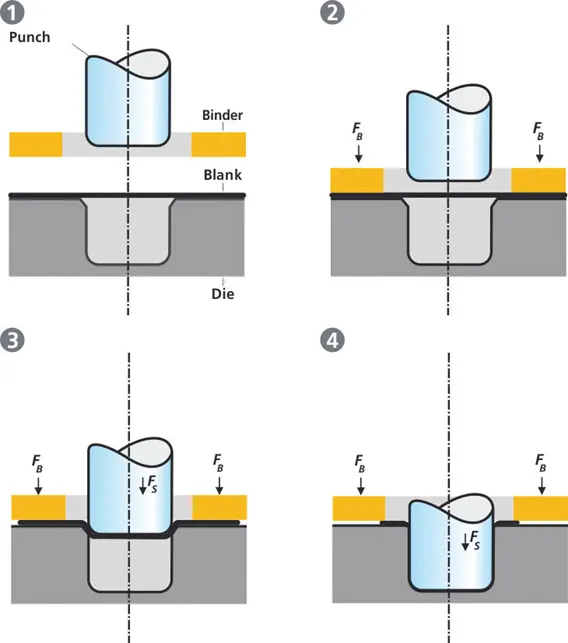
Deep drawing :-
The manufacturing of deep, cuplike products from thin sheet metal is known as deep drawing. The process involves a punch with a round comer and a die with a large radius. The punch-die clearance is slightly larger than the thickness of the sheet metal to be deep drawn.
As the load applied through the punch, the sheet metal is forced to flow radially and sink into the die cavity to form a cup. The process is best suitable for complex shaped problems.
The deep drawing process is a forming process which occurs under a combination of tensile and compressive conditions. A flat sheet metal blank is formed into a hollow body open on one side or a hollow body is formed into a hollow body with a smaller cross-section.
Deep drawing creates a seamless effect on metal, allowing for the creation of a smooth, curved edge. Deep drawn metal parts are created using a single metal blank, not a repeated course of metal blanks as is typically the case with traditional metal stamping.
Deep drawing is one of the most widely used processes in sheet metal forming. Apart from its use in many other sectors, it is applied in the automotive industry for the manufacturing of car body parts.
When drawing complex car body parts in practice, there is usually a combination of stretch and deep drawing involved. It is necessary that the sheet metal is stretched as well as possible without reaching the material’s limits (e.g. splits, wrinkles).
Hemming :-
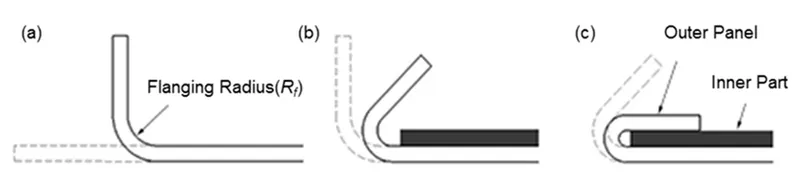
Hemming is a sheet metal forming process in which sheets are joined by bending it usually to 180°. Automotive body panels and automotive parts..
This assembly method is widely used in the final stages of production of automobile hoods, doors, or other closures for aesthetic purposes.
It is a metalworking process that involves rolling the edge of sheet metal over and onto itself, essentially creating an area of two layers. During this process, the edge of sheet metal is folded over. The two newly formed layers then lie flush with each other.
The typical three-step bending process of the hemming operation comprising of the flanging, pre-hemming, and final hemming process.
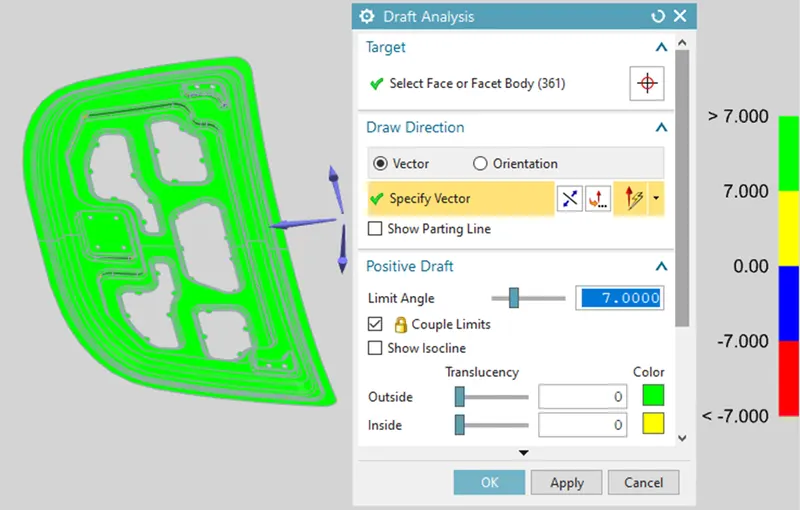
Draft Analysis
Draft analysis done to find the undercuts in a panel. This the most important study for manufacturing feasibility of the panel. Here the green zone represents the draft angle is more than 7 degree.
Conclusion
Thus Hood design is completed with all the necessary design considerations.