Section Modulus calculation and optimization
Aim: The main objective of this project is to understand and learn the basic tools and advanced tools used in NX and calculation as well as section modulus and optimization of car hood.
Objective:
How to calculate section modulus from the moment of inertia:
The section modulus is used by engineers to quickly predict the maximum stress a bending moment will cause on a beam. the equation for the maximum absolute value of the stress in a beam subjected to bending.
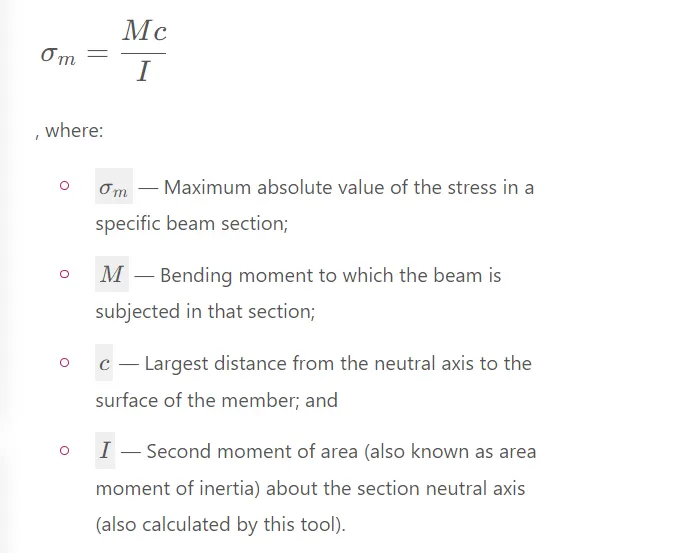
For example, in a circle, the largest distance equals the radius, while it equals half the height in a rectangle.
As the ratio I/c only depend on the geometric characteristics, we can define a new geometric property from it, called the section modulus, denoted by the S latter:
S = I/c
As well the second moment of area, this new geometric property is available in many tables and calculators, but if you want to know how to calculate section modulus from the moment of inertia, simply divide I by c, and you'll get it.
finally, we can relate the section modulus to the stress and moment:
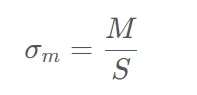
Take these considerations into account when calculating section modulus and maximum stresses:
- We obtain the bending moment through a static or structural analysis of the beam.
- To get the section modulus, we can use tables for predefined members, but this calculator is the best option if you're dealing with custom geometries.
- if we're considering a uniform section beam (as usual), the location of the maximum stress will be at the point of maximum bending moment. If that's not the case, σm could be at a different place.
- The previous formulas apply to materials that exhibit an elastic behavior and obey Hook's law. When there's plastic deformation instead of elastic deformation, we need to use the plastic section modulus.
Plastic section modulus: beyond elastic section modulus
The previous equation doesn't apply when we subject a beam material to stresses beyond the yield strength, as they assume stress and strain are linearly related. In this case, we must use the plastic section modulus. Similar to the elastic section modulus S, its plastic counterpart provides a relationship between stress and moment:
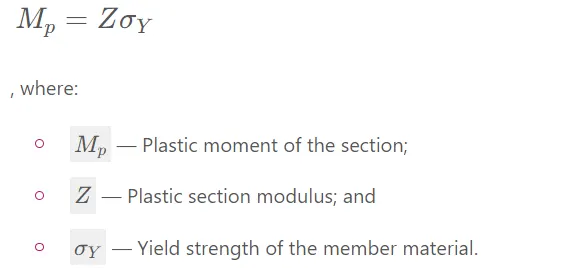
The plastic moment refers to the moment required to cause plastic deformation across the whole transverse area of a section of the member.
The usefulness of the last equation is we can predict the bending moment that will cause plastic deformation by just knowing the yield strength and plastic section modulus.
The following graphic better describes what we refer to when talking about plastic moment:
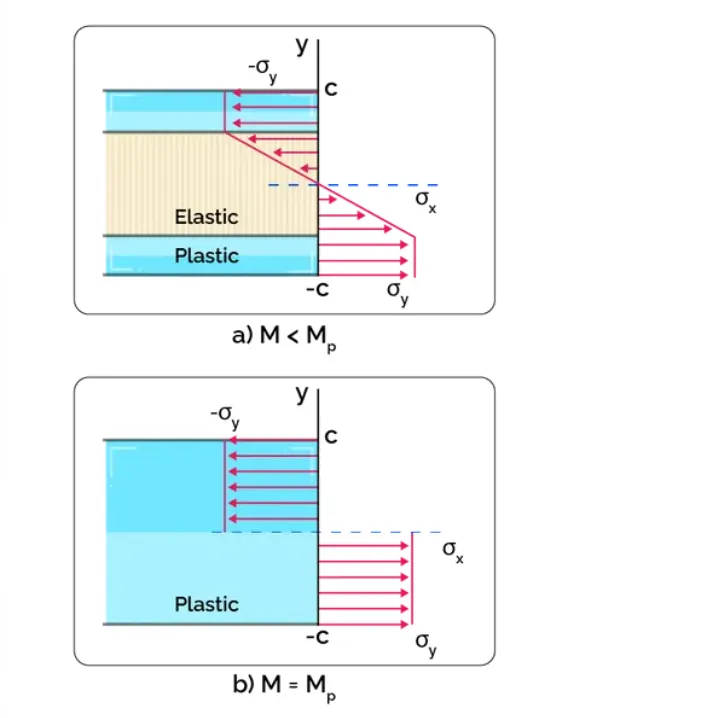
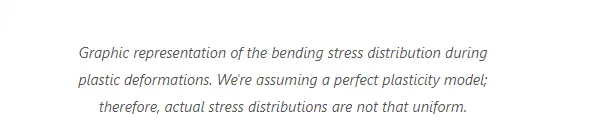
For plastic deformation to occur, we must cause some stress equal to the yield strength of the material. As you can note, the transition Frome elastic to plastic is not uniform across the member, as some regions will reach the yield strength before others.
Once all the section reaches the yield strength, plastic deformation occurs across all that section. The bending moment needed to achieve this is called the plastic moment.
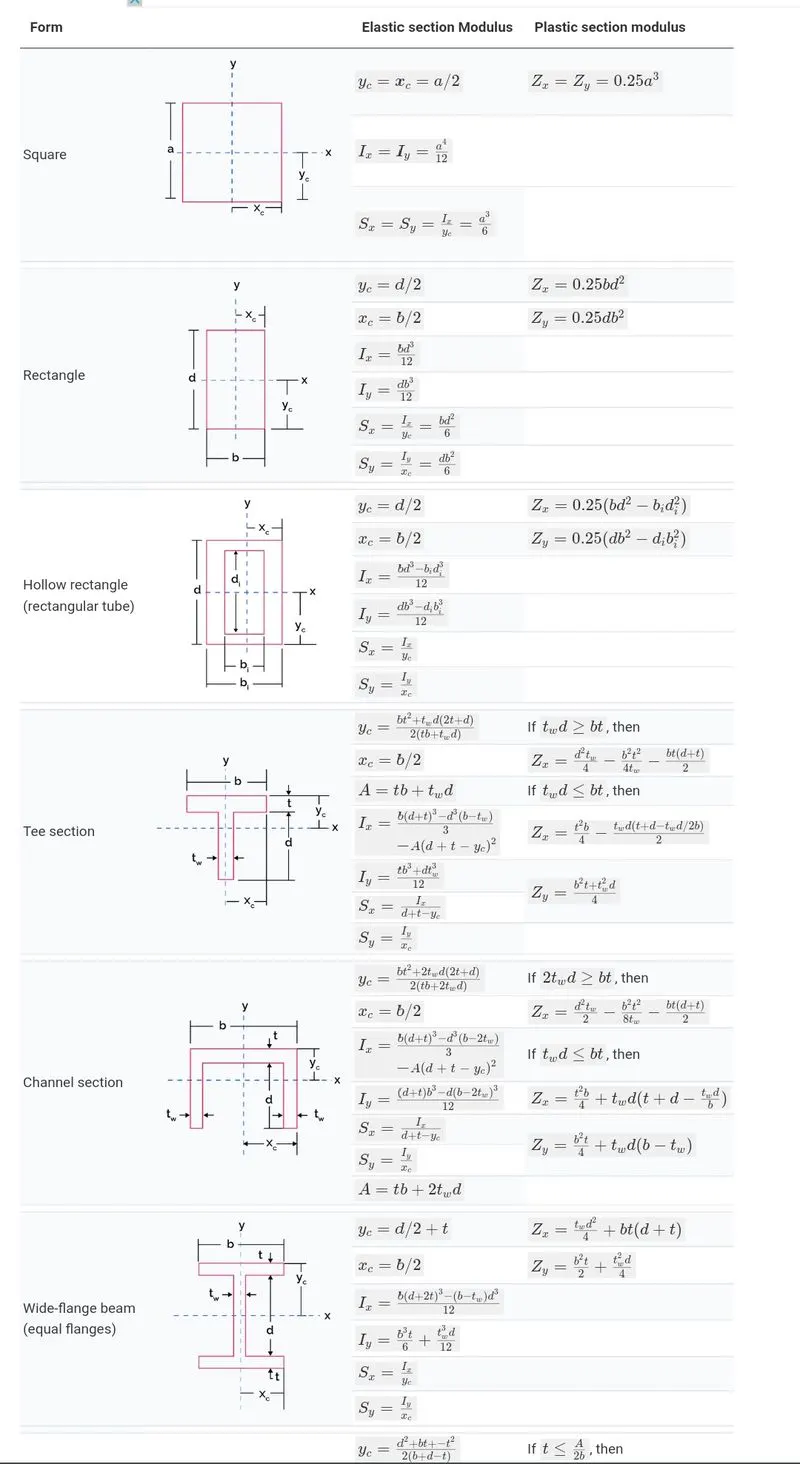
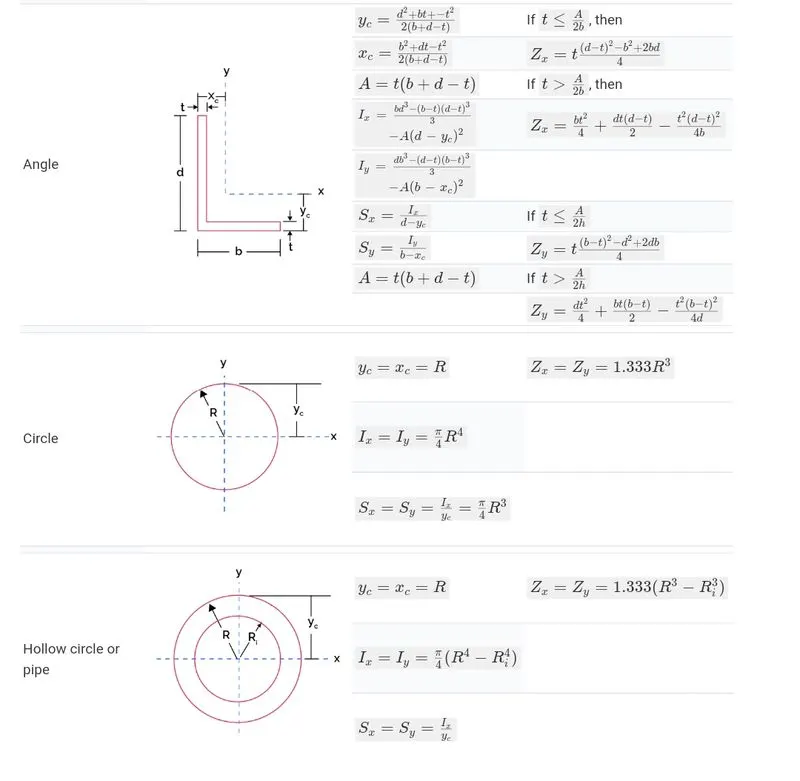
Section modulus formulas for a rectangular section and other shapes:
in the following table, we list the section modulus formula for a rectangular section and many other profiles.
SECTION MODULUS OF AN HOOD
- Section modulus is a direct measure of strength of any sectional area of an object about a reference axis (neutral axis).
- Strength is nothing but, capable of supporting greater loads, so higher the strength it has a highly capable of supporting greater loads.
- This strength can measure directly from section modulus formula, and defined by below formula.
- Section modulus represented with a symbol of 'S'.
S=I/Y
Where 'I' moment of inertia
'Y' is the distance from the reference line (neutral axis) to one of the extreme ends of an object.
- Moment of inertia is nothing but offering resistance against of moment, bending or twisting, i.e if we applied any external load on the body, how much resistance its offering to tend to deform.
- So, higher the value of moment of inertia, have higher resistance to deform under certain load, hence we can say that moment of inertia directly proportional to the strength of the material, and strength of Materia can be calculated with the help of section modulus.
- If we vary the neutral axis towards positive or negative side the overall strength of the body will decrease, because when neutral axis line lies on the middle of the section only have higher at particular point so, here 'y' value was inversely proportional to section modulus.
Thats why formula represented as above.
By using the same principle i going to calculate the strength of a hood panel.
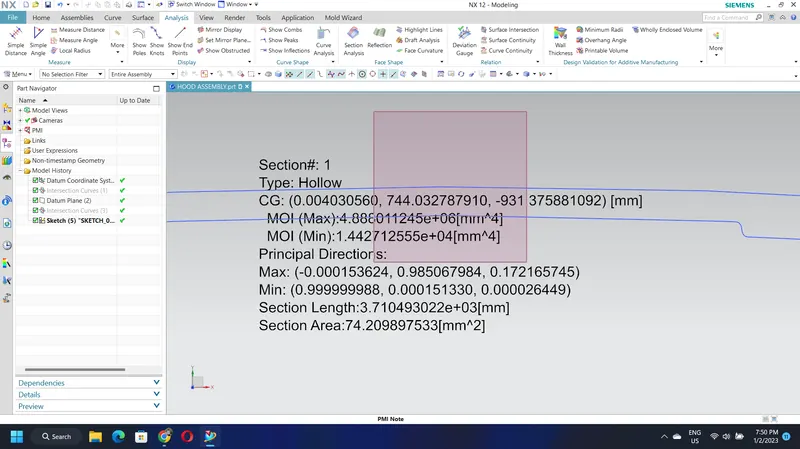
Here the moment of inertia was calculated by using the NX-software obtained values are:
I max = 4.888011245 X 10^6 mm^4
I min = 1.442712555 X 10^4 mm^4
Total length of 'Y' value was 880.4946mm
at neutral axis we need 'Y' value: Y/2=880.4946/2
=440.2473 mm
1.Section modulus (S): I/Y= 4.888011245 X 10^6 mm^4/440.247mm
=11.102 X10^3 mm^3 (Maximum Strength).
2.Section modulus (S): I/Y= 1.442712555 X 10^4 mm^4/440.247mm
=0.03277 X 10^3 mm^3(Minimum Strength).
So, the strength of a hood varies from 11.102 X 10^3 mm^3 to 0.03277 X 10^3 mm^3
Now, one more trail is that, here the inner panel curve offsetting outside by 1mm i.e. increasing in cross section area the results shown below.
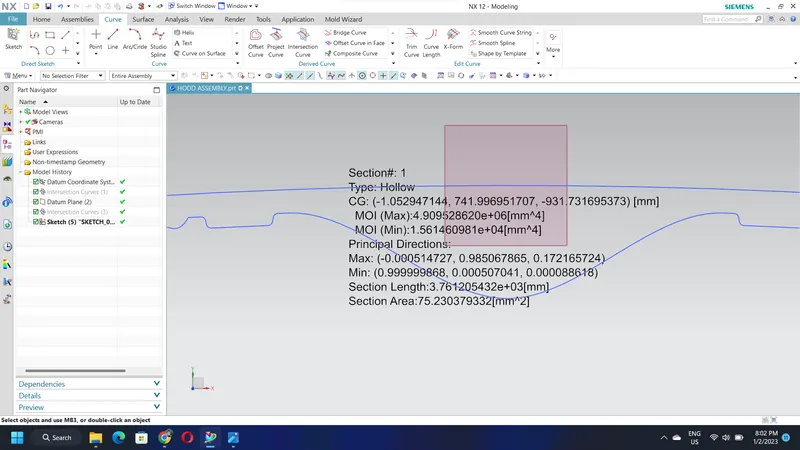
Obtained the values of
I max = 4.909528620 X 10^6 mm^4
I min = 1.561460981 X 10^4 mm^4
Total length of 'Y' value was 880.4946mm
at neutral axis we need 'Y' value: Y/2=880.4946/2
=440.2473 mm
1.Section modulus (S): I/Y= 4.909528620 X 10^6 /440.247
=11.151 x 10^3 mm^3 (Maximum Strength).
2.Section modulus (S): I/Y= 1.561460981 X 10^4/440.247
=0.0354 X 10^3 mm^3 (Minimum Strength).
So, the strength of a hood varies from 11.151 X 10^3 mm^3 to 0.0354 X 10^3 mm^3
- So, here when comparing both the hoods there is changes in both Max and min strength values, what i came to know that when i increased section area by the value of minimum strength was increased from 11.102 X 10^3 mm^3 to 0.03277 X 10^3 mm^3, Hence with increase in cross section area results in increased in strength.
- But when we see the value of maximum strength its slightly decreases from 11.151 X 10^3 mm^3 to 0.03546 X10^3 mm^3, i think this due to hood, here what we want to know that when increase in cross sectional area there will be increase in minimum strength or maximum strength or increase in both.
- So, Newton's first law also explains that, if higher the mass, the force required to move the object is also high due to offering more resistance in order to move the object, this resistance we called it as a moment of inertia.
- In case of hood also same principle will work, i.e. when increase in cross section area by 1mm the minimum load carrying capacity or strength was increase by approximately 8% what we observed from the above discussion.
- The strength of the material also depends upon the composition of material, thickness and cross section area of an object.
CONCLUSION:
Strength of material is directly proportional to the moment of inertia, thus increasing the section area increase the increases strength of component.
Thus, section modulus for hood design is calculated and optimized design is also done to increase the section modulus of hood.