Section Modulus calculation and optimization
Section Modulus calculation and optimization
Section Modulus
Section Modulus is the geometric property of the given cross-section of any shaft or beam structures. It is the direct measure of the strength of the shaft section or the beam section. Higher the section modulus of a structure, the more the resistive it becomes to bending.
Section modulus is defined as the ratio of polar moment of inertia to the radius of the shaft or the distance from the neutral axis to the outer fibres.
Mathematically,
It is defined as the ratio of the moment of inertia of a section about its centroidal axis and to the distance of the extreme layer from the neutral axis.
It is denoted by Z. Here we will denote it as S.
S = I/ymax
Mathematically By bending stress equation,
M/I = σmax/ymax
M = σmax × (I/ymax)
M = σmax × S
Where,
I = Moment of Inertia(m⁴)
y = distance from NA to extreme layer(m)
The unit of section modulus is m³.
The section modulus is classified into two types-
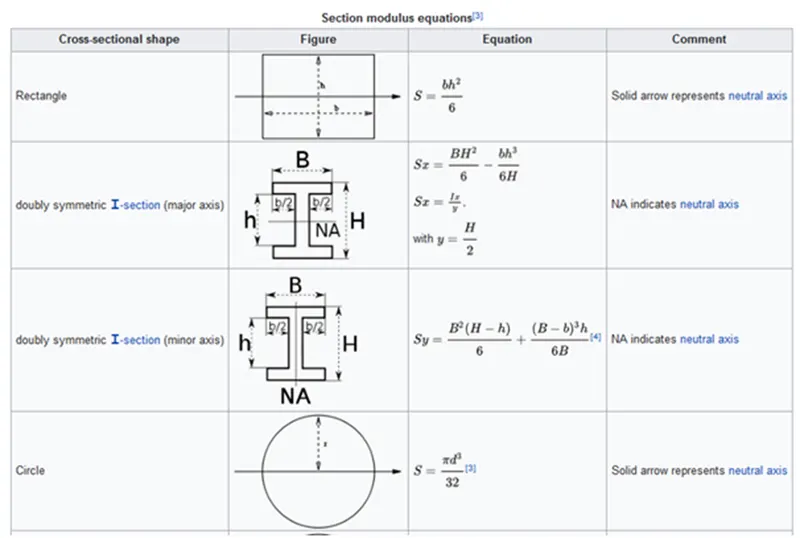
- Elastic Section Modulus-
Elastic section modulus is calculated when we are to use the material behaviour till the yield point.
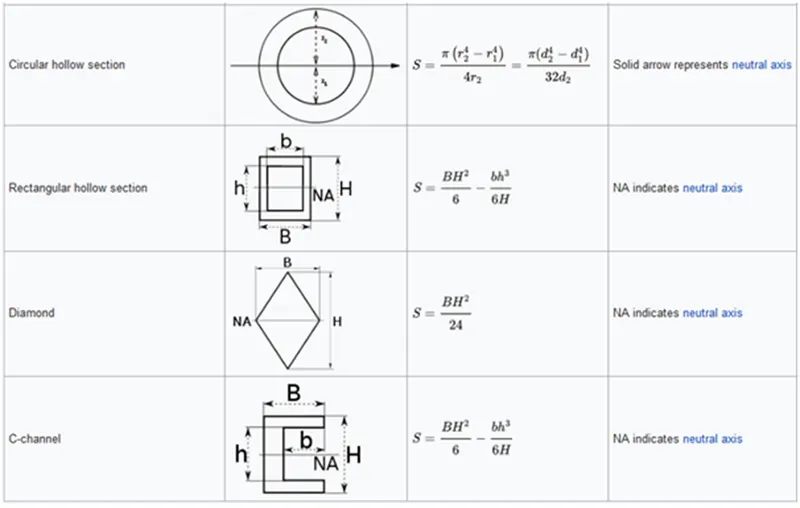
- Plastic Section Modulus-
The plastic section modulus is used for materials where the elastic yield is acceptable and the plastic behavior is considered to be an acceptable range.
It depends on the location of the plastic neutral axis. The PNA is the axis that bisects the cross-section such that the compressive force from the region in compression is equal to the tension force from the region under tension. So, for sections with a constant yield stress, the area above and below the PNA will be equal, but for mixed sections, this is not necessarily the case.
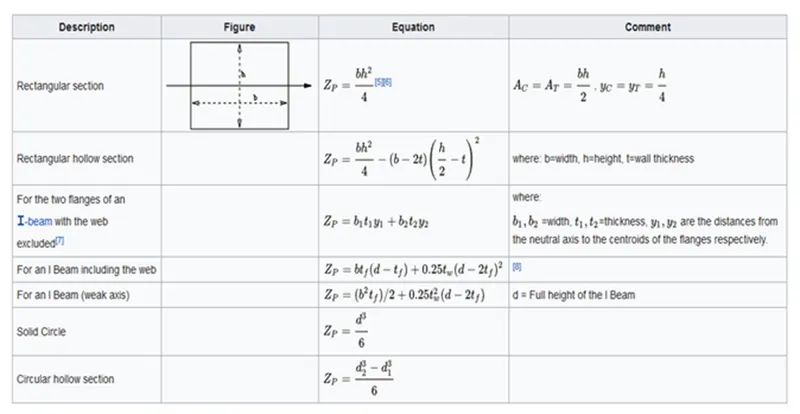
Section modulus calculation and optimization for Hood Design in Different cases
The distance between neutral axes and outermost fiber will be same in all cases.
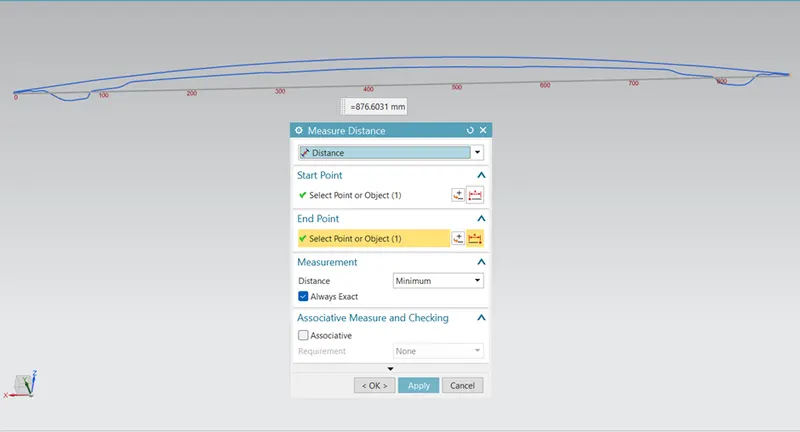
So the y is-
y=L/2=876.6031/2
y=438.30155mm
- Case 1- Calculating the section modulus of hood design –
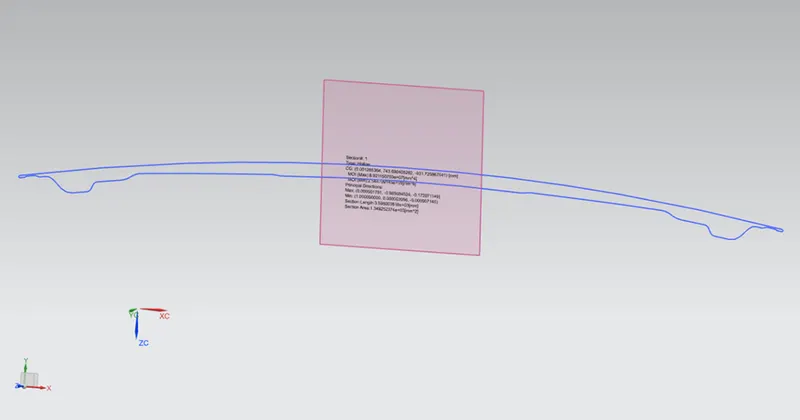
I(max)=8.921150759*10^7mm^4
I(min)=2.544709145*10^5mm^4
y=438.30155mm
S(max)=I(max)/y
S(max)= 8.921150759*10^7mm^4/438.30155mm
S(max)= 2.03539110436*10^5mm^3
S(min)=I(max)/y
S(min)= 2.544709145*10^5mm^4/438.30155mm
S(min)=5.8058410813*10^2mm^3
- Case 2- In this case we have optimized the design. We have taken the offset of inner panel curve as 0.5mm.
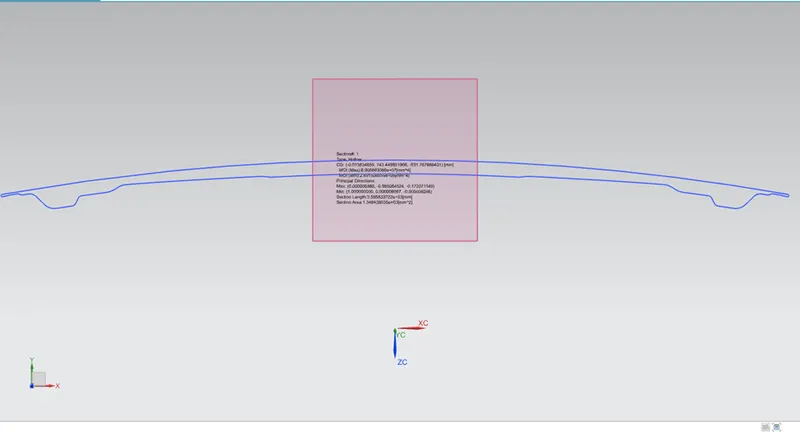
I(max)=8.905863066*10^7mm^4
I(min)=2.591506859*10^5mm^4
y=438.30155mm
S(max)=I(max)/y
S(max)= 8.905863066*10^7mm^4/438.30155mm
S(max)= 2.03190316484*10^5mm^3
S(min)=I(max)/y
S(min)= 2.591506859*10^5mm^4/438.30155mm
S(min)=5.9126116688*10^2 mm^3
- Case 3- Even in this case we will calculate the section modulus of optimized design. We have created the ruff emboss in the inner panel curve.
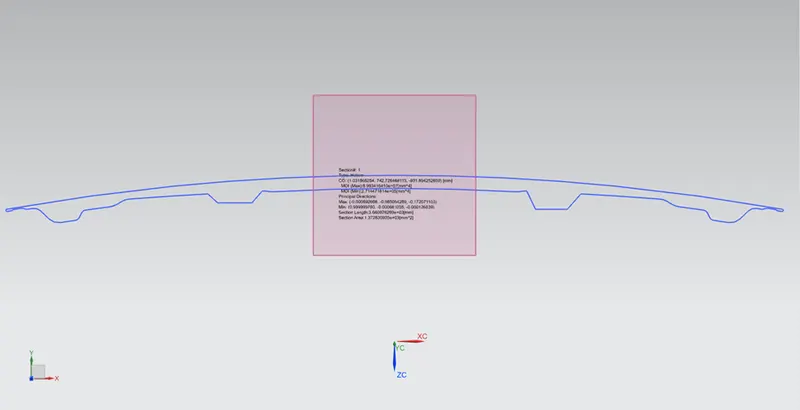
I(max)=8.993416410*10^7mm^4
I(min)=2.714471814*10^5mm^4
y=438.30155mm
S(max)=I(max)/y
S(max)= 8.993416410 *10^7mm^4/438.30155mm
S(max)= 2.05187876018*10^5mm^3
S(min)=I(max)/y
S(min)=2.714471814*10^5mm^4/438.30155mm
S(min)=6.1931604257*10^2 mm^3
Conclusion-
Strength of materials is directly proportional to the moment of interia, thus increasing the sectional area increase the increases strength of component.
Thus sectional modulus of optimized design case 3 is better than other two cases.