Section Modulus calculation and optimization
Section Modulus Calculation and Optimization
Aim: To calculate the section modulus of the previously designed hood for analyzing its strength and stiffness. And also optimizing the hood design to study the variation in the section modulus value (strength).
Section Modulus:
Section modulus is a geometric property for a given cross-section used in the design of beams or flexural members. Other geometric properties used in design include area for tension, radius of gyration for compression, and moment of inertia for stiffness. Any relationship between these properties is highly dependent on the shape of the object.
The section modulus is classified into two types:-
1] Elastic section modulus:-
The elastic section modulus is applicable up to the yield point of material. It is used in most engineering applications.
2] Plastic section modulus:-
The plastic section modulus is generally used for material in which plastic behavior is observed.
For general design, the elastic section modulus is used, applying up to the yield point for most metals and other common materials.
Definition:
Section modulus is defined as the ratio moment of inertia of a section about the neutral axis to the distance of the outermost layer from the neutral axis.It is denoted by the symbol Z or S. Hence mathematically section modulus is given by,
S = I/ymax OR S = I/c
where I - Moment of Inertia about neutral axis
y - Distance from the neutral axis to any given fiber
y → ymax or c - Distance of the outermost layer from neutral axis.
From Bending Equation,
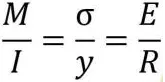
We have, M/I = σ/y
The stress σ will be maximum when y is maximum. Hence the above equation can be written as,
M/I = σmax/ymax
=> M = σmax . S
In the above equation, M is the moment of resistance offered by the section (or maximum bending moment) is maximum when the section modulus is maximum. Hence section modulus represent the strength of the section. Greater the section modulus, stronger will be the section and resistant to the deformation.
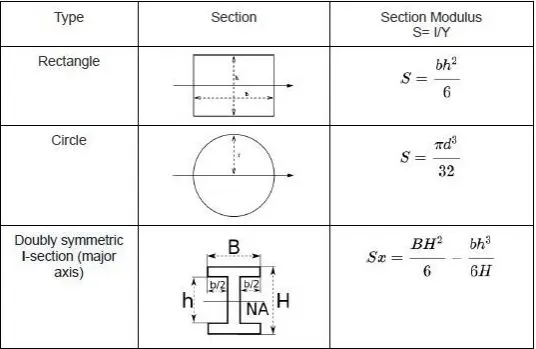
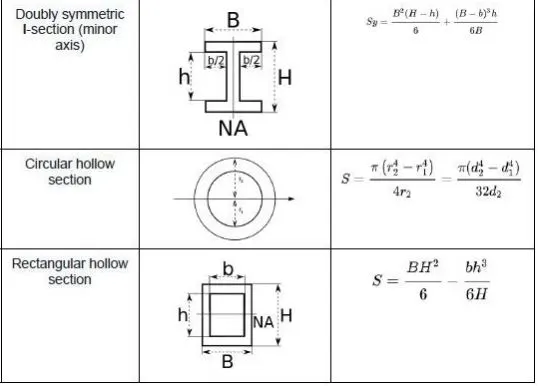
The section moduli of different profiles can also be found as numerical values. For some common profiles, the formula are listed in the below table.
Moment of inertia:
The second moment of area is also known as the moment of inertia of a shape. It is directly related to the area of material in the cross-section and the displacement of that area from the centroid. Once the centroid is located, the more important structural properties of the shape can be calculated. The axis that determines the centroid is also known as the neutral axis (N/A).
The second moment of area is a measure of the 'efficiency of a shape to resist bending caused by loading. A beam tends to change its shape when loaded. The second moment of area is a measure of a shape's resistance to change.
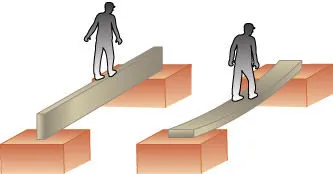
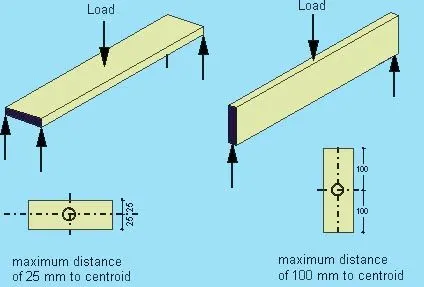
For example, the below picture depicts that two beams of same length, dimension and material are supported at both the ends. A man (same weight) is standing on the centre of gravity of beam which are positioned differently. The beam 2 is bending more than beam 1 because of the lesser moment of inertia. Certain shapes are better than others at resisting bending as demonstrated in the diagram. Clearly, the orientation of the shape also influences bending.
Steps to calculate section modulus:-
Step 1:- Find location of centroid of given cross section.
Step 2:- Find moment of inertia about neutral axis
Step 3:- Find ymax distance from neutral axis.
Step 4:- Find elastic section modulus using the formula.
Distance of ymax NA:

c = ymax = 880.6 / 2 = 440.3 mm
Section modulus calculation for the hood design
CASE 1: Designed Hood

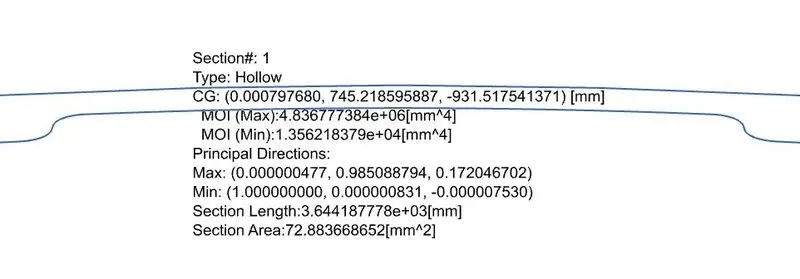
Moment of inertia (Imax) = 4.836777384 * 106 mm4 = 4836777.384 mm4
Moment of inertia (Imin) = 1.356218379 * 104 mm4 = 1356218.379 mm4
c = ymax = 880.6 / 2 = 440.3 mm
Smax = Imax / ymax = 4836777.384 mm4 / 440.3 mm = 10985.186 mm3
Smin = Imin / ymax = 13562.18379 mm4 / 440.3 mm = 30.80214 mm3
CASE 2: Optimized Hood Design
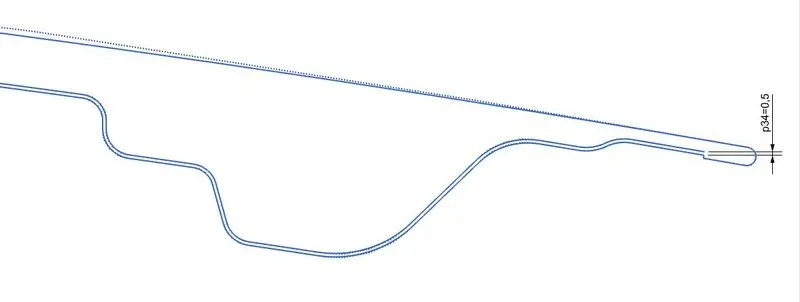
The sketch of lower profile inner panel is offsetted 0.5 mm downward.

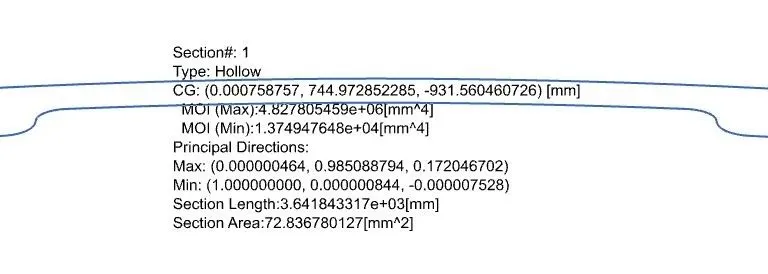
Moment of inertia (Imax) = 4.827805459 * 106 mm4 = 4827805.459 mm4
Moment of inertia (Imin) = 1.374947648 * 104 mm4 = 1374947.648 mm4
c = ymax = 880.6 / 2 = 440.3 mm
Smax = Imax / ymax = 4827805.459 mm4 / 440.3 mm = 10964.809 mm3
Smin = Imin / ymax = 13749.47648 mm4 / 440.3 mm = 31.22751 mm3
Difference in Section Modulus Value:
The section modulus value (strength) of the hood varies from 30 mm3 to 10985 mm3. Strictly, the minimum value of section modulus is taken into consideration to ensure the load supporting capability of the object. Because, on a frontal collision the first impact point is on the hood, so the section modulus value determine its deformation resistant capacity.
On comparing both the cases, there are changes in both MAX and MIN strength values. The value of minimum strength was increases from 30 mm3 to 31 mm3. But, the value of maximum strength its slightly decreases from 10985 mm3 to 10964 mm3. Hence in our case, increase in cross sectional area results in increase in minimum strength and slightly affects the maximum strength. In addition, the strength of the material also depends upon the composition of material ,thickness and cross sectional area of an object.
Conclusion:
The section modulus for both the previously designed hood and optimized hood design is calculated and the difference were examined. Therefore, the strength of the material increases if the moment of inertia of a section rises, which obviously increases the overall mass of the object.