Section Modulus calculation and optimization
Section Modulus Calculation and Optimization:
Section modulus is the property of the cross-section that is used while the design of beams.
The section modulus is classified into two types:-
1] Elastic section modulus:- The elastic section modulus is applicable up to the yield point of material.
It is used in most engineering applications.
2] Plastic section modulus:- The plastic section modulus is generally used for material in which plastic behavior is observed.
Elastic section modulus:
Elastic section modulus is the ratio of moment of inertia about a neutral axis(and the maximum distance between the neutral axis and outermost fiber of beam (.
Elastic section modulus equation:-
The formula of elastic section modulus is given by,
Where,
I = Moment of inertia (
Y = Distance between neutral axes and outermost fiber (m)
Steps to calculate elastic section modulus:-
- Step 1:- Find location of centroid of given cross section.
- Step 2:- Find moment of inertia about neutral axis
(I N A - Step 3:- Find
Y max - Step 4:- Find elastic section modulus using the formula provided above.
Plastic section modulus:
The plastic section modulus is necessary to calculate plastic moment capacity of the section.
The plastic section modulus is the addition of moment of area of area under compression about PNA (plastic neutral axis) and the moment of area of area under tensile stress.
Plastic section modulus equation:–
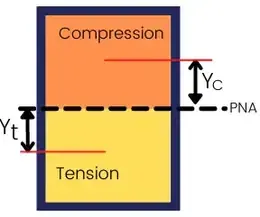
For the above cross-section, the plastic section modulus is given by,
Where,
Steps to calculate plastic section modulus:–
Step 1] Locate the plastic neutral axis.
At the neutral axis, the Area under compression is equal to the area under tension.
By using this relation, we can find the position of the plastic neutral axis.
Step 2] Find the summation of the product of area of section undergoing compression and the distance of its CG from PNA that is
Step 3] Find the summation of the product of the area of cross-section undergoing tension and distance between CG of that area from PNA that is
Step 4] Find the plastic section modulus using the formula.
Section modulus can be calculated using a formula
S = I/y
where,
S - Section modulus
I - Moment of Inertia
y - Distance from the neutral axis to the most extreme end of the object
Importance:
• It is significant for beam and flexural member design.
• More the section modulus, the more the member is resistant to the bending of the beam.
• It is easier to calculate stresses in the beam and an exact measure of the strength of steel.
• If two beams are made of the same material and comparing the “section modulus” of two beams, the beam with bigger section modulus will be tougher and more capable to withstand larger loads.
Section Modulus Analysis:
CASE 1: Initial Hood Design.
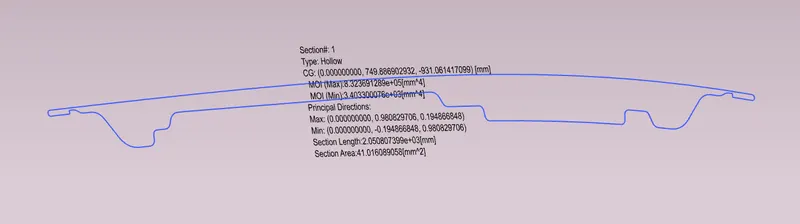
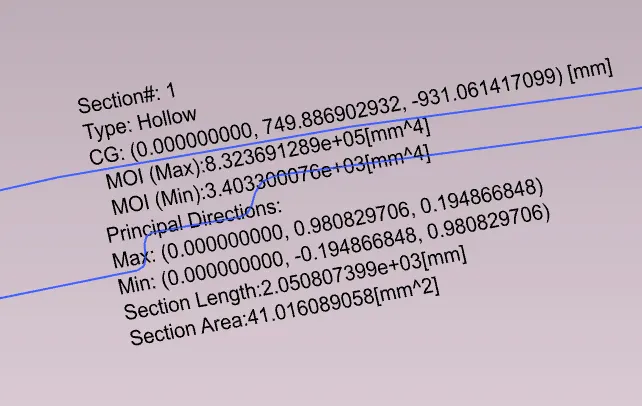
Area Moment of Inertia: I(min)
MOI(min):3.403300076e+03 mm^4
Y distance: 477.1mm
S=I/Y
S = 3.403300076e+03 mm^4/477.1mm
S = 7.1333 mm^3
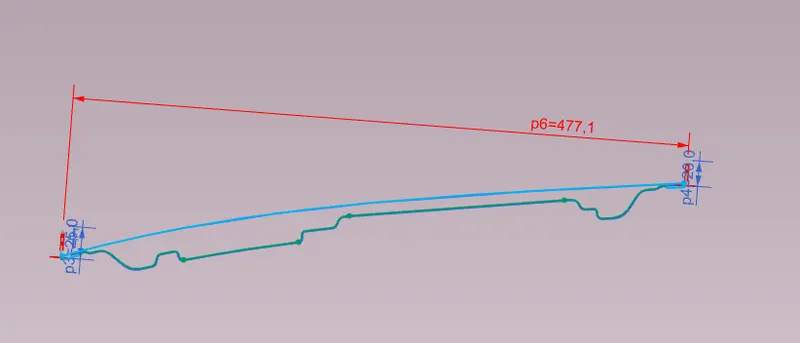
CASE 2: Optimized Hood Design
Aim: Our Aim here is to increase the I(min)
MOI(min):- 3.558965575e+03 mm^4 (increased)
Changes made: I increased the 0.5mm distance between the outer hood panel & the inner hood panel.
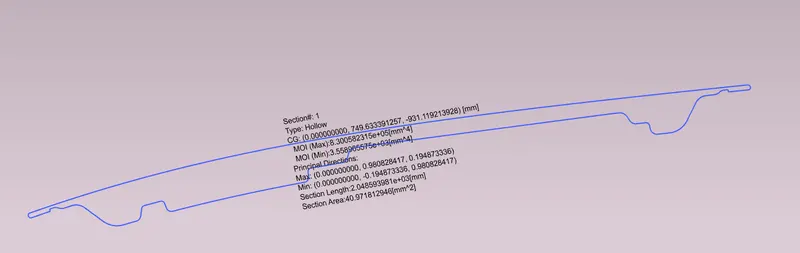
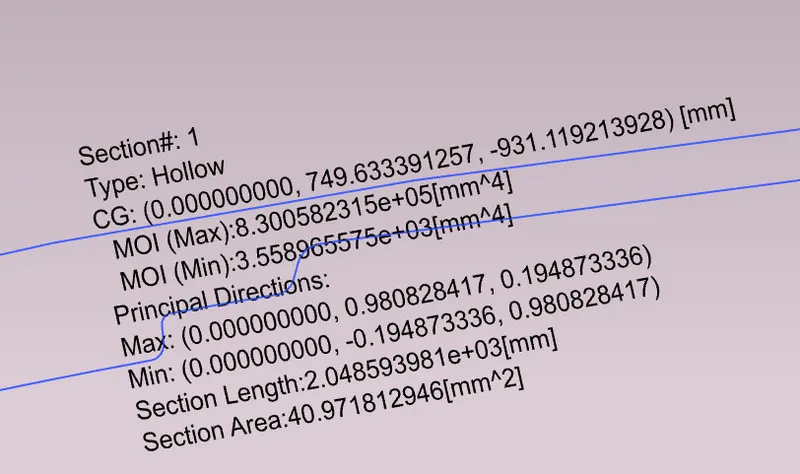
MOI(min):3.558965575e+03 mm^4
Y distance: 477.1mm
S=I/Y
S = 3.558965575e+03 mm^4 /477.1mm
S = 7.4595 mm^3
Comparision of CASE 1 and CASE 2
When we compare case 1 of section modulus to the case 2 of section modulus, the case 2 section of modulus is more than case1, it means the section of modulus is directly propotional to the area of cross section, and we can also say strength and load bearing capacity is more case 2 compared to case 1
Percentage increase in optimised one= (7.4595-7.1333)/7.1333
=4.57%
Conclusion:
- By comparing the values we can clearly say that the section modulus of the optimized hood increases by 5.5%
- moment of inertia increases by increasing depth of hood.
- We can increase the section modulus just increasing the gap between the outer & inner panel.