Section Modulus calculation and optimization
Section modulus calculation and optimization
Aim
- To study and understand about the concept of section modulus
- To find the area moment of inertia of the existing hood design and calculate the section modulus
- To optimize the section modulus of the hood by increasing the area and comparing it with the stock hood design
Area Moment of inertia
Let’s consider an example of a concentrated weight placed on a rectangular plank. The plank which is placed horizontal tends to bend from the centre while the plank which is placed in vertical direction does not easily bend. This is due to the better moment of inertia of the second plank in reference to the first one even though the total area remains the same. The orientation of the Planck makes all the difference here.


The area moment of inertia (also called the second moment of area) defines the resistance of a cross-section to bending, due to the shape of the cross-section. It is a key parameter for the analysis of beams and columns.
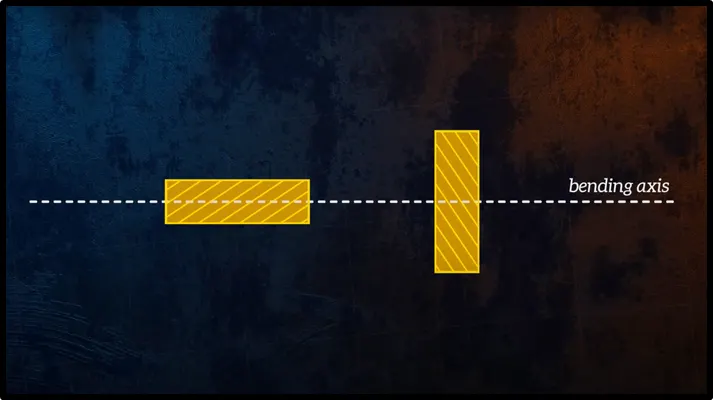
Some cross sections are better at resisting bending than others. The further the material is spread away from the bending axis; the larger the resistance to bending will be and hence will make the cross section stiffer.
The I beam section locates most of the material far away from the bending axis and thus is one of the most efficient and widely used cross section for structural members. It is one of the most preferred cross sections for beams and columns in constructions and is also used in automobile components like the connecting rod, axles and suspensions arm
Section modulus
Section modulus is a geometric property for a given cross section used in sign of beams and other flexural members. It is defined as the ratio of area moment of inertia of a section about its central axis to the distance of the extreme layer from the neutral axis of the cross section. There are generally two types of section moduli
Elastic section modulus
The elastic section modulus is generally used for design calculations and it is applicable up to the yield point for most of the materials. The elastic section modulus is defined as the ratio of the second moment of area (or moment of inertia) and the distance from the neutral axis to any given (or extreme) fibre.
It is denoted as:
S=I/Y
Where,
S = section modulus (Unit: mm^3)
I = Area moment of inertia (Unit: mm^4)
Y = Distance from neutral axis to extreme fibre (Unit: mm)
Area moment of inertia and the section modulus of few commonly used cross sections are given below:
|
S.No |
Cross section |
Figure |
Area Moment Of Inertia |
Distance |
Section Modulus |
|
1 |
Rectangle |
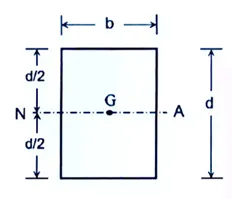 |
I = bd³/12 |
Y = d/2 |
S= bd²/6 |
|
2 |
Rectangular hollow section |
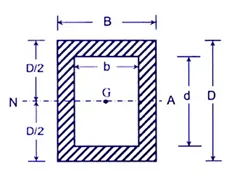 |
I = (BD³/12) - (bd³/12) |
Y = D/2 |
S= (BD³ - bd³)/6D |
|
3 |
Circle |
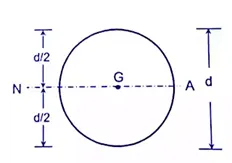 |
I = (π/64) × d⁴ |
Y = d/2 |
S= (π/32) × d³ |
|
4 |
Circular hollow section |
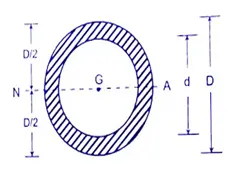 |
I = (π/64) × (D⁴ - d⁴) |
Y = D/2 |
S= π/32 × {(D⁴ - d⁴)/D} |
|
5 |
I section |
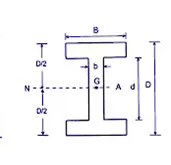 |
I = (BD³/12) - {(B - b)d³}/12 |
Y = D/2 |
S= {BD³ - (B - b)d³}/6D |
|
6 |
C channel |
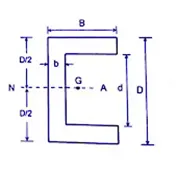 |
I = (BD³/12) - {(B - b)d³}/12 |
Y = D/2 |
S= {BD³ - (B - b)d³}/6D |
Plastic section modulus
The plastic section modulus can be used in cases where plastic behaviour is more predominant.Usuually the structures are designed to stay within the elastic limit all the time to avoid permanent deformation and hence the plastic section modulus is considered only for the ultimate conditions where the load applied exceeds the limits. The plastic section modulus depends on the location of the plastic neutral axis (PNA).The PNA is defined as the axis that splits the cross section such that the compression force from the area in compression equals the tension force from the area in tension.
Section modulus calculation of hood:
Section 1
- The first step is to take the intersection of the outer and inner plane along the YZ plane of the hood assembly
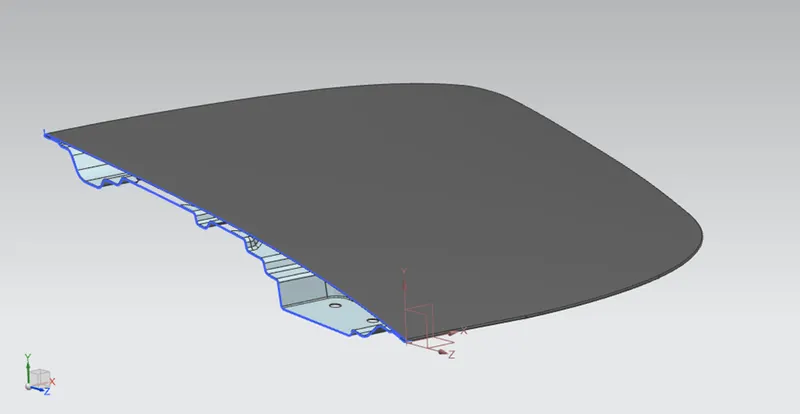
- Next the two intersection curves are joined with the line command and any excess curve left is trimmed off.
- Using the section inertia analysis tool, the moment of inertia(I) of the cross section is found
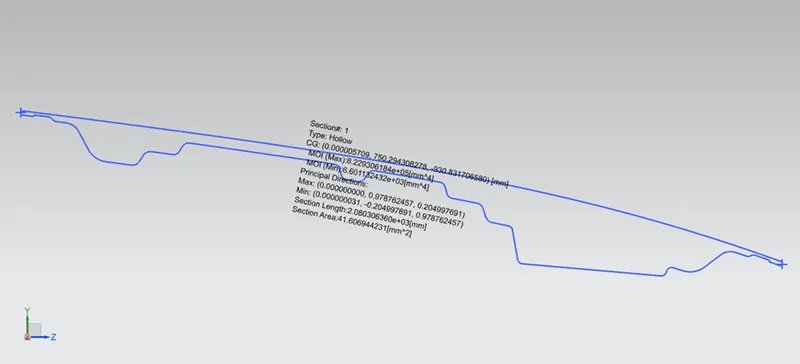
- Next the distance between the outermost fibre and the neutral axis(Y) is measured by taking the distance between the two outer most points and dividing it by 2
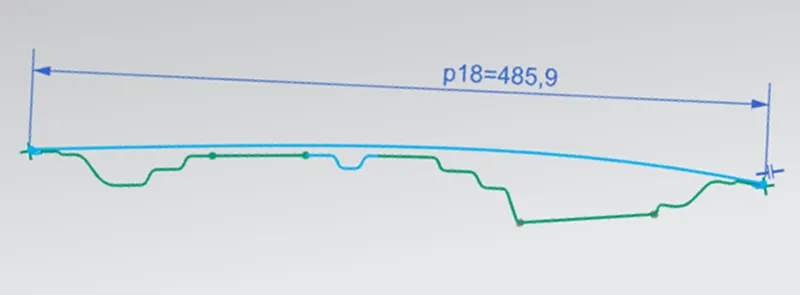
- Finally the section modulus is calculated using the formula:
S=I/y
Where,
I_min (moment of inertia) = 6.6011*10^3 mm^4
Y (distance from neutral axis to extreme fibre) =485.9/2 = 242.95 mm
S=6.6011*10^3 /242.95
S=27.17 mm^3
Optimization of hood section modulus
Section 2
The hood plays a major role in the safety of the occupants and hence during collisions it must have enough strength and rigidity to absorb the impact forces and deflect it away from the cabin. In order to achieve this many of parameters are considered while designing and section modulus is one such parameter.
- First we can take the intersection of the outer and inner plane along the YZ plane of the hood assembly
- To optimize the section modulus we have offsetted the intersection curve of the inner panel to a distance of 0.6 mm.
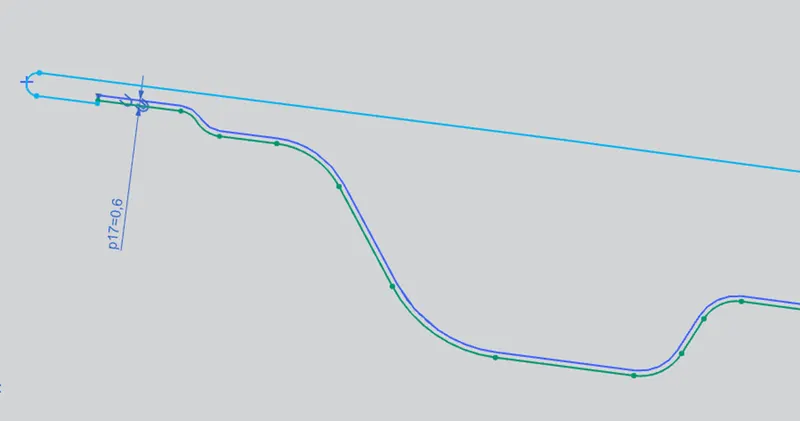
- Next the two intersection curves are joined with the line command and any excess curve left is trimmed off.
- Using the section inertia analysis tool, the moment of inertia(I) of the cross section is found
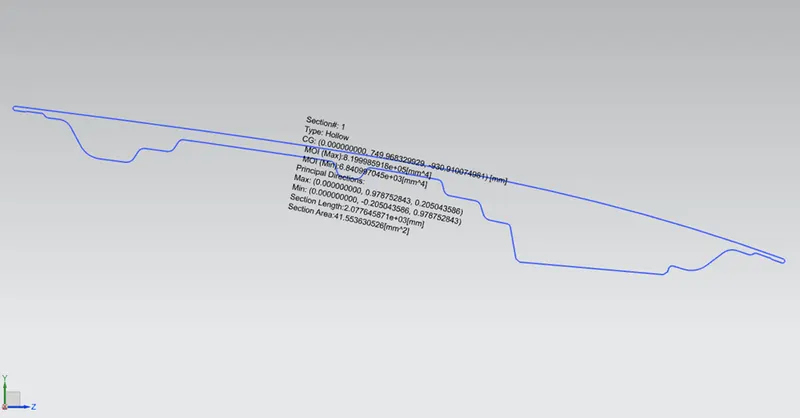
- Next the distance between the outermost fibre and the neutral axis(Y) is measured by taking the distance between the two outer most points and dividing it by 2
- Finally the section modulus is calculated using the formula:
S=I/y
Where,
I_min (moment of inertia) = 6.8409*10^3 mm^4
Y (distance from neutral axis to extreme fibre)= 242.95 mm
S = 6.8409*10^3/242.95
S=28.16 mm^3
|
S.no |
Section |
Moment Of Inertia(I) |
Distance(Y) |
Section Modulus (S) |
|
1 |
Section 1 |
6.6011*10^3 mm^4 |
242.95 mm |
27.17 mm^3 |
|
2 |
Section 2 |
6.8409*10^3 mm^4 |
242.95 mm |
28.16 mm^3 |
Conclusion
- The concept of section modulus is studied in detail
- The area moment of inertia of the existing hood design is found and its section modulus is calculated
- Section modulus optimization of the hood is done by increasing the area and it is then compared with the stock hood design
- As seen from the calculation we have observed an increase in section modulus by 3.6 percentage