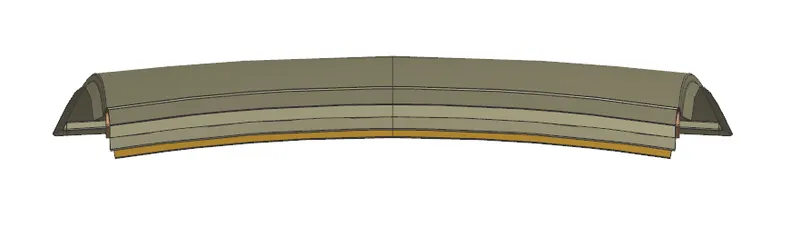
Roof Design
ROOF DESIGN
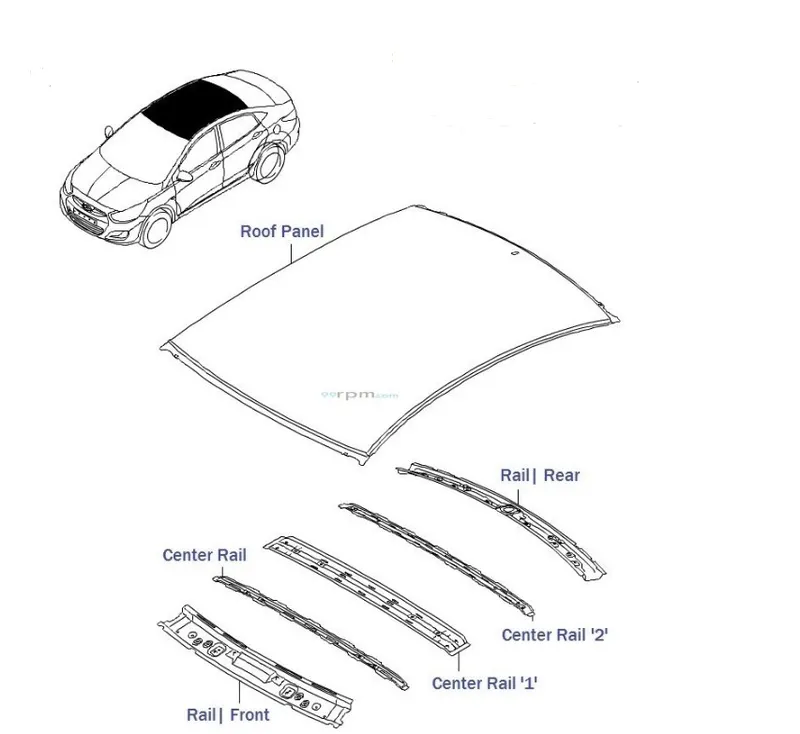
An automobile roof or car top is the portion of an automobile that sits above the passenger compartment, protecting the vehicle occupants from sun, wind, rain, and other external elements.Roof is not just single panel. It consists of Subelements:
- Front Roof
- Bow Roof
- Center reinforcement
- Rear Roof
Front roof: Front roof is the first and the main part of roof body. It joins windshield glass and front roof rail body side outer. It adds clearance to the main head room. Proper standards are maintained for this.
Bow Roof: Bow roof number depends upon the size of the roof structure. Small cars have less and large cars have more positions for bow roof. Bow roofs are placed mostly in flat surface. They provide enogh strength to the roof.
Center Reinforcement: Center reinforcement is added to improve the structural strength for the roof curvature.
Rear Roof: Rear roof is placed on the bottom area where it meets the rear windshield glass.
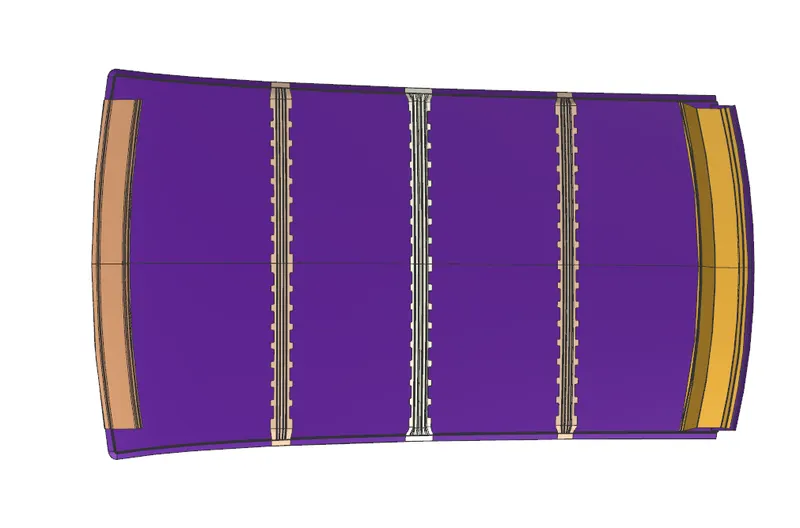
In the figure given below, its depicts a roof when looked from bottom. From left end, first is the Front roof rail, second is the bow roof rail, third is the center roof rail, next is another bow roof rail and last is the rear roof rail. They all are going to be mounted on to the outer roof panel, which has the styling surface.
JOINING OF ROOF AND SUB ELEMENTS:-
Joining of roof with sub elements includes various methods as folllows:-
- Rubber: Rubber structure is added between the front roof rail and the windshield glass structure because it will damage the front roof part because windshield has high thickness and strength.
- Mastic: Mastic is added between inner and outer structures for mounting and improvement in strength.
- Spot Weld: Spot welding is applied for roof mountings for complete assembly of panels at the ditch area.
- Emboss: Adding embossments increases the strength of the part.
DRAFT ANALYSIS:-
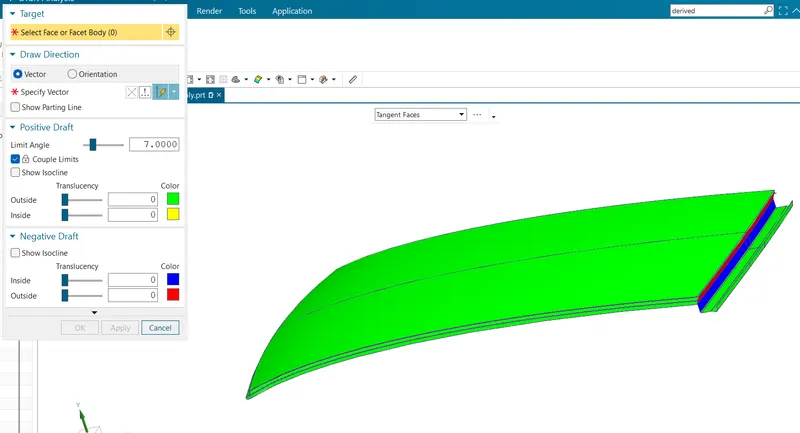
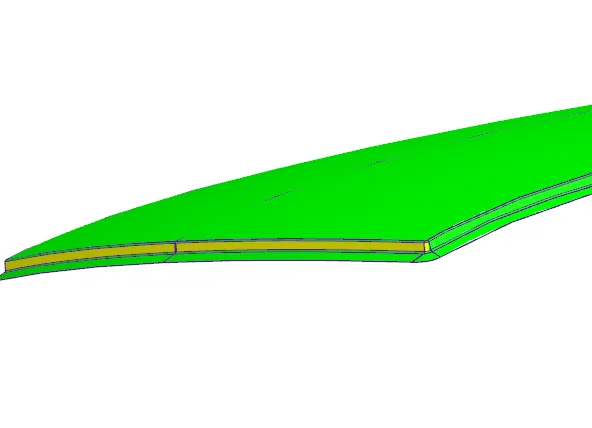
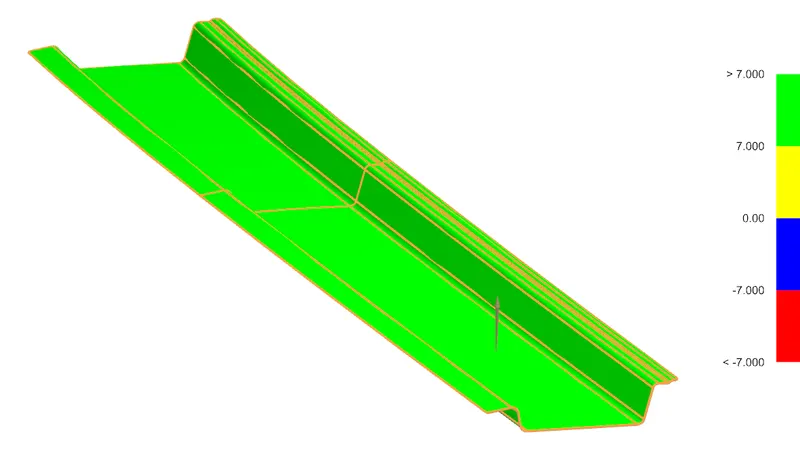
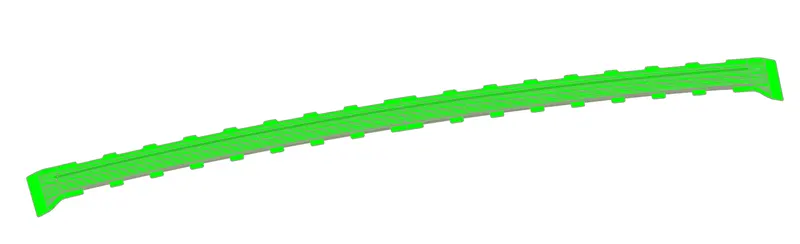
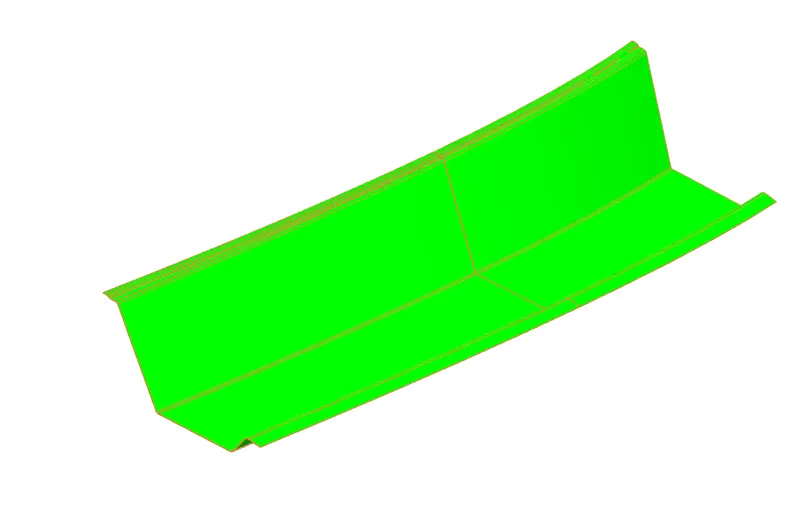
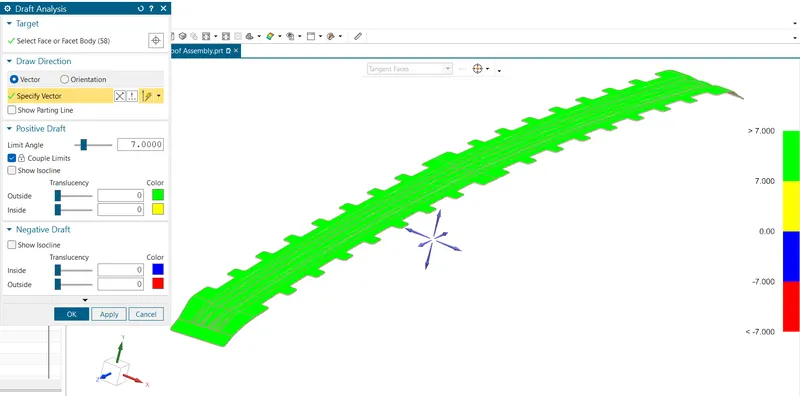
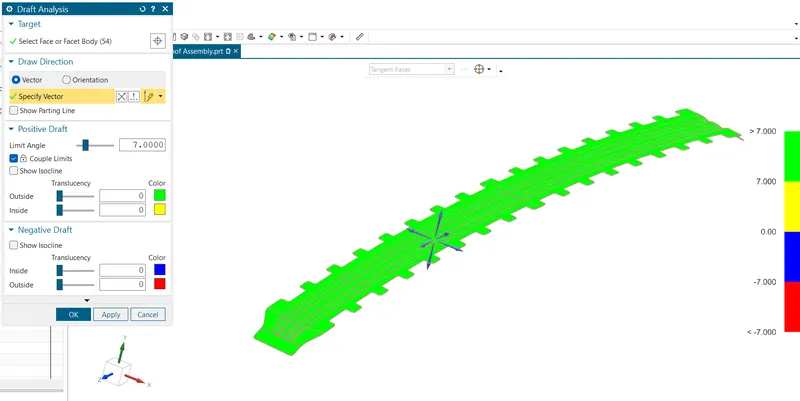
Draft analysis of individual components are carried out and the results are as shown as below. The faces which clears draft criteria of 7 degrees is shown in green:
- Outer Roof Panel
For outer roof panel, every point except 2 faces on the rear side and one face on the front side, other faces cleared a draft angle of 7 degree. The mentioned faces didn't satisfy the draft criteria. The design is made as per given master section, so the parent design needs to be corrected in order to rectify this error.
2. Front Roof Rail
Every face of Front roof rail is clearing draft analysis with 7 degree, when the draft direction is set to normal to the surface.
3. Center Roof Rail
Every face on center roof rail is satisfying the draft condition as shown below.
4. Rear Roof Rail
As shown in the figure below, rear roof rail is also clearing the minimum draft required.
5. Bow Roof Rail 1 and 2
Both the bow roofs are satisfying the minimum draft condition of 7 degree draft angle.
BOW ROOF PREDICTION CALCULATION:-
HEAT DISTORTION CRITERIA
The heat distortion study plays a major role in sheet metal urges. Heat distortion temperature is a temperature limit above which the material cannot be used for structural applications. This study is used to predict the heat distortions temperature at where the material starts to soften when exposed to a fixed load at an elevated temperature. To avoid bending or damage to the roof, based on the heat distortion temperature, this study will predict the bow roof position which helps to strengthen the roof.
Formula :
W = [1.73 x 10^(-3) x L] + [1.85 x 10^(-8) x (R^2)/t] + [ 1.10x10^(-3) x l] - 2.68
Where,
L = Roof Length in X-Direction[mm](Roof dimension in 0-Y)
R = Roof curvature
R = 2(Rx x Ry)/(Rx+Ry)
Rx = X curvature
Ry = Y curvature
t = Roof plate thickness [mm]
l = Bow Roof Span [mm]
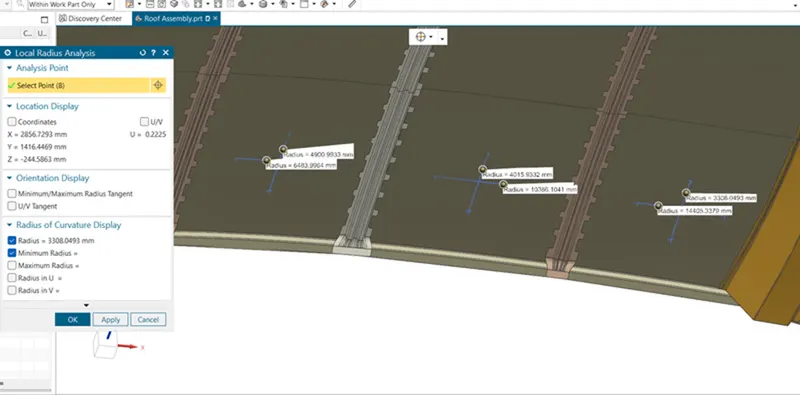
The values are found out and calculations are made out. The whole data and calculations are made out into a table. Sample data collection of Rx and Ry is shown in the figure below:
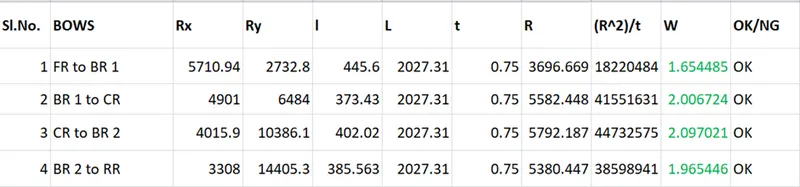
Inference:- The value obtained for W is below 2.7 in all cases, which inicates that the present location of bow roofs are feasible.
SNOW LOAD PREDICTION CALCULATION
Snow load is the downward force on a car's roof by the weight of accumulated snow and ice. The roof can fail if the snow load exceeds the weight the roof was designed to shoulder or if the roof was poorly designed or constructed.
Formula :
Qr = [Iy x t2] / [α x s x [(Rx + Ry)/2]2 x 10-8]
Where,
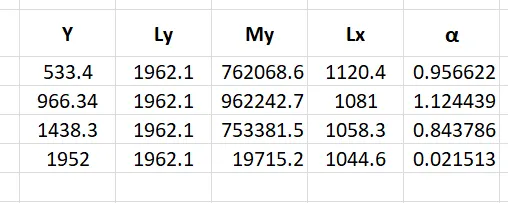
α = My x Lx2 x 10-12 , My = Y(Ly-Y)
t = Roof plate thickness [mm]
Ly = Distance between the front and rear roof Rails on the Vehicle along with 0Y[mm]
Length of Roof panel with the center point between Roof rail Front /Rear as the front and rear reference point.
Lx = Distance between the Left and Right end of the roof on the Roof BOW [mm]
The width of the roof panel is exposed on the surface.
Y = Distance front Front Roof Rail to Roof BOW[mm]
s = Distance for which Roof BOW bears divided load [mm]
s = L1/2 + L2/2
Iy = Geometrical moment of inertia of Roof BOW (Y cross-section )[mm4]
Rx = Lateral direction curvature radius of roof panel Y cross-section on Roof BOW [mm]
Roof panel curvature Radius of the Length Lx in Front view
Ry = Longitudinal Direction curvature radius of the Roof panel X cross-section on Roof BOW [mm]
Roof panel X curvature radius of length s in Side view
The data are collected from the assembly file using appropriate tools and are tabulated. Sample data collection methods are shown below:
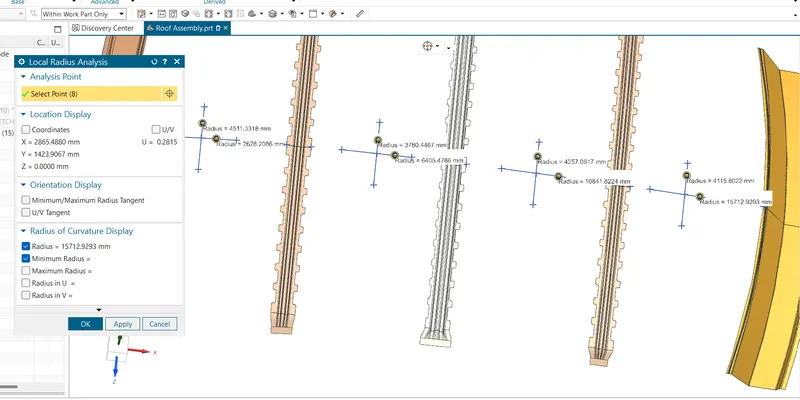
Table to find α, alpha is as follows:
The final data sheet for snow load calculation is as follows:

Inference:-Though the value of s is not meeting the requirement, tha value value of Qr is way greater than the requirement criteria, which implies that the roof can handle snowload.
As the value of 's' exceeded the range (250 ≤ s ≤ 380) for all the 3 regions, it is advisable to add an additional bow roof to further distribute the load.
Increasing the cross section to improve the strength and MOI is also advisable.
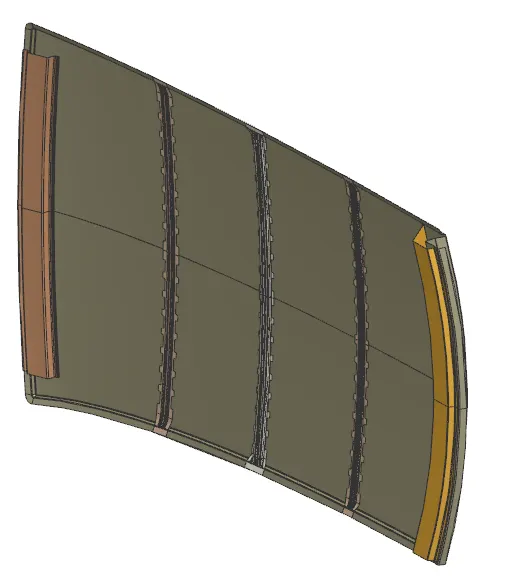
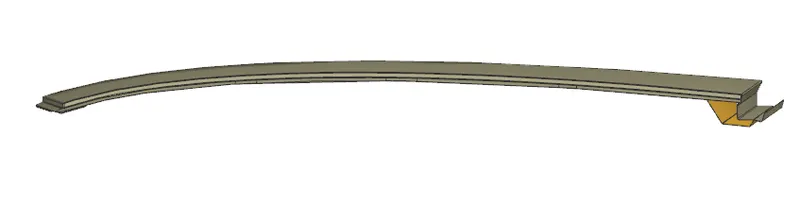
Different views of the roof is shown below:
Trimetric View:
Side View:
Front View: