Roof Design
Introdution:
Roof is an important and integral part of a car or automobile. It protects the vehicle occupant from weather changes. It is used for the safety and comfort of the vehicle occupant while travelling fron one place to another.
Roof model image:
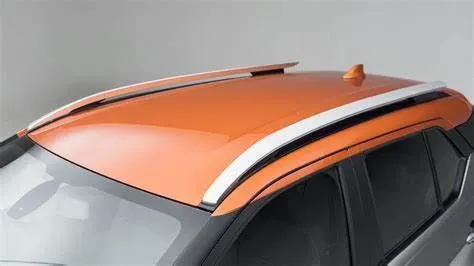
Designing of roof:
The roof is sourced from the styling team with all asethetic considerations to match the design of car.
Roof design by the styling team:
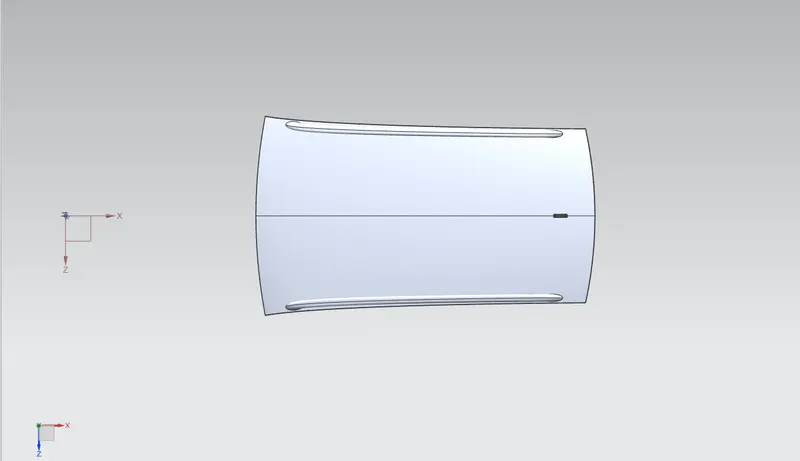
Roof design engineer before designing the roof the roof is designed considering the following important factors.
- Front visibility criteria
- Rear visibility criteria
- Heat room clearance
- Curvature study
- Material strenth and weight
Design consiteration:
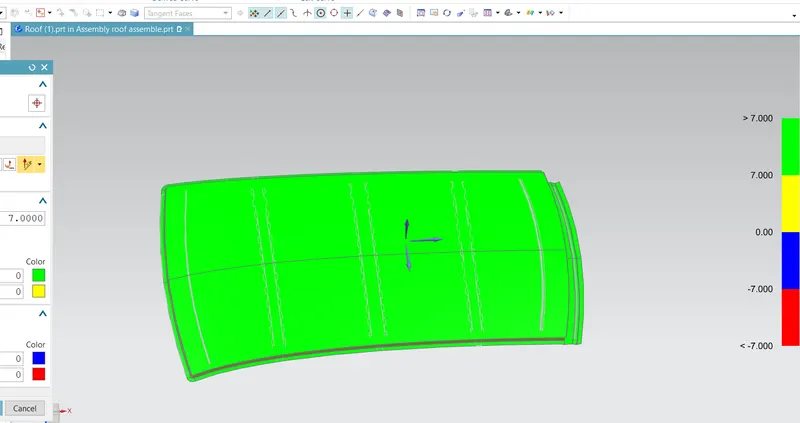
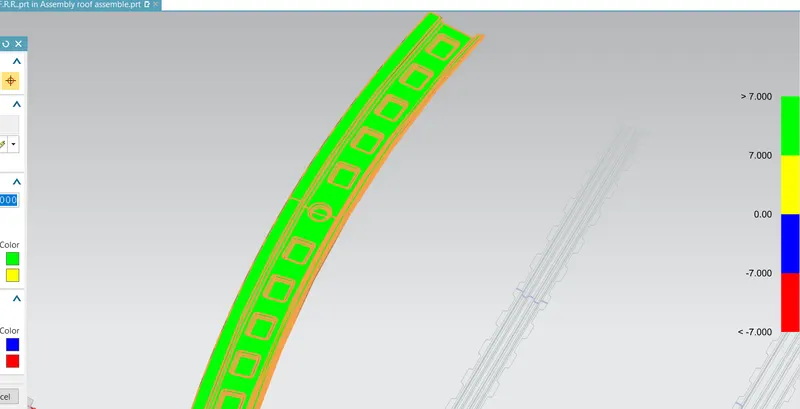
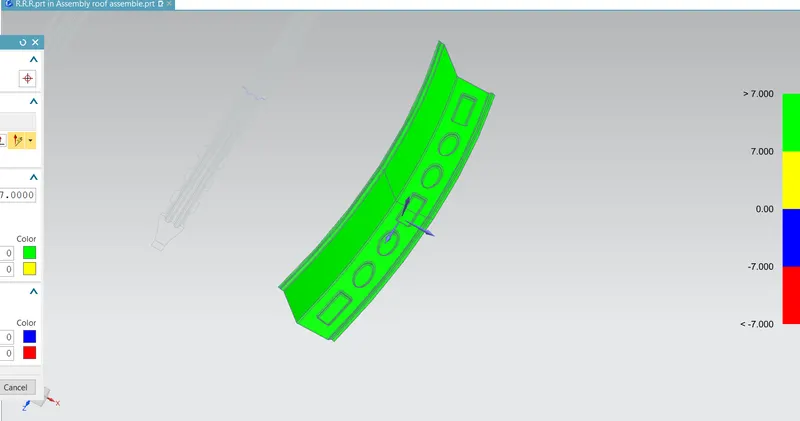
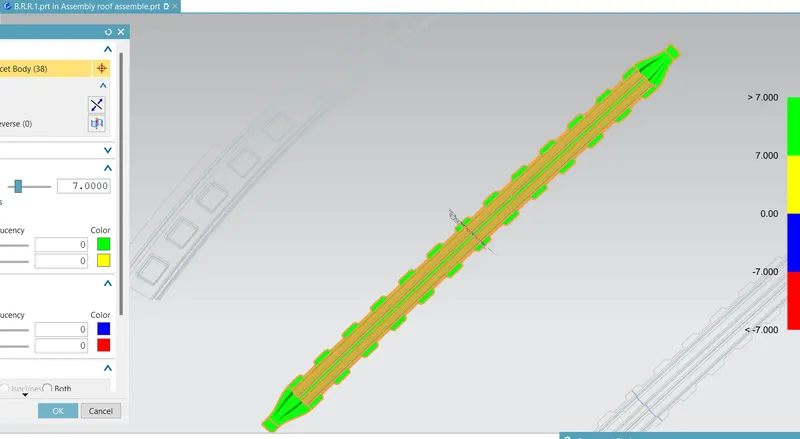
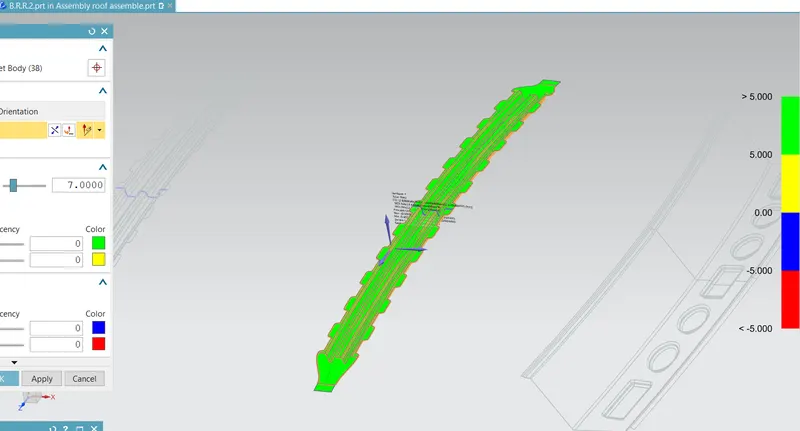
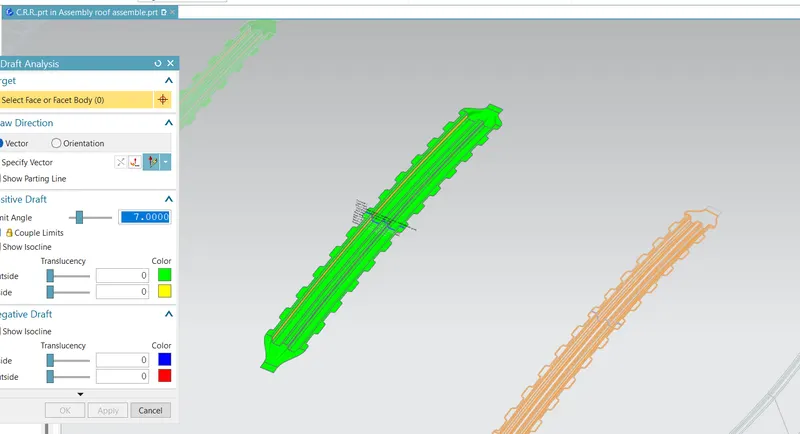
The roof draft angle should be more than 7 degrees.
A bow roof is added to strengthen the roof is designed considering the headroom clearance. Thus the bow roof height is taken as 20mm.
The roof is designed considering bow roof load prediction and snow load roof perdiction.
All the roof rails and reinforcements are designed by taking into consideration of the draft angle and also made sure that all the sharp corners are avoided by applying blends of the surfaces.
Assembly section:
- Front Roof Rail.
- Rear Roof Rail.
- Center Roof or reinforcement roof.
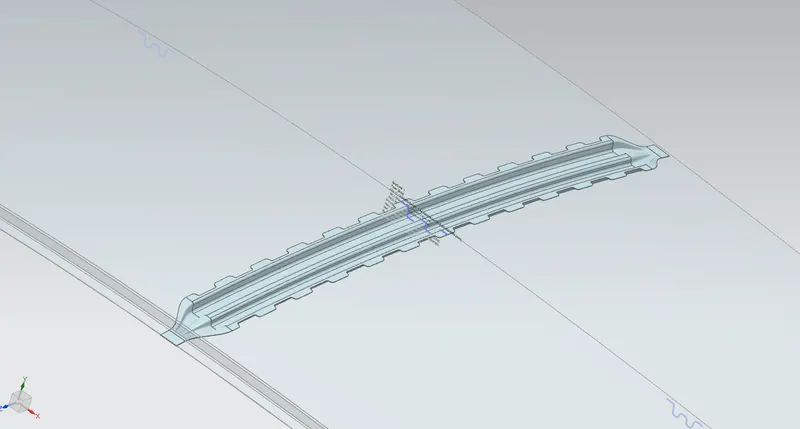
- Bow Roof Rails.
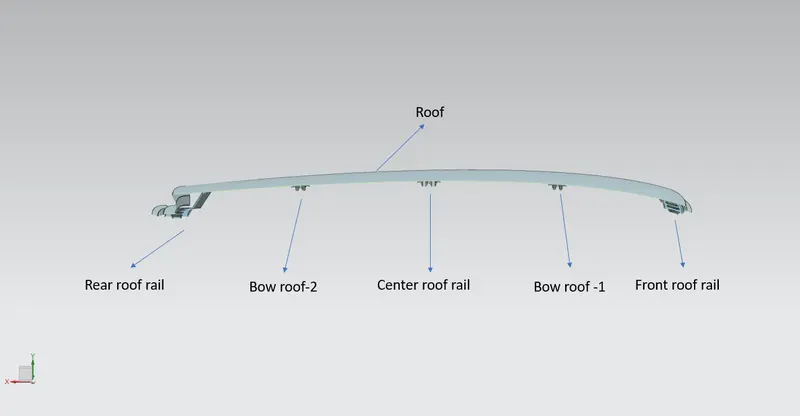
Designed roof and roof assembly:
Top roof:
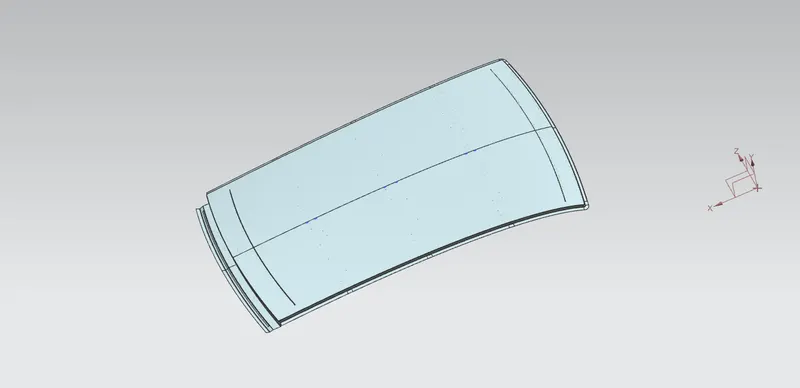
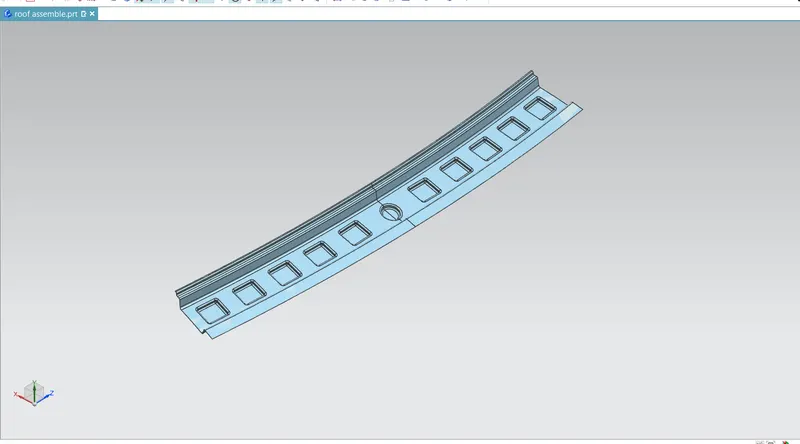
Front roof rail:
The front roof rail provides reinforcement to the front part of the roof and also serves to attach the windshield.
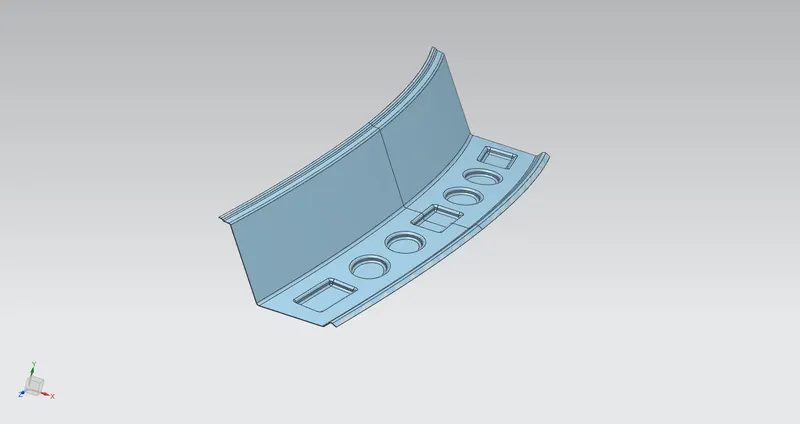
Rear roof rail:
The rear roof rail provides reinforcement to the rear portion of the roof.
Bow roof rail:
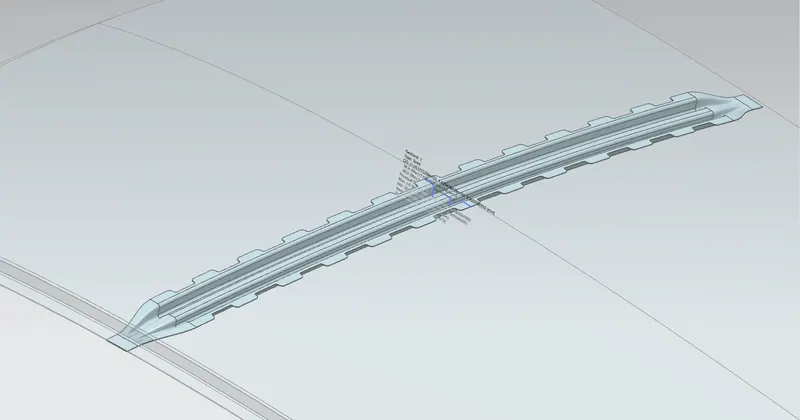
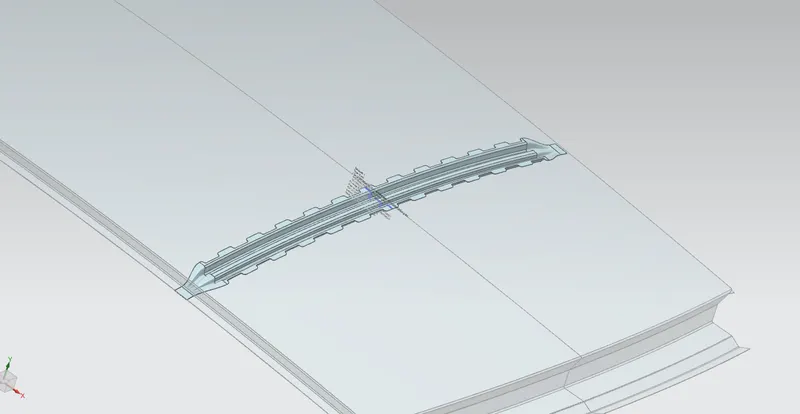
An bow roof rail provides reinforcement to the roof and two or more bow roofs are provided to increase its strength considering the length of the top roof.
Front bow roof rail:
Rear bow roof rail:
Center roof rail:
The center roof rail increase the strength of the roof and helps during rollover testing.
Calculation:
Heat distortion criteria:
The heat distortion temperature is the temperature at which the metal softens and deforms under a certain load. This study is done to check the ability of the roof to withstand its temperature depending on the condition of the reinforcement.
Bow–Roof Prediction Formula
W = [1.73 x 10^(-3) x L] + [1.85 x 10^(-8) x (R^2)/t] + [ 1.10x10^(-3) x l] - 2.68
Where,
L = Roof Length in X-Direction[mm](Roof dimension in 0-Y)
R = Roof curvature
R = 2(Rx*Ry)/(Rx+Ry)
Rx = X curvature
Ry = Y curvature
t = Roof plate thickness [mm]
l = Bow Roof Span [mm]
Judgment Condition
OK< 2.7
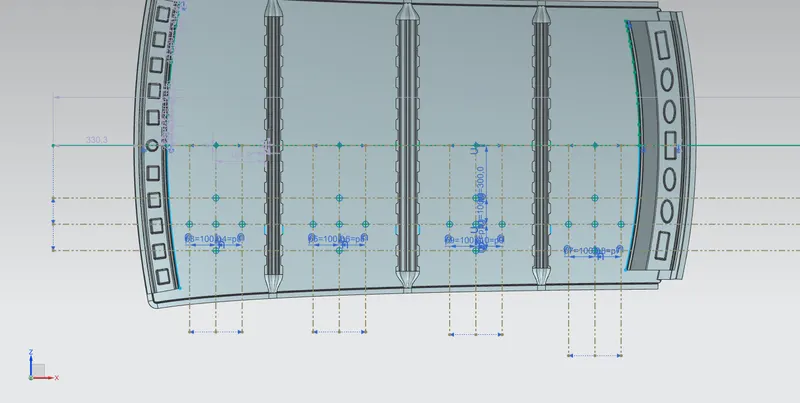
Heat distrotion calculation result:
| Section | Rx | Ry | R | I | L | (R^2)/t | t | W | Result |
| FR-BR 1 | 5739 | 2538.6 | 3520 | 369.7 | 2034.8 | 16520533.3 | 0.75 | 1.55 | Pass |
| BR 1-CRR | 4973.5 | 6192.2 | 5516.3 | 430.1 | 2034.8 | 40572754.3 | 0.75 | 2.06 | Pass |
| CRR-BR 2 | 3969.7 | 10620.3 | 5779.2 | 429 | 2034.8 | 44532203.5 | 0.75 | 2.13 | Pass |
| BR 2-RRR | 3286.6 | 6963.1 | 4465.5 | 337.3 | 2034.8 | 265875587.1 | 0.75 | 1.7 | Pass |
Snow load prediction:
This test is done to know how the roof performs when it snows. A crater is usually caused by snowfall. But the roof should be designed so that the roof will return to its original position when the snow is removed. These are the basic requirements for snow load criteria.
Snow Load Prediction Formula:
Qr = [Iy x t2] / [α x s x [(Rx + Ry)/2]2 x 10-8]
α = My x Lx2 x 10-12 , My = Y(Ly-Y)
t = Roof plate thickness [mm]
Ly = Distance between the front and rear roof Rails on the Vehicle along with 0Y[mm]
Length of Roof panel with the center point between Roof rail Front /Rear as the front and rear reference point.
Lx = Distance between the Left and Right end of the roof on the Roof BOW [mm]
The width of the roof panel is exposed on the surface.
Y = Distance front Front Roof Rail to Roof BOW[mm]
s = Distance for which Roof BOW bears divided load [mm]
s = L1/2 + L2/2
Iy = Geometrical moment of inertia of Roof BOW (Y cross-section )[mm4]
Rx = Lateral direction curvature radius of roof panel Y cross-section on Roof BOW [mm]
Roof panel curvature Radius of the Length Lx in Front view
Ry = Longitudinal Direction curvature radius of the Roof panel X cross-section on Roof BOW [mm]
Roof panel X curvature radius of length s in Side view
Judgment condition
Qr ≥ 3.1
250 ≤ s ≤ 380
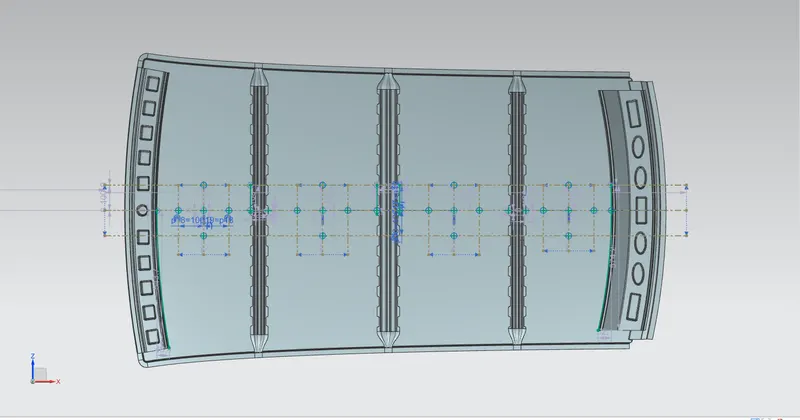
Moment of Inertia :
Iy for Section Bow Roof 1:
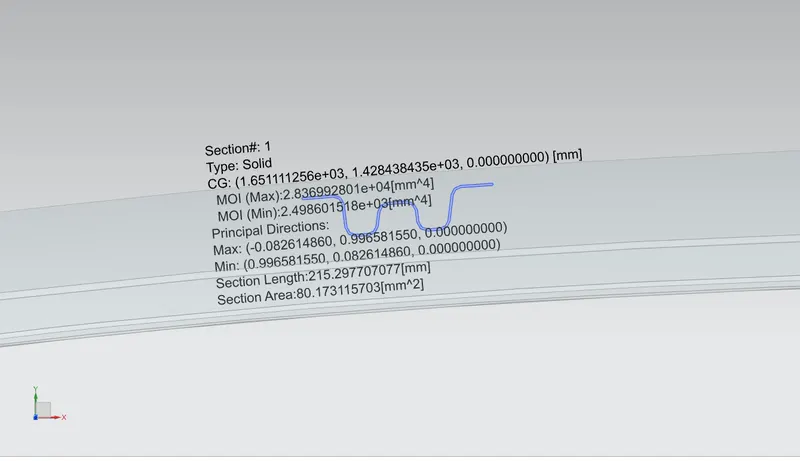
Iy for Section Bow Roof 2:
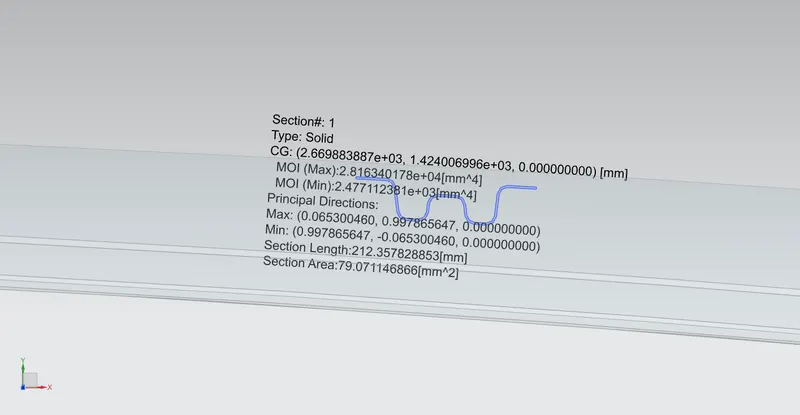
Iy for Section Center Roof Reinforcement:
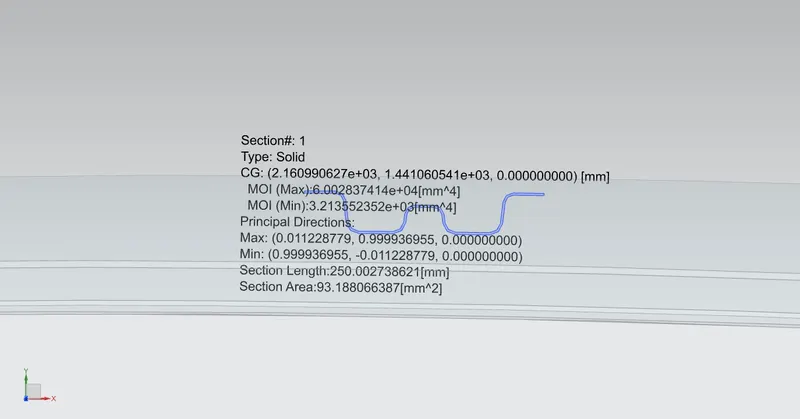
Snow load prediction calculation result:
| Section | Iy | Y | Ly | Lx | Rx | Ry | L1 | L2 | α | S | ((Rx+Ry)/2)^2 | Q | Result |
| FR-BR 1 | 2498.6 | 467.5 | 1948.7 | 1113.1 | 4533.95 | 2595.45 | 467.5 | 510 | 0.8579 | 488.75 | 0.1270 | 26.39 | Pass |
| BR 1-CRR | 3213.5 | 977.5 | 1948.7 | 1074.1 | 3764.28 | 6100.84 | 510 | 508.9 | 1.0952 | 509.45 | 0.2433 | 13.51 | Pass |
| CRR-BR 2 | 2477.1 | 1486.4 | 1948.7 | 1053.4 | 4279.10 | 11129.45 | 508.9 | 462.4 | 0.7623 | 485.65 | 0.5935 | 6.34 | Pass |
Draft Analysis:
Draft analysis is used to predict the manufacturable feasibility of the part.
The draft angle provided for design is around 7 degrees.
Roof Styling surface:
Front Roof rail:
Rear roof rail:
Bow Roof 1:
Bow Roof 2:
Center roof reinforcement:
Conclusion:
The Design passes both the Bow load prediction as well as the snow load prediction criteria.So there is no modification needed in the roof design.Roof design is made as per the design and the engineering standards.