Roof Design
Objective:
The main objective of this project is to develop the car roof design and its reinforcements from the given styling surface. And to prepare a detailed report about the engineering standards for roof design, its design procedure, Draft analysis and manufacturing techniques.
Introduction:
An automobile roof or car top is the portion of an automobile that sits above the passenger compartment, protecting the vehicle occupants from sun, wind, rain, and other external elements. Because the earliest automobiles were designed in an era of horse-drawn carriages, early automobile roofs used similar materials and designs.
Types of Roofs:
1) Hardtops:
When we talk about hardtops, we are referring to the common rigid forms of automobile roofs which we see around. In modern-day cars, this type of roof is made from metal or plastic.
So, the common Toyota Corolla, Camry, and many of the cars in Nigeria are all Hardtops. However, we should say that there are different types. The one we just described is the fixed hardtop. Other types include:
- The detachable hardtops
- The retractable hardtops
- fixed-hardtop-of-toyota-corolla-2006.
2) Sunroof:
This type of roof is also quite popular. You might have been seeing it around. A sunroof is an operable type of roof that allows for an opening in the roof of an automobile; say a window in a roof. It can allow either light or air or both to enter the vehicle. They are either operated manually or automatically. There are 3 popular types of sunroofs. They include:
a. Pop-up:
The pop-up sunroof usually tilts when you open it. It is the most basic and relatively cheaper type of sunroof. Some can even be removed so that they are kept properly, maybe in the trunk whenever you want to go ‘sunroof mode.’
A-pop-up-sunroof-pops-up!
b. Spoiler:
Wait, this is not spoiling anything o. It just means that it can slide. So, the spoiler is a pop-up that would slide, instead of tilting upwards. The advantage of this is that it can easily be restored to its original position by sliding.
2)Panoramic sunroof:
Please take the pronunciation easy. Panoramic sunroofs are distinct. While other sunroofs basically allow air and light or both into the front seats, the panoramic sunroof would allow for both the front and rear.
Panorami- sunroofExterior-view-of-moonroof
3) Convertibles:
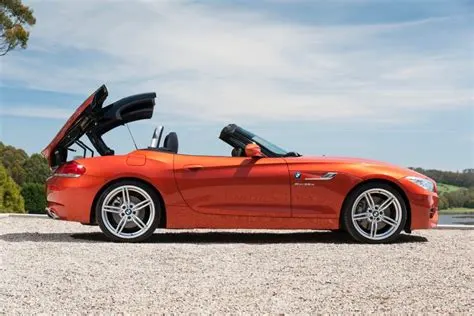
convertibles are passenger cars that can be driven with or without the entire roof in place. They were first introduced as open-air vehicles; no roofs, no sides. There are different types of convertibles based on the method of conversion and the materials used.
a. Retractable hardtops:
Made from metal or plastic and is retracted automatically.
Retractable-hardtop
b. Detachable hardtops:
This type of hardtop is manually removed from the roof and then stored usually in the trunk. They are also made from metal or plastic.
Detachable-hardtop-convertible
c. Soft tops:
This type of convertibles have roofs that are not made from metal or plastic. They are made of textile. The earliest versions of the convertible used canvas for the roofs. More recent models use cloth materials instead. Other materials used now include latex, vinyl, polyvinyl chloride.
4) The T-Top roof:
An ‘almost convertible’ car. Actually it was built this way because the car manufacturers were not sure the government of the day would approve convertibles. So they made a ‘T-shaped bar’ from front to rear and made the roof on either side detachable. Of course, this type of roof is no longer in production.
T-top-roof
Design Consideration of Roof:
- Visibility criteria
- Head room clearance
- Bow roof position
- Curvature study
- Heat distortion and Snow load criteria
- Draft analysis.
In design point of view, it is hard to create the roof design. Because for designing roof we have to create no of support rails for enough strength to withstand the load. Bow roofs are primarily fixed in flatter region to enhance strength. Front roof and rear roof rails are fixed to the ditch area using spot weld operation. And front, rear bow roof and center roof rails are fixed to roof using mastic sealants. We don’t want so much gap between roof rails and bow roof area. So, we reducing the NVH issues.
Design Parameters:
The styling surface of a hardtop roof is given by the styling team to develop it. The car roof consists of outer panel and its reinforcements. Those reinforcements are as per below:
- Front Roof Rail
- Bow Roof
- Centre Roof and
- Rear Roof Rail
There are certain engineering standards to design the Automobile Roof. These standards are derived from trial and error method to reduce the material wastage, production cost and to improve the safety over the years. These standards may vary region to region according to the conditions, usage, rules and regulations of that particular region. The common considerations for roof design are head room clearance, driving vision, heat distortion criteria and snow load criteria. The common standards for car roof design are the draft angle should be minimum of 7° and the blends should be minimum of 3+t (t-thickness of the sheet).
Master Section:
Master sections are the crosssection of 3D model. These master sections are widely used in OEMs and in automotive industries to convey the functional requirements of commodity to the design engineer. It gives the parameters like length, width, height, radius and clearance should be considered while designing the particular part or component.
1) Roof outer panel & front roof rail master section:
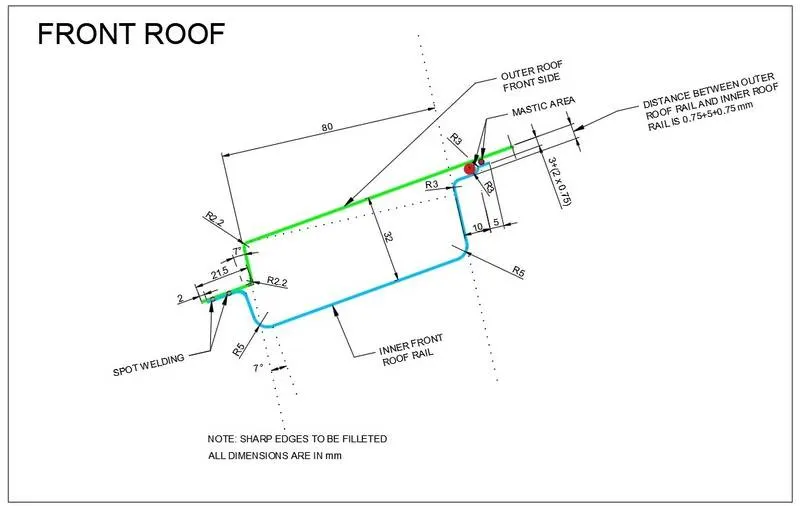
In the above master section the verticle flange is given at 7° followed by the given class A curvature surface. And the distance between the outer roof panel and inner front roof rail is given 32mm. Also the front side the ditch area is given 22 mm in the outer roof and for the inner front roof rail it is reduced by 2.00mm here at this end there is Spot welding is shown so, there is no any gap between the outer roof and inner front roof rail. Also the blend of the corner dimensions are given at diiferent edges. In the end of the inner front roof rail the 10.00mm and 5.00mm distance horizontal flange are given where the MASTIC Sealant is used. So Area is given for mastic joint is 3.00mm and 5.00mm.
2) Bow roof master section:
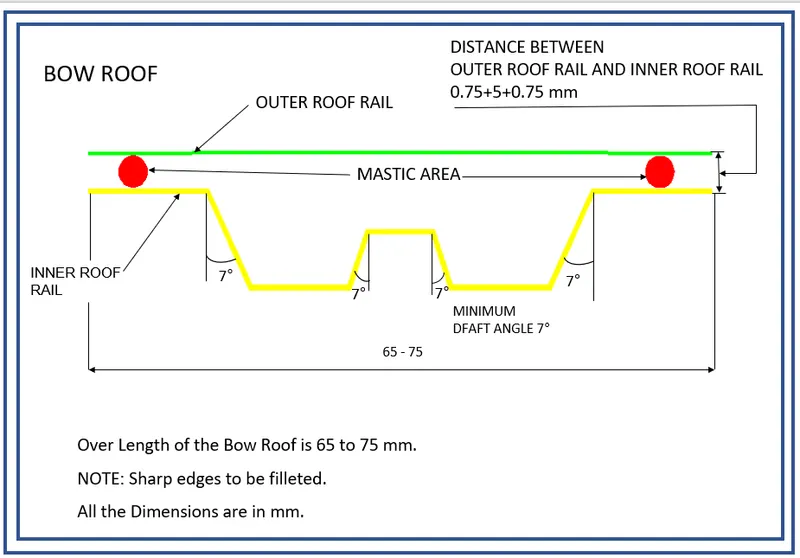
Here, the overall width of the bow roof should lie between 65-75mm and all the embosses have atleast 7° of positive draft with respect to the tooling direction. Then the offset of bow roof outer flange is 0.75+5+0.75mm from the roof outer panel because of the Mastic Area.
3) Center roof master section:
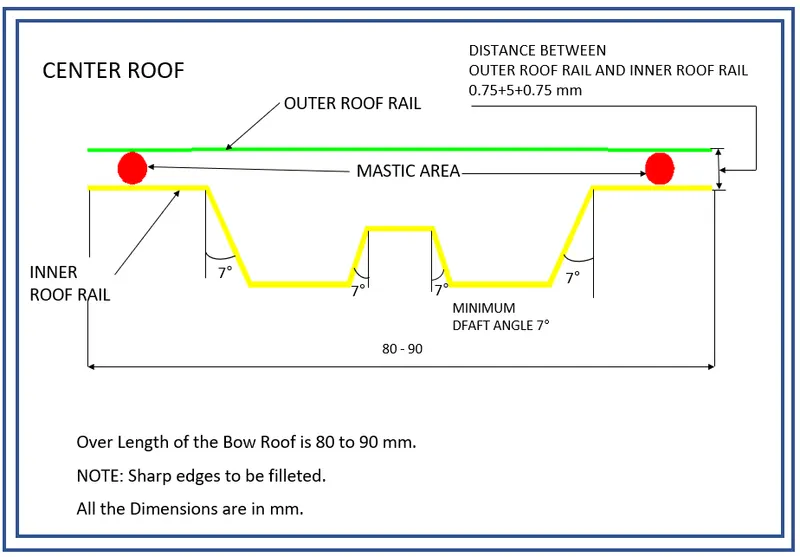
Same as the bow roof, the overall width of the center roof should lie between 80-90mm and all the embosses have atleast 7° of positive draft with respect to the tooling direction. Then the offset of center roof outer flange is 0.75+5+0.75mm from the roof outer panel because of the Mastic Area.
4) Rear roof rail master section:
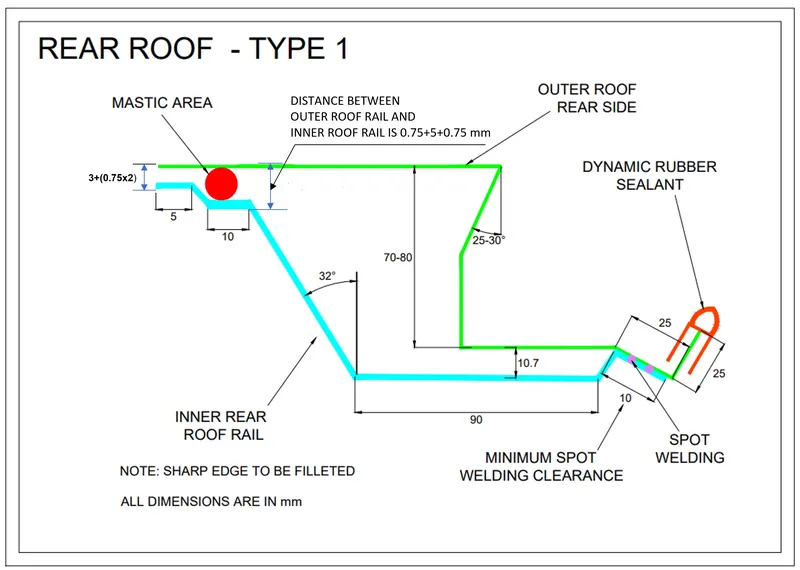
The outer roof panel rear flange should have the negative flange of 25° - 30° draft to accommodate the clearance for back door movements. The overall hight of the rear flange must lie between 70-80mm. The Dimenstions for rear roof rail are offset of (3+0.75+0.75) & (0.75+5+0.75) for front flanges, which is given because of Mastic Area. and the 10.7mm for the offset of center emboss and its width is 90mm. Then the draft angle for emboss connecting the front flange is 32°. Here in the rear area of the rear roof rail is SPOT welded to the outer roof so there is no gap maintain between them at this area.
Design procedure:
For designing this roof we first have to create the assembly file and adding the given styling surface first and by using this different roof rails is created as the separete part.
1) Roof Outer Panel :
The different views for the roof outer panel is given in below image.
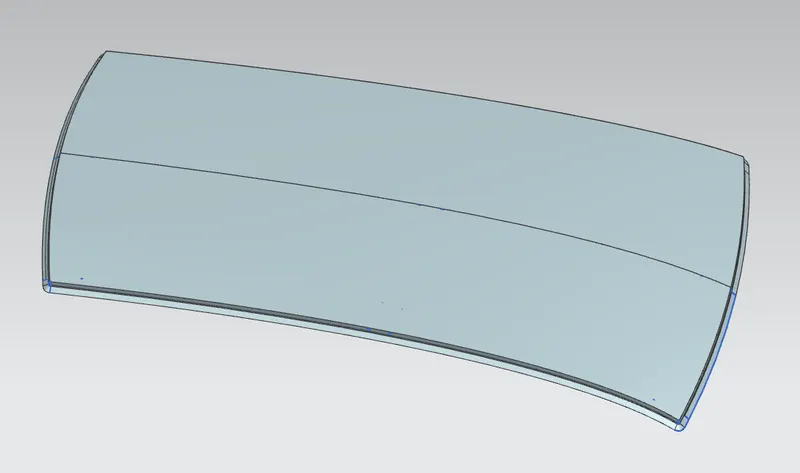
- The roof outer panel is the aesthetic part of the roof and also it is the external part which covers the occupant or passenger compartment from the wind shield to the back door.
- First of all Importing the The given styling surface and after that half of the portion of styling surface is extracted because the remaining one is the mirror of it. Now unntrimming this extracted surface to fill the gaps and holes and then trim it to remove the extra surface over boundries of styling surface.
- Using law extension tool create the flanges as per the given master section from front roof rail as well as rear roof rail. After all flanges are done using edge blend tool the sharp edges is to be removed. Same as the ditch area is also created using the same law extension.
- Also the sheet is extended to the Y axis and trimed with the xz plane so gap is removed and after that using mirror geomatery the whole surface is mirror and then using sew it is joined. Then the thickness of the 0.75mm is given to the surface by using the thicken command.
Draft Analysis:
Draft Analysis of the Outer Roof Panel is done which is as per the below image.
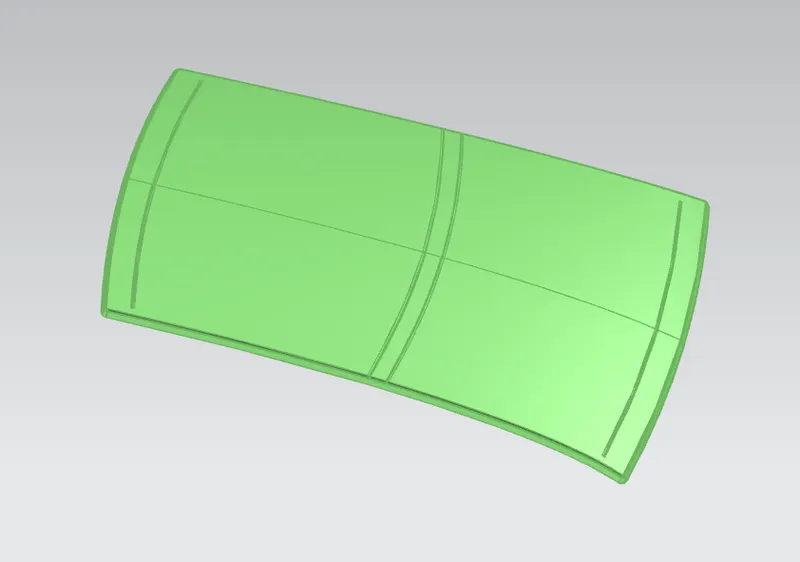
Here, In the rear portion the negative draft is shown due to the opening trajectory. It is done by bending process.
Here, we can see that the all portion is cleared for the draft analysis as per the required draft angle.
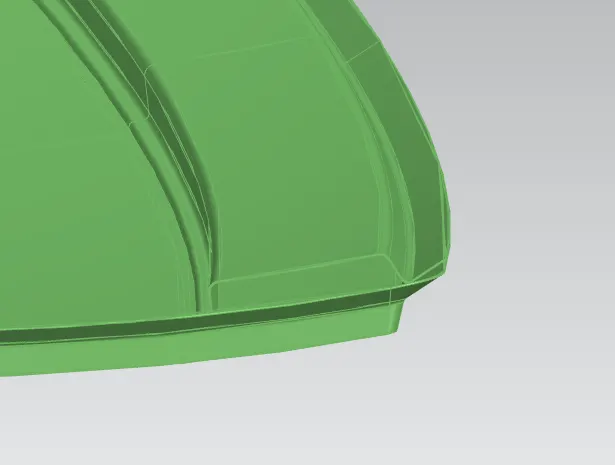
2) Front Roof Rail :
The different view for the Front roof rail is given as per the below image.
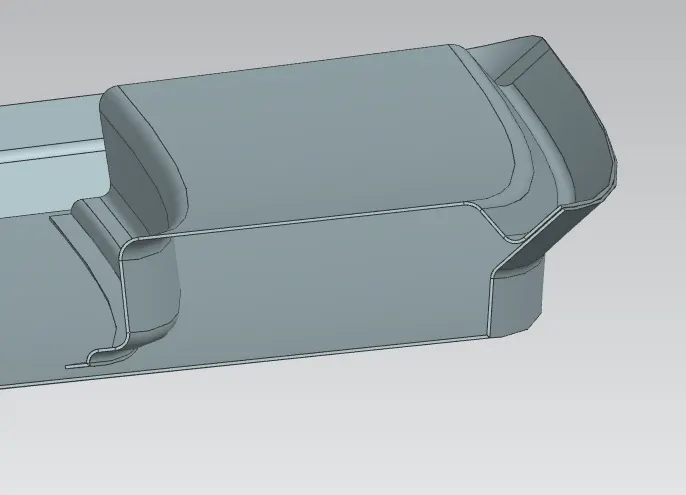
The reference surfaces for front roof are taken from the roof outer panel using the wave geometry linker command. By offsetting this surface as per the given master section we can create the reguired flanges. And by using law extension the verticle surface is created at the draft angle. by trim or corner we can remove the extra surface . after all surface is done as per master section using blend command the sharp edge is to be blended.
Using the sheet extend the whole surface is extended in the y direction and trim it using xz plane and then mirror whole surface and using sew the surface is to be join. After that using thiken command the whole surface is getting the thickness of 0.75mm. We can create the emboss in this surface by using emboss command.
Draft Analysis:
Draft Analysis of the Front Roof Rail is done which is as per the below image.
3)Centre Roof Rail:
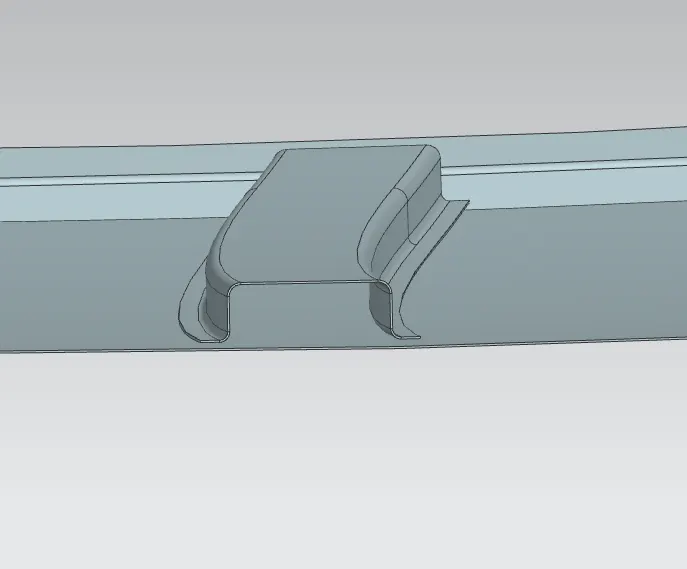
Draft Analysis:
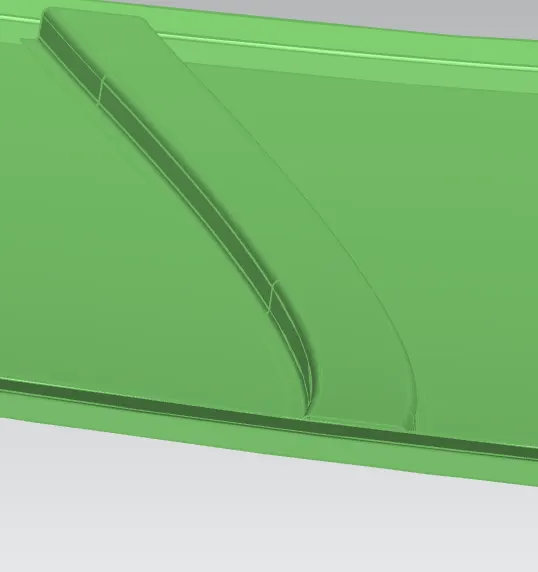
Draft Analysis of the Centre Roof Rail is done which is as per the below image.
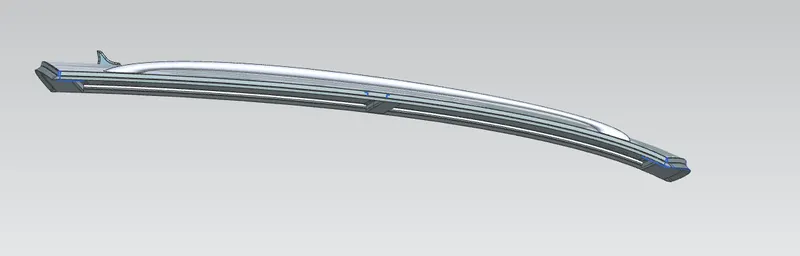
Final product before manufacture:
Manufacturing method:
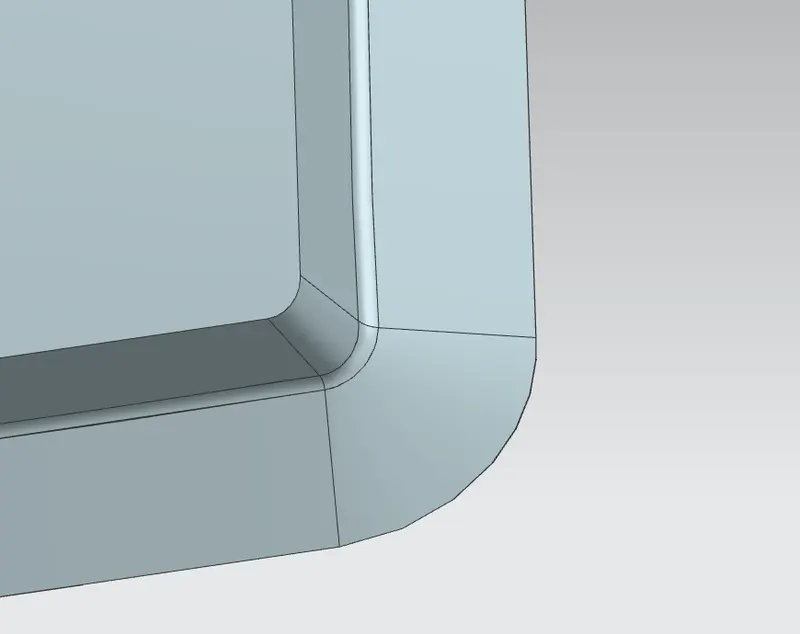
Here, The car roof is generally manufactures from the sheet metal sheet. In the manufacturing process the stamping process and at some place bending process is done. Also for joining this all sheets there are mastic sealant is used and at some place the spot welding is done. Here, which portion is visible from the outside is joined using mastic sealant and which portion is hide from outside is joined by spot welding process. Emboss is done by punching which is increase the strength of the panel. also some cutout is done for weight loss.
Conclusion:
Hence the roof, front roof rail, rear rail roof and centre rail roof are desiged by follwing the master sections, and the momnet of inertia, draft analysis is carried out to check the feasibility of the part to the final manufacturing.