Roof Design
ROOF DESIGN
AIM: To Design a roof with all the components like front roof rail, rear roof rail, and bow roofs by following the given master section and the high-quality surface, considering all the design requirements as per the OEM standards.
ROOF
An automobile roof or car top is the portion of an automobile that sits above the passenger compartment, protecting the vehicle occupants from sun, wind rain and other external elements. The roof is a single panel as seen from the exterior it consists of from roof rail, bow roof, center roof rail, and rear rail with different thicknesses which act as a reinforcement for the top.
OBJECTIVE
- To design a roof of the car with all the reinforcement from the give styling surface.
- To perform the curvature study on the roof by considering heat distortion and snow load criteria.
- To calculate the moment of inertia for the reinforcements.
- To perform the draft analysis for analyzing the components manufacturing feasibility.
TYPICAL SECTIONS
- Front Roof Rail.
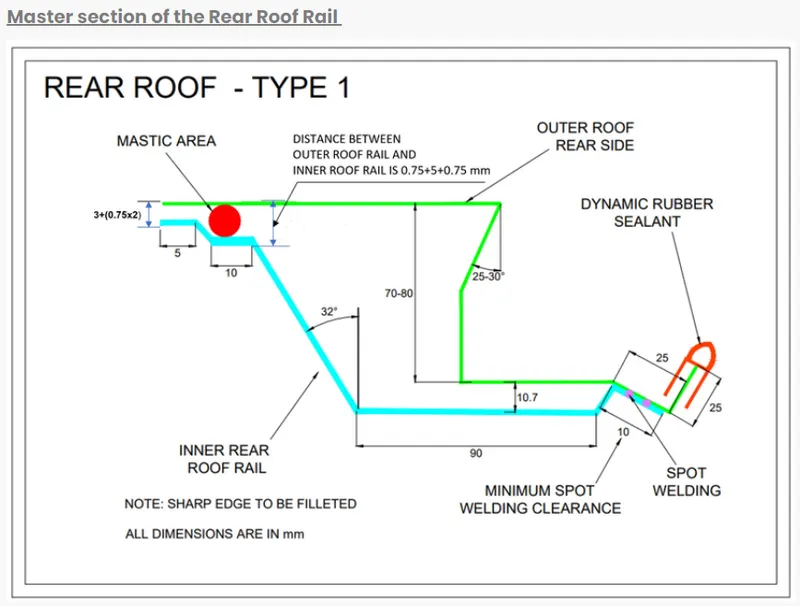
- Rear Roof Rail.
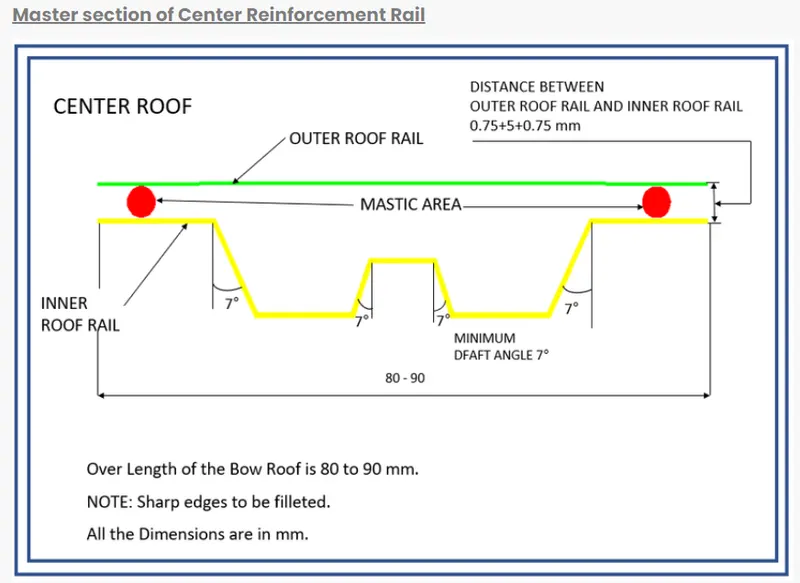
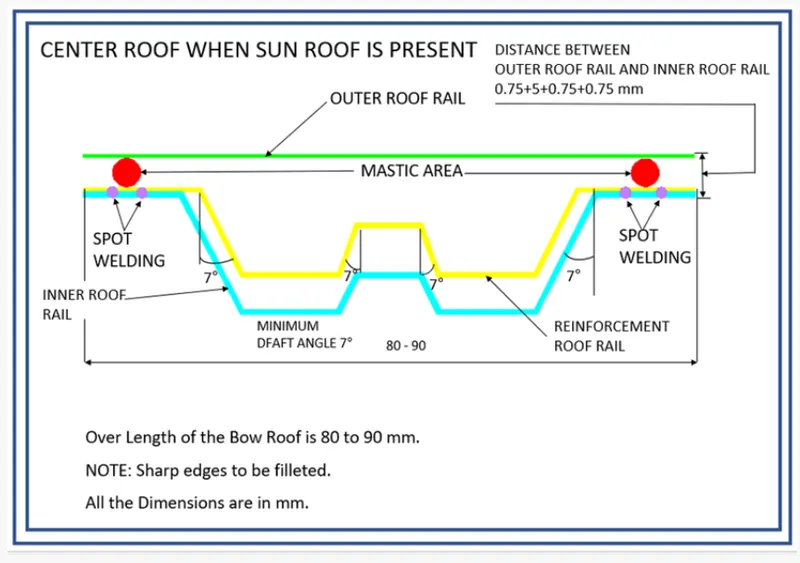
- Center Roof with a reinforcement.
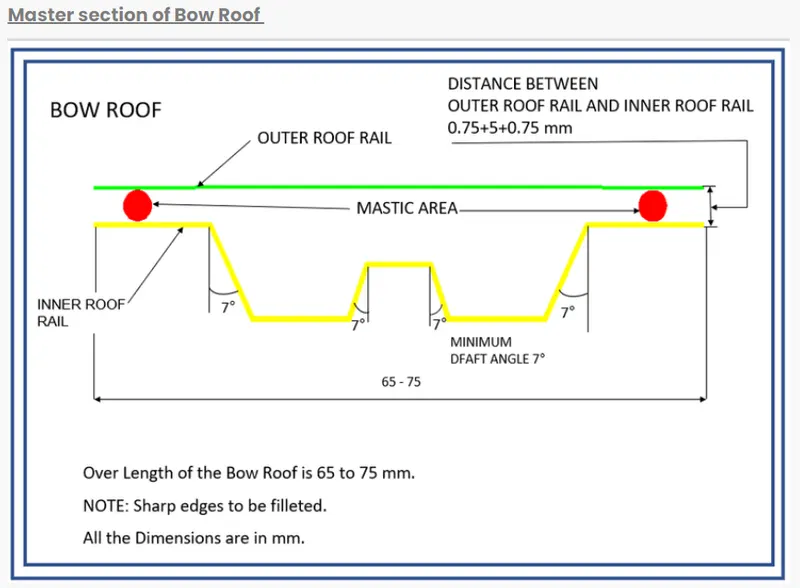
- Bow Roof Rails.
Design Consideration of roof:
- Visibility Criteria
- Head Clearance
- Curvature Study
- Heat Distortion and snow load criteria
- Safety Parameters
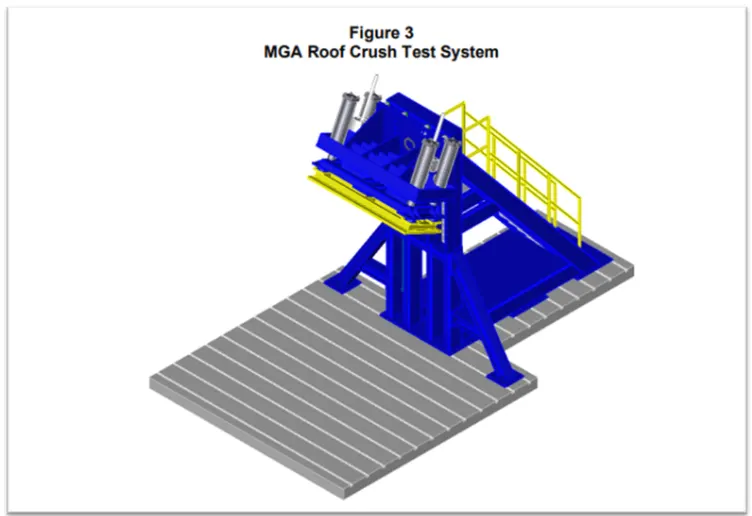
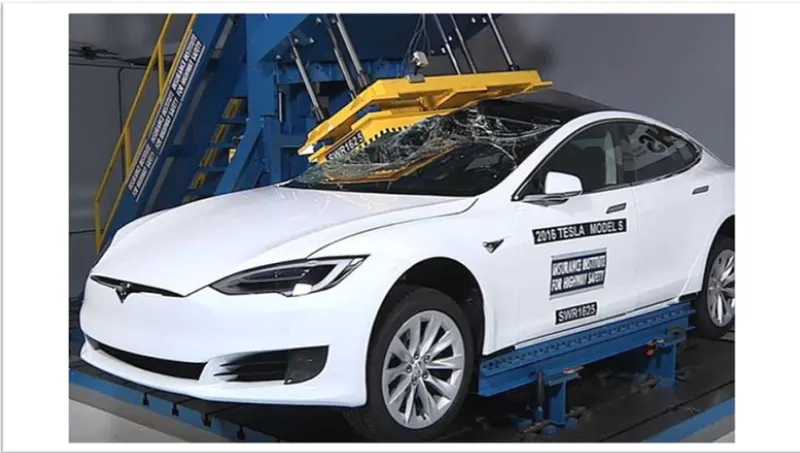
Roof Crush test for passenger car:
Safety point of view vehicle roof plays a very crucial role especially roll over kind of accidents, in which vehicle tips over into its side of the roof vehicle rollover crashes are the cause of many fatalities and head, neck and spine trauma around the world.
Strength of the roof structure to occupant protection in real world roll over crashes, requiring the maximum moving distance of the roof structures should be less than 127mm, (5in), where the induced load is 1.5 time the vehicle weight.
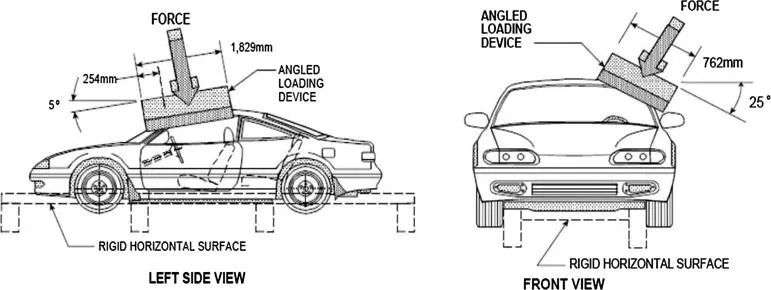
For the test, the passenger car shall be rigidly placed or positioned on a horizontal surface with the doors locked and the window closed. Furthermore, a flat, rigid block with a lower surface a rectangle measuring 30 inches wide by 72 inches long (762mm x 1829mm) shall not move more than 5 inches (127mm), measured as the distances between the original location of the lower surface of the test device and its location as the specified force level is reached, when it is used to apply a force of 1.5 times the unload vehicle weight (UVW) or 5000 lbs. (22224N), whichever is less. To either side or forward edge of the vehicle.
This test can be conducted on either side of the roof structure, the front left or the front right side but not on the both sides in one single test and still meet the requirement of the test. The rigid plate shall not move faster than 0.5 inches / second and the force applied on the plat shall not exceed the lesser of 1.5 times the unloaded vehicle weight (UVW) expressed in kilograms multiplied by 9.8 or 5000 lbs (22240N).
Also, the direction of the force shell be downward and perpendicular to the lower surface of the rigid plate and such that it moves in a straight line without rotation. The duration of the test shall not exceed 120 seconds. The longitudinal axis of the plate is pitched forward at a 5' angle as viewed from the side of the passenger car as shown,
The lateral axis or the roll of the plate is such that it forms a 25-outboard angle with a horizontal surface as viewed from the front of the passenger car as shown in below, fig.
Master Section and its Parameters:
joining Process:
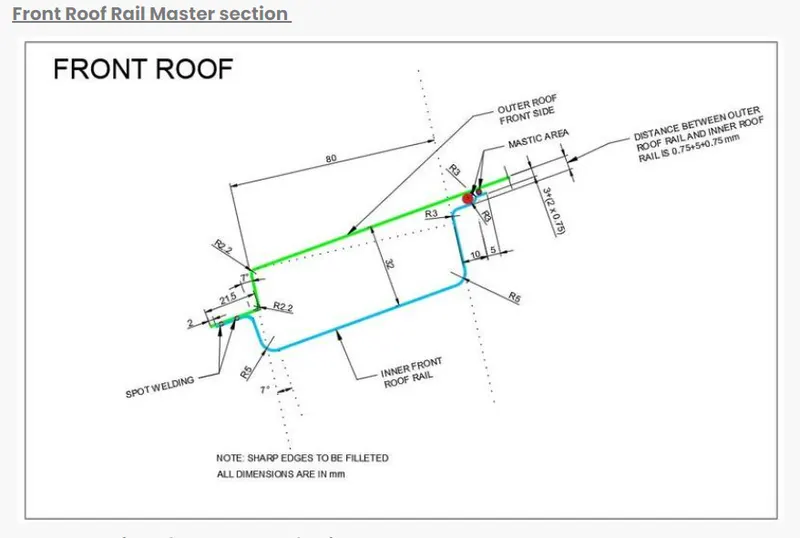
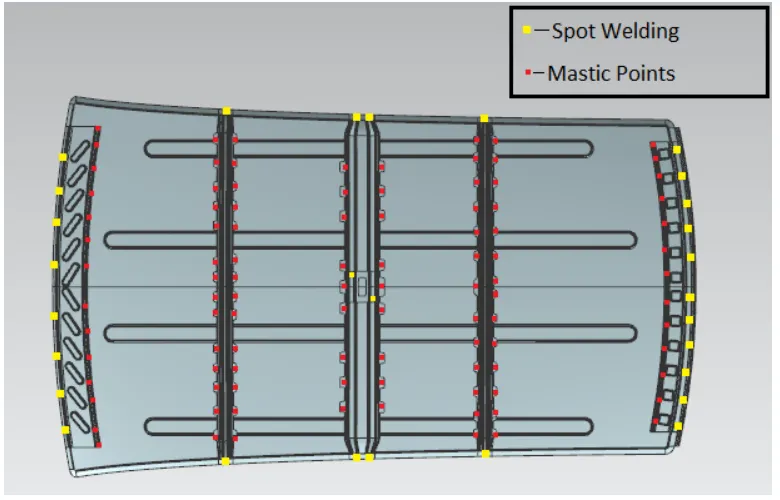
Mastics are introduced between the roof outer panel and reinforcement for joining. Where ever the mastics are introduced there is remarkable strength. Spot welding is also introduced to join the reinforcement and the outer panel.
Reinforcement and its types:
If the roof is flat, it is weak and cannot able to with stand the external load like snow load, roll over and etc. So, in order to increase the strength of the roof, reinforcement like front roof rail, central roof rail, rear rail and the bow roof are introduced and joined in the flat surface of the roof with different joining process. In there are four types of reinforcement are used in the hard roof top they are,
- Front roof rail
- Central roof rail
- Rear roof rail
- Bow roof rail
Roof Outer Panel:
Design Consideration and Criteria:
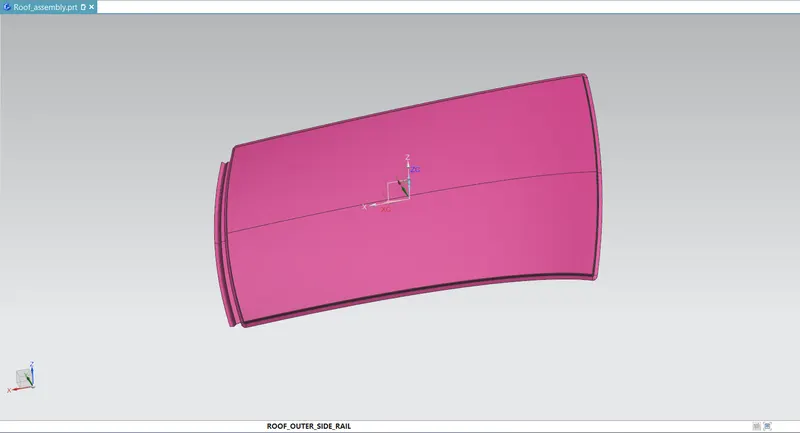
1.Roof:
- We are making the hardtop type of roof from the given section we are not adding any reinforcement for the central roof rail.
- We are adding the flanges to all sides of the roof for spot welding of the front roof rai, central roof rail, rear roof rail, and bows.
- The length and angle of the flange are decided based on the visibility criteria and according the draw angle required for manufacturing the sheet metal.
- The thickness of the roof is decided 0.75mm.
2. Front roof rail:
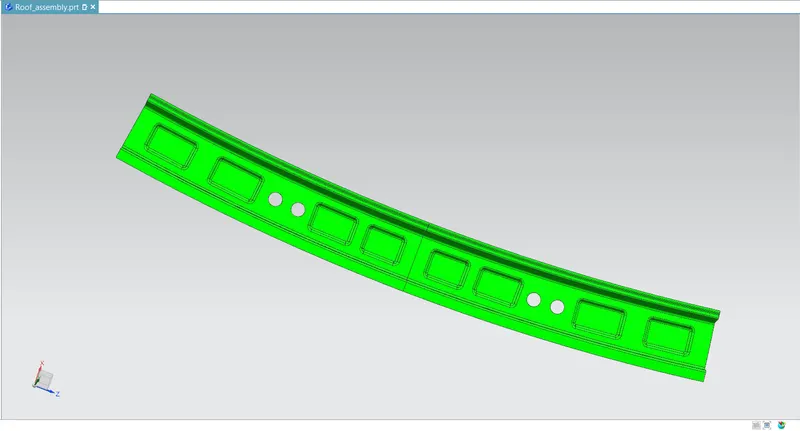
- The front roof rail is used as the reinforcement to the roof surface to increase the strength and also used to mount the brackets for some features such as room lamp or map lamp and rear mirror.
- The depth of front roof rail. is decided based on the visibility criteria line decided for the driver visibility.
- The Width of front roof rail is decided in such a way that there should be enough headroom clearance between the head of the drive and the end surface of the roof rail to avoid injuries to the person.
- At the front side we are doing spot welding and on the rear side the front roof rail, we are using mastic point to join it with the roof surface.
3.Rear roof rail:
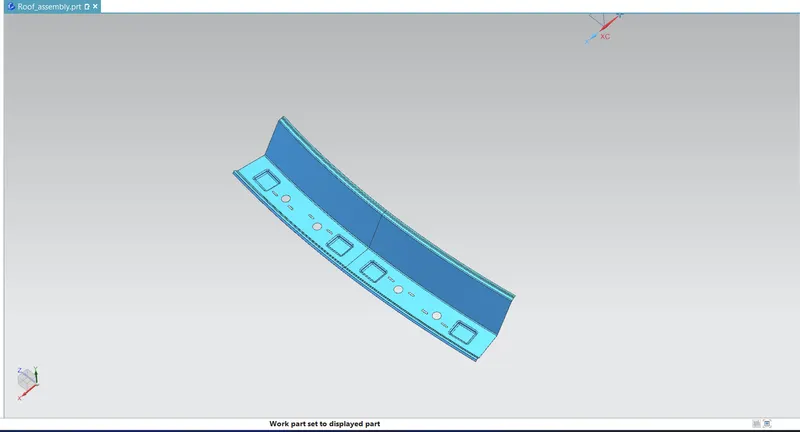
- The rear roof rail is used as the reinforcement to the roof surface at the rear side.
- The joining method used for this rail is the same as that of front roof rail.
4.Bows Roof Rail:
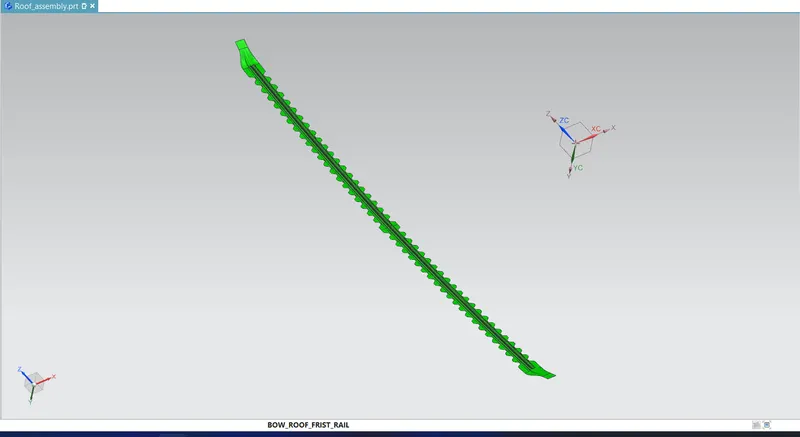
- We are making two bow one is in between the front roof rail and central roof rail and another is in between the central roof rail and roof rail.
- Both ends of the bow are joined to the roof outer flanges by the spot welding and the inner side of the bow are joined to the inner surface of the roof with the help of mastic points.
- The cross-section of bow is made a way that should get the maximum value of the minimum moment of inertia at which the bow fails.
5.Heat distortion criteria:
In these criteria, we check the heat distortion capacity of the roof at temperatures with the fixed load on it. So, when the surrounding temperature is high and the roof is loaded with some weight on it them if roof is deformed it fail, so to calculation as follows.
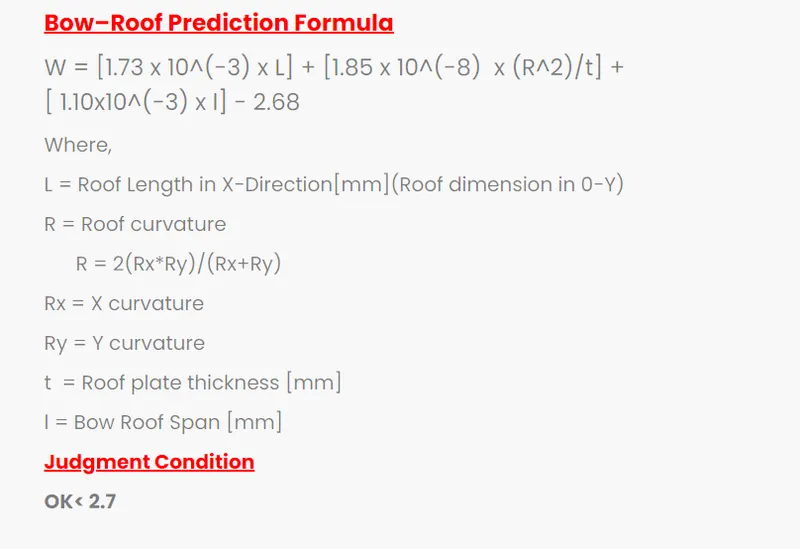
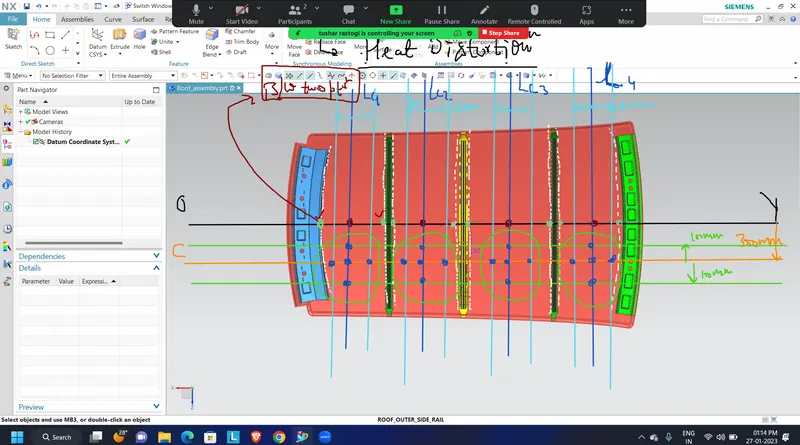
Step to calculate the distortion as follows:
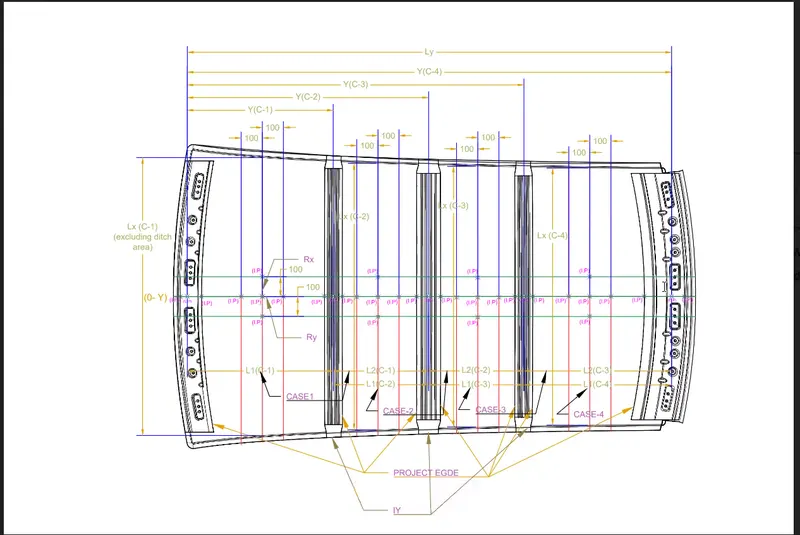
- First, we offset the center y-axis line to 300mm distance apart it represented as (-3y to 3y line).
- After that we offset this -3y to 3y to 100mm offset each side represented with the green line.
- We draw the vertical line at center of two consecutive bow rood span. Next, we offset this line 100 on each side.
- Now we have three horizontal line and three 12 vertical line we take the intersection points of the vertical line with that line.
- After getting all the point we project these point on the roof surface and draw the three points curves along the x-axis point to get the radius of curvature of Ry and along y- axis points to get the radius of curvature of Rx.
We do the calculation for the roof positions as in the following table for it passed the hear distortion criteria.

6.Snow load condition:
This snow load condition calculation is done to check the strength of the roof when there is dead weight on the roof. As we know that in some regions, we have snowfalls so when snow falls on the roof this act as dead weight for that we do this calculation to check the position of the bow and its sectional area.
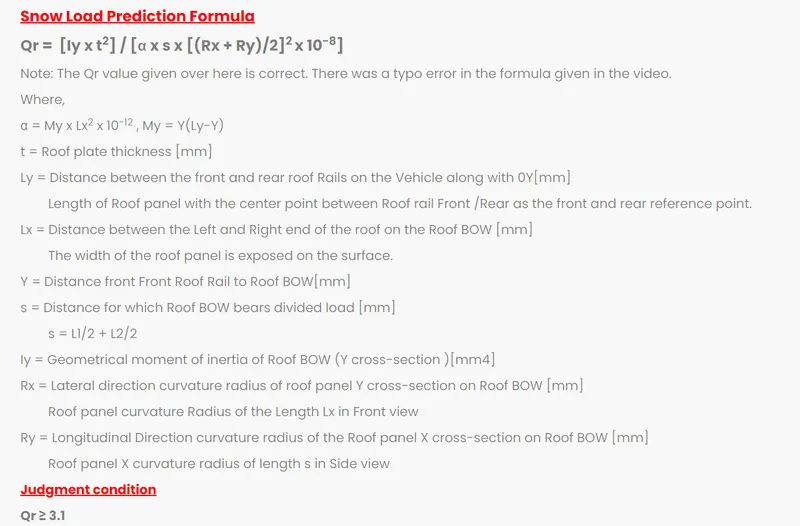
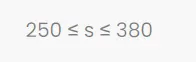
Steps to calculate snow load condition:
- Steps is same as heat distortion criteria but the difference is calculated the Rx and Ry at the centerline of the roof along the Y-axis.
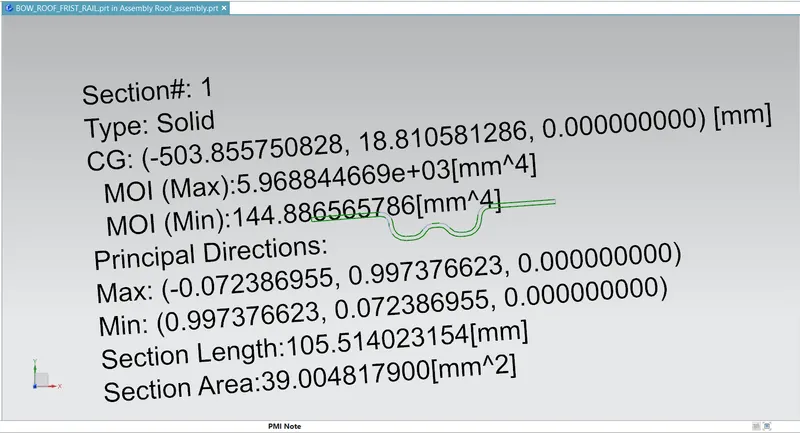
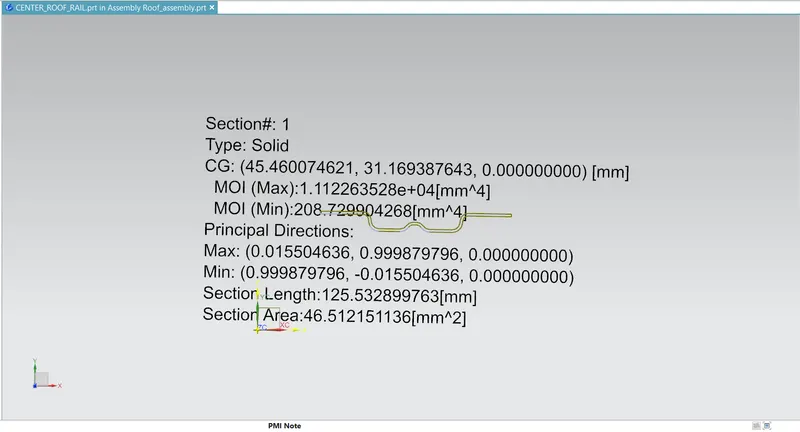
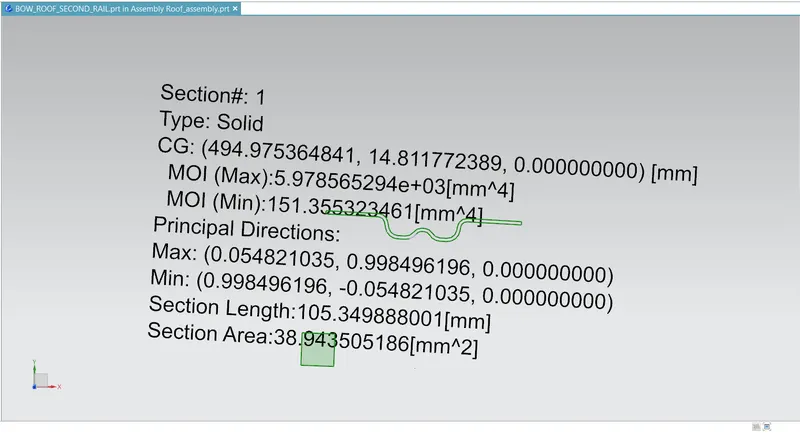
Now we use a sectional inertia analysis tool to calculate the MOI as follows
1.1st Bow Roof Rail:
3.Center Roof Rail:
4.2nd Roof rail:
We do the calculation for the Roof positions as in the following table for it passed the snow load condition is OK or not.

Joining method used for manufacturing of roof:
- Spot welding points:
- Mastic point:
position of these points on Roof
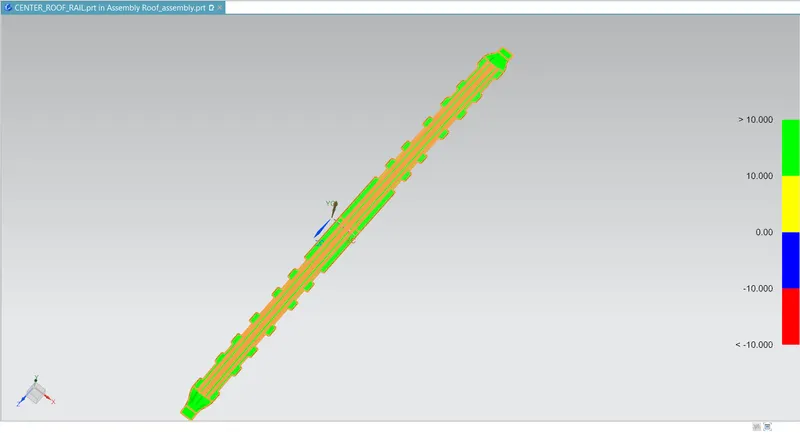
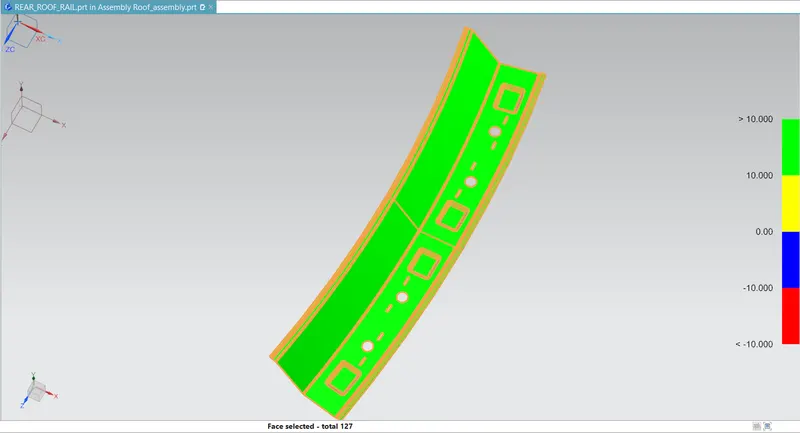
Draft analysis to check the manufacturability of roof and its parts:
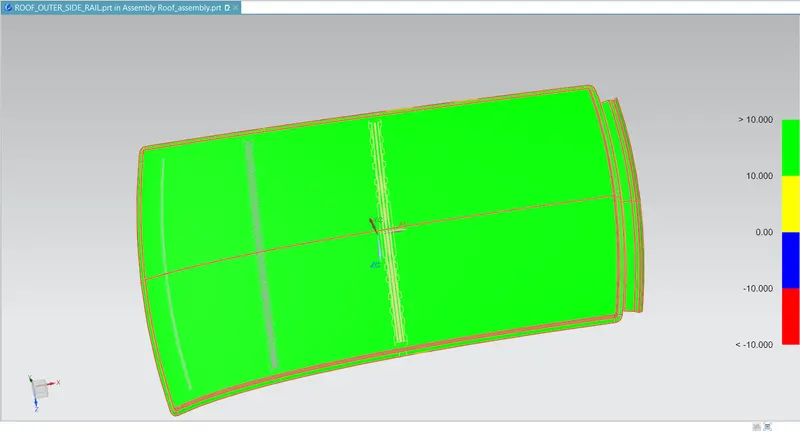
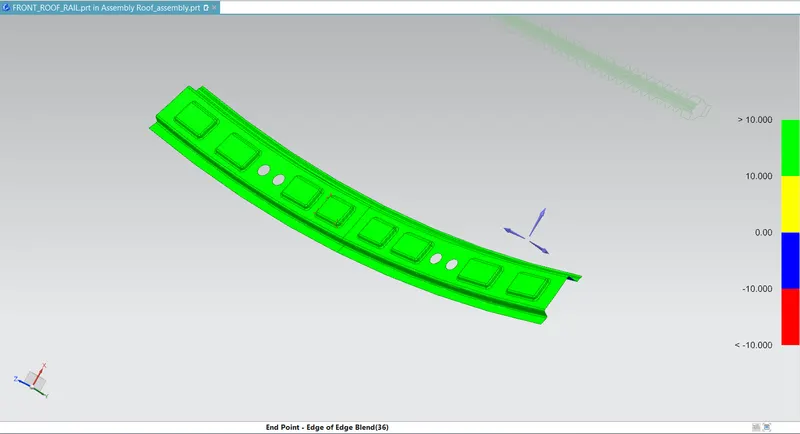
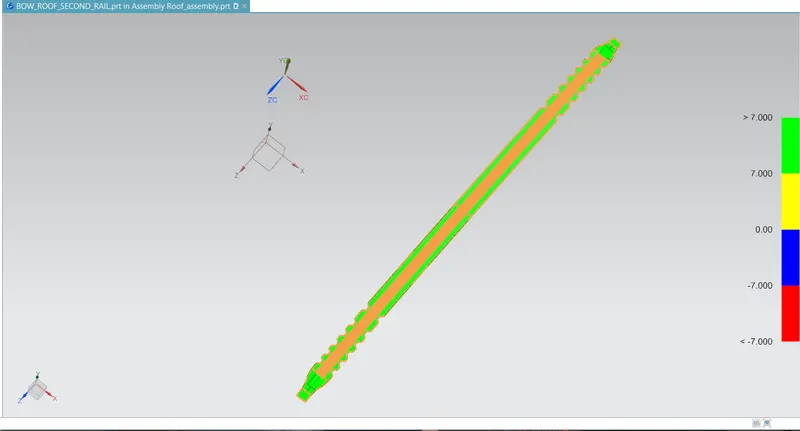
We are doing analysis for the 7' draw angle in upward as follows:
1.Roof:
2.Front roof rail:
3.Bow roof Rail:
4.Central Roof Rail:
5.Rear roof rail:
Conclusion:
I did the My roof design and check heat distortion and snow load condition for bow roofs are placed at right place or not. So, after finishing my design. I did the heat distortion and snow load condition.
After, finishing the curvature study. Then go to check the section modulus. And last, we check the draft analysis. Because, whether part is manufacturable or not. That, why we doing this analysis. That's all my design pass the whole requirement for placing the roof on the car.