Roof challenge
AIM:- to design roof of the car with the component .and create an ASSEMBLY by developing the essential flanges for the outer roof and creating the reinforcements.
ROOF
An automobile roof or car top is the portion of an automobile that sits above the passenger compartment, protecting the vehicle occupants from sun, wind, rain, and other external elements
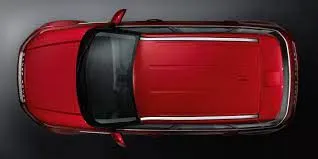
TYPESOF CAR ROOF
1 HAEDTOPS
When we talk about hardtops, we are referring to the common rigid forms of automobile roofs which we see around. In modern-day cars, this type of roof is made from metal or plastic.
2. SUN ROOF
This type of roof is also quite popular. You might have been seeing it around. A sunroof is an operable type of roof that allows for an opening in the roof of an automobile; say a window in a roof. It can allow either light or air or both to enter the vehicle. They are either operated manually or automatically.
3. CONVERTIBLES
Oyaaaaa, everyone wants to talk about convertibles. Anyways, convertibles are passenger cars that can be driven with or without the entire roof in place. They were first introduced as open-air vehicles; no roofs, no sides.
IN OURE CASE WE ARE USING HARDTOP ROOF
where there are four main component
- FRONT RAIL
- REAR ROOF
- BOW RAIL
- CENTER RAIL
MY DESIGN
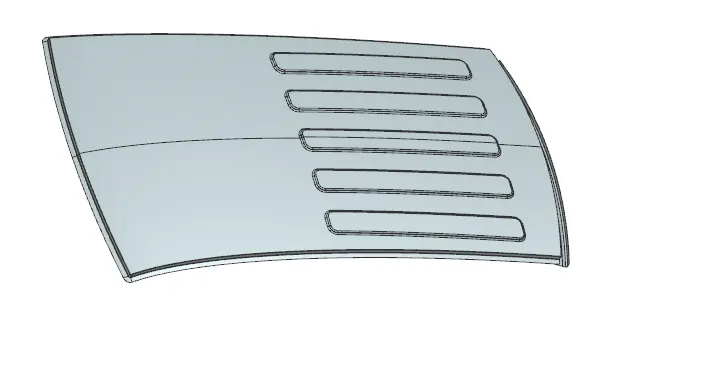
roof outer panel
FRONT RAIL
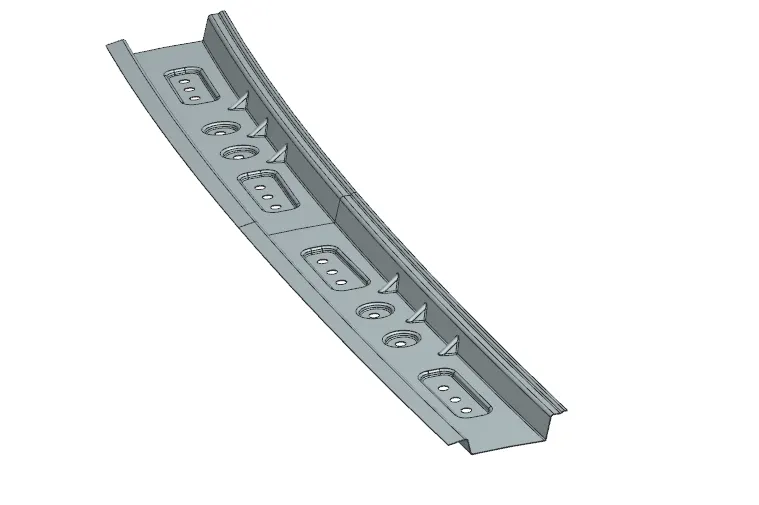
this part is connected with the windsheld glass roof of the car and the roof of the car . this part is also used to spot weld and mastic to stick with theb roof . the thickness of the sheet is 0.75mm and i thickened it inupwords direction.
REAR ROOF
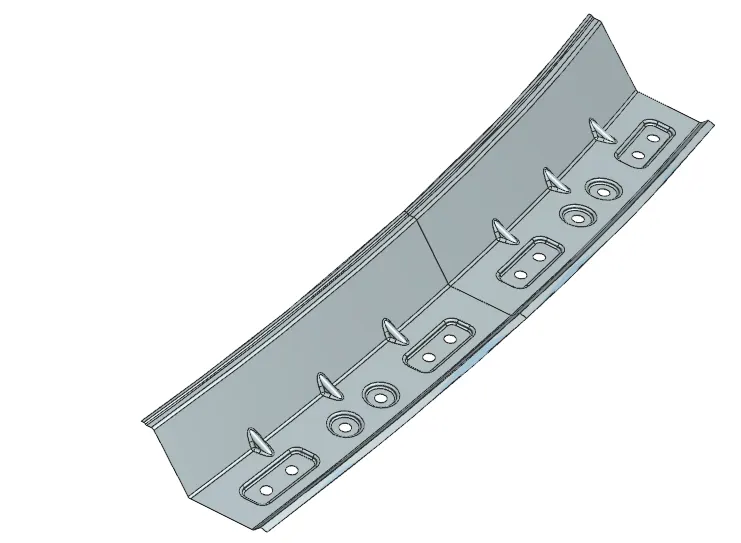
this rear rail is used to strengthen the part and the stability of the roof this support is connected to roof and back door. here i provided some emboss to strengthen the part and some darts are provided to the part. this part is also used to spot weld. the thickness of the sheet is 0.75mm and i thickened it inupwords direction.
BOW RAIL
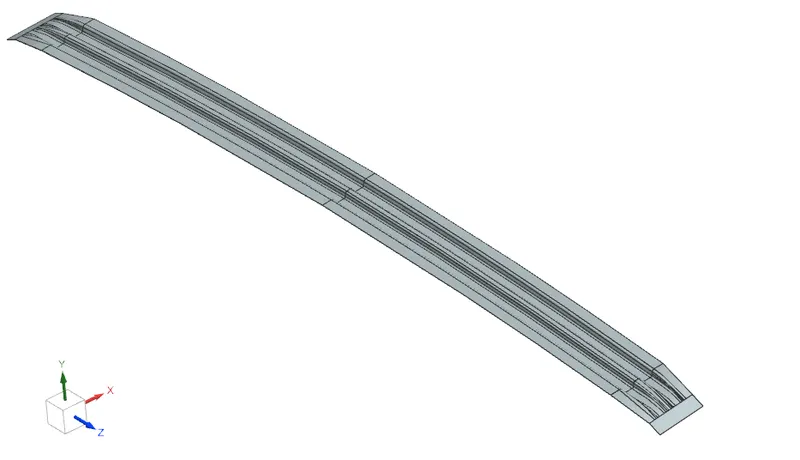
CENTER RAIL
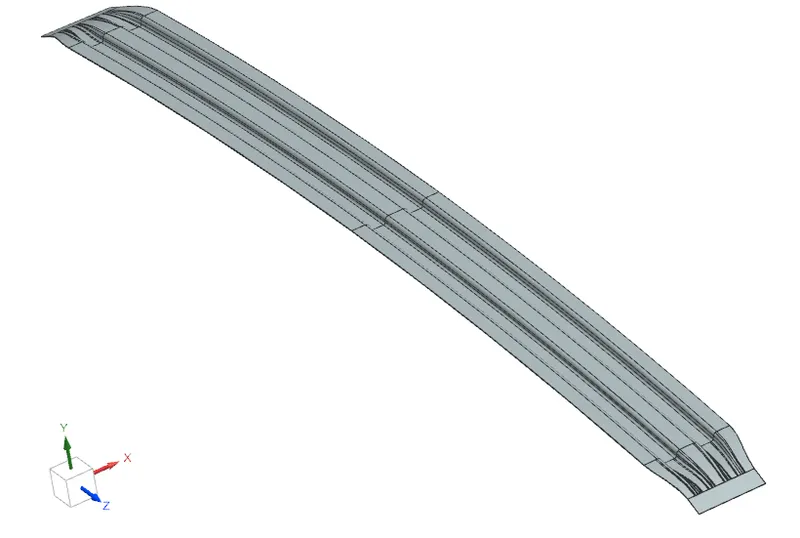
BOW RAIL 2
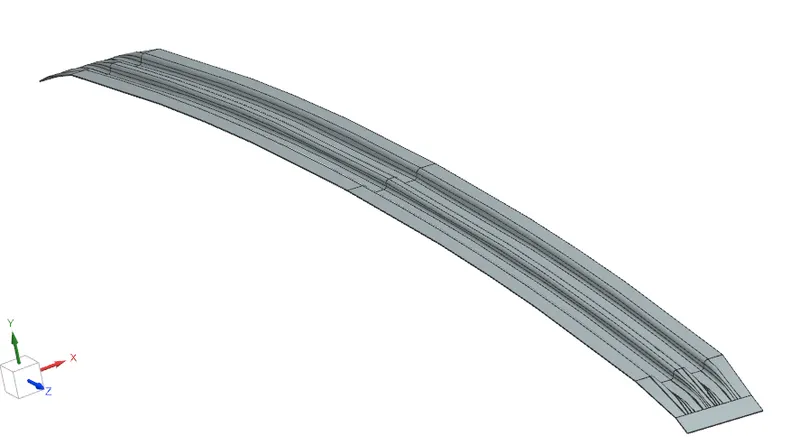
these are used to support and strengthening the roof from the curvature of the roof.
the above three parts are jointed with the spotweld at the ends and the in center they are sticked with mastic.
section modulus
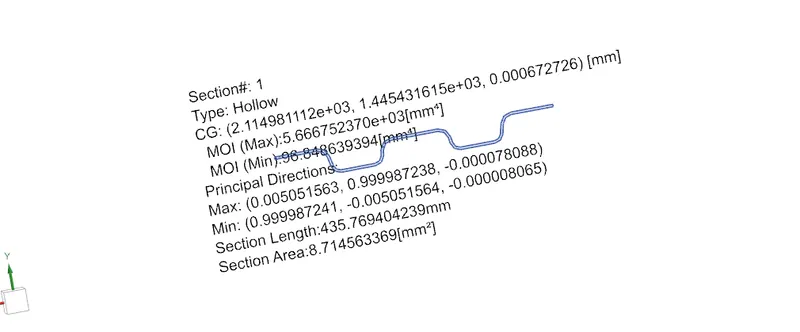
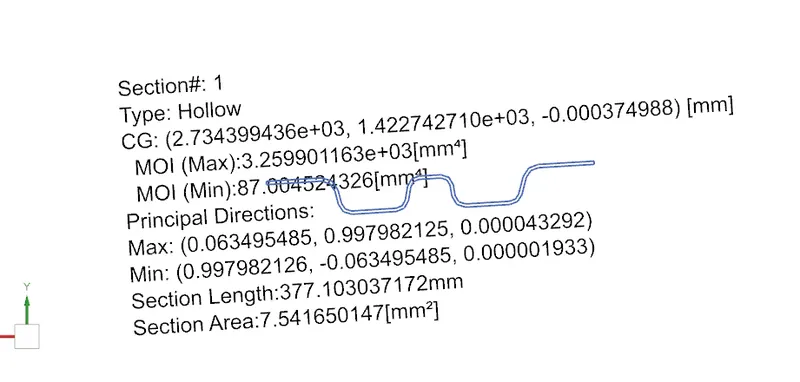
Section moment of inertia is used to predict the amount of deformation and deflection of a part. A higher moment of inertia is preferable as it reduces the amount of deflection for a given force. The thickness of the part and the addition of flanges and embosses increase the section inertia of the part. Here the master sections of the roof and roof rails and their section analysis are given.
BOW RAIL 1
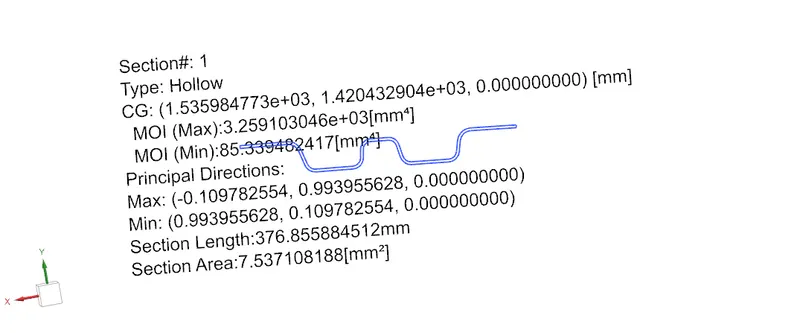
CENTER RAIL
BOW RAIL 2
CALCULATION
Heat distortion
the temperature at which the metal softens and deforms under a specific load. Roof of a car is probably the only component which is exposed to sun for almost all the time, so this study is done to check the ability of the roof to withstand high temperature with respect to the positioning of the reinforcements which contribute to increased strength.
Bow–Roof Prediction Formula
W = [1.73 x 10^(-3) x L] + [1.85 x 10^(-8) x (R^2)/t] + [ 1.10x10^(-3) x l] - 2.68
Where,
L = Roof Length in X-Direction[mm](Roof dimension in 0-Y)
R = Roof curvature
R = 2(Rx*Ry)/(Rx+Ry)
Rx = X curvature
Ry = Y curvature
t = Roof plate thickness [mm]
l = Bow Roof Span [mm]
ACCEPTANCE CONDITION :- OK< 2.7
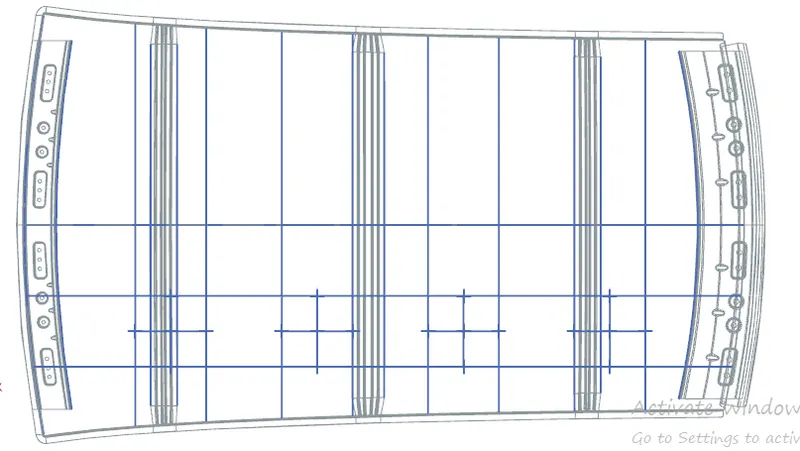
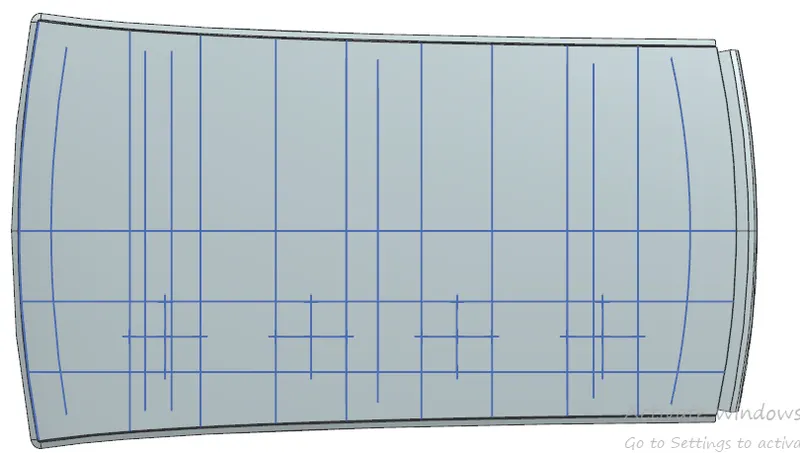

FROM THIS CALCULATION THE DESIGN FOR THE HEAT DISTORTION IS SAFE TO USE.
Snow load :- it is done to check the ability of the roof to withstand snowfall and bounce back to its original shape without any permanent deformation once the load is removed.
Snow Load Prediction Formula
Qr = [Iy x t2] / [α x s x [(Rx + Ry)/2]2 x 10-8]
Note: The Qr value given over here is correct. There was a typo error in the formula given in the video.
Where,
α = My x Lx2 x 10-12 , My = Y(Ly-Y)
t = Roof plate thickness [mm]
Ly = Distance between the front and rear roof Rails on the Vehicle along with 0Y[mm]
Length of Roof panel with the center point between Roof rail Front /Rear as the front and rear reference point.
Lx = Distance between the Left and Right end of the roof on the Roof BOW [mm]
The width of the roof panel is exposed on the surface.
Y = Distance front Front Roof Rail to Roof BOW[mm]
s = Distance for which Roof BOW bears divided load [mm]
s = L1/2 + L2/2
Iy = Geometrical moment of inertia of Roof BOW (Y cross-section )[mm4]
Rx = Lateral direction curvature radius of roof panel Y cross-section on Roof BOW [mm]
Roof panel curvature Radius of the Length Lx in Front view
Ry = Longitudinal Direction curvature radius of the Roof panel X cross-section on Roof BOW [mm]
Roof panel X curvature radius of length s in Side view
Judgment condition
Qr ≥ 3.1
250 ≤ s ≤ 380
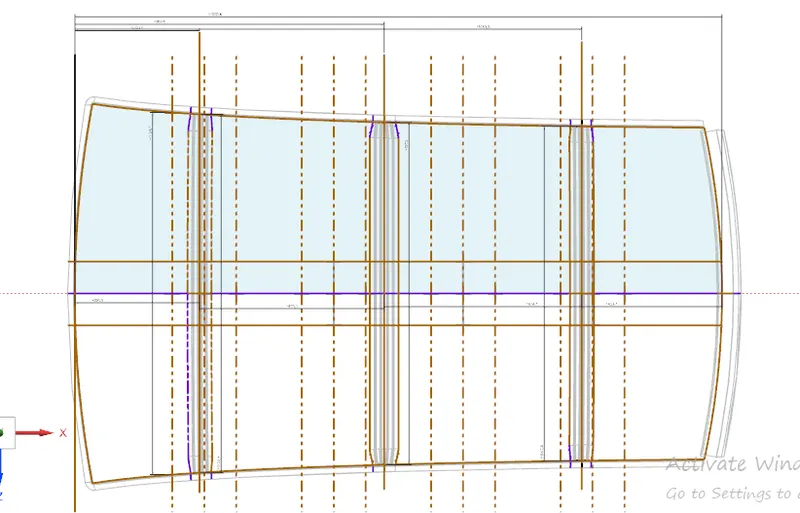
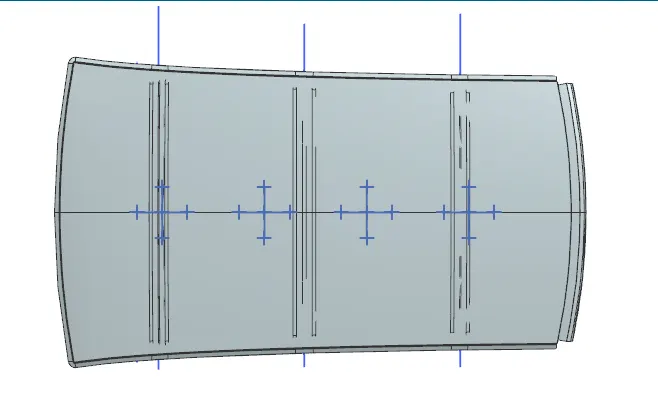

here we ca see that none of the valuses are satisfing the snow load condition
this is due to vert low moment of in (Iy) value
so i had provided the emboss to strengthen the roof.
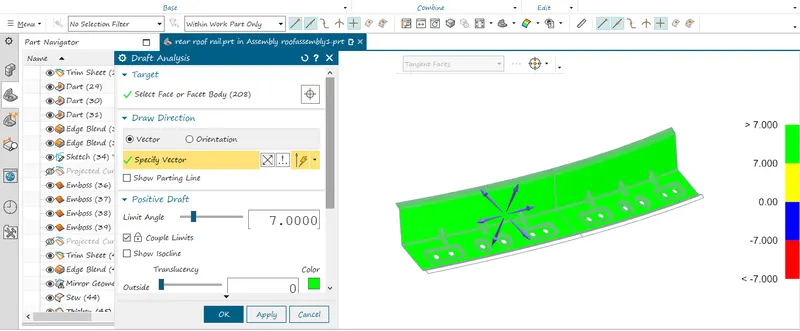
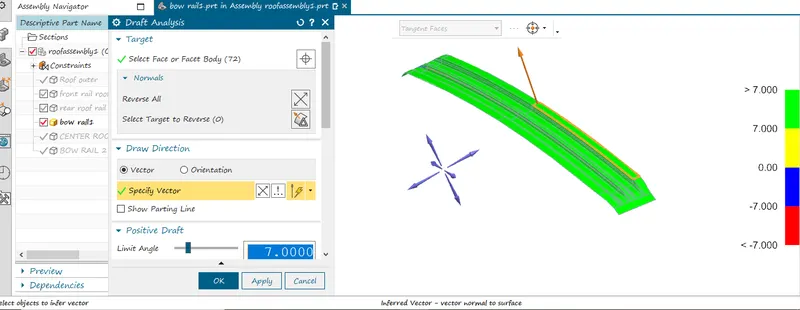
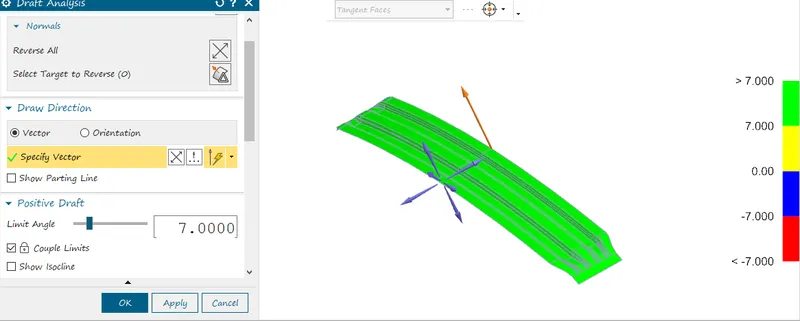
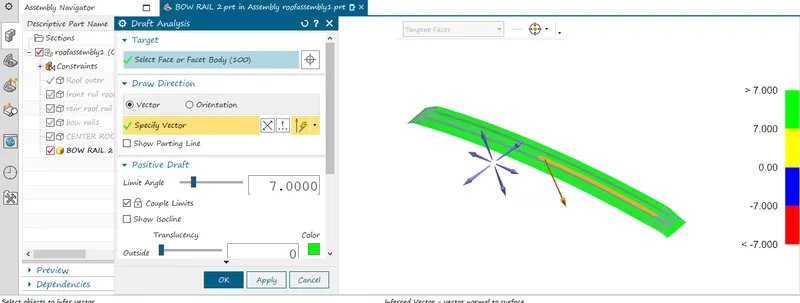
Draft Analysis ?
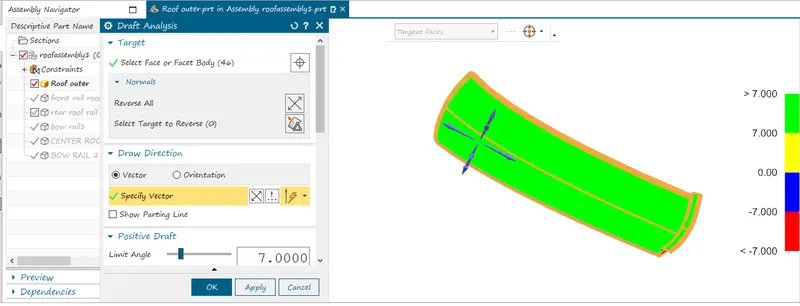
The Draft Analysis allows the user to easily analyze a part for proper draft angle. A Draft Angle describes the amount of taper for molded or cast parts perpendicular to the parting line.
Draft angles ?
Draft angles are very important in thermoforming product design. If the product is formed onto a female or negative mold, it shrinks away from the mold sidewalls. As a result, true female or negative products can be thermoformed with vertical walls having zero draft angles. If the product is formed onto a male or positive mold, it shrinks onto the mold sidewalls. A draft angle of 1–5 degrees is recommended for all male or positive products.
here we are taking minimum 7degree of draft angle because our die should not get damage and we should get a finish good product. In some area we cannot avoid negative draft. So bending operation is provided for the manufacturing process, because deep drawing cannot be done at the negative draft area.
ROOF OUTER
FRONT RAIL
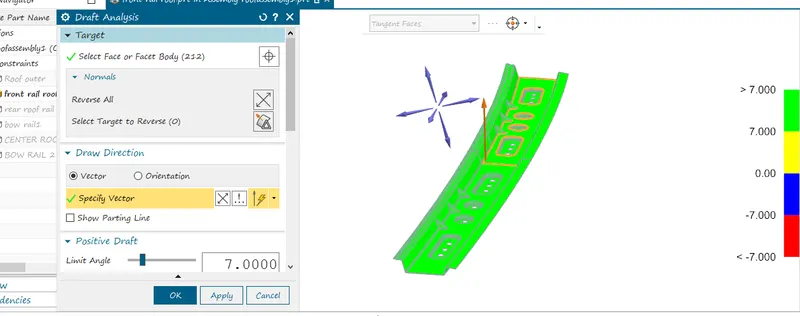
REAR ROOF
BOW RAIL 1
CENTER RAIL
BOW RAIL 2
manufacturing process of car roof involves Drawing and stamping process.
CONCLUSION :-
THE CAR ROOF IS DESIGNED AND THE CALCULATION OF HEAT DISTORTION AND SNOW LOAD IS ALSO DONE ,
UNDERSTAND THE CONCEPT OF CREATING THE ASSEMBLY FILE IN NX CAD .
REFRENCES:-
https://patents.google.com/patent/CN103692156A/en
THANK YOU