Roof challenge
Roof Challenge
Question:
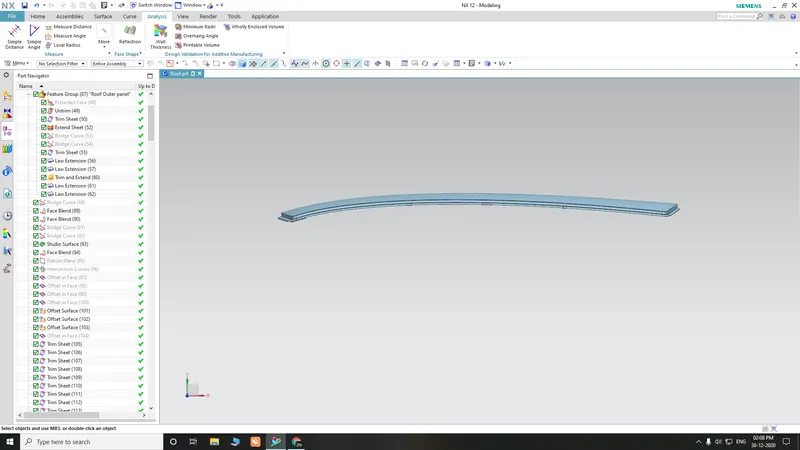
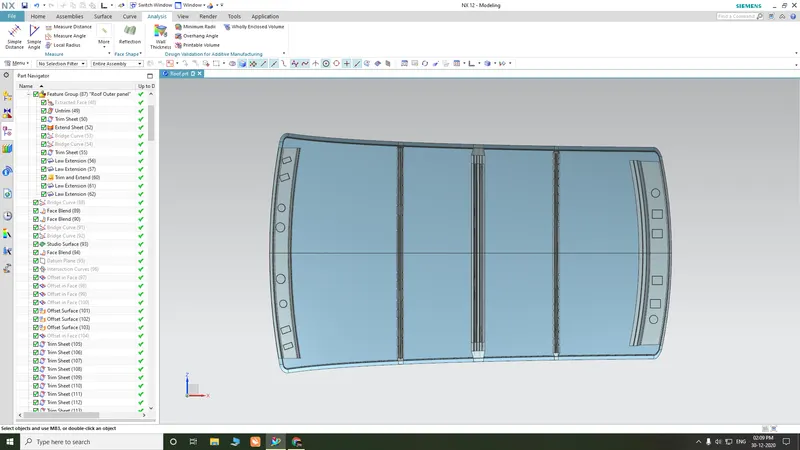
For the Given Roof styling, Develop the essential flanges and reinforcements, Provide appropriate dimension and check for Draft analysis and also submit your section modulus report on the 0-Y section.
Start with the creation of a roof ditch area the tool opening angle is only 3 degrees.
Do a curvature study on the roof and perform calculations to determine the position of the Bow-roof
Objective:
- To design the Automotive Roof based on the given styling surface and to analyze the prepared model to check the manufacturability and the feasibility of the design.
- To perform the section modulus study for the master sections and create for the Front roof rail, Rear roof rail, Bow roofs and center roof rail.
- To create the Ditch area and to perform the draft analysis.
ROOF:
An automobile roof or car top is the portion of an automobile that sits above the passenger compartment, protecting the vehicle occupants from sun, wind, rain, and other external elements.
The roof itself may be constructed of soft or rigid material. Soft-tops are made of vinyl, canvas or other textile material; hard-top convertibles have roofs made from steel, aluminium, plastic or carbon fibre composites.Your vehicle can also become ruined in an accident. Though a defect may seem insignificant at first, it can lead to serious consequences. Whether your roof was dented due to downfall or roughed up in a collision, it is urgently necessary to find a replacement for it. The roof panel is attached to the BIW of the car with the help of front and rear roof rail. This attachment is done with the help of sealants. Bow roofs 1 & 2 are attached depending upon the length of the roof along with the central roof rail. Longer the roof, more the number of roof rail. Other dimensions like strength and material is governed by the factors like head room, overall space, visibility, ergonomics and the rules and regulations of the states where it is sold.
DESIGN CONSIDERATIONS:
- Visibility criteria
- Head clearance
- Curvature study
- Heat Distortion and Snow load criteria
- Material thickness
Material Properties:
Density : 7890 kg/m3
Young's modulus : 210000Mpa
Poisson's ration : 0.3
Yield stress : 210 Mpa
Metal Roof Mass : 11.2kgs
Thickness : 0.75mm
Joining process : Metal roof with spotweld connections.
ASSEMBLY COMPONENTS OF ROOF:
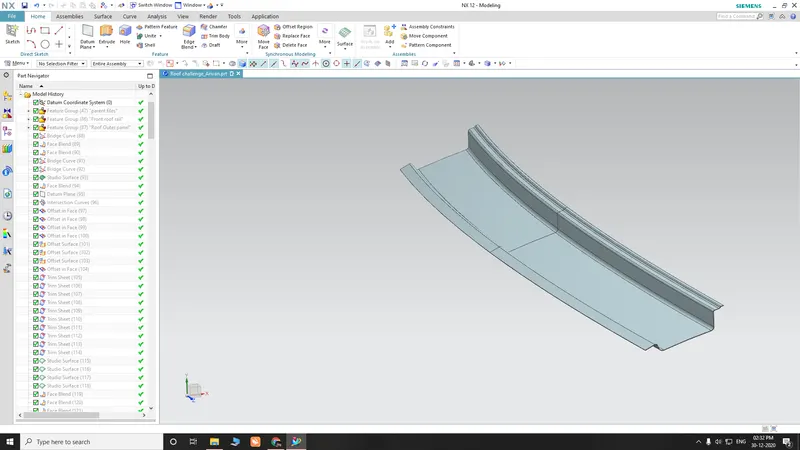
MASTER SECTION OF FRONT ROOF RAIL:
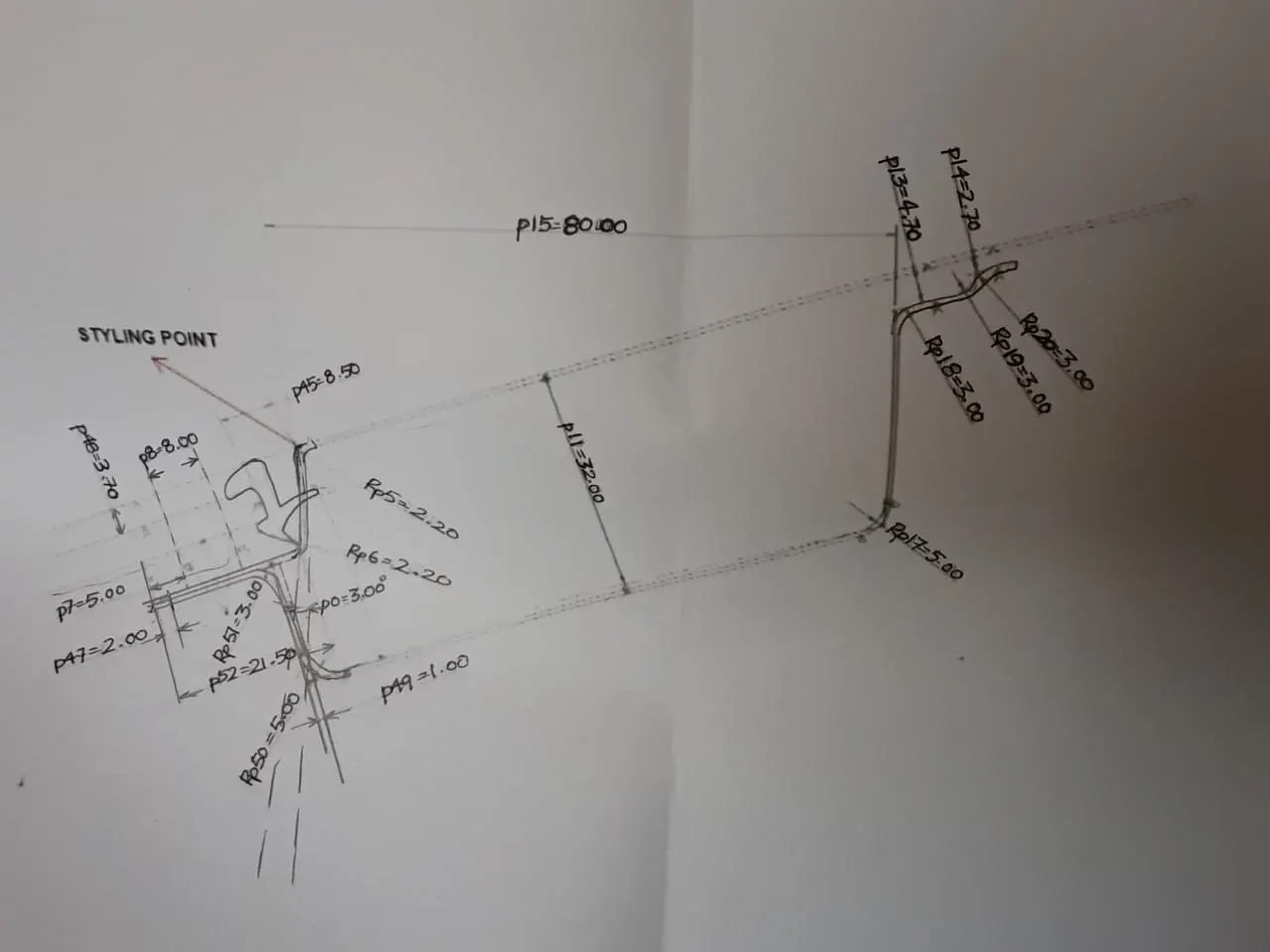
FRONT ROOF RAIL:
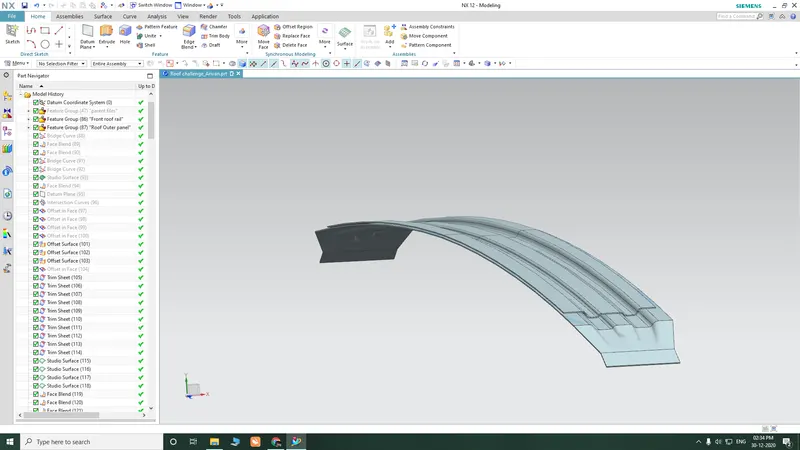
It is the support that is joined with the windshield glass, body side outer and inner panels. It is usually made from bodyside outer scrap and therefore the thickness of the rail is 0.75mm. A draft angle of 3-5 degree is provided for deep drawing operation. The visibility criteria and head room clearance of the passengers are taken into consideration for the bottom most flange. Windshield end and the roof end are spot welded and the other end of the front roof rail is joined with the roof using mastic sealants for increased strength.
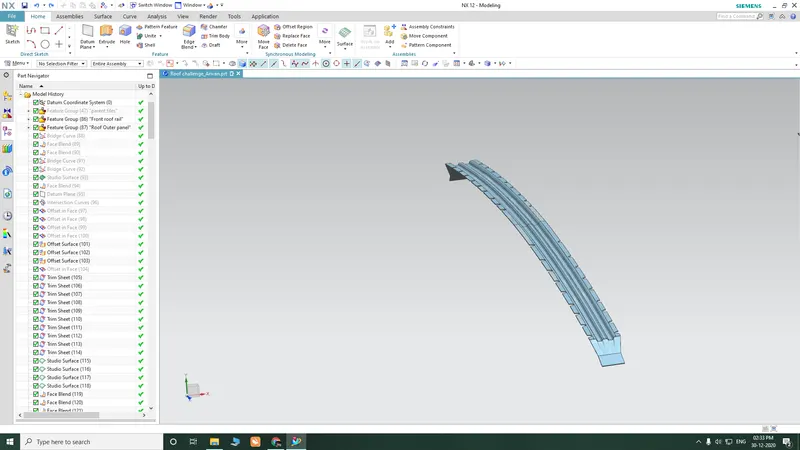
BOW ROOF 1: Bow roof center 1 is an additional stiffening member used in the roof assembly for the localised strength improvement and it is join directly to roof itself with several spot welding or even with mastic sealent.
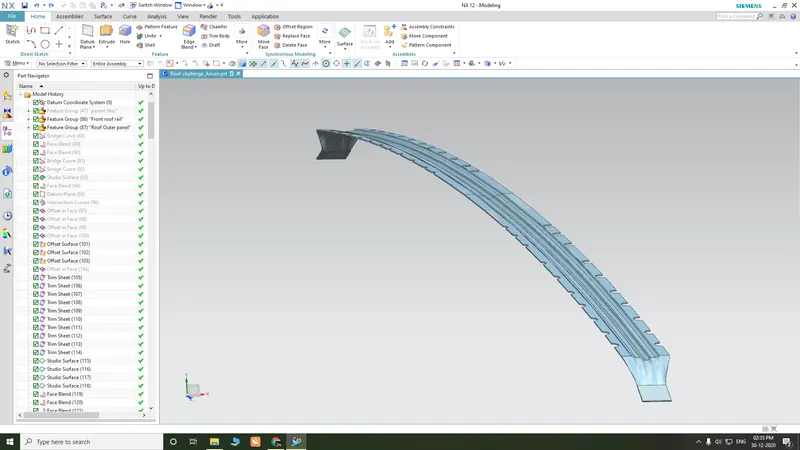
BOW ROOF 2: It is similar to that of bow roof 1 which serves the same purpose as the previous but with a limited extend and hence it is used with a smaller cross.
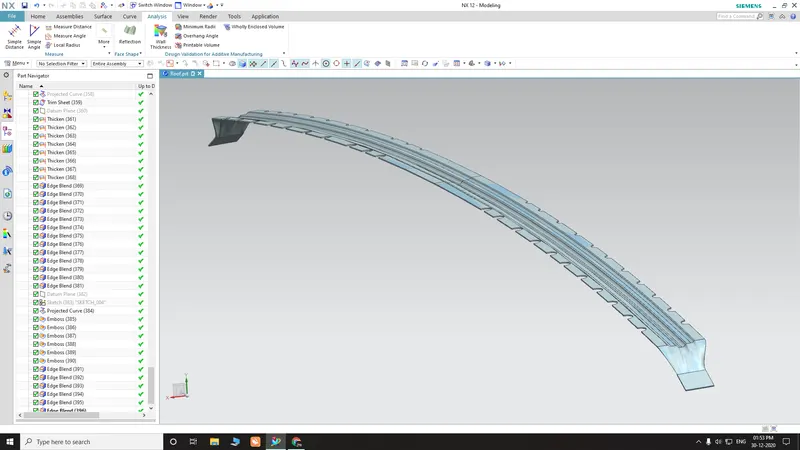
MASTIC POINTS:
Why Automotive uses MASTIC SEALANTS?
Engineers are constantly faced with the challenges of sealing assemblies against air, dust, noise, and making sure that these assemblies do not squeak and / or rattle.
Sealants are materials that are for one time use only. Meaning, the whole assembly is replaced or the particular area that needs to be sealed will not be taken apart and put back together as part of its requirements.
Prevents excessive absorption of adhesive or penetration of liquid or gaseous substances.
- Reduction of Direct Labor Costs
Reduction of Indirect Costs/Inventory Management
Reduction of Scrap Materials
Material Cost Reduction
Ease of Accommodation of Engineering Changes
CENTER ROOF RAIL: Center roof rail or reinforcement center is used as a cross member between bodyside left hand and right hand respectively. In some cases, the reinforcement center is not joined with the roof and in some other cases, it is made to join in both roof and bodyside. The reinforcement center and Bow roof are joined either spot weld or by mastic sealants.
REAR ROOF RAIL:
Back Door and the Rear Roof rail got attached here with the help of masting sealants.
I maintained 0.75 mm thickness for the rearof rail,Why because if we use more than 0.75 mm means there is increase in overall weight of the car leads to low performance,need more power,simply weight of the car increases.
This 0.75mm is the perfect and stardard thickness for the automotive sheet metal components.
Thickness for automotive sheetmetal components vary from 0.65 mm to 0.75 mm.
It is the support that is joined to the backdoor, the bodyside outer and the inner panels. Inputs from the backdoor design is also taken to accommodate the required clearance along with headroom clearance and rear visibility criteria while designing the rear roof rail. Spot welds are applied at the backdoor end of the rail and other end is joined with the roof.
I provided Some embosses for the extra strength for the front roof rail.We giving embosses for the strength to the component.
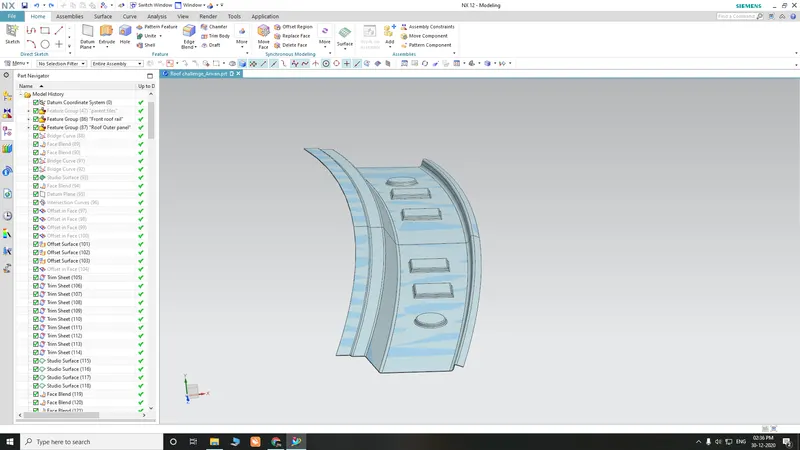
DITCH AREA: It is the extended portion of the main roof concealed by other BIW panels and not a styling surface. Headroom clearance, visibility criteria, clearance for windshield and back door are the some of the factors to be considered while designing the ditch area.
DRAFT ANALYSIS:
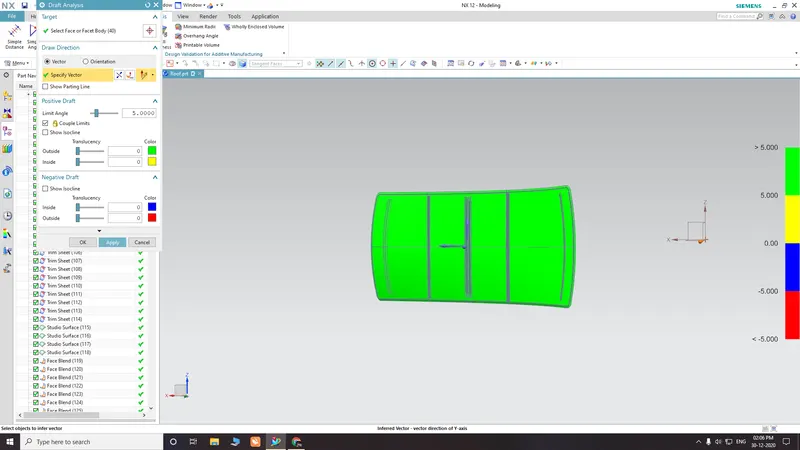
Draft analysis is a method of checking the draft angle on various faces of a part with a particular direction.
Draft Analysis command enables you to detect if the part you drafted will be easily removed. This type of analysis is performed based on color ranges identifying zones on the analyzed element where the deviation from the draft direction at any point, corresponds to specified values.
HEAT DISTORTION CURVATURE STUDY:
The heat distortion study plays an important role in sheet metal usage. Heat distortion temperature is a temperature limit above which the material cannot be used for structural applications. This study is used to predict the heat distortion temperature at where the material starts to soften when exposed to a fixed load at elevated temperature. In order to avoid bending or damages on roof, based on heat distortion temperature, this study will predict the bow roof position on the roof to strengthen the roof.
Curvature study on the roof:
Bow – roof prediction Formula is given as
W = 1.73x10^-3 x L+1.85x10^-8 x (R^2)/t + 1.10x10^-3 x l - 2.68
Where
L = Roof Length in X – Direction (mm) (Roof dimension in o-Y)
R = Roof curvature
R = 2(Rx * Ry) / (Rx + Ry)
Rx = X curvature
Ry = Y curvature
t = Roof plate thickness (mm)
l = Bow Roof Span (mm)
Judgement condition: ok < 2.7mm < NG
|
S.No |
Positions |
Rx |
Ry |
R |
l (mm) |
L (mm) |
t (mm) |
R^2/t |
W |
OK/NG |
|
1 |
FRR & BR1 |
3566.25mm | 3997.85mm | 3769.73mm | 380mm | 2065.14mm | 0.75mm | 27316039 | 1.19 |
OK |
|
2 |
BW1 & CRR |
4186.16mm | 4569.40mm | 4369.42mm | 330mm | 2065.14mm | 0.75 | 25455774 | 1.65 |
OK |
|
3 |
CRR & BR2 |
3987.72mm | 3790.30mm | 3886.50mm | 351mm | 2065.14mm | 0.75 | 20139843 | 1.95 |
OK |
|
4 |
BR2 & RRF |
3397.52mm | 3182.42mm | 3286.45mm | 359mm | 2065.14mm | 0.75 | 14401004 | 1.84 |
OK |
For considering above calculations our design is safe according to heat distortion criteria for Bow Roof
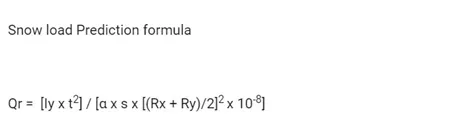
SNOW LOAD CRITERIA:
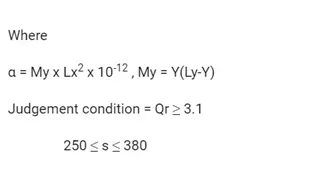
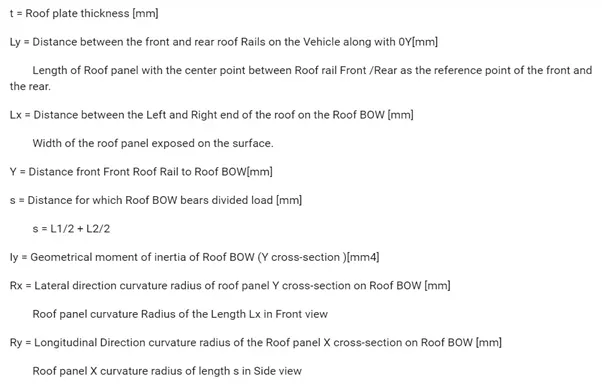
|
Snowed Criteria |
||||||||||||||
|
S.No. |
Component |
Iy |
α |
Lx | Ly |
Y |
s |
Rx | Ry |
t |
L1 | L2 | Qr |
OK/NG |
|
1 |
FRR-BR1 |
637.5 |
0.96 |
1079.92 |
2065.14 |
545.23 |
501.5 |
4468.67 |
2867.31 |
0.75 |
600.42 |
402.58 |
5.536 |
OK |
|
2 |
BR1-CRR |
414.5 |
0.69 |
1081.24 |
2065.14 |
348.82 |
399.59 |
7057.06 |
4486.20 |
0.75 |
402.58 |
396.65 |
2.538 |
NG |
|
3 |
CRR-BR2 |
405.5 |
0.60 |
1002.73 |
2065.14 |
348.45 |
461.7 |
10840.27 |
4246.19 |
0.75 |
396.65 |
526.9 |
1.44 |
NG |
|
4 |
BR2-RRR |
0.78 |
1079.55 |
2065.14 |
409.18 |
263.45 |
15686.79 |
4364.78 |
0.75 |
526.9 |
||||
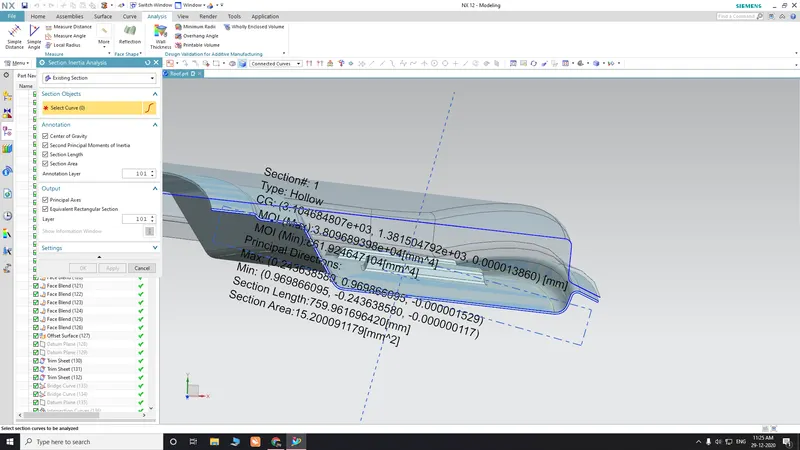
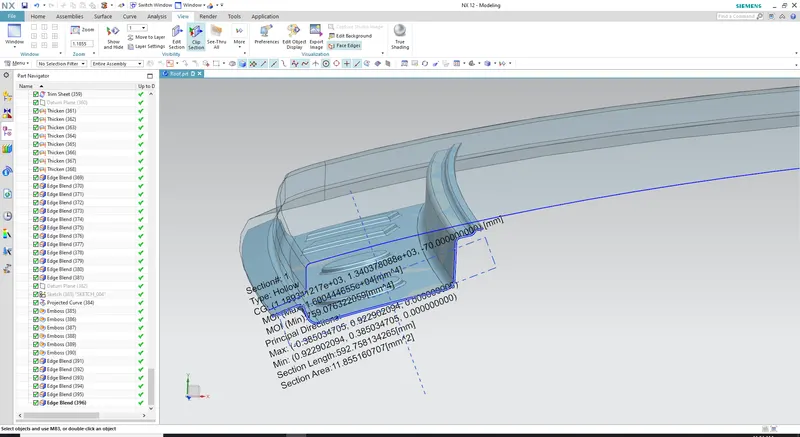
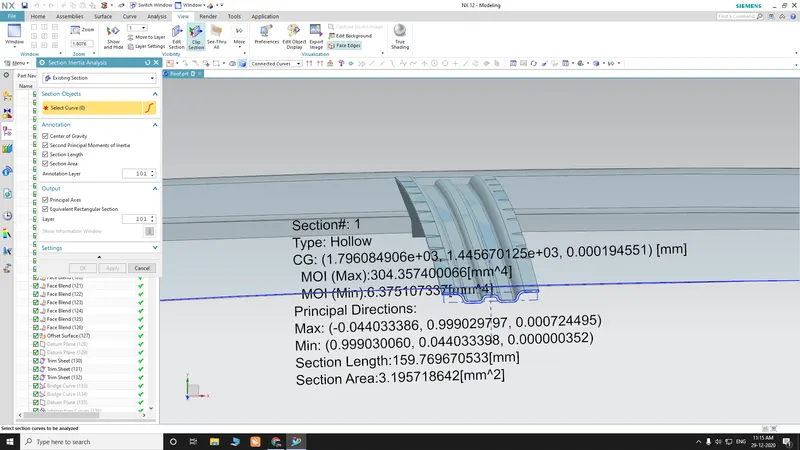
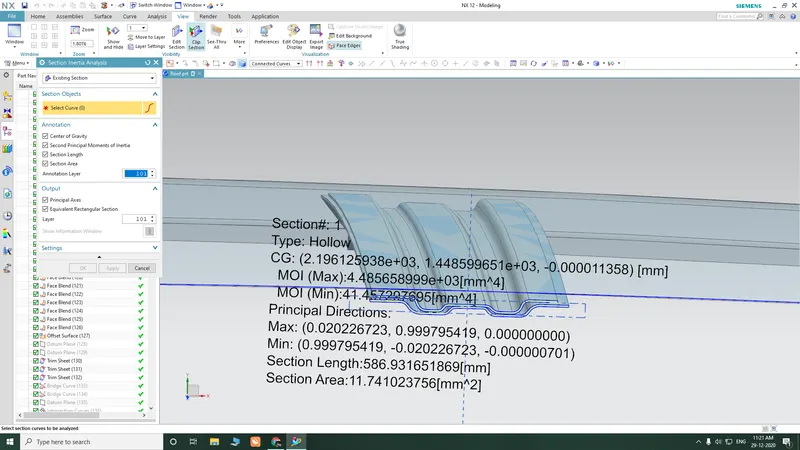
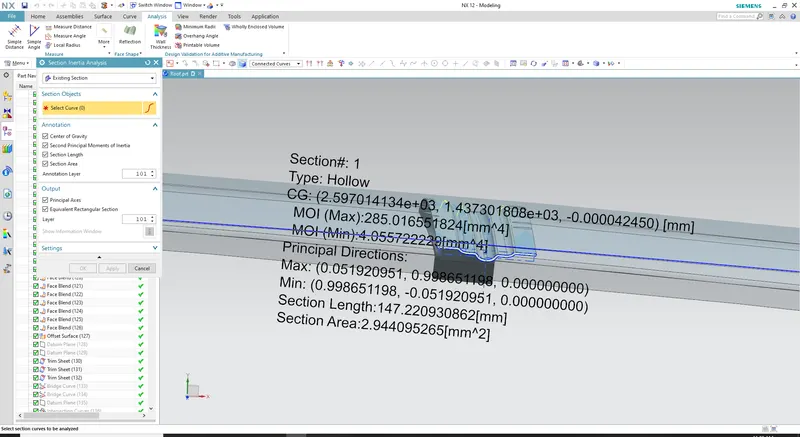
Moment of Inertia (Iy):
FRONT ROOF RAIL :
BOW ROOF 1 :
CENTER ROOF RAIL :
BOW ROOF 2 :
REAR ROOF RAIL :