Roof challenge
CAR ROOF
An automobile roof or car top is the portion that is placed above the passenger compartment useful to protect vehicle passengers from sun, wind, rain and other external elements. This roof is attached to front and back rail. There are several types of roof modules depending upon the car variant and is supplied to satisfy customer needs. Therefore, roof is a critical element and hence needs to be tough to protect the passenger during crashing.
In support to the above statement, roof reinforcements have been added to give the roof structure more strength in all weather condition at different places and also during accidents.
In this design, there are three bow roofs, one reinforcement center, a front roof rail and a rear roof rail and analysis is made to study their impact towards strength.
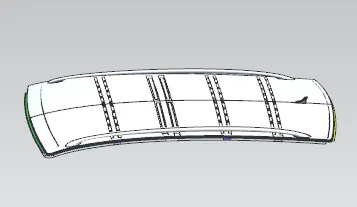
Figure 1: Final roof design with all the roof reinforcements
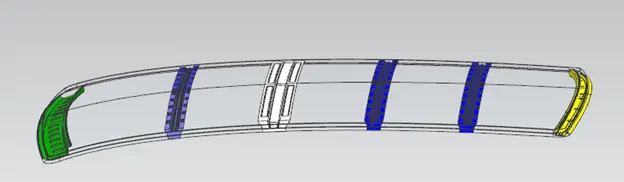
Figure 2: Placement of the roof reinforcements
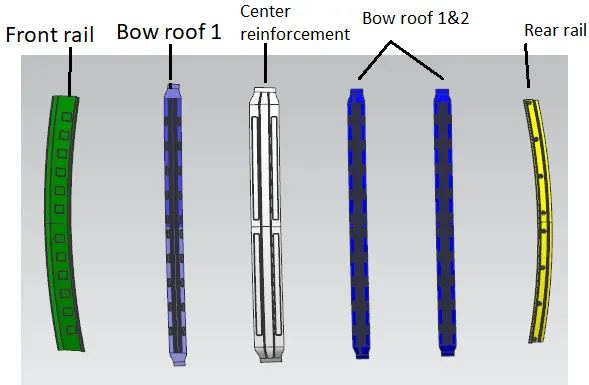
Figure 3: Different types of roof reinforcements
The roof reinforcements are embossed to have added strength and facilitate good bonding for masting the inner and outer roofs.
Section modulus of feature sections:
Front roof rail:
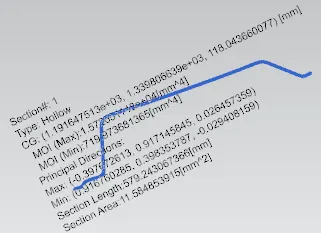
Bow roof:
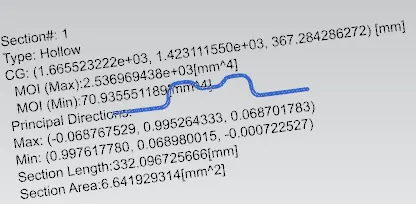
Reinforcement center:
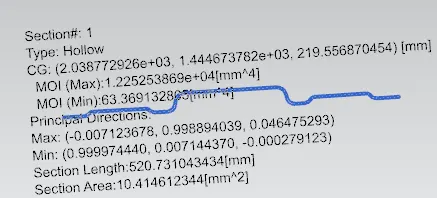
Rear roof rail:
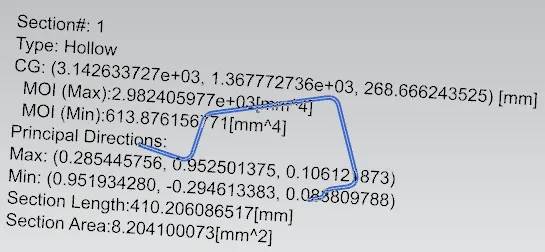
Roof analysis
The roof is tested for two different load conditions in order to pass the crash test. It is given as follows:
Heat distortion formula
W = [1.73 x 10^(-3) x L] + [1.85 x 10^(-8) x (R^2)/t] + [ 1.10x10^(-3) x l] - 2.68
Judgement Condition : OK< 2.7> 3.1
Where
L = Roof Length in X-Direction[mm](Roof dimension in 0-Y)
R = Roof curvature
R = 2(Rx*Ry)/(Rx+Ry)
Rx = X curvature
Ry = Y curvature
t = Roof plate thickness [mm]
l = Bow Roof Span [mm]
Y-curvature
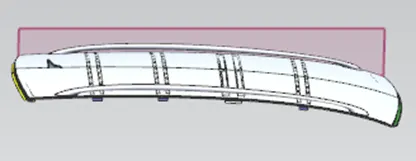
X-curvature
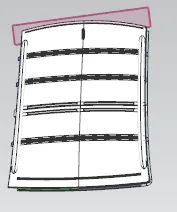
Now finding the Rx and Ry distances and Lx and Ly will help to determine the snow load using the governing formula
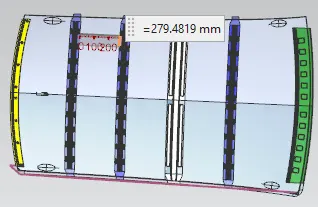
Same way, steps are repeated, and the values are tabulated as shown below:
|
S.No |
Roof |
Rx |
Ry |
I |
L |
T |
R2 / t |
W |
Status |
|
1 |
Fr to 1st |
5768.25 |
2456.68 |
348.61 |
2110 |
0.75 |
178956415 |
1.986524 |
PASS |
|
2 |
1st to CTR |
4896.61 |
6658.78 |
403.47 |
2110 |
0.75 |
456236897 |
1.564521 |
PASS |
|
3 |
CTR to 2nd |
4125.741 |
10965.21 |
396.59 |
2110 |
0.75 |
498657824 |
2.36984 |
PASS |
|
4 |
2nd to 3rd |
3896.77 |
5421.21 |
329.2 |
2110 |
0.75 |
396589541 |
1.1214 |
PASS |
|
5 |
3rd to RR |
3474 |
368 |
2110 |
0.75 |
439965112 |
2.0214 |
PASS |
Qr judgement for heat distortion is less than 2.9 and since, all the values obtained in the above satisfy the criteria, this roof design will pass the heat distortion criteria.
Snow load condition:
Snow load condition curve is developed on the roof curve and analysis is done based on the pitch distance between the predicted sections.
Snow load criteria governing equation is as follows:
Qr = [Iy x t2] / [α x s x [(Rx + Ry)/2]2 x 10-8]
Where
α = My x Lx2 x 10-12 , My = Y(Ly-Y)
Judgement condition = Qr ≥ 3.1
250 ≤ s ≤ 380
t = Roof plate thickness [mm]
Ly = Distance between the front and rear roof Rails on the Vehicle along with 0Y[mm]
Length of Roof panel with the center point between Roof rail Front /Rear as the reference point of the front and the rear.
Lx = Distance between the Left and Right end of the roof on the Roof BOW [mm]
Width of the roof panel exposed on the surface.
Y = Distance front Front Roof Rail to Roof BOW[mm]
s = Distance for which Roof BOW bears divided load [mm]
s = L1/2 + L2/2
Iy = Geometrical moment of inertia of Roof BOW (Y cross-section )[mm4]
Rx = Lateral direction curvature radius of roof panel Y cross-section on Roof BOW [mm]
Roof panel curvature Radius of the Length Lx in Front view
Ry = Longitudinal Direction curvature radius of the Roof panel X cross-section on Roof BOW [mm]
Roof panel X curvature radius of length ‘s’ in Sideview
Based on the values of Rx, Ry,t and Ly values recorded above, substitute the same in snow load formula and corresponding table obtained is as below:
|
S.No |
Roof |
Iy |
T |
Y |
Ly |
My |
Lx |
Alpha |
L1 |
L2 |
S |
Rx |
Ry |
Qr |
status |
|
1 |
Fr to 1st |
7856.03 |
0.75 |
468.35 |
2110 |
79516.45 |
1189.23 |
1.1024564 |
259.03 |
488.36 |
375.24 |
5768.25 |
2456.68 |
64.25687 |
PASS |
|
2 |
1st to CTR |
2563.21 |
0.75 |
529.23 |
2110 |
8956142 |
1154.78 |
1.15689 |
498.26 |
531 |
601 |
4896.61 |
6658.78 |
7.89 |
PASS |
|
3 |
CTR to 2nd |
3589.47 |
0.75 |
489.24 |
2110 |
7789652.4 |
1136.13 |
0.9854 |
521.478 |
283 |
401.24 |
4125.741 |
10965.21 |
21.254 |
PASS |
|
4 |
2nd to 3rd |
1856.254 |
0.75 |
456.23 |
2110 |
7456214.01 |
1014.54 |
0.856 |
221.14 |
456.22 |
354.21 |
3896.77 |
5421.21 |
9.541 |
PASS |
|
5 |
3rd to RR |
1921.28 |
0.75 |
512.21 |
2110 |
8432174.24 |
115 |
1.012 |
3474 |
NA |
PASS |
Qr judgement for snow load is 3.1 and as all the obtained values above are greater than the required value, this roof design will pass the criteria.
Conclusion
The roof is designed such that it impacts strength at a greater rate and satisfy all the load conditions i.e. snow load and heat distortion criteria. Therefore, this roof design is suitable for next step and also can be further analyzed for various orientations of the roof reinforcements.