Roof challenge
ROOF DESIGN
AIM
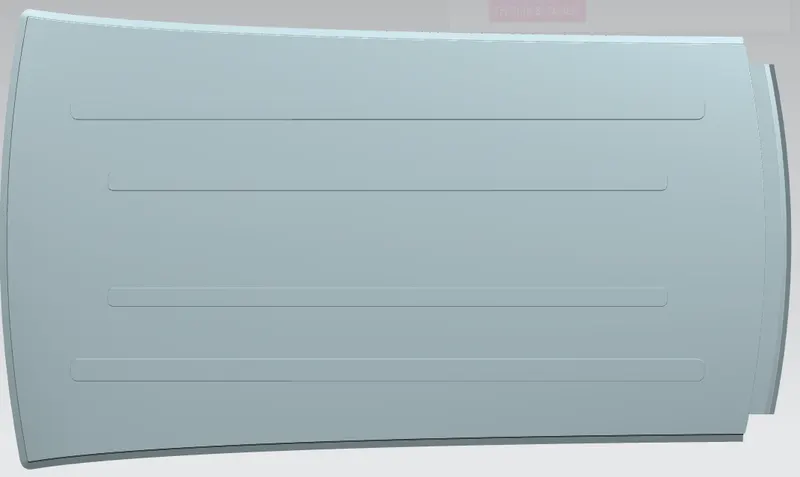
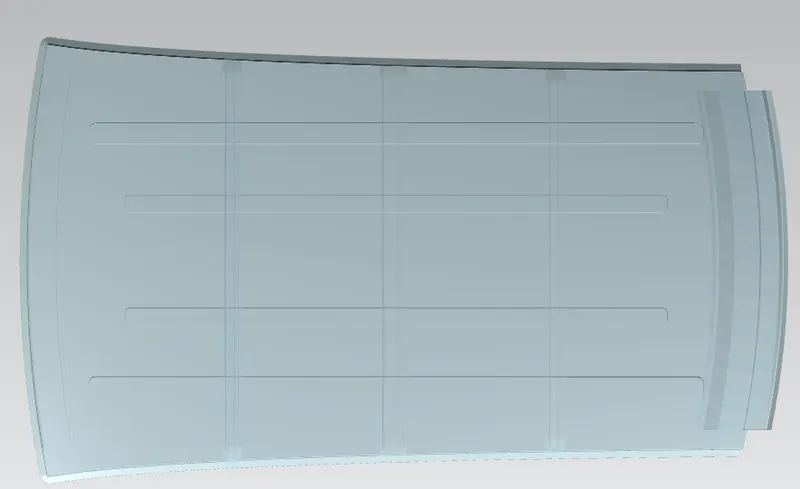
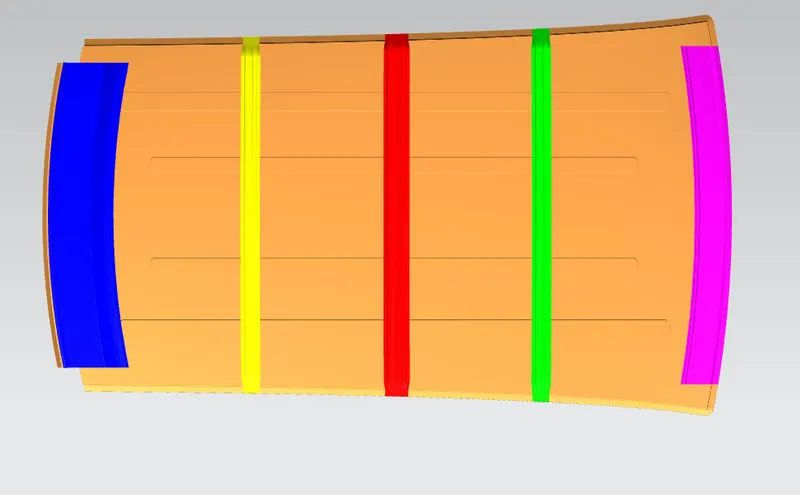
The aim of this challenge is to create all the components of the roof and test the design conditions from the given skin data of the outer panel and the master sketch.
THEORY
An automobile roof is a BIW component and portion of an automobile that sits above the passenger compartment, protecting the vehicle occupants from sun, wind, rain, and other external elements. Though it just looks like a styling surface that protects from sun, wind, and other elements, various environmental conditions are taken into account for designing the same. The roof should be provided with proper reinforcements for strengthening. Vehicle roofs can be subjected to high heat conditions or load during snowy conditions. To make the roof withstand these conditions, various calculations are done. This ensures the safety of the passengers in the vehicle.
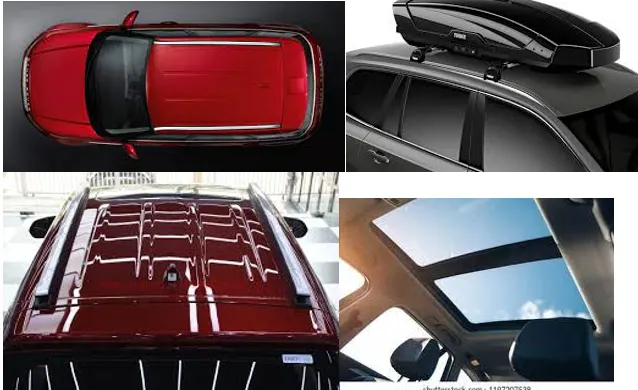
In some cars, a roof is also used to place the luggage. There are many types of roofs present in today’s market with a different type of cars coming in for different purposes. Some of the common roofs are as follows:
- Sun Roofs
- Moon Roofs
- Panoramic Roofs
- Convertible Roofs
- Hardtops
- Vinyl Roofs
DESIGN CONSIDERATIONS
- Visibility criteria
- Crashworthiness of Roof
This is a test done on the roof to find the strength-to-weight ratio (SWR) and rate the given car roof. Roof strength evaluations are conducted on a quasi-static test system manufactured by MGA Research Corporation. Once the vehicle is positioned correctly, the roof is crushed to a minimum displacement of 127 mm at a nominal rate of 5 mm/second. The maximum force prior to 127 mm of platen displacement is divided by the measured curb weight to obtain the SWR.
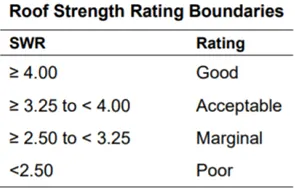
- Head clearance
- Curvature study
- Hear distortion and snow load criteria
Generally, bodies tend to deform when subjected to change in temperature. So, when we design a roof we need to make sure that the roof is able to withstand the extreme climatic changes. Heat distortion criteria tell us if the roof is passing this test or not.
During extreme snow conditions, the roof tends to bend or deform with a heavy application of the snow load. So, when the load due to the snow is removed the roof should go back to its original shape. To check this condition snow load criteria are used to validate the roof.
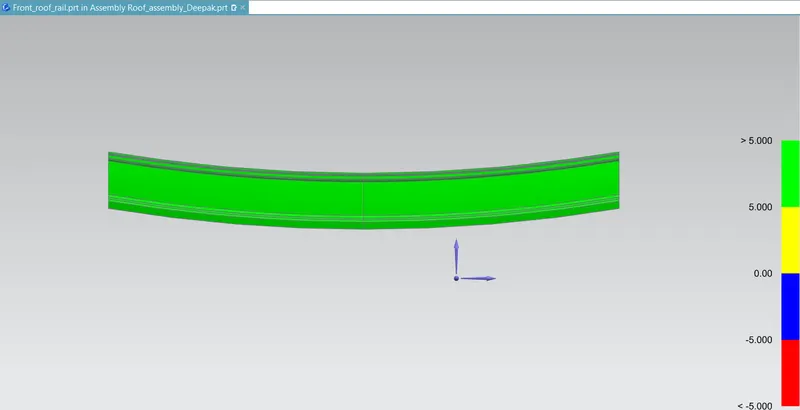
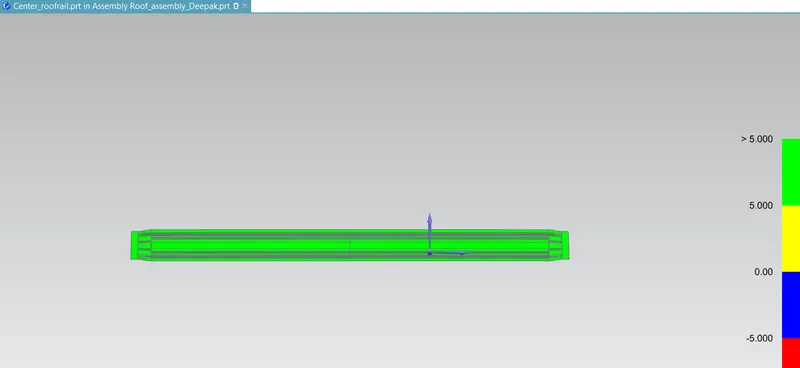
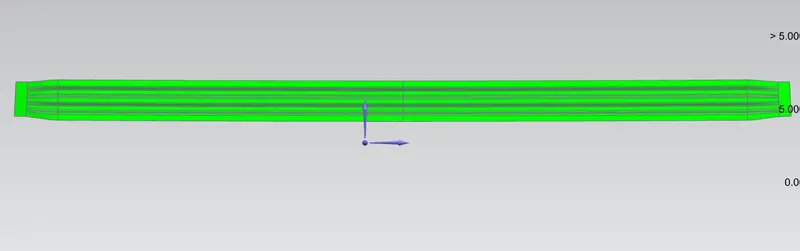
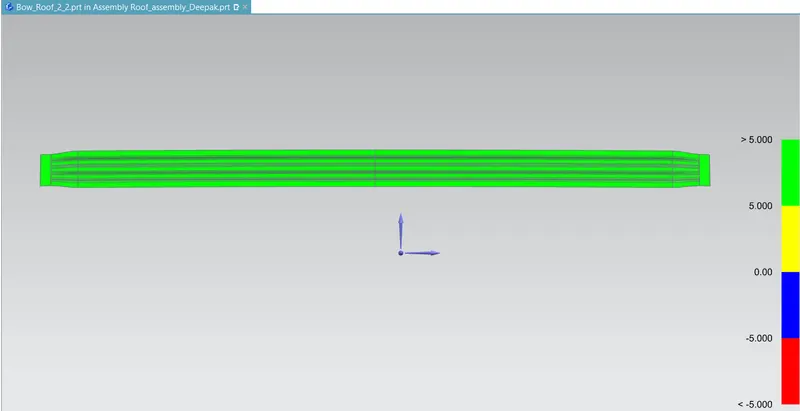
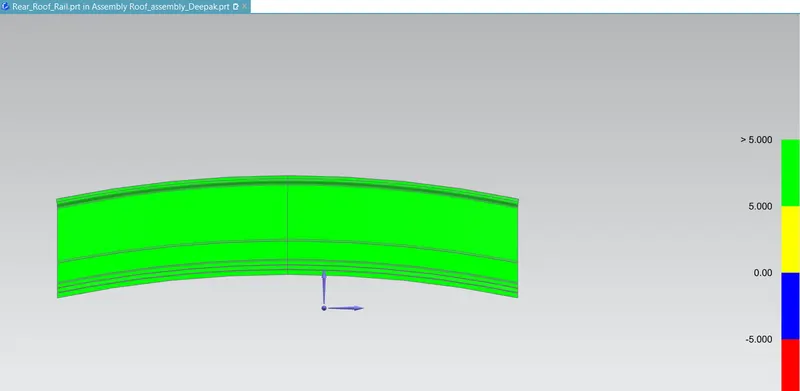
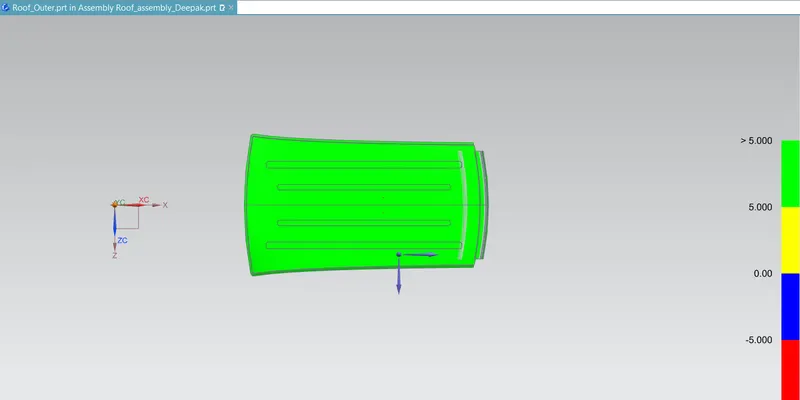
- Draft analysis.
Draft analysis needs to be done for the part after all the design is completed to know whether the part is producible by deep drawing. There should always be a positive draft for the part to be producible. For sheet metal, the draft angle is taken as 7 degrees and sometimes around 5 degrees is also accepted.
ELIGIBILITY CRITERIA
- For Heat Distortion
Bow-Roof prediction formula:
W= [1.73 x 10^(-3) x L] + [1.85 x 10^(-8) x (R^2)/t] + [1.10 x 10^(-3) x l] – 2.68
Where, L = Roof length in x-direction (0-Y)
Roof Curvature, R = 2 x (Rx.Ry)/[Rx + Ry]
t= Roof plate thickness
l = Bow roof span
Judgment condition: W< 2.7
MEASURING L
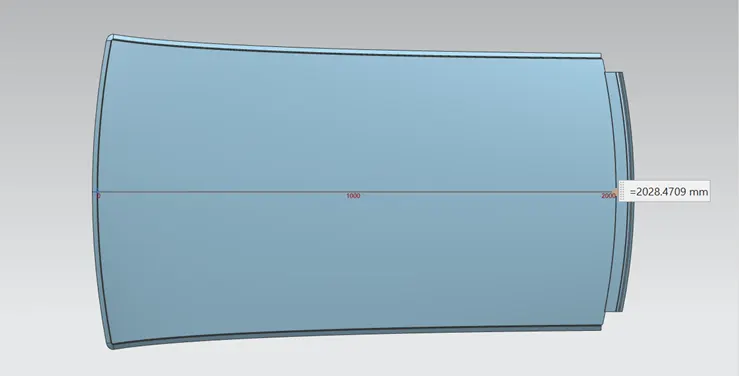
MEASURING Rx
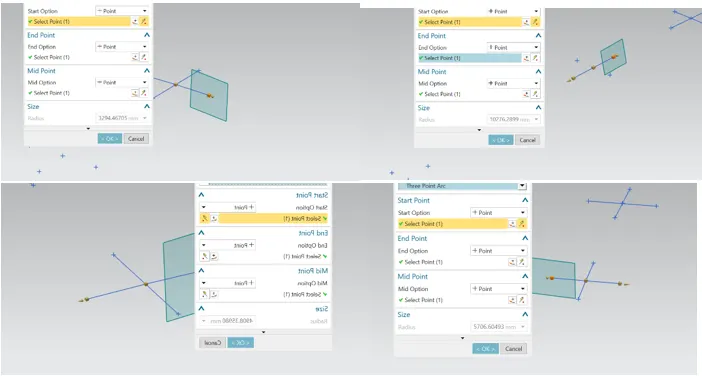
MEASURING Ry
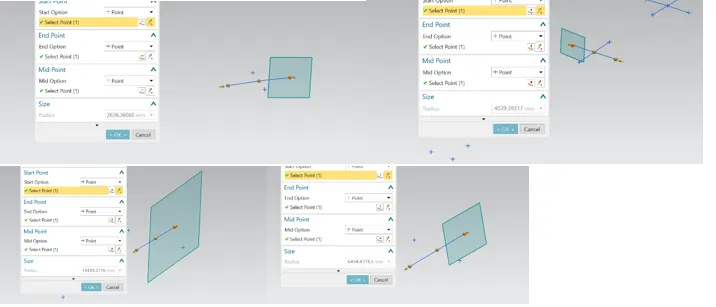
MEASURING l
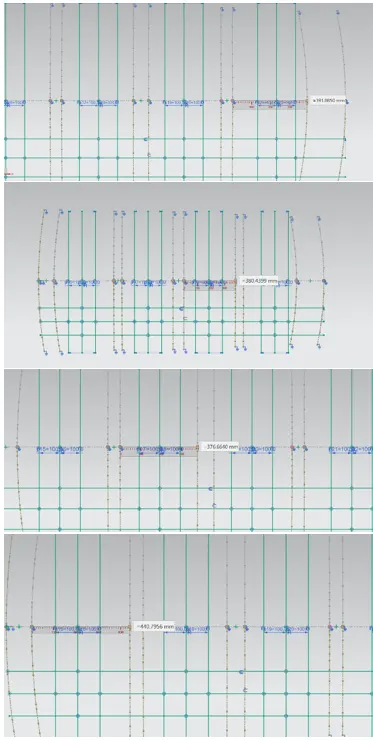
TABLE
|
S.No |
BOW |
Rx |
Ry |
R |
l |
L |
t |
R2/t |
W |
OK/NG |
|
1 |
FR&1st |
5706.60 |
2636.36 |
3606.55 |
440.80 |
2028.4709 |
0.75 |
17342937.2 |
1.63 |
ok |
|
2 |
1st&CTR |
4908.36 |
6454.43 |
5576.213 |
376.66 |
2028.4709 |
0.75 |
41458868.56 |
2.01 |
ok |
|
3 |
CTR&2nd |
1026.39 |
4039.40 |
1636.862 |
380.44 |
2028.4709 |
0.75 |
3572422.94 |
1.31 |
ok |
|
4 |
2nd&RR |
3294.47 |
14494.31 |
5368.673 |
391 |
2028.4709 |
0.75 |
38430199.70 |
1.97 |
ok |
Since heat distortion criteria satisfied all the components no changes would be required. But creating embosses on front and rear roof rails increases strength for the respective components.
For Snowed Criteria
Snow load prediction formula
Qr = [Iy x (t ^ 2)]/ [α x s x {([Rx+Ry]/2)^2} x (10^8)]
α= My x Lx^2 x 10^(-12) My= Y(Ly –Y)
t= Roof plate thickness
Ly= Distance between the front and the rear roof rails on the vehicle along 0Y
Lx= Distance between the left and right end of the roof on the BOW
Y= Distance between front roof rail to Roof Bow
S= Distance for which Roof BOW bears the divided load
S= (L1+L2)/2
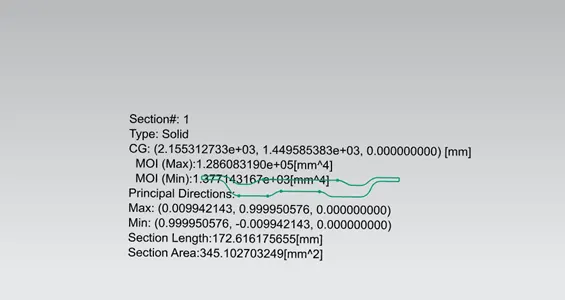
Iy= Geometrical Moment of inertia of Roof Bow
Rx= Roof panel curvature radius of the length Lx in Front view
Ry= Roof panel curvature radius of the length s inside view
Judgment condition: Qr>= 3.1
MEASURING Lx
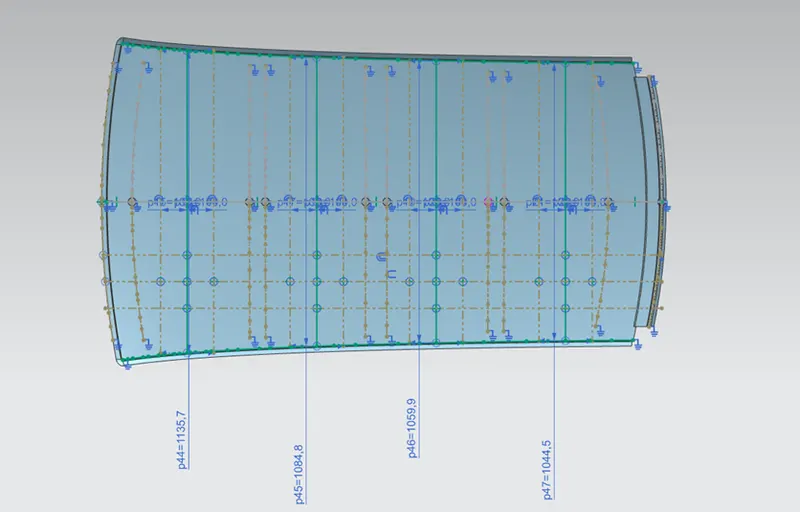
MEASURING Ly
Ly in this case is the same as L in Heat distortion i.e, Ly=L= 2028.4709mm
MEASURING y
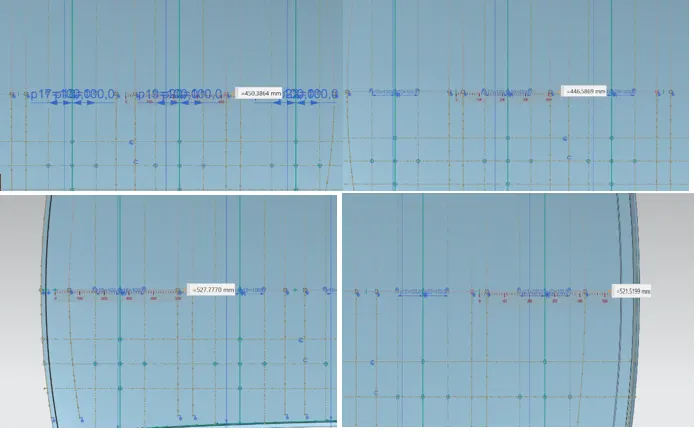
MEASURING Rx
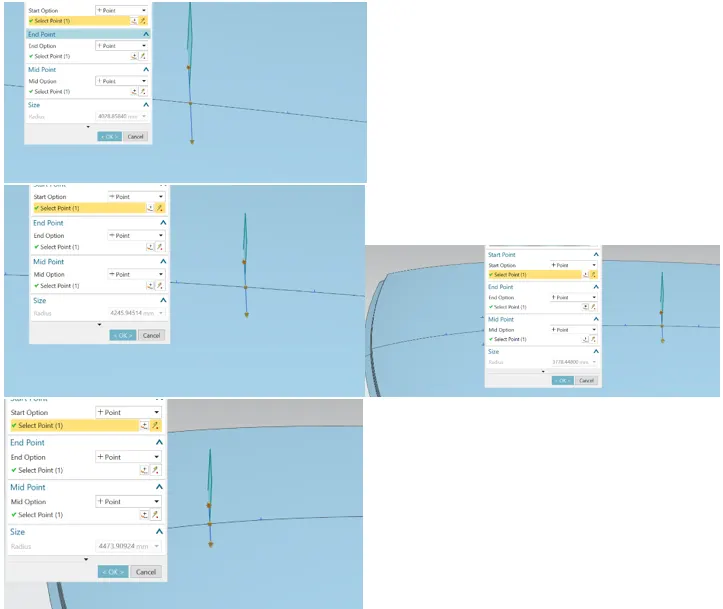
MEASURING Ry
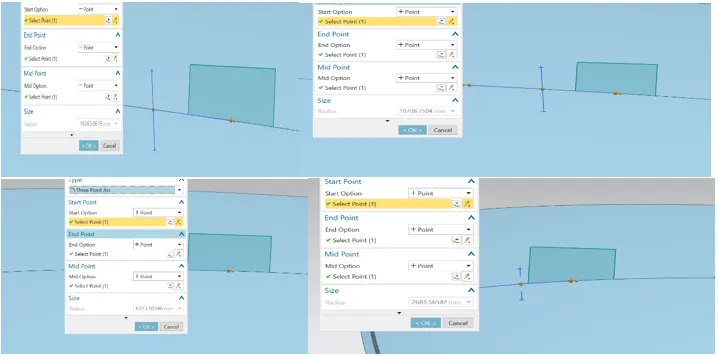
TABLE
|
S. |
BOW |
Iy |
α |
Lx |
Ly |
y |
Rx |
Ry |
t |
Qr |
OK/NG |
|
1 |
FR&1st |
82.37765 |
1.02 |
1135.7 |
2028.4709 |
527.777 |
4473.90924 |
2683.56542 |
0.75 |
0.73 |
ng |
|
2 |
1st&CTR |
1377.14316 |
0.91 |
1084.8 |
2028.4709 |
446.5869 |
3778.48 |
6373.50146 |
0.75 |
7.13 |
ok |
|
3 |
CTR&2nd |
84.10522 |
0.84 |
1059.9 |
2028.4709 |
450.3864 |
4245.94514 |
10708.7504 |
0.75 |
0.21 |
ng |
|
4 |
2nd&RR |
1044.5 |
2028.4709 |
521.5199 |
4028.8584 |
16263.0615 |
0.75 |
|
S.No |
L1 |
L2 |
s |
|
1 |
527.777 |
446.5869 |
487.18 |
|
2 |
446.5869 |
450.3864 |
448.49 |
|
3 |
450.3864 |
521.5199 |
485.95 |
|
4 |
- |
- |
- |
MEASURING Iy
Front roof rail
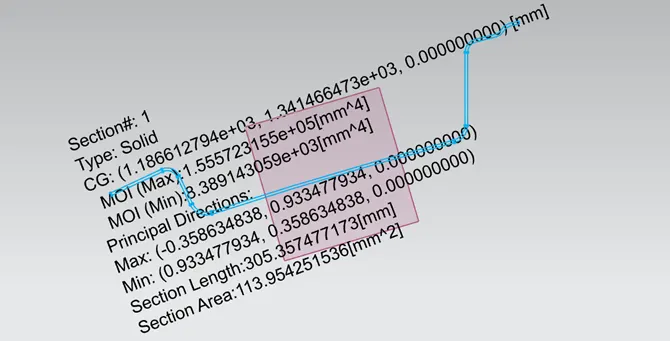
Bow roof-1
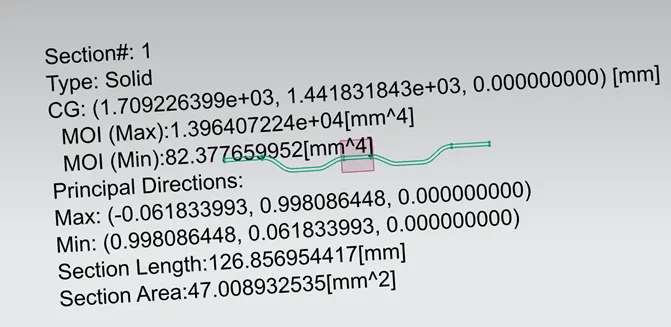
Bow roof-2
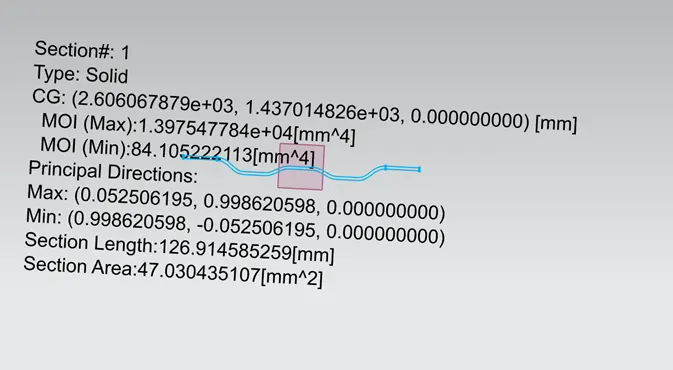
Center roof rail
Rear roof rail
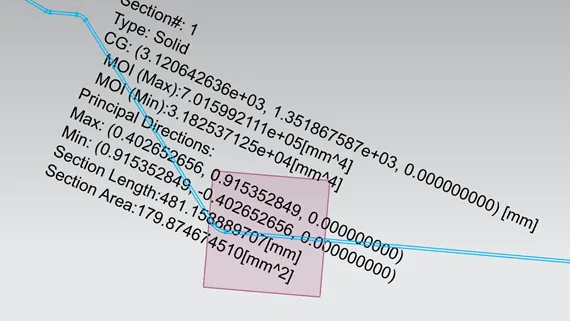
From the above values, we can say that snow load criteria is not valid between front roof rail and BOW roof 1 and between center roof rail and BOW roof 2.
Now to improve the part we have two solutions:
- Strengthen the outer panel by creating embosses in the regions where the part is failing
- By repositioning the roof rails and increasing the moment of inertia.
Since the second one is more time-consuming than the first one, we prefer the first method. If the manufacturer does not want embosses on the outer panel second method should be followed.
DRAFT ANALYSIS
Front roof rail
Center roof rail
Bow roof - 1,2
Rear roof rail
Roof Outer panel
FINAL DESIGN