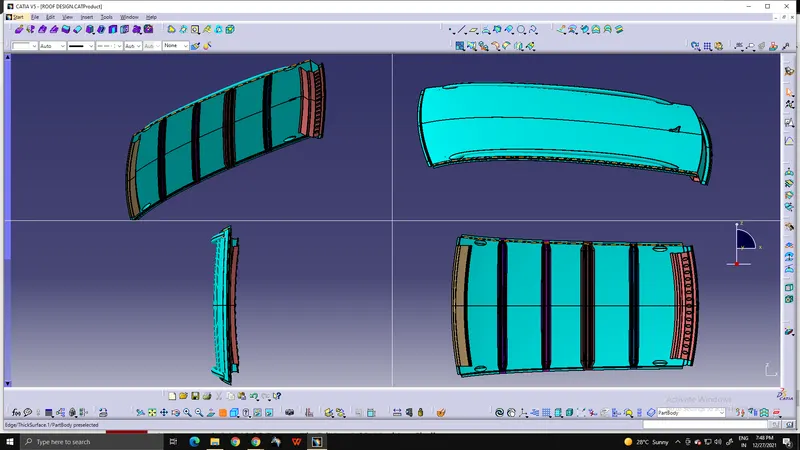
Roof challenge
ROOF DESIGN AND ANALYSIS (BIW)
OBJECTIVE-
To design a Roof of the car from the given styling surface with consideration of all engineering aspects which are draft analysis for DFM, heat distortion, and snow load prediction to justify roof curvature.
INTRODUCTION-
An automobile roof or car top is the portion of an automobile that sits above the passenger compartment, protecting the vehicle occupants from sun, wind, rain, and other external elements. this is called the roof. To give strength to the roof we attached bow roofs. bow roof is nothing but it is a supporting sheet metal part. Likewise in the front edge of the roof, there will be a sheet metal part called front roof rail. the windshield will come and cope right above the front roof rail which is on the roof ditch area.
The rear roof rail as the name suggests its place on the end of the roof. the master section should have the right geometry so that the back door will attach to the ditch area with the help of henge to open and close the back door.
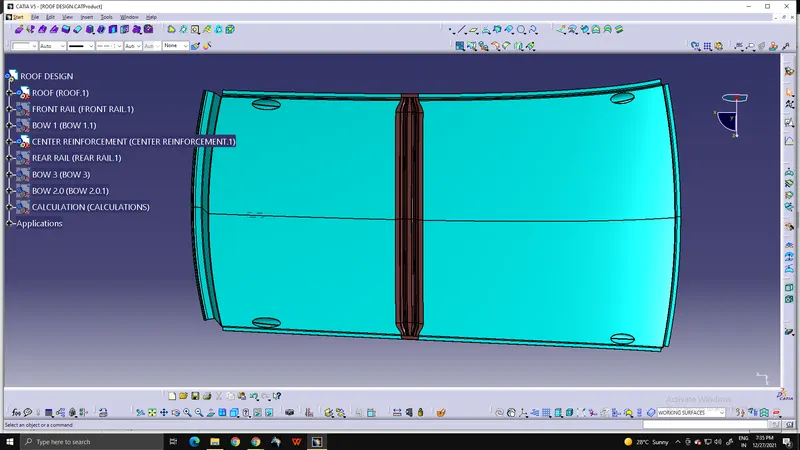
In this design phase, I used 3 bow roofs to comply "s" value during snow load calculation with one reinforcement.
STEPS IN DESIGN OF ROOF-
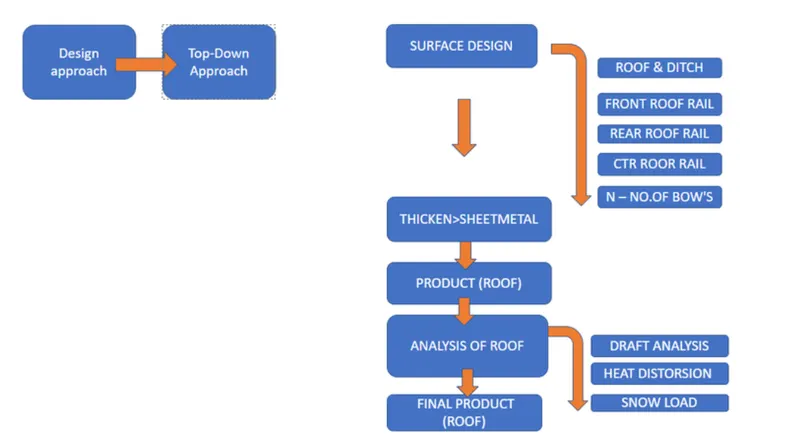
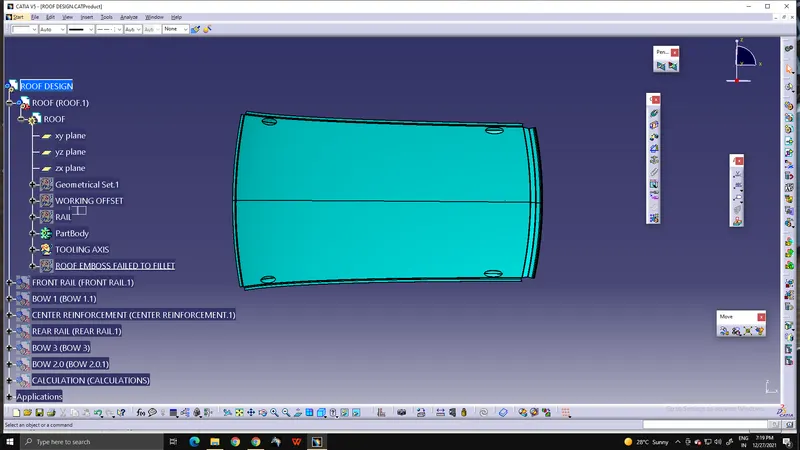
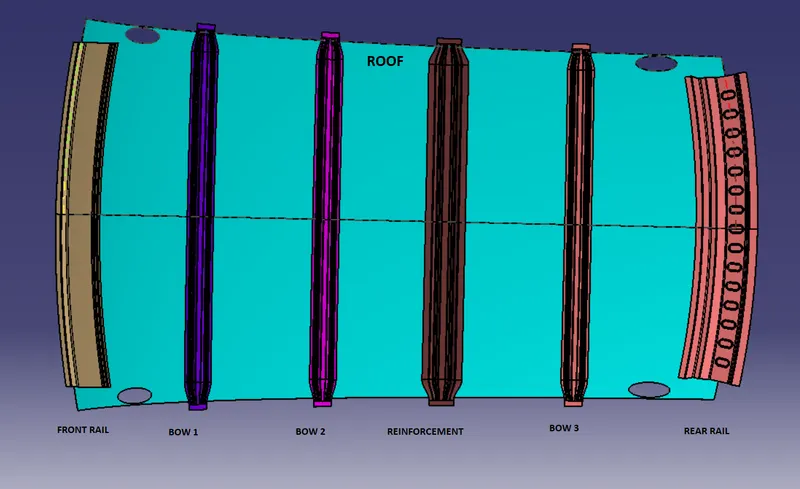
Fig.No. 01
ROOF-
- BOTTOM VIEW OF ROOF.
SIDE VIEW OF ROOF-
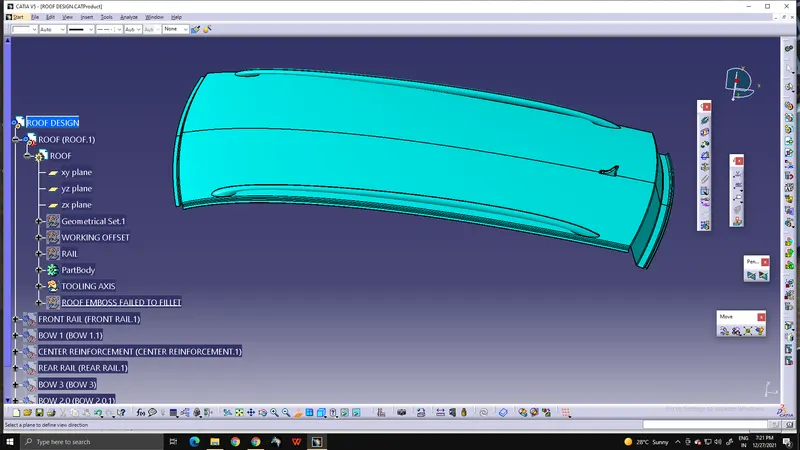
- The thickness of roof=0.75mm
1) FRONT ROOF RAIL-
- The front roof rail is the one that joints the front roof side and the bodyside front.
- Basically, the roof rails and the roofs are joined with the help of mastic and spot welding.
- The front-most end is joined by spot weld and the backside will be joined by the mastics.
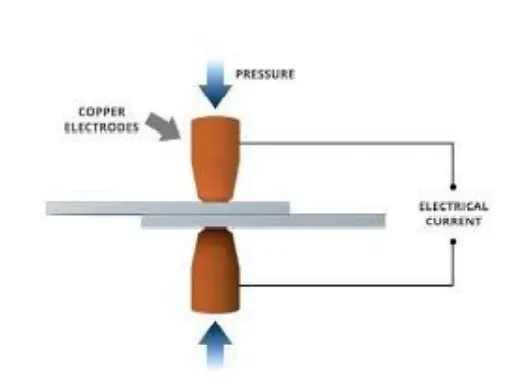
SPOT WELDING-
- Spot welding (or resistance spot welding) is a type of electric resistance welding used to weld various sheet metal products, through a process in which contacting metal surface points are joined by theheat obtained from resistance to electric current.
MASTIC JOINT-
Mastic in automotive sheet metal generally used to bond two different sheet metals by using additives and sealant. it is very helpful to reduce vibration between the sheet metal part.
MASTER SECTION FOR FRONT RAIL-
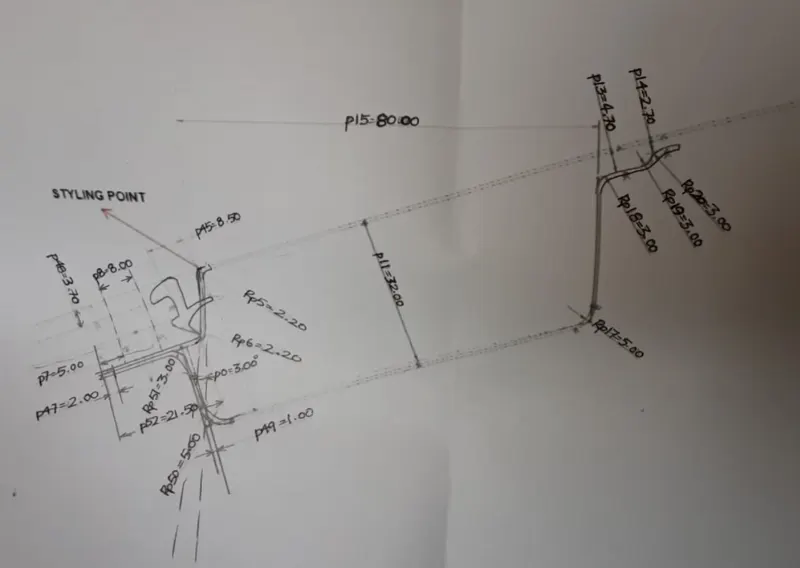
The master sections are created considering the below criteria:
Visibility, clearance between driver head and front roof rail backside edge.on the ditch area, there will be some extra components added to fix the windshield. components which are made of absorbing shocks (or) vibration.
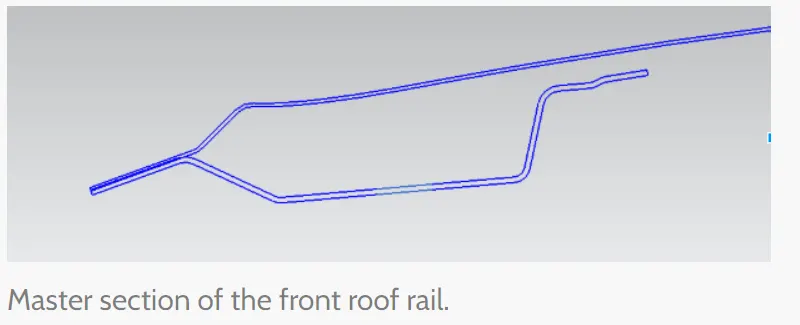
- PLACEMENT OF FRONT RAIL IN ROOF-
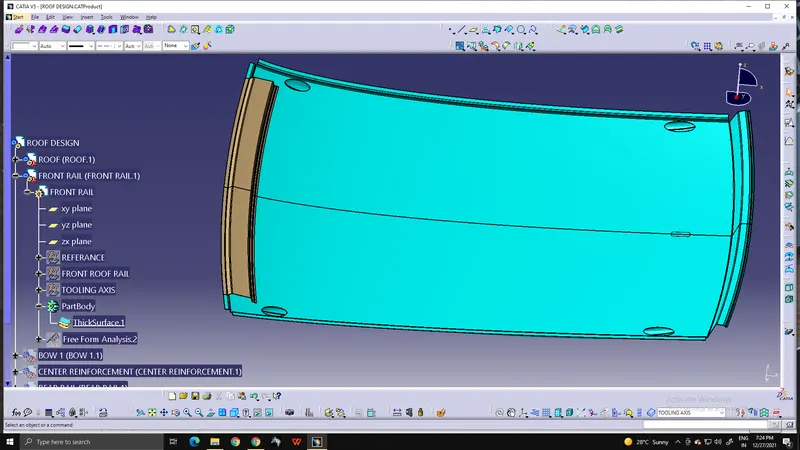
- CROSS SECTION OF FRONT RAIL-
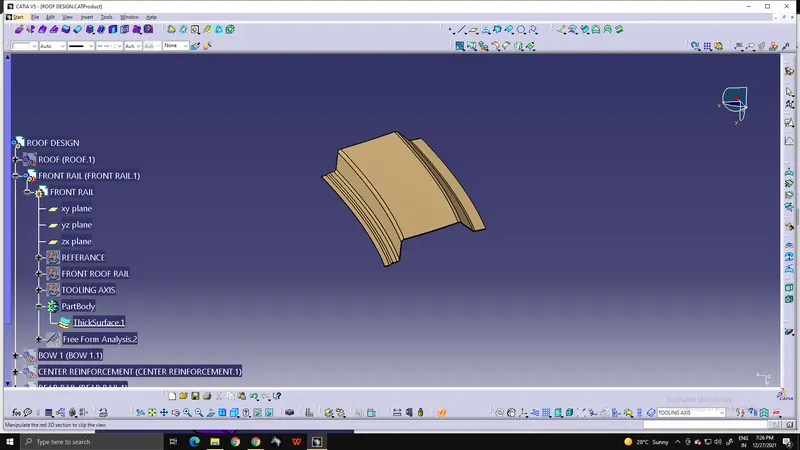
- MOMENT OF INERTIA OF FRONT RAIL FOR SNOW LOAD CALCULATIONS-
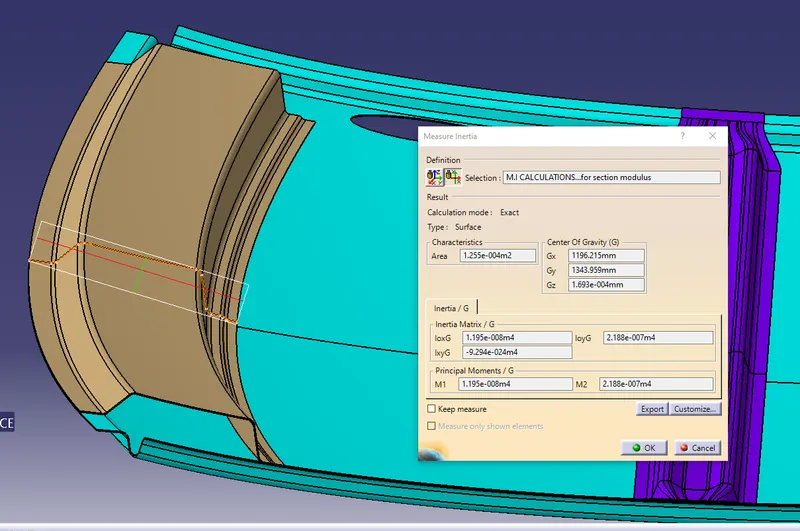
- The thickness of roof=0.75mm
- Front rail roof thickness=0.75mm
2) BOW ROOF 1
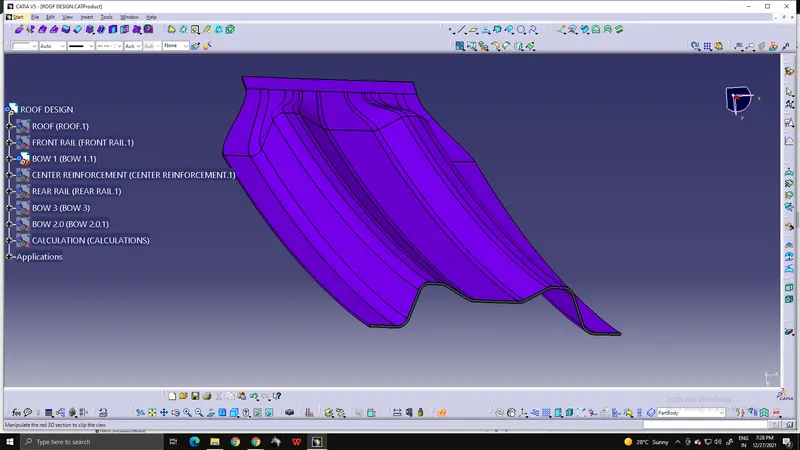
- SUPOORT SECTION IMAGE OF BOW ROOF IS GIVEN AS-
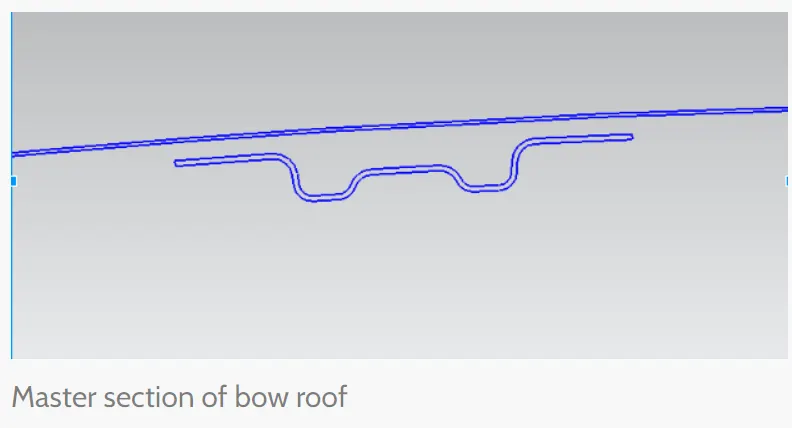
- PLACEMENT OF BOW ROOF 1 IN ROOF-
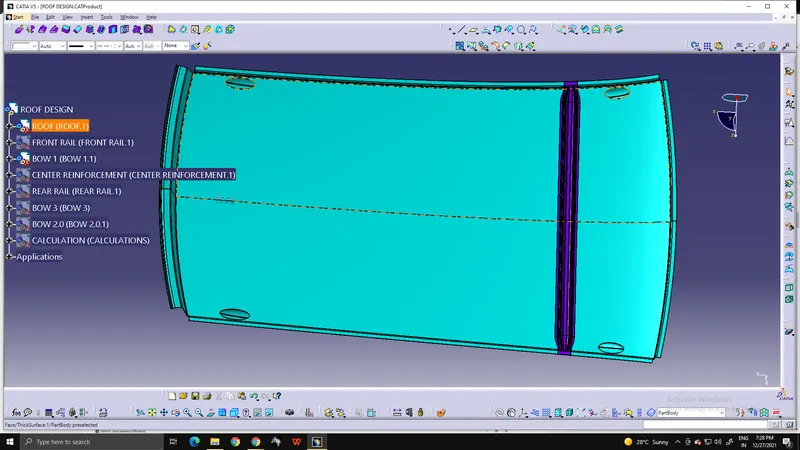
- CROSS SECTION OF BOW ROOF 1-
- MOMENT OF INERTIA OF BOW ROOF 1 FOR SNOW LOAD CALCULATIONS-
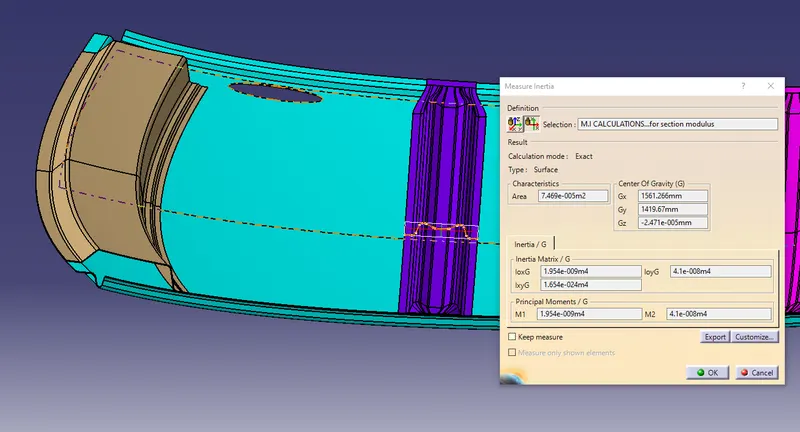
another two BOW ROOFs are also as same as this with differnt loaction as shownn in abaove figure no.01 and their dection modulus are as follows-
- For BOW ROOF 2-
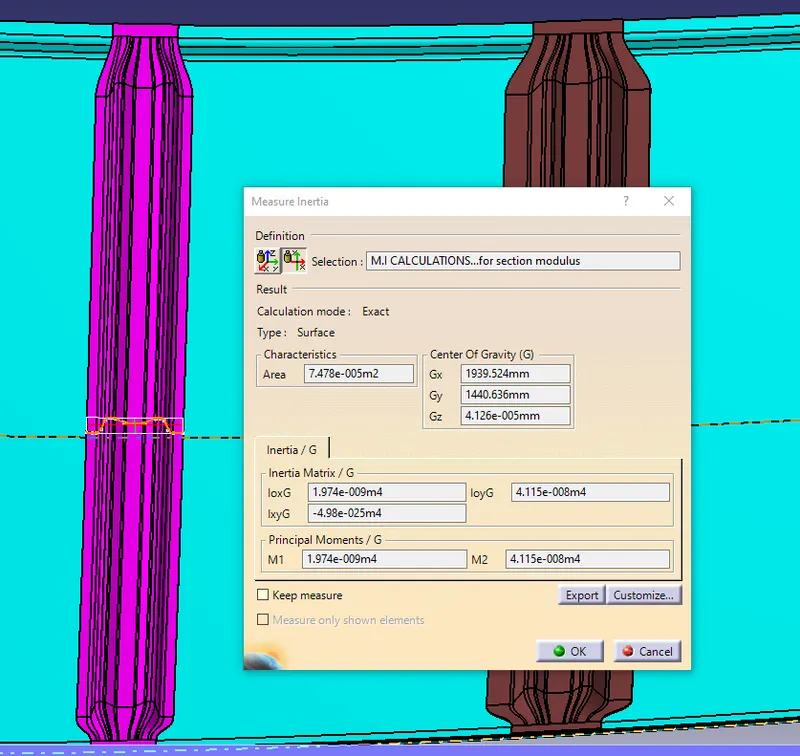
- For BOW ROOF 3-
- the thickness of bow roof 1,2 & 3 = 0.75mm=roof thickness
- gap between the roof and the bow is maintained as per rule in between 4mm to 6mm (4.25mm) for mastic.
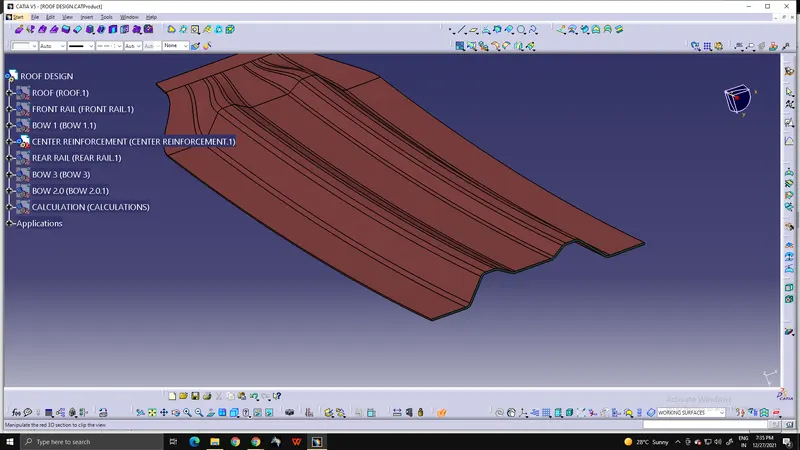
3) REINFORCEMENT-
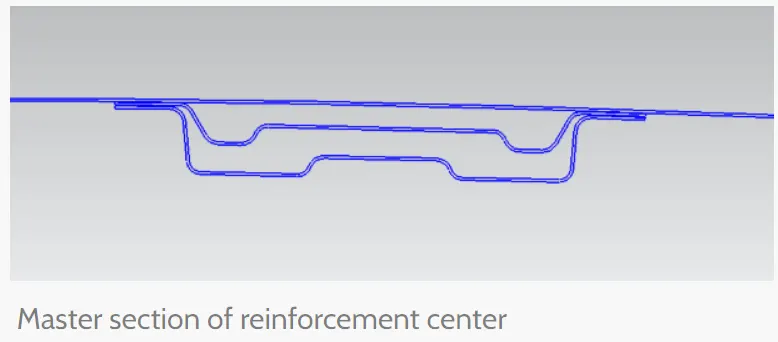
- SUPPORT SECTION IMAGE OF REINFORCEMENT IS GIVEN AS-
- PLACEMENT OF Reinforcement in Roof-
- CROSS SECTION VEIW-
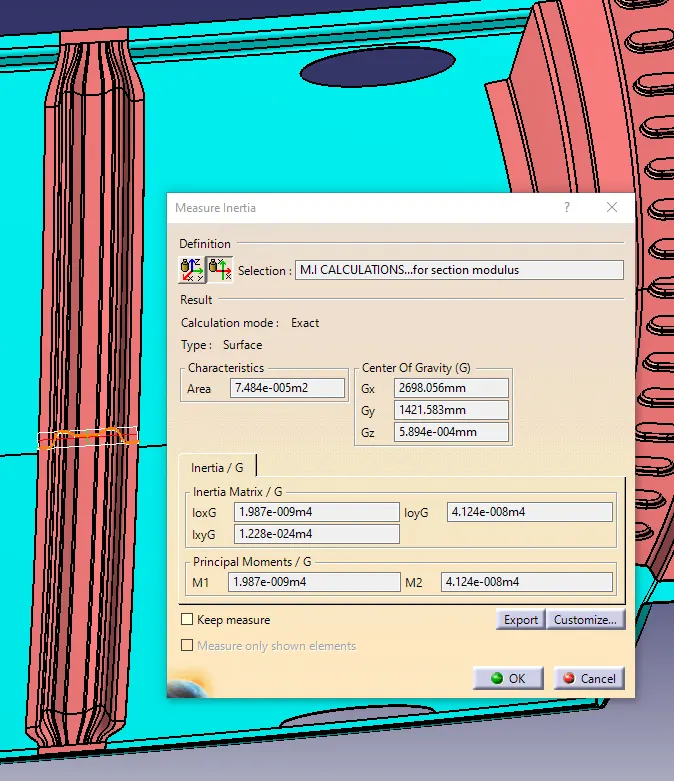
- MOMENT OF INERTIA-
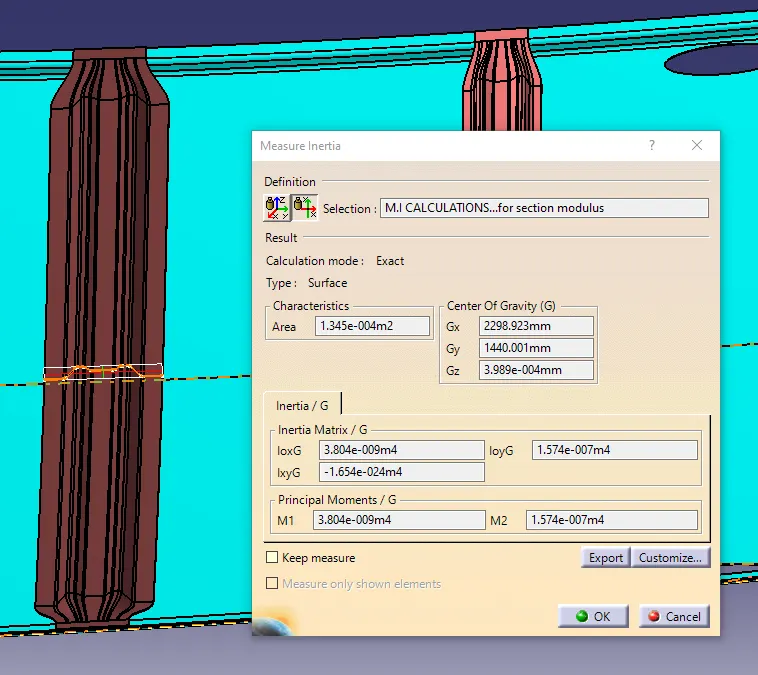
- The thickness of roof=0.75mm
- Reinforcement thickness=1 mm
Because reinforcement gets a maximum load that's why its thickness is increased, to give more strength.
4) REAR RAIL-
- SUPOORT SECTION IMAGE OF BOW ROOF IS GIVEN AS-
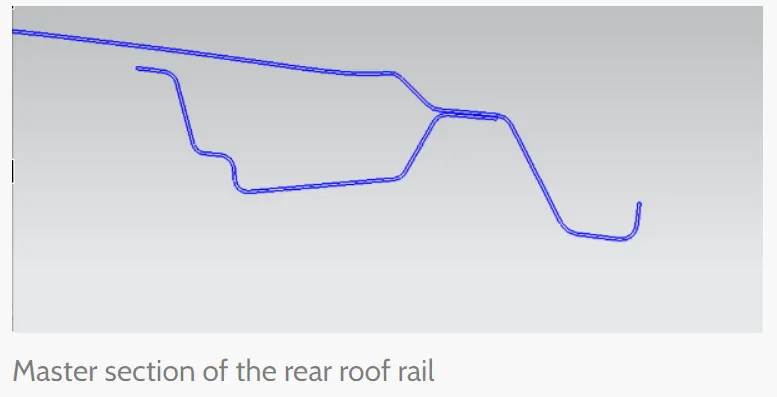
- MASTER SECTION-
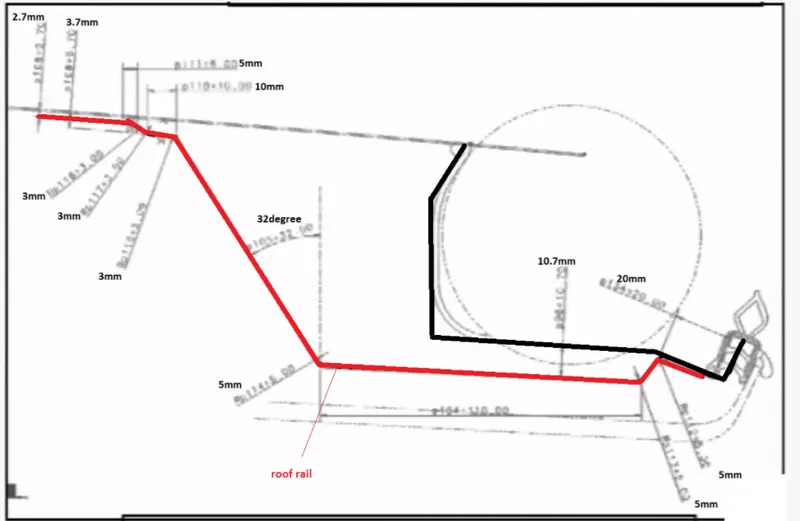
- PLACEMENT OF REAR RAIL IN ROOF-
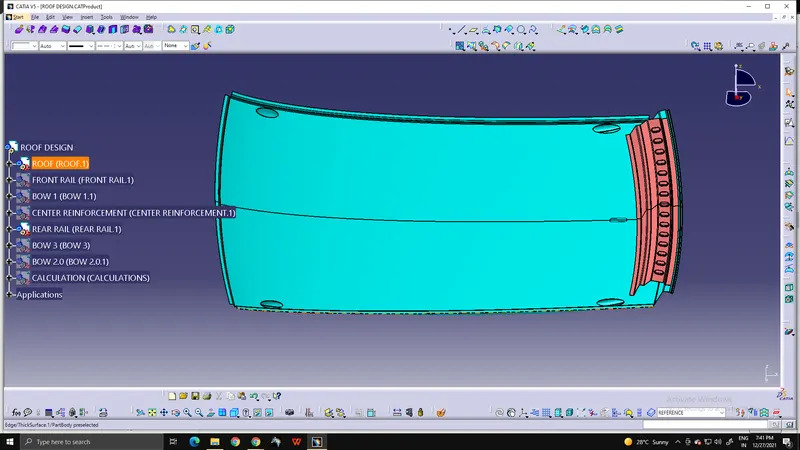
- EMBOSSES ARE CREATED TO INCREASE THE STRENGTH OF REAR RAIL.
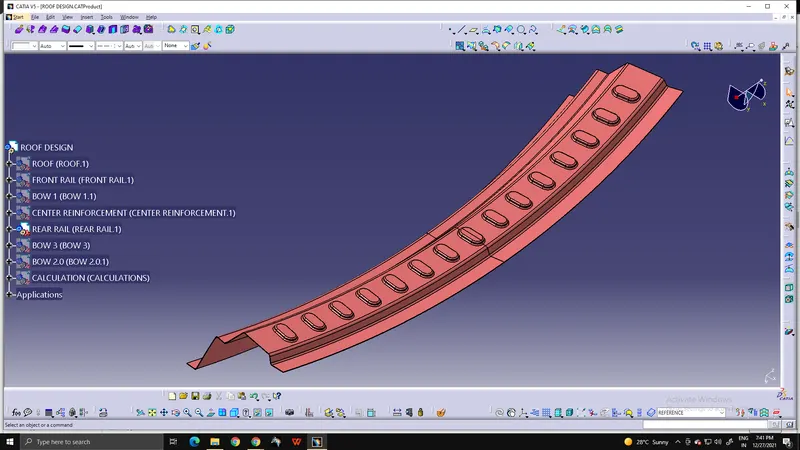
- CROSS SECTION OF REAR RAIL-
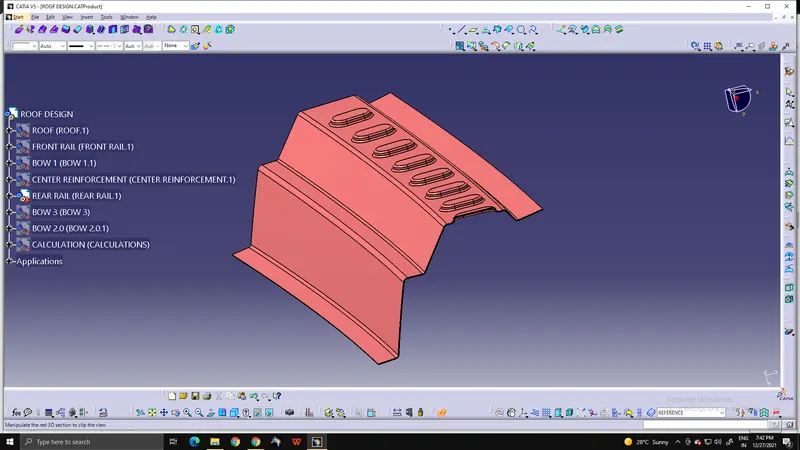
- The thickness of roof=0.75mm
- Front rear rail roof thickness=0.75mm
DRAFT ANALYSIS-
- Sheet metal parts are generated from a press tool or some forming tools, maybe the plastic parts which generally come out from the plastic molds and maybe the casting parts, all such kind of parts required some face on the surfaces which are parallel to the tooling direction.
- If we don't provide a draft on the surface then the tool will not come out and tool motion will destroy the surfaces or also reduce the finishing of surfaces.
- The draft is used for providing angles or tapers on product features such as walls, ribs, posts, and bosses that lie parallel to the direction of release from the mold eases part injection.
- Draught angles are designed in such a way that they will assist depart rejection. By doing so we have a reduced cycle time and improved productivity.
- Draft value for a particular part is mostly decided by the material used for making it.
- Draft angle is given as 7 deegrees.
- DRAFT ANALYSIS ON ROOF -
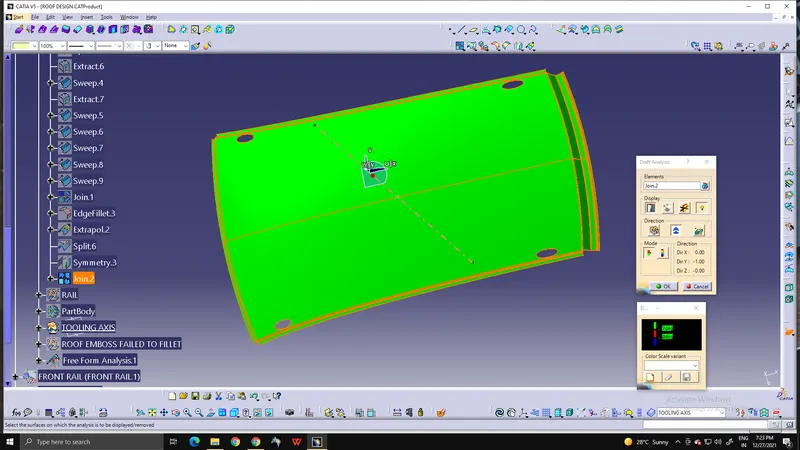
- DRAFT ANALYSIS ON FRONT RAIL -
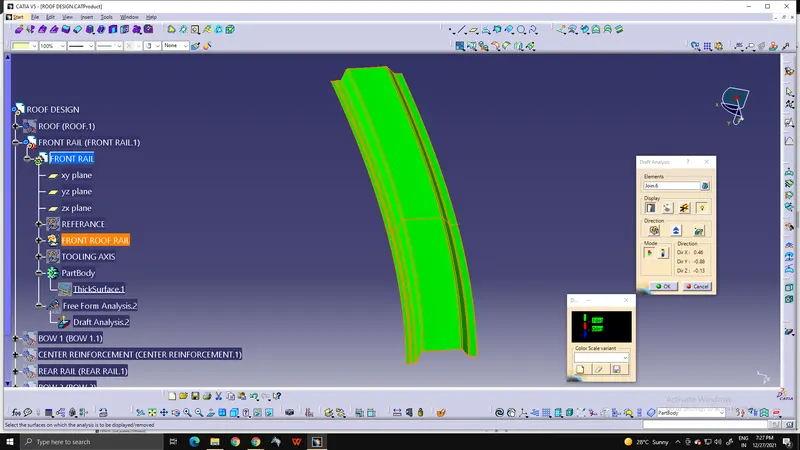
- DRAFT ANALYSIS ON BOW ROOF 1,2 & 3-
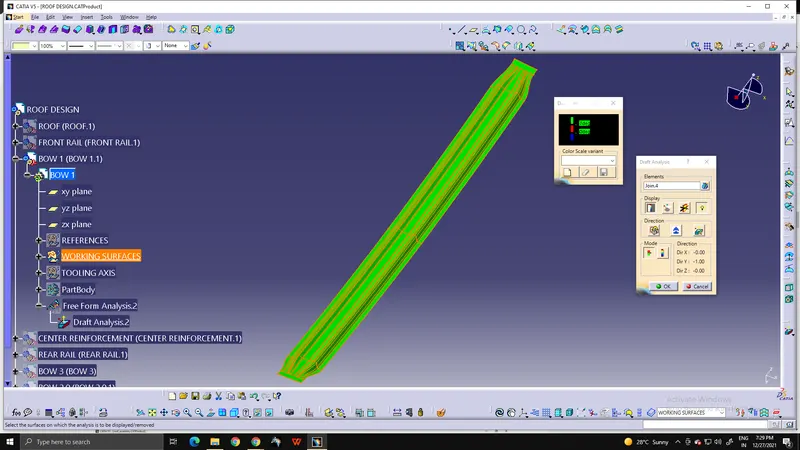
- DRAFT ANALYSIS ON REINFORCEMENT-
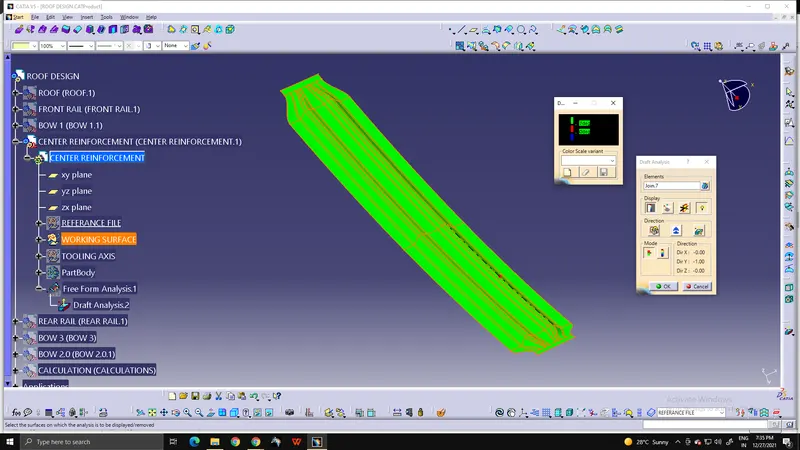
- DRAFT ANALYSIS ON REAR RAIL-
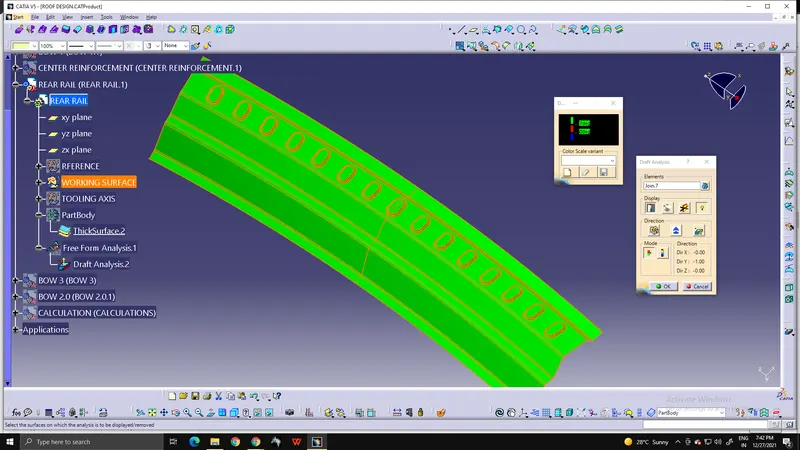
TESTS WILL BE CONDUCTED
There is some physical test which will be conducted on the car roof which has been filled for passenger safety.
List of test-
1. Roof crash test
2. Heat distortion test
3. Snow load test
1. Rollcrash test
The roof over test is a very important test for the roof of the car.
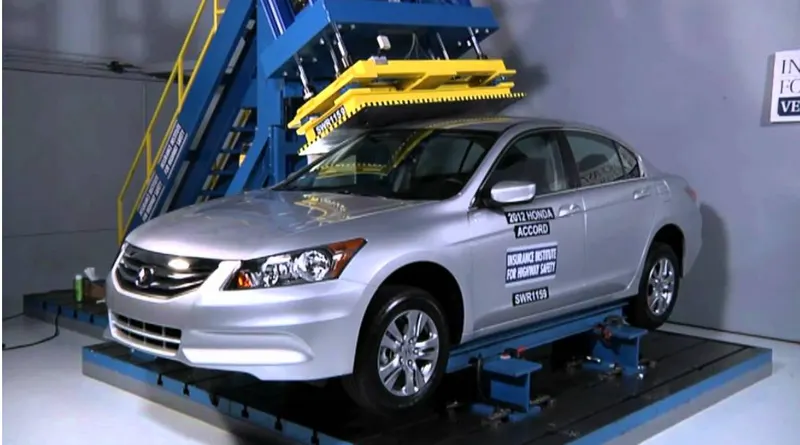
Roof crush test is the test of failure and displacement of an automobile roof into the passenger compartment during a roll-over accident.
Initial condition
All the doors and windows should be closed and locked.
Fix the body sill (or) chassis on hard, and level the surface horizontally.
Test type: Static test
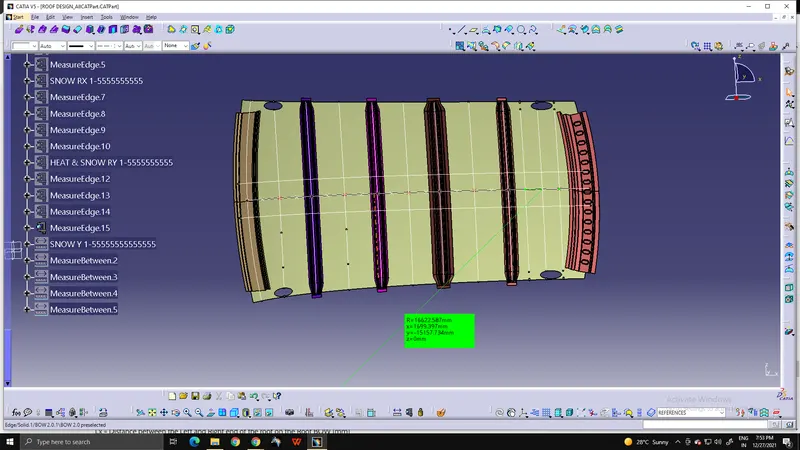
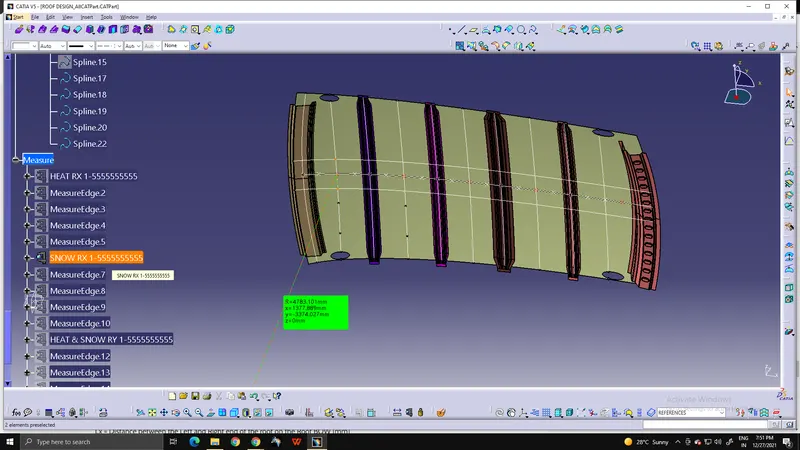
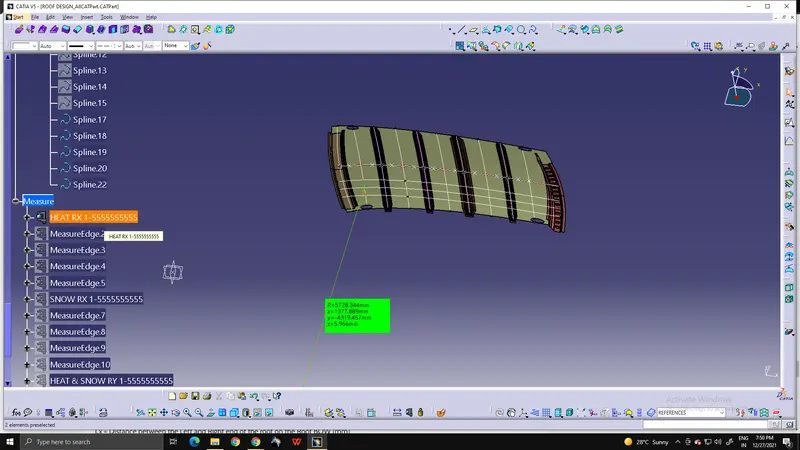
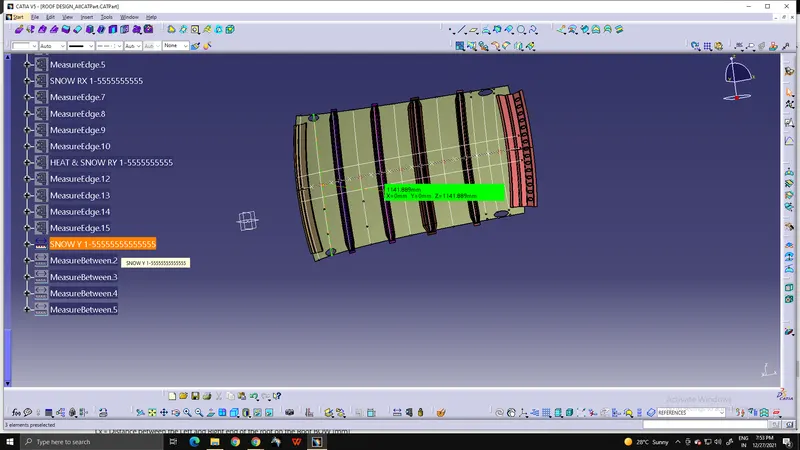
- MEASUREMENTS TAKEN FOR HEAT DISTORTION AND SNOW LOAD TESTS-
2. Heat distortion test
curvature study
This is the theoretical study to make sure the correct position of bow roofs. these are the prediction formulas.
Heat distortion criteria
Prediction formula
W =(1.73*10^(-3)*L)+(1.85*10^(-8)*(R^2/t))+(1.10*10^(-3)*I)-2.68
Judgement Condition : 2.7<W<3.5g
where
l = roof length X- direction in mm ( 0Y section)
R = Roof curvature
R =(Rx*RY)/(Rx+Ry)
Rx = X curvature
Ry = y curvature
t = Roof plate thickmess in mm
I = bow roof span in mm
HEAT DISTORTION TABLE
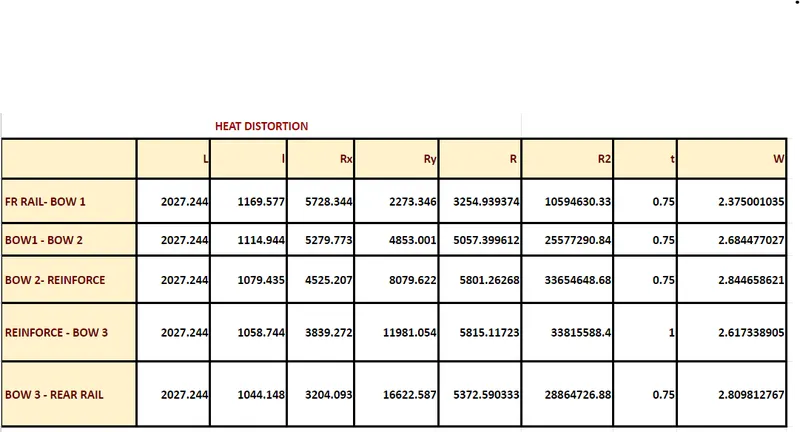
ALL THE VALUES OF "W" ARE WITHIN THE LIMIT, SO THE ROOF IS PASSED IN HEAT DISTORTION TEST.
- SNOW LOAD TEST-
The purpose of calculating snow load criteria is during the winter session there will be snowfall. snow may settle on the roof of the car when the snow is removed the roof should back to its original position. this is the purpose of doing snow load prediction. the snow load prediction gives a 95% correct value compared to the actual test. so it is obviously a number.
Calculation of snow load criteria for roof-
Snow load prediction value
Qr = [Iy x t ] / [α x s x [(Rx + Ry)/2] x 10 ]
Where
α = My x Lx x 10 , My = Y(Ly-Y)
Judgement condition = Qr ≥ 3.1
250 ≤ s ≤ 380
t =Roof plate thickness in mm
Ly = Distance between the front roof rail and rear roof rails on the vehicle along with 0Y [mm]
Lx = Distance between left and right end of the roof on the roof bow in mm
width of the roof panel exposed on the surface
Y =Distance between front roof rail to roof bow in mm
s = distance for which roof bow bears divided load in mm
s =L1/2+L2/2
Iy Geometrical Moment of inertia of roof bow [y cross - section] in mm^4
Rx =Lateral direction curvature radius of roof panel Y cross-section on roof Bow in mm
Roof panel curvature radius of the length Lx in front view
Ry = Longitudinal direction curvature radius of the roof X cross-section on roof bow in mm
- SNOW LOAD TEST TABLE-
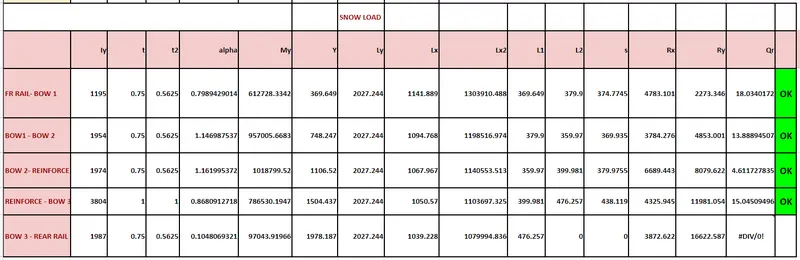
- Hence the Roof design does get satisfying in the snow load prediction. Qr values were above 3.1.
- upcoming risk was predetermined by putting approx values in testing tables, so by according that I added extra BOW. So the risk is eliminated, Roof design is Passed in Snow Load Test.
MULTI-VIEW OF DESIGNED ROOF ASSEMBLY-