Battery Technology Report: Specifications of Lithium Ion Cell
Aim:
To study the specifications of Lithium ion Cells.
Theory:
A battery is a type of electric power source that consists of one or more electrochemical cells with external connections that are used to power electrical devices such as flashlights, mobile phones, and electric cars. When a battery is supplying electricity, the positive terminal is known as the cathode and the negative terminal is known as the anode. The negative terminal is the source of electrons that will flow to the positive terminal via an external electric circuit. When a battery is connected to an external electric load, a redox reaction occurs, converting high-energy reactants to lower-energy products and delivering the free-energy difference to the external circuit as electrical energy. Historically, the term "battery" referred to a device made up of multiple cells; however the usage has evolved to include devices composed of a single cell.
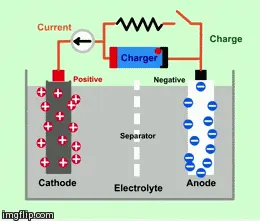
Figure: Working of Battery [link]
An electrochemical cell is a device that can generate electrical energy from chemical reactions or use electrical energy to cause chemical reactions. Electrochemical cells that generate an electric current are known as voltaic or galvanic cells, whereas those that generate chemical reactions, such as electrolysis, are known as electrolytic cells. A standard 1.5 volt cell intended for consumer use is a common example of a galvanic cell. A battery is made up of one or more cells that are connected in parallel, series, or series-and-parallel fashion.
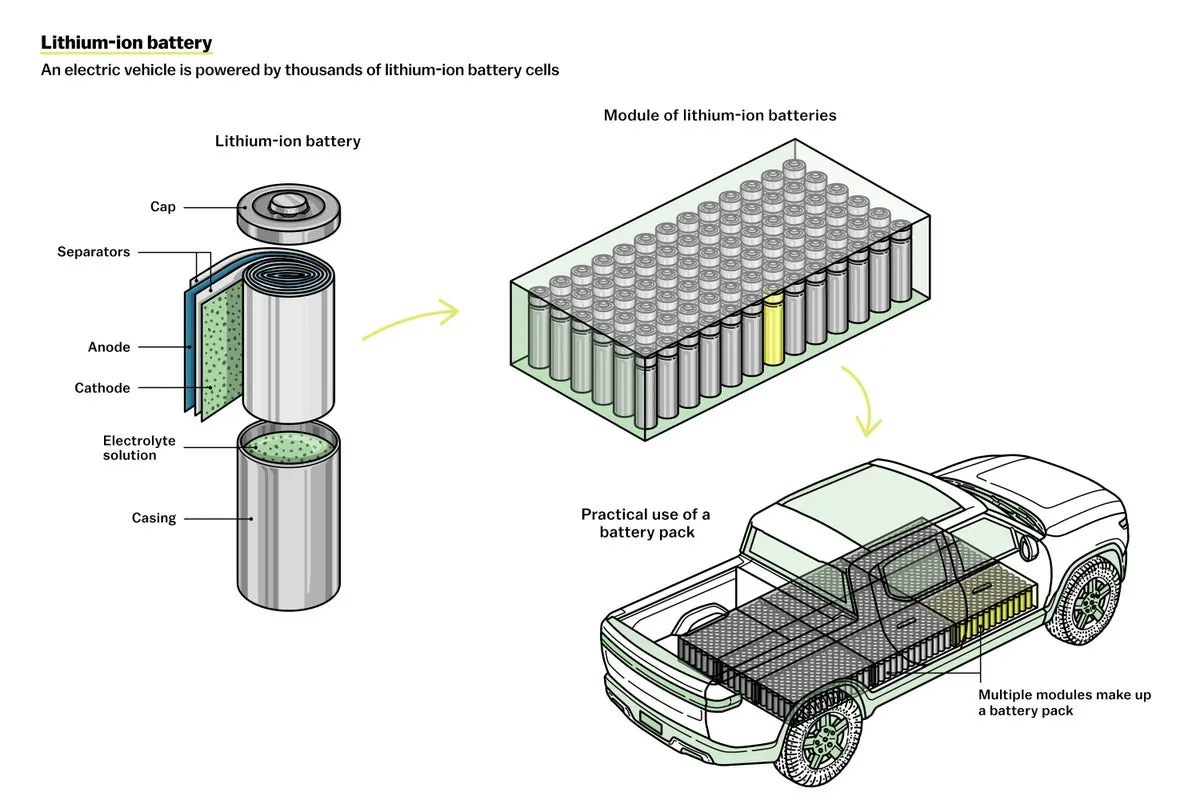
Figure: Lithium-ion Battery in EV [Vox, link]
A lithium-ion battery, also known as a Li-ion battery, is a type of rechargeable battery in which lithium ions move from the negative electrode to the positive electrode via an electrolyte during discharge and back again during charging. Li-ion batteries use an intercalated lithium compound as the positive electrode material and typically graphite as the negative electrode material. Li-ion batteries have a high energy density, no memory effect (with the exception of LFP cells), and a low self-discharge rate. Cells can be designed to prioritise either energy or power density.
Objectives:
- To read a lithium ion cell datasheet.
- To differenciate between nominal voltage and maximum voltage.
- To identify the situation under which the changes in dimensions and weight of a cell can be observed.
- To list out various mechanical testing and standards.
- To find out the discard procedure suggested generally for used Li ion+ batteries.
Lithium-Ion Battery Data Sheet:
The data sheet of the battery model LIR18650 2600mAh was considered for this study on specifications of lithium ion cells. The data sheet for the same can be downloaded from the below link:
https://www.ineltro.ch/media/downloads/SAAItem/45/45958/36e3e7f3-2049-4adb-a2a7-79c654d92915.pdf
The Difference Between Nominal Voltage And Maximum Voltage:
- Nominal Voltage:
A Li-ion cell is an electrochemical device that generates a voltage potential by combining metals with varying affinities in an electrolyte. Manufacturers rate a cell by assigning a nominal voltage, which, with a few exceptions, follows an agreed-upon convention. In brief, here are the nominal voltages of the most common cells. A lithium-ion cell has a nominal voltage of 3.6V. Some manufacturers label their cells as 3.7V or higher. This provides a marketing advantage because higher voltage increases watt-hours on paper. When connecting three and four cells in series, the 3.7V rating generates unfamiliar references of 11.1V and 14.8V rather than the more familiar 10.80V and 14.40V for 3.6V, respectively. Most Li-ion systems use a nominal cell voltage of 3.6V as a power source, which is followed by equipment manufacturers.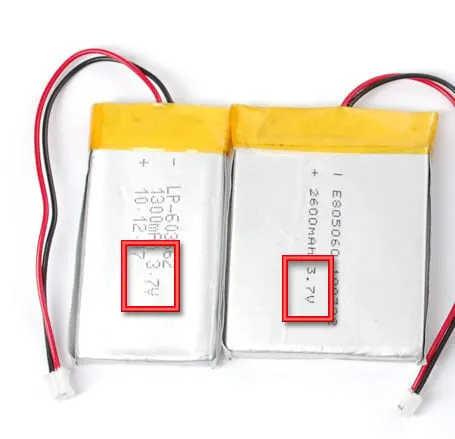
Figure: LiPoly Batteries with specifications [link]
The nominal voltage is determined by the materials of the anode and cathode, as well as the impedance. Voltage calculations include determining the halfway point between a full charge of 4.20V and the 3.0V cutoff with a 0.5C load. The mid-point for Li-cobalt is approximately 3.6V. Similarly, an average voltage of 3.7V is obtained on Li-manganese with a lower internal resistance. It should be noted that the higher voltage is frequently set arbitrarily and has no effect on the operation of portable devices or the charging settings. There are, however, exceptions. Some LCO-architecture Li-ion cells have a surface coating and electrolyte additives that increase the nominal cell voltage and allow for higher charge voltages. To achieve full capacity, the charge cut-off voltage for these batteries must be adjusted.
The figure below shows the typical voltage settings [link]: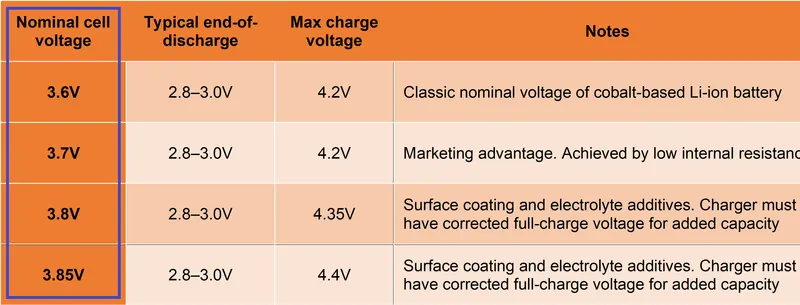
Users want to know if higher charge voltage Li-ion cells compromise longevity and safety. There is limited information available, but what is known is that these batteries have a shorter cycle life than standard Li-ion batteries, as well as a shorter calendar life. Because these cells are primarily used in consumer products, longevity can be balanced against obsolescence, making a shorter battery life acceptable. Because of the increased Wh, the benefit is a longer runtime (Ah x V). All cells must meet regulatory requirements and be safe. The nominal cell voltage of phosphate-based lithium-ion is 3.2V and 3.3V, while lithium-titanate is 2.4V. Because of the voltage difference, these chemistries are incompatible with standard Li-ion in terms of cell count and charging algorithm. During discharging, the output voltage of a lithium battery varies. Based on a 0.2C discharge, the nominal voltage is measured halfway between fully charged and fully discharged (where C is the rated capacity of the cell in mAh). A single lithium battery cell's nominal voltage is typically displayed as 3.6V, 3.7V, or 3.8V.
Figure: Nominal Voltage of Lithium Ion Batteries [link]
The actual voltage profile during discharge is affected by the cell chemistry, discharge rate, temperature, and age of the cells or battery being discharged. A single cell lithium battery cell has a maximum voltage of 4.2V and a cut off voltage of 2.5V ~ 3V. - Maximum Voltage:
Typically, Vmax's maximum voltage is 4.2V or less. For the time being, use 4.2V. In terms of current, the maximum voltage applied has an impact on cell longevity (and capacity on a given charge). Charging at a terminal voltage much higher than 4.2V will reduce cell life, may result in metallic lithium plating out, and may result in the exciting and equipment-consuming "vent with flame" battery meltdown phenomenon. In this case, the maximum voltage AT the battery (1 cell) under maximum constant current CCmax is Vmax = 4.2V.
Vmax is also the maximum voltage AT the battery (1 cell) under ANY current. If the battery refuses to accept Imax when Vmax is applied, CC mode is no longer suitable. Charging should be CV (or should be stopped if Icharge at Vmax = Icv min - see below). The location of the "charging voltage" measurement is critical here. This is measured properly at the cell electrodes, as close to the cell internals as possible. In practise, anywhere on the (usually) weld-attached tabs should be fine because the voltage drop across the tabs should be minimal at the maximum allowed current. As long as the voltage at the actual cell is <= Vmax then the voltage at other points in the charger may be > Vmax if the charger design requires it.
The figure below shows the typical voltage settings [link]: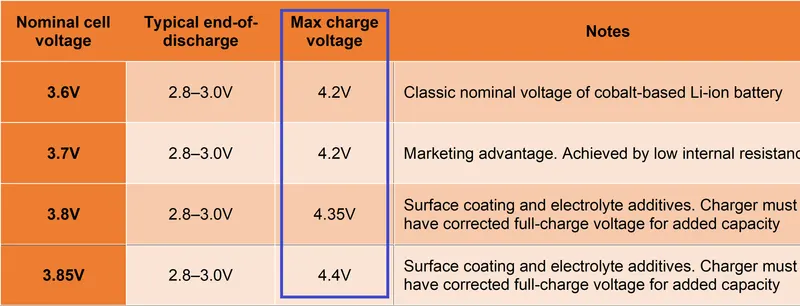
Consider the following scenario: Apply a "true" constant current source to a discharged LiIon cell. Because of the lead resistance outside the cell, the voltage elsewhere in the system may be higher than at the battery terminals. Ignore that for the time being; comment on it at the end. The terminal voltage of a discharged LiIon battery will be around 3V and will gradually rise as CC is applied. The TERMINAL voltage will reach 4.2V after approximately 40 to 50 minutes of charging a LiIon cell at 1C (= CCmax in this case) from fully discharged. This is the point at which you stop applying CC and apply a CV of Vamx (= 4.2V in this case) at whatever current is required to maintain the voltage at 4.2V (up to a maximum of CCmax).
Charging voltage is removed when Icharge falls below Icv_min to prevent potentially irreversible electrochemical reactions and to prevent Lithium metal "plating out".
- If Vmax is set at 4.15V then charge capacity is reduced noticeably but cycle life is extended.
- If Vmax is set at 4.1V charge capacity is significantly reduced and cycle life is significantly extended.
When Vmax is reduced, the loss of capacity per cycle results in an overall INCREASE in total lifetime capacity because the extension in life cycles rises faster than the loss of capacity per cycle. If you are primarily concerned with maximum capacity per charge, set Vmax as high as possible and accept a low cycle life.
Set Vmax lower if you can tolerate 80% to 90% of maximum possible capacity per cycle and get more overall energy storage before replacement.
The graph below, from a Battery University article, depicts what happens when Vmax is raised above 4.2V [link]:
Figure: Effects on Cycle Life at Elevated Charge Voltages [link]
The Situation Under Which The Changes In Dimensions And Weight of The Cell Can Be Observed:
Battery changes may occur depending on the positive and negative terminals that are affected by deep scratches, cracks, rust, discoloration, and leakage. Physical appearance should also be checked before using the cell.
The battery thickness changes during cycles for three reasons:
- Lithium intercalation causes host material expansion and contraction.
- Irreversible reaction deposits cause an increase in electrode volume.
- The dead volume and pressure within the cell case vary depending on the structure and construction of the battery.
There will be minor weight differences between fully charged and empty batteries due to (Einstein's) m = E/c^2, but this weight will be negligible. Energy equals mass, and the conversion factor is c^2, the squared speed of light.
- When a battery is charged, its total mass increases, while it decreases when it is discharged.
- Lead-acid batteries, which are used in internal combustion automobiles and many electric vehicles such as electric forklifts and golf carts, are heavy due to the high density of lead.
- The battery is filled with a rather heavy water-acid mixture.
- The weight of the battery may change as the temperature rises.
- Deep charging may have an effect on battery weight because the total mass of a battery increases when charged and decreases when discharged.
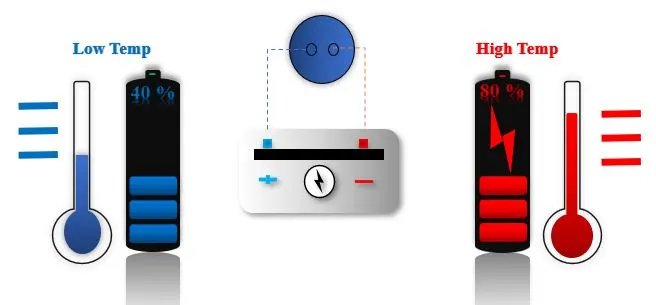
The following factors are also to blame for the changes in dimensions and weight:
-
Manufacturing Flaws:
-
During the manufacturing process, flaws in production can cause metallic particles (impurities) to seep into the lithium-ion cell. Battery manufacturers must ensure that their cleanrooms are strictly controlled.
-
Another flaw could be separator thinning, which could be detrimental in actual use. Before being sold, cells should go through stringent quality-control tests and validation.
-
-
Usage that is abnormal or improper:
-
External factors such as keeping the battery near a heat source or a fire can cause it to explode. Penetrating the battery pack, whether on purpose or by accident, will result in a short circuit and the battery catching fire. As a result, unauthorised disassembly of the battery pack in electric vehicles results in a warranty lapse.
-
Users are advised to only have their batteries checked and repaired by authorised service centres of the car manufacturer. Even high-voltage charging or discharging of the battery can harm it.
-
-
Charger Problems:
-
Poorly insulated chargers can cause battery damage. If the charger shorts or generates heat near the battery, it can cause it to fail.
- While lithium-ion batteries have built-in safeguards to prevent overcharging, using unauthorised chargers can cause long-term damage to the battery.
-
-
Components of poor quality:
-
Aside from manufacturing flaws, one of the leading causes of battery failure is the use of low-quality components. Increasing competition is driving down battery prices, forcing battery manufacturers to cut corners where they should not. The risk of battery failure increases when poor quality electronics, such as the battery management system, are used.
-
The battery management system is critical to the safety and performance of the battery. It prevents the battery pack from operating beyond its safe operating range.
-
As batteries form a high-value component of an electric vehicle or energy storage system, it’s essential to invest in a smart battery management system that can detect cell failures immediately and prevent the battery from exploding.
-
Various Mechanical Testing And Standards:
The safety standards listed below include typical tests. They range from simple dimensional accuracy tests to dynamic testing to ensure that the product can withstand any static and dynamic mechanical stresses to which it may be subjected. Mechanical tests at various charge states and environmental conditions are dependent on: Crush Tests, Nail Penetration Tests, Shock Test, Vibration Test, Impact Test and Drop Test.
- Crush Test:
- The battery suffered compression during the use procedure of a battery crush tester simulation of several types of power lithium batteries.
- The battery crush tester machine simulates the squeezing of multiple power batteries. Each battery sample cell is subjected to pressure in only one direction.
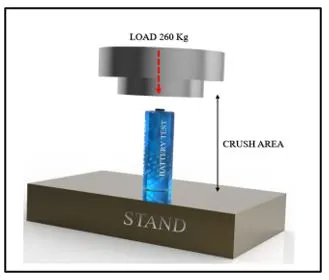
- A cylindrical or prismatic cell should be extruded with its longitudinal axis parallel to the plane of the extrusion device. Place the battery between two flat plates and squeeze. The hydraulic head of the piston applies extrusion pressure.
- Nail Penetration Test:
- Nail penetration testing is a type of safety test that is performed to simulate internal short-circuiting.
- A nail is inserted into the sample battery to simulate an internal short-circuit and ensure that the battery does not catch fire or burst.
- Shock Test:
- Shock tests are used to simulate the effects of a product's lifetime by measuring the impact of sudden acceleration caused by a collision, drop, or explosion.
- Shock tests are used to simulate the effects of a product's lifetime by measuring the impact of sudden acceleration caused by a collision, drop, or explosion.
- Vibration Test:
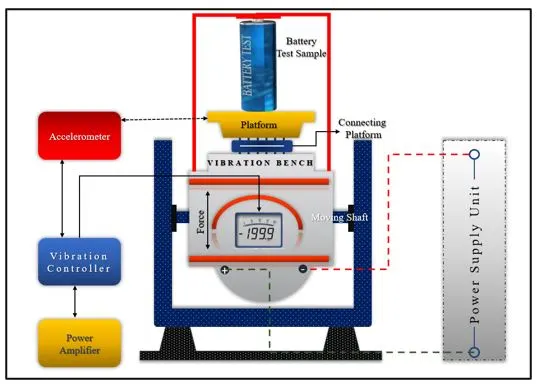
- Battery vibration testing can also be done as a random test or as a sinusoidal test. The random vibration test closely resembles the test described in SAE J2380.
- The sinusoidal test begins with 2000 cycles of excitation at a fixed frequency between 10 and 30Hz. Vibration testing is critical during the product development process.
- Impact Test:
- An impact test is a mechanical stress test used to determine how a Li-ion cell reacts to a sudden and measured force. Impact testing is performed to determine the safe prevention of fire or explosion after an object disrupts the cell.
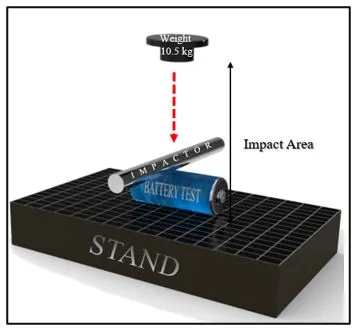
- An impact test is a mechanical stress test that involves placing a rigid object, such as a steel rod, on a test specimen and dropping a load on the steel rod.
- An impact test is a mechanical stress test used to determine how a Li-ion cell reacts to a sudden and measured force. Impact testing is performed to determine the safe prevention of fire or explosion after an object disrupts the cell.
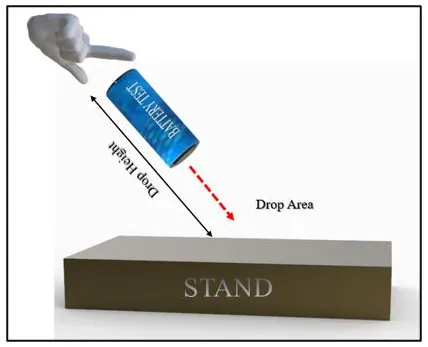
- Drop Test:
- A drop test is performed on a battery (with the flat, negative end down) to determine its charge life.
- If the battery is fully charged, it should make a solid knock and most likely remain upright. If the battery is dead, it will immediately bounce and fall over.
Lithium-Ion Battery Standards [usaid.gov, link]:
Many organisations have developed guidelines for lithium-ion battery safety, performance, testing, and maintenance.
Standards are norms or requirements that provide a foundation for common understanding and evaluation of materials, products, and processes. Standards are an invaluable tool in industry and business because they streamline business practises and create a level playing field for companies to develop products and services. They are also essential in ensuring the safety of products and services for consumers and the environment. A number of standards for the design, testing, and installation of lithium-ion batteries have been developed. The International Electrotechnical Commission (IEC), Underwriters Laboratories (UL), the Japanese Standards Association (JSA), and others developed the internationally recognised standards listed in this section. These standards were chosen because they are applicable to lithium-ion batteries and battery management in stationary applications such as uninterruptible power supply (UPS), rural electrification, and solar photovoltaic (PV) systems. When purchasing and evaluating equipment and professional services, these standards should be consulted.
International Electrotechnical Commission (IEC) :
- Performance:
- IEC 61960: Alkaline or other non-acid electrolyte secondary cells and batteries - Secondary lithium cells and batteries for portable applications - Part 3: Prismatic and cylindrical lithium secondary cells and batteries made from them
- IEC 61960: Alkaline or other non-acid electrolyte secondary cells and batteries - Secondary lithium cells and batteries for portable applications - Part 3: Prismatic and cylindrical lithium secondary cells and batteries made from them
- Safety:
- IEC 62133-2:2017: Safety requirements for portable sealed secondary lithium cells and batteries made from them for use in portable applications - Part 2: Lithium systems
- IEC 62281:2019: Transport safety of primary and secondary lithium cells and batteries
- Testing:
- IEC 61959:2004: Secondary cells and batteries containing alkaline or other non-acid electrolytes - Mechanical tests for sealed portable secondary cells and batteries.
Underwriters Laboratories (UL):
- Safety:
- UL-1642, 5th Edition: Standard for Lithium Batteries.
- UL-9540, 2nd Edition: ANSI/CAN/UL Standard for Energy Storage Systems and Equipment.
- Testing:
- UL-9540A, 4th Edition : ANSI/CAN/UL Standard for Test Method for Evaluating Thermal Runaway Fire Propagation in Battery Energy Storage Systems.
- UL-1973, 2nd Edition: ANSI/CAN/UL Standard for Stationary, Vehicle Auxiliary Power, and Light Electric Rail (LER) Batteries.
- UL-1974, 1st Edition: ANSI/CAN/UL Standard for Battery Repurposing Evaluation.
The Discard Procedure Suggested Generally For Used Li+ion Batteries:
Lithium-ion batteries' superior performance characteristics improve the performance of our electronic devices. However, handling lithium-ion (li-ion) batteries during the end-of-life phase of electronic products necessitates extra care. When batteries are handled improperly, there is a greater risk of fire, pollution, and other negative consequences. Every lithium-ion battery bears the identification mark li-ion. This can be etched into the material or applied as a sticker to the battery. Lithium-ion batteries are recyclable, but they should not be thrown away. The goal of recycling lithium-ion batteries is to keep toxic electronic waste out of landfills and to reuse the recovered materials in the production of new products.
The shelf life of lithium-ion batteries used in electric vehicles is less than ten years. After 5 to 8 years of use, the power generated by the batteries is insufficient to allow an EV to achieve the desired range. Once the drop-in capacity falls below 70-80 percent, they can still be used in other applications such as household or energy backups, whereas recycling lithium-ion batteries aids in the recovery of metals such as cobalt, lithium, nickel, and others.
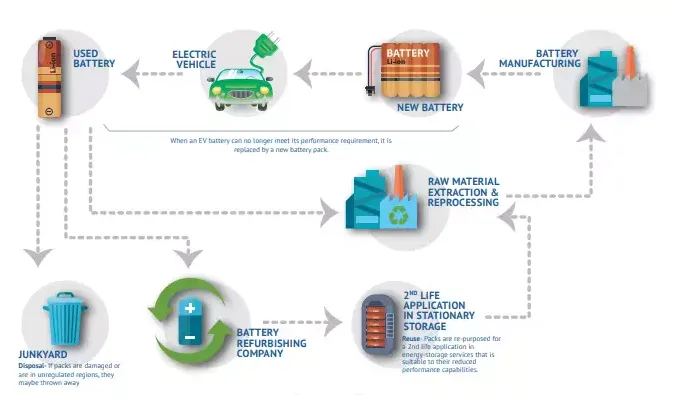
Figure: Electric Vehicle Battery Life Cycle [Auto Economic Times, link]
Li-ion batteries cannot be disposed of in the same manner as regular chemical/industrial waste:
- A variety of chemicals are present in lithium-ion (li-ion) batteries. Improper disposal has serious consequences, including environmental pollution and the depletion of (material) resources.
- Lithium is a highly reactive metal that is difficult to control. High temperatures, an excessively high charging voltage, a short circuit, or even too much strain can all cause an exothermic reaction - a chemical reaction that releases energy through light or heat - in the battery. In a nutshell, it can quickly catch fire. This is why airlines prohibit the transport of spare lithium metal and lithium-ion batteries in checked baggage.
- A thin sheet of polypropylene separates the electrodes and prevents short-circuiting in lithium-ion batteries. A thermal event can occur if a device is crushed or punctured, as batteries short-circuit when the separator between their positive and negative components is breached. The stronger the thermal reaction, the larger the battery. As a result, a discarded battery could ignite other flammable materials nearby. Especially if a large number of batteries are gathered, where even a single lithium-ion battery could ignite.
It is difficult to process lithium-ion batteries as e-waste:
There are three major reasons why processing lithium-ion batteries can be difficult.
- First, because these batteries are bonded to the hardware, they can be difficult to remove from devices in many cases.
- The second reason is that it is very easy to damage the battery during the disassembly process. As a result, professional separation and recycling generally necessitate the use of specialised tools, processes, and controls.
- Finally, due to the high temperature exothermic reaction, lithium-ion batteries have been linked to a number of fires. High-capacity batteries can be discharged during processing to reduce the risk of fire or the release of toxic fumes. Thermal events must be classified as much more likely than in conventional batteries, even when the batteries are in storage.
How to Recycle Lithium-Ion Batteries Correctly:
- How should customers dispose of their batteries?:
- Lithium-ion batteries can be recycled, but only in approved facilities. They must be discarded at a household e-waste collection point or a battery-recycling drop off location. Of course, the electrical hazard must be taken into account. Because they can deliver higher voltages, high-capacity batteries can pose an electric shock hazard.
- Lithium-ion batteries can be recycled, but only in approved facilities. They must be discarded at a household e-waste collection point or a battery-recycling drop off location. Of course, the electrical hazard must be taken into account. Because they can deliver higher voltages, high-capacity batteries can pose an electric shock hazard.
- How should professional users/companies dispose batteries?:
- Make sure lithium batteries are not exposed to excessive heat or prolonged sunlight. Batteries should not be exposed to water or humidity. Handle these batteries with care and package them properly so that the safety device (casing) is not damaged. When batteries are stacked without a protective layer or placed beneath heavy objects, this is a common occurrence. Additionally, ensure that cores do not come into direct contact with one another and that batteries are professionally discharged before further processing. Failure to do so can result in batteries exploding, rupturing, or catching fire.
- Li-ion batteries contain materials that, with the proper process, can be recycled. Metal compounds, ferrous metal, aluminum, copper, graphite, and plastic are examples of recyclable materials.
- Additional points:
- If possible, remove the device's battery.
- Batteries should be kept in a cool, dry place, such as a plastic container.
- To avoid short-circuiting, store the batteries in an insulated plastic bag if they are physically damaged.
- Recycle your batteries at a recycling centre or in a local battery drop-off bin.
- Batteries should be packaged in UN-approved barrels or boxes (depending on the type), with layers separated with dry sand (for lithium-ion) or vermiculite.
- If the batteries cannot be separated easily, contact a specialist, and ensure that the specialist processing facility has the necessary permits.
- To prevent short circuits, insulate the battery terminals or wires.
Avoid these mistakes when recycling lithium-ion batteries:
- Batteries should not be disposed of in your regular household garbage or recycling bin.
- Batteries may explode if burned in a fire.
- Don’t mix damaged, and non-damaged batteries.
- Batteries should not be stored in metal containers.
- Don’t store batteries for a long period of time.
- Crush, puncture, throw, or do anything else to the batteries that could result in electrodes coming into contact and short-circuiting.
- Place a large number of batteries together without proper segregation, as this increases the risk of a fire.
Batteries without protective casings and pouch cells must be sorted separately for each of these three categories for safety reasons, resulting in six potential sorting categories (refer figure).
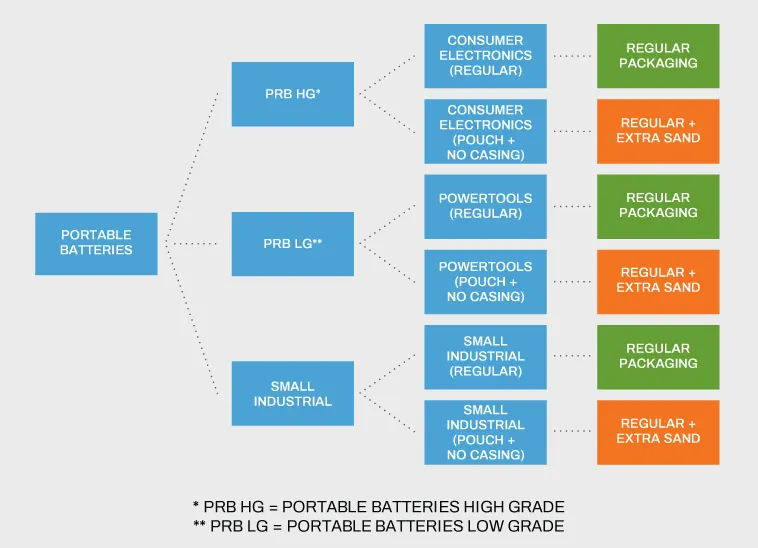
Figure: Tree Chart for Disposal methods of various lithium ion batteries and their users [simslifecycle, link]
Conclusion:
The specifications of a chosen Lithium ion cell of the battery model "LIR18650 2600mAh" has been studied. Additionally, the difference between nominal voltage and maximum voltage has been understood. The situation under which the changes in dimensions and weight of a cell can be observed has been found. Also, various mechanical testing and standards has been studied. Finally, the discard procedure suggested generally for used Li ion+ batteries recognized.
References:
- https://www.ineltro.ch/media/downloads/SAAItem/45/45958/36e3e7f3-2049-4adb-a2a7-79c654d92915.pdf
- https://electronics.stackexchange.com/questions/93892/maximum-charging-voltage-for-li-ion-battery
- https://www.usaid.gov/energy/powering-health/technical-standards/lithium-ion-batteries
- https://www.linkedin.com/pulse/confusion-nominal-voltage-especially-nmc-cells-36v-37v-yadav/?trk=related_artice_Confusion%20with%20Nominal%20voltage%20especially%20in%20NMC%20cells%3A%203.6V%20or%203.7V%3F_article-card_title
- https://www.mpoweruk.com/testing.htm
- https://www.ionenergy.co/resources/blogs/battery-safety/
- https://auto.economictimes.indiatimes.com/news/auto-components/evs-battery-waste-and-million-dollar-opportunity/77215015
- https://cleanriver.com/how-to-safely-dispose-recycle-lithium-ion-batteries/
- https://www.sciencedirect.com/science/article/abs/pii/S0378775303002817
- https://www.simslifecycle.com/blog/2019/guide-how-to-responsibly-dispose-of-lithium-ion-batteries/