Relation between Stoichiometric combustion and the number of carbon atoms.
AIM: To find the relation between Stoichiometric combustion and the number of carbon atoms.
OBJECTIVE:
1. Write functions to calculate the stoichiometric co-efficient (ar) for each fuel
2. Show a plot that compares the effect of a number of atoms of carbon on the stoichiometric co-efficient "ar". Compare how this trend changes with the fuel type (alkane, alkene, and alkyne).
THEORY:
The ideal combustion process during which a fuel is burned completely with theoretical air is called the stoichiometric combustion of that fuel. Here, the minimum amount of air needed for the complete combustion of a fuel is called stoichiometric or theoretical air. Thus, when fuel is completely burned with theoretical air, no uncombined oxygen is present in the product gases. The theoretical air is also referred to as the chemically correct amount of air, or 100 percent theoretical air. A combustion process with less than the theoretical air is bound to be incomplete. Also as a product, we obtain only `CO_2, H_2O, N_2`
To show a plot that compares the effect of the number of atoms of carbon on the stoichiometric coefficient (ar) for different fuel types namely, alkanes, alkenes, and alkynes; we have to find the relation for stoichiometric coefficient (ar) for different types of fuels; we can do that by applying mass balancing to each of the elements in the relation for each type of fuel.
1. Stoichiometric combustion reaction for alkanes
`C_nH_(2n+2) + ar(O_2 + 3.76N_2) = aCO_2 + bH_2O+ cN_2`
Where, n=number of moles of carbon(C)
Ar= stoichiometric coefficient
a= number of moles of CO2
b= number of moles of H2O
c= number of moles of N2
By applying mass balance equation
For carbon (C) :- n= a
For hydrogen:- 2n+2 = 2b or n + 1 = b
For oxygen:- 2ar=2a + b
For nitrogen:- 3.76⋅2⋅ar = c
From the above balancing equation, we’re going to find 'ar' in terms of 'n'.
2ar = 2n + n + 1
Stoichiometric coefficient, `ar = (3n +1)/2`
The above equation shows the relationship between the stoichiometric coefficient (ar) and the number of moles of carbon (n) for alkanes.
2. Stoichiometric combustion reaction for alkenes
`C_nH_2n + ar(O_2 + 3.76N_2) = aCO_2 +bH_2O + cN_2`
Applying mass balance for each of the element of the equation
For carbon (C):- n=a
For hydrogen (H):- 2n = 2b or n= b
For oxygen (O)(O):- 2ar = 2a + b
For nitrogen (N)(N):- 3.76⋅2⋅ar= c
From the above balancing equation, we’re going to find 'ar' in terms of 'n'.
Putting the value of (V) and (VI) in equation (VII); we get:
2ar = 2n + n
Stoichiometric coefficient, `ar = (3n)/2`
The above equation shows the relationship between the stoichiometric coefficient (ar) and the number of moles of carbon (n) for alkenes.
3. Stoichiometric combustion reaction for alkynes.
`C_nH_(2n-2) + ar(O_2 +3.76N_2) = aCO_2 + bH_2O + cN_2`
Applying mass balance equation
For carbon (C):- n=a
For hydrogen (H):- 2n - 2 = 2b or n - 1 = b
For oxygen (O):- 2ar = 2a + b
For nitrogen (N):- 1.76.2.ar = c
From the above balancing equation, we’re going to find 'ar' in terms of 'n'
2ar = 2n + n - 1
Stoichiometric coefficient, `ar = (3n -1)/2`
The above equation shows the relationship between the stoichiometric coefficient (ar) and the number of moles of carbon (n) for alkynes.
MATLAB program
clc
clear all
close all

%create an array for 20 atoms
%number of moles of carbon is denoted by n
%stoichiometric coefficient is denoted by ar

n = linspace (1,20,20);

for i=1:length(n)
    ar_alkanes(i)=((3*n(i))+1)/2;
    ar_alkenes(i)=(3*n(i))/2;
    ar_alkynes(i)=((3*n(i))-1)/2;
end

%plotting the graph b/w (ar).

figure(1)
plot(n,ar_alkanes,'linewidth',2,'marker','o')
hold on
plot(n,ar_alkenes,'linewidth',2,'marker','x')
hold on
plot(n,ar_alkynes,'linewidth',2,'marker','*')
title('Stoichiometric coefficient(ar) vs Number of moles(n)')
xlabel('number of moles (x)')
ylabel ('stoichiometric coefficient (ar)')
legend('alkanes','alkenes','alkynes')
grid on
RESULT
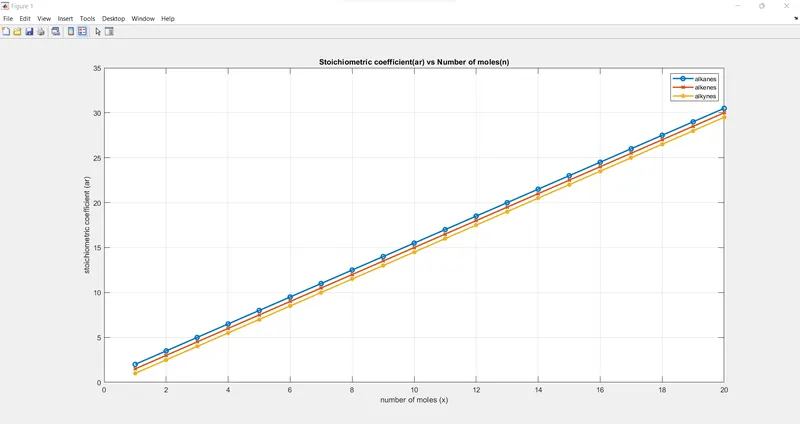
CONCLUSION
From the above plot, we can conclude that the variation of the stoichiometric coefficient (arar) vs. the number of moles of carbons (nn) is linear. Here all three different fuels, named alkanes, alkenes, and alkynes depicting different y-intercepts. It is understood from the above plot and as well as from the ‘ar_alkynes’ values, that y-intercept of alkynes are showing the least y-intercept as compared to the other two fuels; alkynes are showing smaller values of stoichiometric coefficient (arar). Since, stoichiometric coefficient simply denotes, the number of moles of oxygen required to completely burn the fuel. Henceforth, alkynes require a small amount of oxygen (air) to get completely burned in comparison to alkenes which require little more oxygen, and alkanes the most amount of oxygen to get burned.