Rayleigh Taylor Instability Challenge
RAYLEIGH TAYLOR INSTABILITY CHALLENGE
AIM :
To find out the rayleigh instability waves ,between two fluids when they are in contact, by using different mesh sizes.
INTRODUCTION :
Rayleigh instability occurs when the two different fluids with different density penetrate each other ,it occurs when two light fluid pushes heavy fluid due to gravity nad density difference .this was the set up studied by lord Rayleigh .the rayleigh instability is similar to the bernoulis but it says about the pressure difference inside the fluids .
The contact discontinuity between the two fluids is unstable to perturbations that grow by converting potential energy to kinetic energy ,causing bubbles of the low- density fluid to rise and the high density fluid to sink.
There are many applications of rayleigh ,such as rayleigh waves are used in geophysics and geotechnical engineering for the charaterisation of the oil deposits.and rayleigh scattering are used in weather radar and remote sounding .
PRE-PROCESSING :
GEOMETRY:
In order to do the rayleigh instability process ,first we have to create a geometry .inorder to create the geometry we have to go to ansys fleunt and then go the space claim and then create geometry.
draw two rectangles with 20mm lenght and 20mm height .
And after drawing the rectangle click on the pull option inorder to change in to the surface and after then click on the workbench then click on the share option then click ok .
by doing the sharing ,that the surfaces may transfer its molecules to the other .
And then after close the geometry..and then go to mesh .
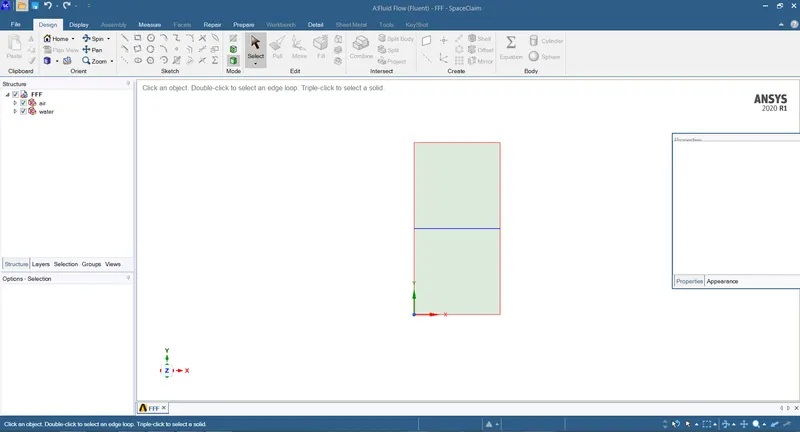
Geometry in the space claim
MESH :
After the geomerty is created then go the mesh inorder to create the mesh .after going to the mesh process
first do the base mesh
here i have done three types of meshes
0.05mm ,0.02mm ,0.01mm
the below figures shows the meshes with different refined meshes.
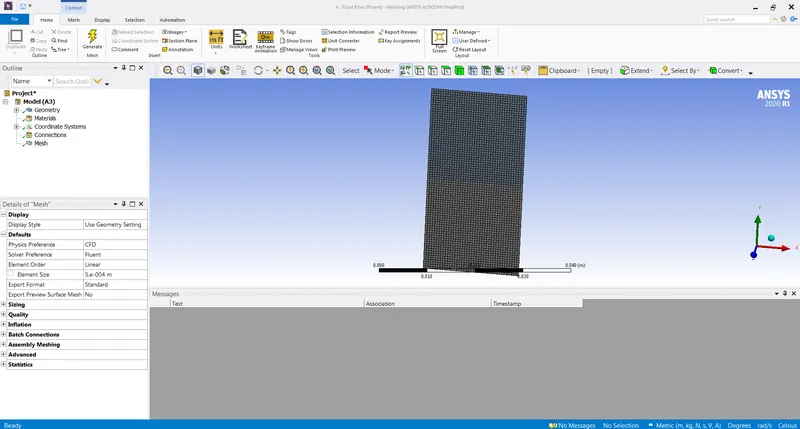
mesh with 0.05 mm
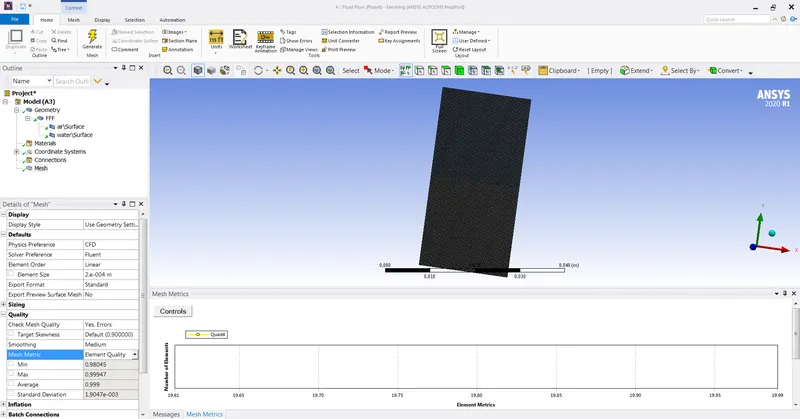
mesh with 0.02mm
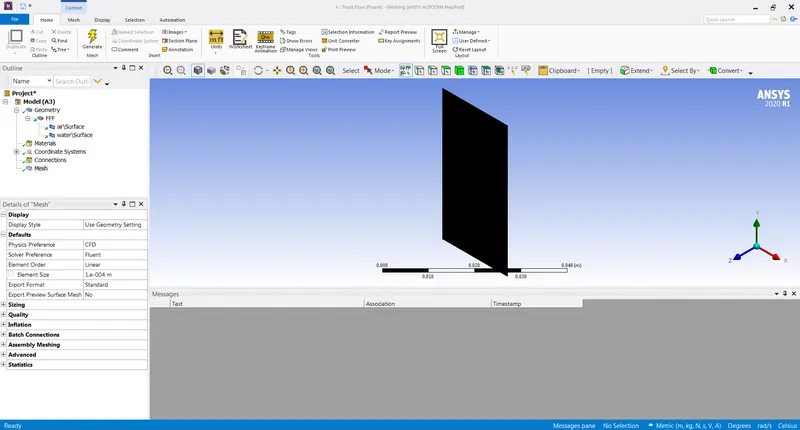
Mesh with 0.01 mm
and above all figures shows mesh with differnt grid sizes ...as we observed
and after that go the post processing process like solution ,setup and results
SOLUTION PROCESS :
I n the solution process we are going to create the solver method,phases ,materials and animation and so on.
in the solution process we set up
transient based solver
taking gravity in consideration (-9.81 in y axis )
And multi phase ,in the multiphase we using the implicit method for doing the process
And add the materials as air and water
And after Adding the materials we are going to phase option and in this we are going to allot the phase names
Then intialize the process and after then patch ,water with volume fraction -1 and air with -0
Then go to results and contour ,add new select the phase option and then water then select all the surfaces then display
then you can see the contour wheather the process is right or wrong
and the create the animation ofthe contour and then click ok.
give the time steps and ilterations then click on caluclate .
and then after the completion of the calucltion click on the playback in the aniamtion and change the format into mpeg and then click on write ,then it will write the animation and after that play the animation
you can the process ,you will get an idea how the rayleight instablity works .
https://drive.google.com/file/d/17tiuLbLe2resKruBUBmItg5Ki0FsgOii/view?usp=sharing -animation of 0.05 mesh
https://drive.google.com/file/d/13N7gt02wljIcHvj4u7hMINs8ShDXkuPn/view?usp=sharing -animation 0f 0.02 mesh
https://drive.google.com/file/d/1isRgHn0npn7cf6-X9JFCF4mKa6eWmMoo/view?usp=sharing -animation of 0.01 mesh
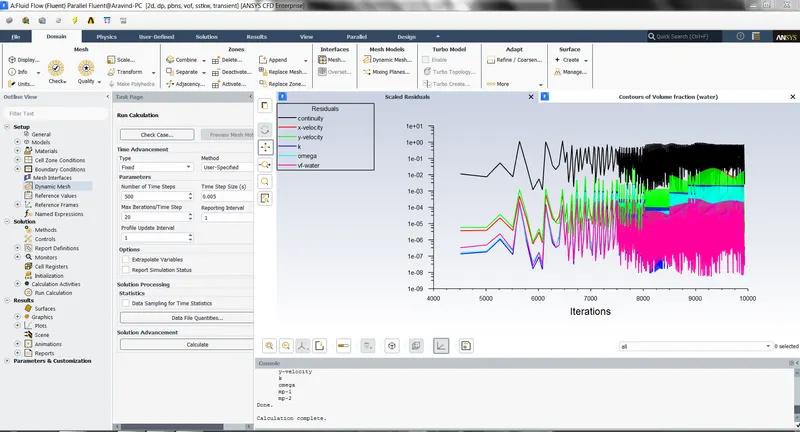
0.05 mesh residuals
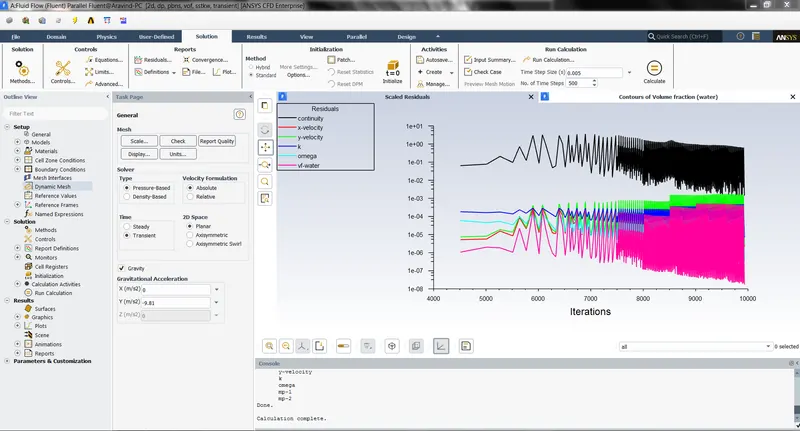
0.02 residuals
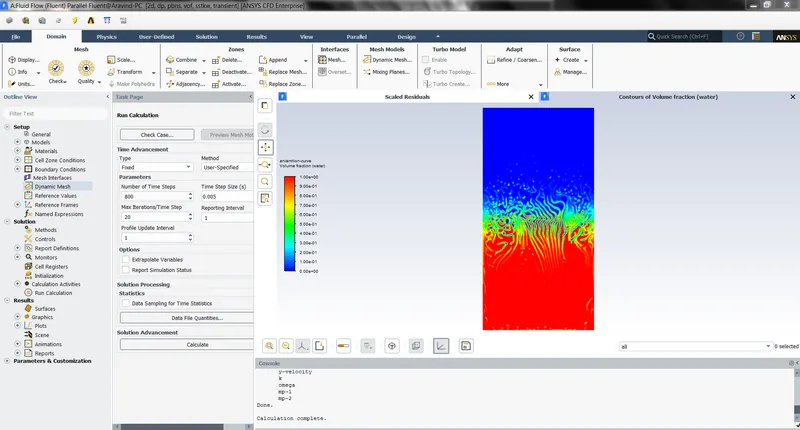
0.01 mesh after the completion of the calucltion .....show the variation how the fluids changes .
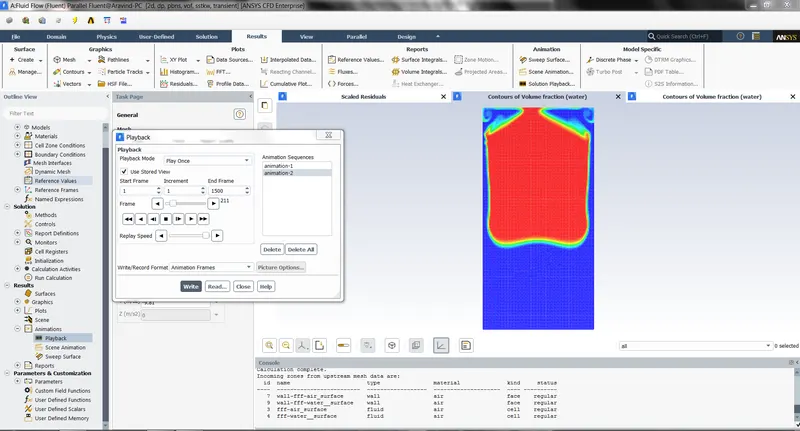
0.02 mesh size animation picture how the interphase is occuring between the fluids .
And the above all figures and aniamtion shows how the air and water are changing their phases when they are in contact .
WHY THE STEADY STATE APPROACH IS NOT RECOMMENDED FOR THIS PROCESS
The steady state approach is independent of time ,which isonly depended on the end stage .And the steady state process cannot track the intermediate tracks and it also time consuming process .as the pattern is changing from laminar to transiet and transient to turbulent ,the at which the time period increases an dbubbles are generated for RT instability and at this time ,the steady state approach is not suitable .
for incompersssible flow ,As the mach number is more then 0.1 densities are going to change with time period and for this transient approach is more suitable .
ATWOOD NUMBER :
Atwood number is a dimensionless number ,which describes the density difference between two adjacent fluids at a common interface .Atwod number is an important parameter in the study of rayleigh taylor instability and meshkov instability .if the density difference is very low than atwood number is tends to zero
the formula for atwood number is given below
At=density 1-density2/density 1+density2
density 1=density of the heay fluid
density 2=density of the light fluid
once the atwood number increases for the incompressible fluids the spikes height increases and the bubble development slows down
CONCLUSION :
And at the end ,i canconclude that by using different kinds of mesh sizes like the refined meshes we can get the accurate values .
and we observe the above figures and the changes we observe after refining the mesh are more good and accurate
And also learned how to rayleigh instablity process ,and how it is done and works .
And also byusing refined mesh we can see the flow variation more better then the normal meshes.
And i also what is atwood number and importance of the atwood number.