Exhaust Port Challenge
EXHAUST PORT
AIM:
To find out the conjugate heat transfer of the exhaust port and also the velocity at the exit of the port.
INTRODUCTION :
As we know the function of the exhaust port is to send the exhaust gases that are coming from the engine cylinder .And we sholud have to simulate and design the port carefully ,that which cause the back pressure and that leads to the decrease the efficincy of the engine .so, when the hot gases are coming from the cylinder will have high temperature and that pass through the exhaust system ,and while passing thier will be a heat transfer occurs across the between the gases and the exhaust system .and conjugate heat transfer occurs and also the heat transfer occurs due to the convection .
PRE-PROCESSING :
GEOMETRY:
In the geometry we going to import the component from the downloads in the space claim and here we are going to extract the volume of the component by selecting the edges of the component and after selecting then click ok ,and then volume wil be created ,fluid volume and solid volume and move them to new component and also select share option inorder their volumes and that will give good results in the meshing
.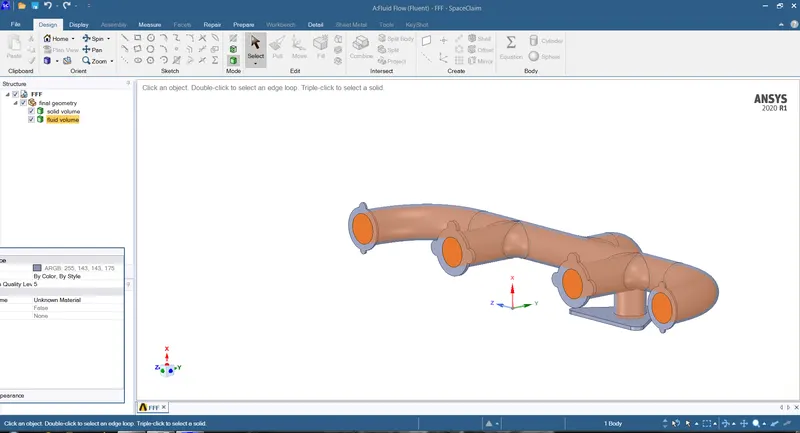
geometry in space claim
MESH :
And after the geometry is done then click on the mesh ,after the mesh page has opened then first give the name to the component and then generate the coarse mesh 150mm .and see that the shape of the cells are intersecting or not and after that update mesh
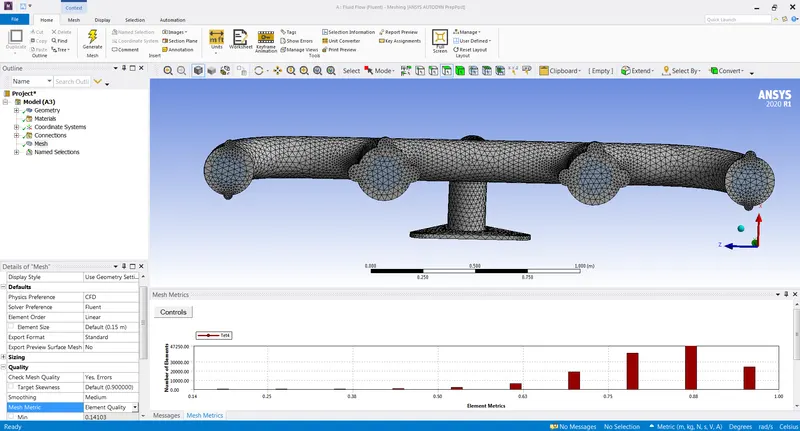
coarse mesh with quality >10 ,means it is fine
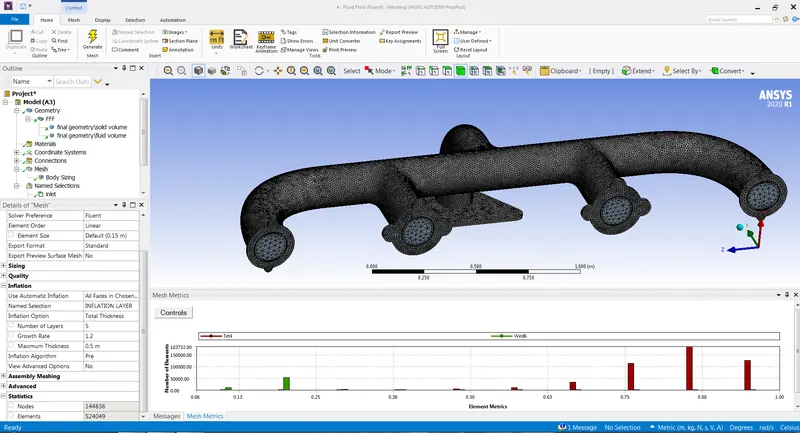
refined mesh 10mm
Nodes -144836
Elements -524049
while doing the refined mesh ,create the inflation layer ,with 5 layers and 5mm thickness and after creating all this then generate mesh and update it
and aftert then go the post processing for doing the solution process
POST PROCESSING :
After the meshing is done ,then click onthe set up for the solution process ,after clicking the page opens and
then here we are using pressure based solver ,as pressure based solvers are used for low mach number
and afterward select the energy equation and select the k-epsilon equation for solving and then give the boundary conditions as inlet velocity as -5m/s and temperature as -700kand the heat transfer coefficient -20w/m2 and then click ok .
and after that intialize the hybrid ,after the hybrid intialization select the contours plot for plotting the temperature and also xy plot to see wheather the results are correct .
as below the following plots shows the results
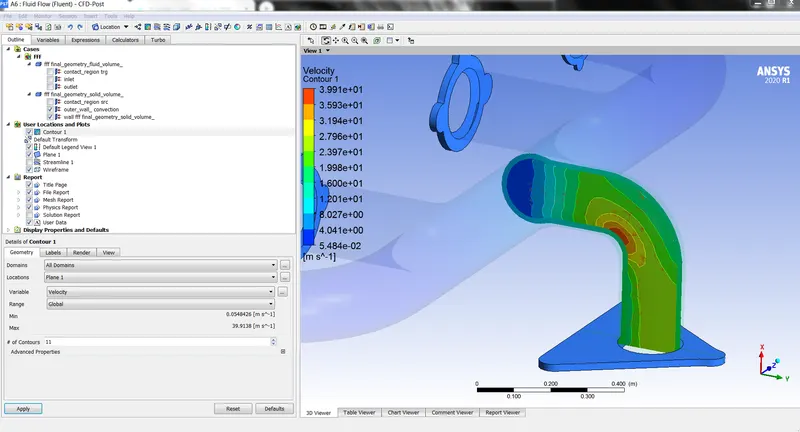
coarse mesh -velocity contour -40m/s
as we see the max velocity in the exhaust port ...and the region it high.
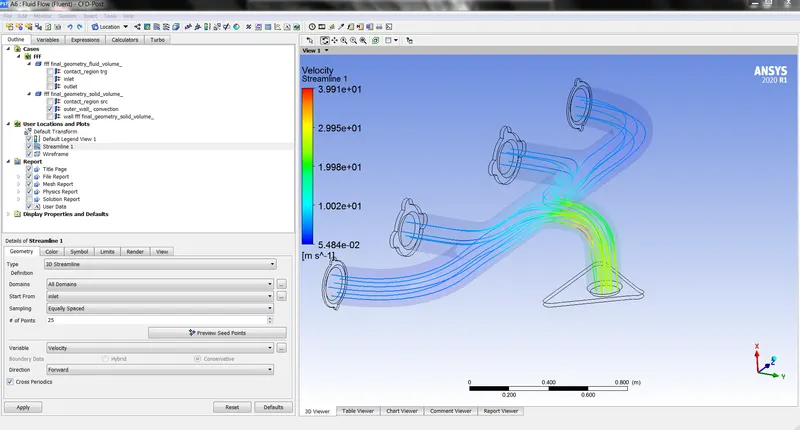
coarse mesh -stream line visualization
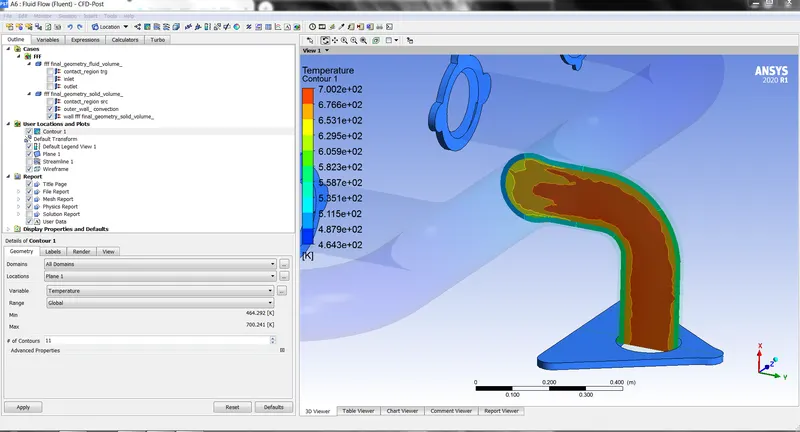
the above figure shows the temperature distribution inthe port and also where the maximum temperature is .
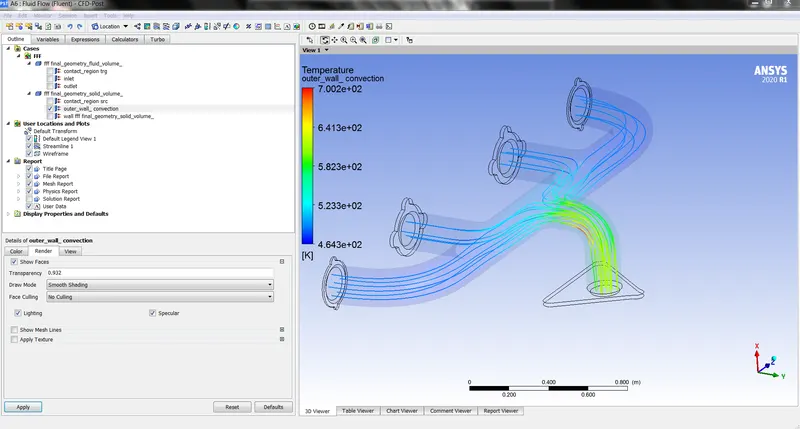
coarse temperature stream line
FINE MESH PLOTS :
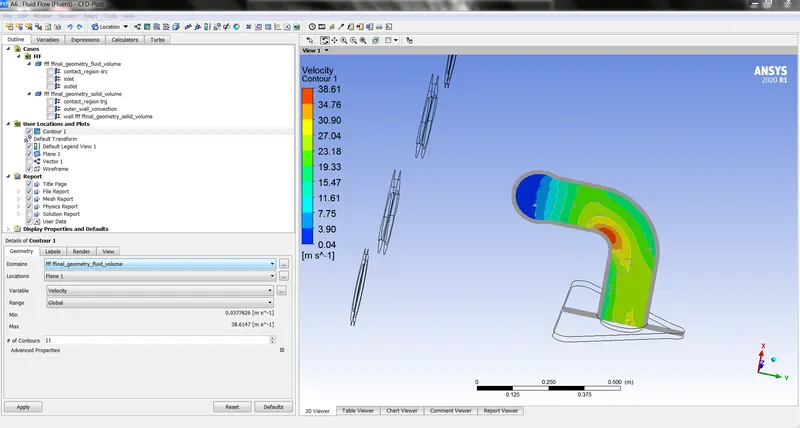
FINE MESH -VELOCITY PLOT -38M/S and the plot shows where the maximum velocity is .
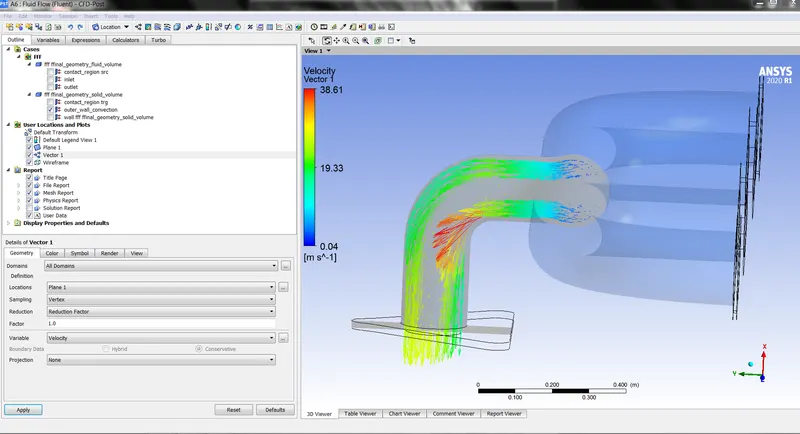
VELOCITY VECTOR
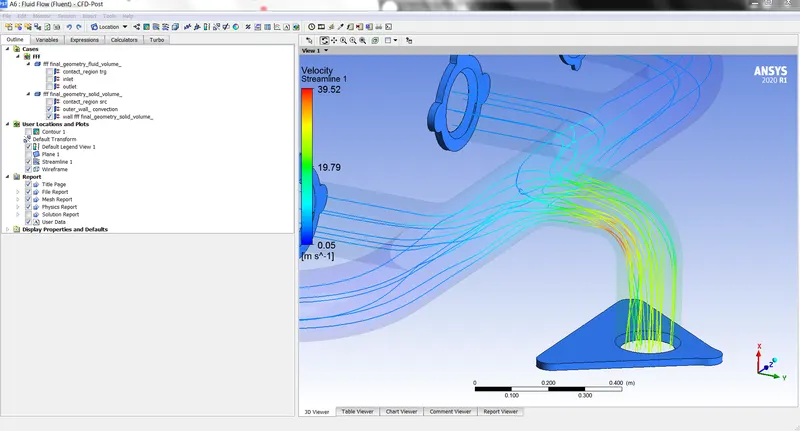
VELOCITY -STREAMLINE
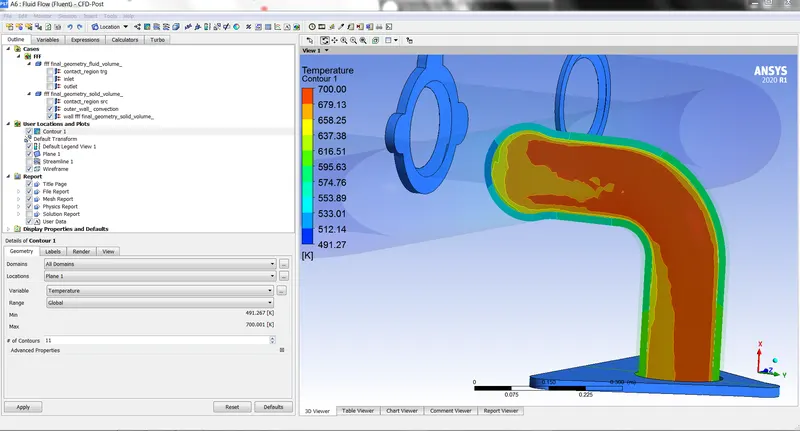
TEMPERATURE -VECTOR PLOT
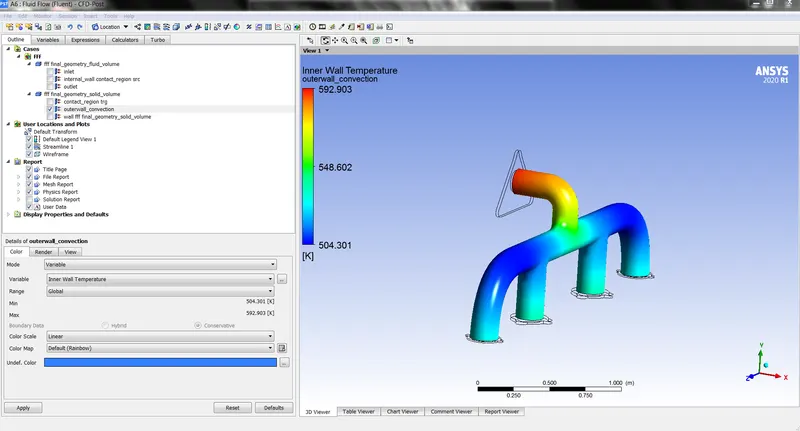
INNER WALL TEMPERATURE
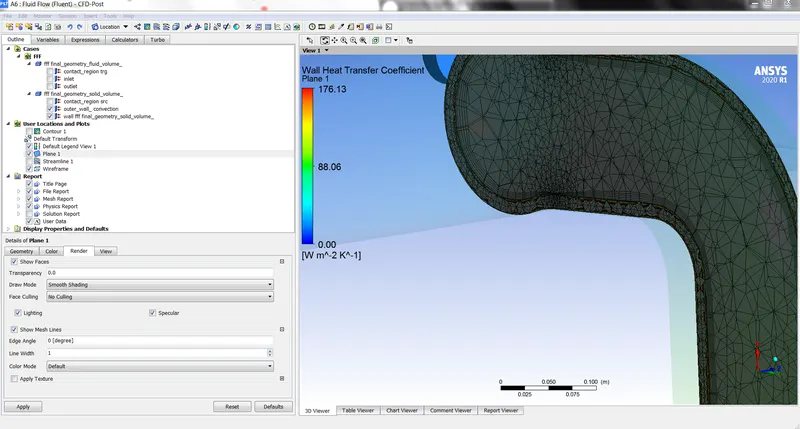
HEAT TRANSFER COEFFICIENT
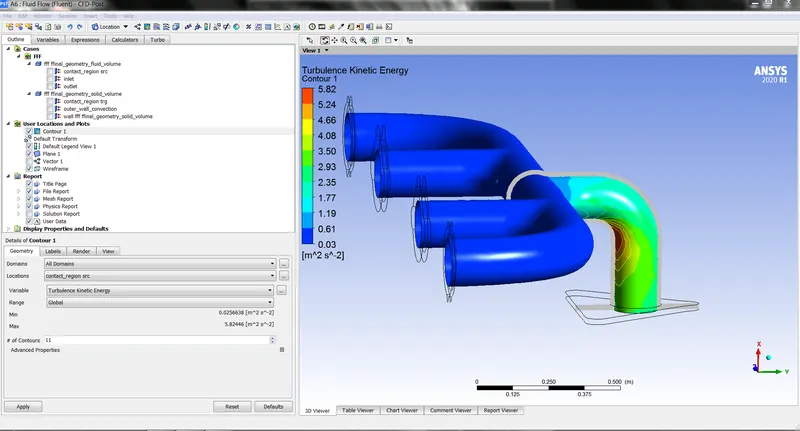
TURBULENCE KINETIC ENERGY
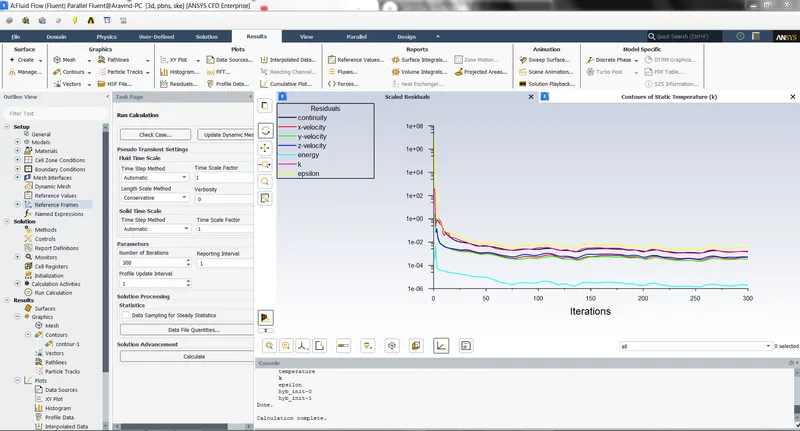
RESIDUALS
As the above following figure shows the where the max temperature and the max velocity occurs in the port .
by this we can identify where the what is the condition of the system where the maximum heat transfer occurs .
and also the residuals plot shows the how the process takes place
and the stream line and the vector plots the how the flow velocty reaches the maximum condition and where it effects the most in the system.
QUESTION AND ANSWERS :
- AS ,the conjugate heat transfer is heat transfer where the heat transfer occurs between the two domians fluid and the solid by exchanging the thermal energy.as we see in many applications conjugate heat transfer occurs like condensers ,electrical systems ,in automobiles and many it plays a important role in the heat transfer analysis of the systems .it can show the where the maximumheat tranfer ocuurs and how it is occuring in the system .by this we can assure what we can do to reduce the given conditons
- And also we should choose te correct turbulence model in oder to get correct values and also correct solution for the given condition .like k-epsilon Y+ -30-300 and omega Y+0-5 ,like that turbulence model we should we based on the model or conditon.
And as the following process is correct as the exhaust velcoity increases while leaving the system ,as we are given the inlet velocity as 5m/s and the exit velocity is 38m/s ,so by this we can say that soltuion process is correct
and the heattransfer coefficient can also find by using nusselt number
And as finally by using the finer mesh we get the results more accurate and also shows the exact conditions of the component where the max and mini .so we can analyse the component in correct way .
CONCLUSION:
And finally conclude that ,i have learned what the conjugate heat transfer is ,as it defined as the heat transfer between the two domains like solids and the liquids .and there aremany applications like condensers ,gas turbines ,automobiles,pumps and heat exchangers and so on .and the selecting the turbulence model an dfine mesh plays a vital role in getting the results .And also i got an idea where max temperature and velocity occurs in the exhaust port .