Projefct 1_Comparative study of different storey buildings for Seismic forces
1) Given that the to calculate the in Etabs
Factors influencing the dynamic characteristics of a building
Factors influencing the Natural Period of a building
Factors influencing the Mode shape of oscillations
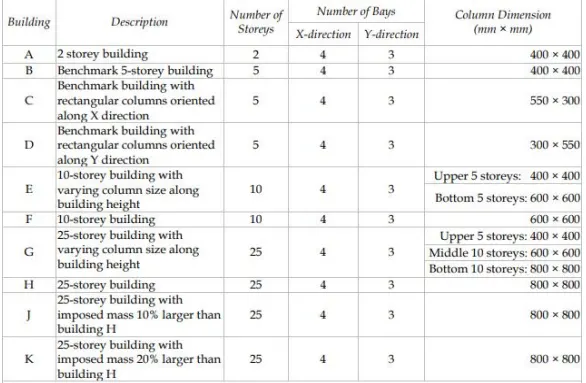
A) In this given that the building is a 2 storeys building with number of bays in X axis as 4 and Y axis as 3 and column dimension as 400*400 mm and beam dimension as 300*400 mm and the live load as 3kn and dead load ie wall load as 10Knm by this we can get the table of Etabs results as.
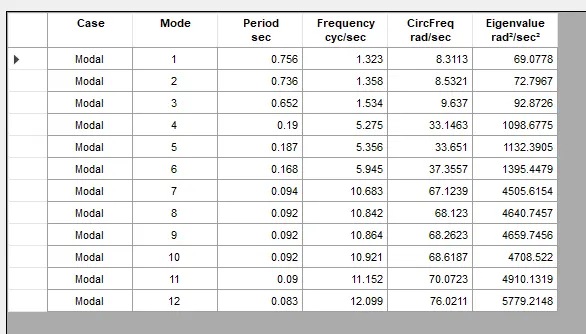
B) In this given that the building is a 5 storeys building with number of bays in X axis as 4 and Y axis as 3 and column dimension as 400*400 mm and beam dimension as 300*400 mm the live load as 3kn and dead load ie wall load as 10Knm by this we can ge the modal table of Etabs results as.
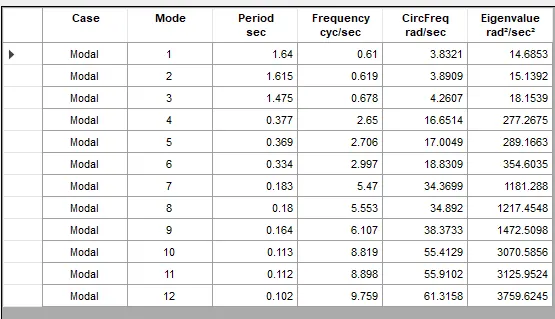
C) In this given that the building is a 5 storeys building with number of bays in X axis as 4 and Y axis as 3 and column dimension as 550*300 mm and beam dimension as 300*400 mm by this we can ge the modal table of Etabs results as.
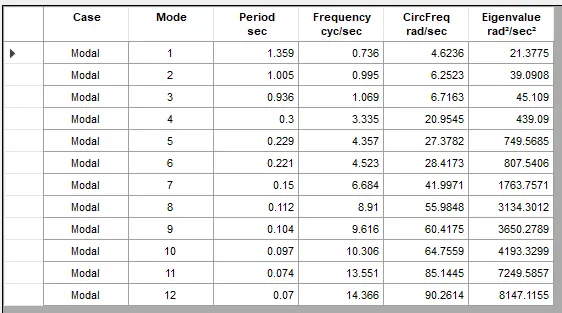
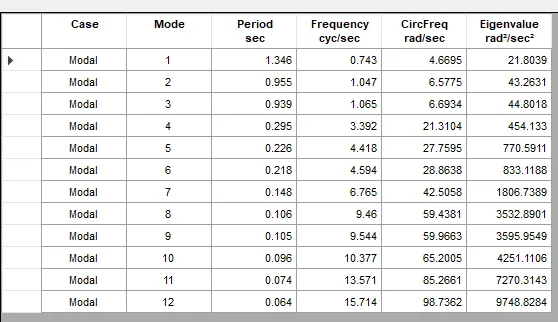
D) In this given that the building is a 5 storeys building with number of bays in X axis as 4 and Y axis as 3 and column dimension as 300*550 mm and beam dimension as 300*400 mm the live load as 3kn and dead load ie wall load as 10Knm by this we can ge the modal table of Etabs results as.
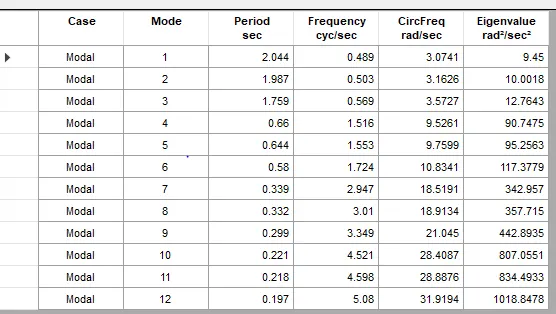
E) In this given that the building is a 10 storeys building with number of bays in X axis as 4 and Y axis as 3 and column dimension for first five storeys as 600*600 mm and upper five storeys as 400*400 mm and beam dimension as 300*400 mm the live load as 3kn and dead load ie wall load as 10Knm by this we can ge the modal table of Etabs results as.
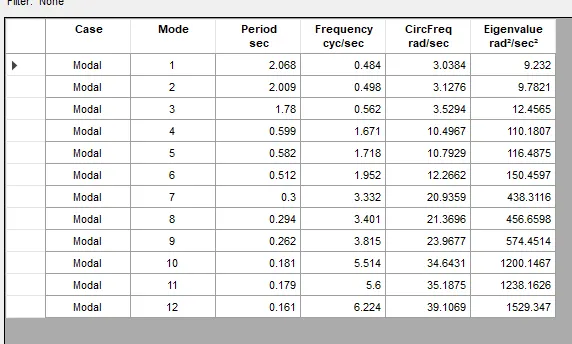
F) In this given that the building is a 10 storeys building with number of bays in X axis as 4 and Y axis as 3 and column dimension 10 storeys as 600*600 mm and beam dimension as 300*400 mm the live load as 3kn and dead load ie wall load as 10Knm by this we can ge the modal table of Etabs results as.
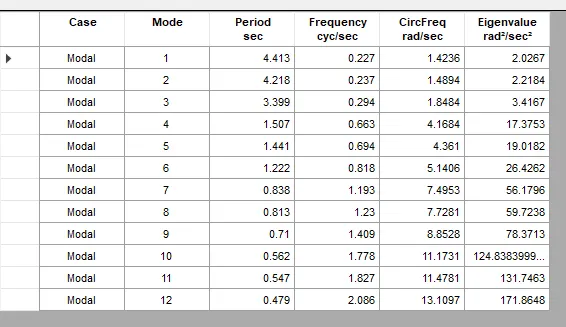
G) In this given that the building is a 25 storeys building with number of bays in X axis as 4 and Y axis as 3 and column dimension for first five storeys as 800*800 mm and secound five storeys as 600*600mm and remaining five storeys as 400*400 mm and thebeam dimension as 300*400 mm by this we can ge the modal table of Etabs results as.
H) In this given that the building is a 25 storeys building with number of bays in X axis as 4 and Y axis as 3 and column dimension 25 storeys as 800*800 mm and the beam dimension as 300*400 mm the live load as 3kn and dead load ie wall load as 10Knm by this we can ge the modal table of Etabs results as.
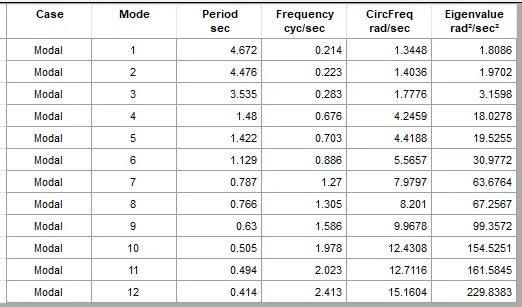
J) In this given that the building is a 25 storeys building with number of bays in X axis as 4 and Y axis as 3 and column dimension 25 storeys as 800*800 mm and the beam dimension as 300*400 mm and the 10% of increment in the height of the building that we get in the last building ie G the live load as 3kn and dead load ie wall load as 10Knm by this we can get the modal table of Etabs results as.
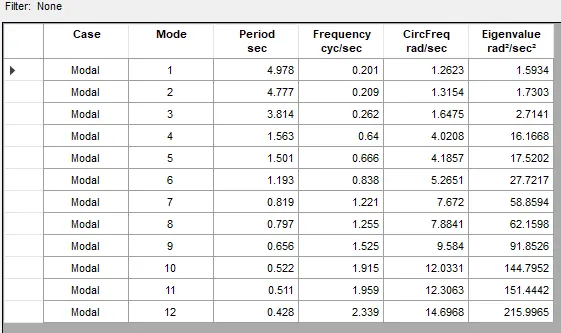
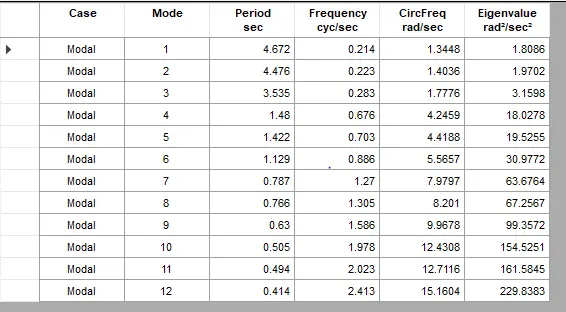
H) In this given that the building is a 25 storeys building with number of bays in X axis as 4 and Y axis as 3 and column dimension 25 storeys as 800*800 mm and the beam dimension as 300*400 mm and the 20% of increment in the height of the building that we get in the last building ie G the live load as 3kn and dead load ie wall load as 10Knm by this we can get the modal table of Etabs results as.
mode 1 frequencies for the different buildings are taulated in a table for the different time period as
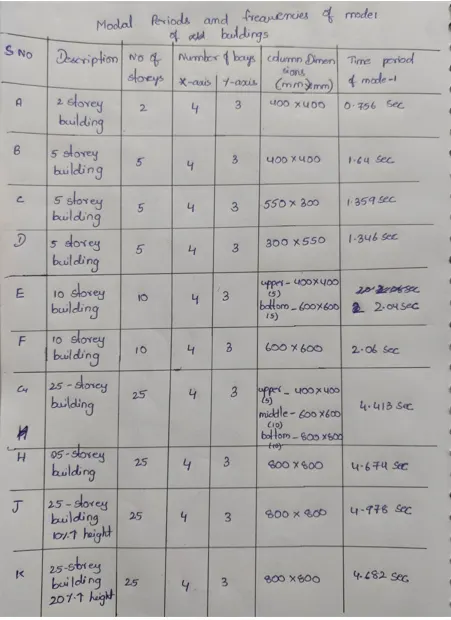
BY the above table by comparing all the buildings which consists of the different varieties that the modal frequiencies of the reults depends on the follwing factors.
- building A is small storey building so that modal frequency is less compare to others so the time period of the mode1 is 0.756 sec.
- By comparing the buildings B,C & D that all the conditions are similar but the column sizes and the orintation of the cloumn are different so the time period of mode1 is different ie 1.64 sec for B and 1.359 sec for C and 1.346 for D. so the time period is also depends in the column sizes and oreintation of column.
- By comparing the buildings E & F that all the conditions are similar but the column sizes for first 5 storeys and secound five storeys of building E is different and the orintation of the cloumn are different so the time period of mode1 is different ie 2.04 sec for E and 2.06 sec for F. so the time period is also depends in the column sizes and oreintation of column.
- By comparing the buildings G,H,J & K that all the conditions are similar but the column sizes for first 5 storeys and secound five storeys of building G is different and the orintation height of the basement is different as increing of height of 10% and 20% are different so the time period of mode1 is different ie 4.413 sec for G and 4.674 sec for H and 4.978 for J and 4.682 sec so the time period is also depends on the height of the basement that we consider.
SO by the comparision we can conclude that the the time frequiencies is depend on the factors of
- Column sizes and the orientation of the columns of the buildings
- columns which are considering for the differernt sizes for different floor levels as per condition.
- number of storeys of the buildings
- Height of the basement which are condsidering as per the condition.