Project on Concrete Mix Design for various grades of Concrete
where,
- f'ck = target average compressive strength at 28 days,
- fck = characteristics compressive strength at 28 days, and
- s = standard deviation (IS 10262:2009, Table-1)
- Target mean strength, f'ck = fck +1.65 s
- Volume of concrete = 1 m3
- Volume of cement = [Mass of cement] / {[Specific Gravity of Cement] x 1000}
- Volume of water = [Mass of water] / {[Specific Gravity of water] x 1000}
- Volume of chemical admixture (superplasticizer) @ 2.0% by mass of cementitious material) = [Mass of admixture] / {[Specific Gravity of admixture] x 1000}
- Volume of fly ash: [mass of fly ash ] /{[Specific Gravity of fly ash] x 1000}
- Volume of all aggregates = [a - (b + c + d + e)] i.e., (volume of concrete-(volume of cement + volume of water + volume of fly ash + volume of admixture).
- Mass of coarse aggregates = volume of all aggregate x volume of coarse aggregate x specific gravity of coarse aggregate x1000
- Mass of fine aggregate = volume of all aggregate x volume of fine aggregate x specific gravity of fine aggregate x 1000
- IS 10262 : 2009
- IS 456 : 2000)
- IS 8112
- IS 9103
- IS 3812 (part 1)
- To achieve desired workability, durability and the required strength of the structure which is measured in compressive strength.
- To make the concrete mix design as economical as possible.
Concrete Mix Design for M35 grade concrete with fly ash is as follows
1. STIPULATIONS FOR PROPORTIONING
| a. | Grade designation | : | M35 |
| b. | Type of cement | : | OPC 53 Grade conforming IS 12269 |
| c. | Maximum nominal size of aggregate | : | 20 mm |
| d. | Minimum cement content | : | 340 kg/m^3 (IS 456:2000) |
| e. | Maximum water-cement ratio | : | 0.45 (Table 5 of IS 456:2000) |
| f. | Workability | : | 100 mm slump |
| g. | Exposure condition | : | Severe (for reinforced concrete) |
| h. | Method of concrete placing | : | Pumping |
| i. | Degree of supervision | : | Good |
| j. | Type of aggregate | : | Crushed Angular Aggregates |
| h. | Method of concrete placing | : | Pumping |
| i. | Degree of supervision | : | Good |
| j. | Type of aggregate | : | Crushed Angular Aggregates |
| k. | Maximum cement content | : | 450 kg/m^3 (As per code) |
| l. | Chemical admixture type | : | Super Plasticizer ECMAS HP 890 |
| m. | Type of mineral admixture | : | Fly ash conforming to IS 38I2 (Part I) |
2. TEST DATA FOR MATERIALS
| a. | Cement used | : | OPC 53 Grade conforming IS 8112 |
| b. | Specific gravity of cement | : | 3.15 (Test – IS: 2720 ) |
| c. | Chemical admixture | : | Super Plasticizer conforming to IS 9103 (ECMAS HP 890) |
| d. | Fly ash | : | Conforming to IS 3812 (Part I) |
| e. | Specific gravity of Fly ash | : | 2.2 |
| f. | Specific gravity of: - | ||
|
: | 2.74 | |
|
: | 2.74 | |
|
: | 1.12 | |
| g. | Water absorption: - | ||
|
: |
0.5 % |
|
|
: | 2.5 % | |
| h. | Free (surface) moisture: - | ||
|
: | Nil (Absorbed Moisture also Nil) | |
|
: |
Nil |
|
| i. | Sieve analysis: - | ||
|
: |
Conforming to Table 2 of IS 383 |
|
|
: |
Conforming to Grading Zone II of Table 4 of IS 383 |
3. TARGET MEAN STRENGTH FOR MIX PROPORTIONING
f’ck = fck + 1.65 s
where
f’ck = target average compressive strength at 28 days,
fck = characteristics compressive strength at 28 days, and
s = standard deviation.
From Table I of IS 10262:2009,
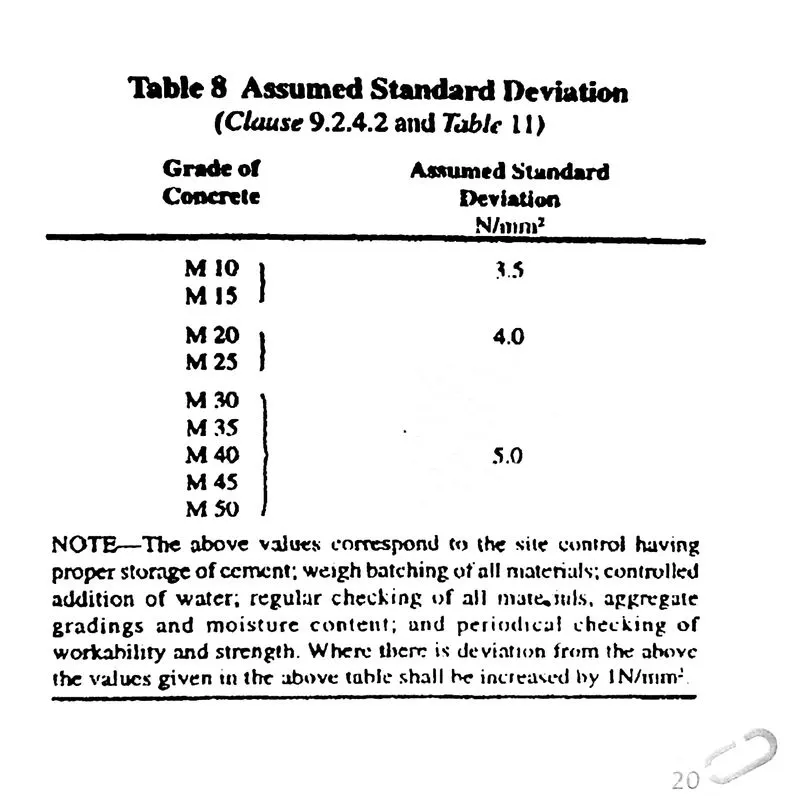
Standard Deviation, s = 5 N/mm2.
Therefore,
Target mean strength, f'ck = 35 + 1.65 x 5 = 43.25 N/mm2.
4. SELECTION OF WATER-CEMENT RATIO
From the Table 5 of IS 456,
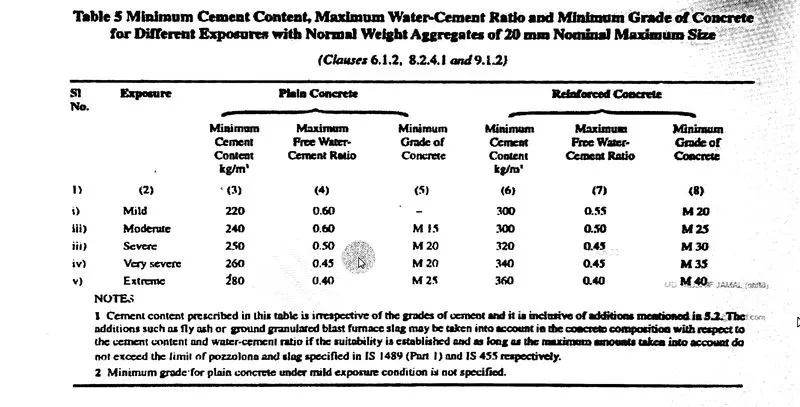
for Severe Exposure condition,
- Maximum Water Cement Ratio = 0.45
- Adopted W/C ratio = 0.45
5. SELECTION OF WATER CONTENT
From Table 2 of IS 10262:2009,
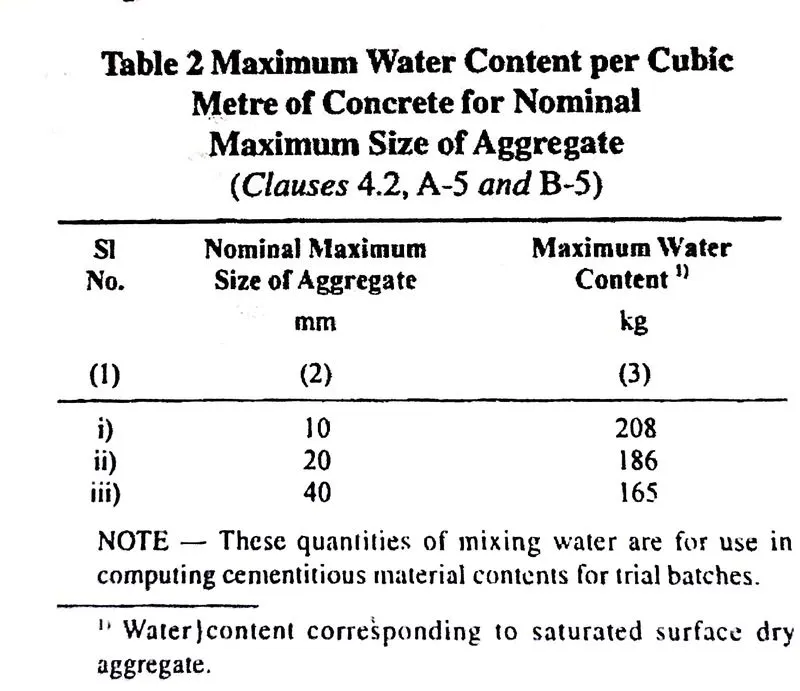
Maximum water content for 20 mm aggregate = 186 litre (for 25 to 50 mm slump range)
Therefore,
Estimated water content for 100 mm slump = 186+ (6/186) = 197 litre.
(Note: - If Super plasticizer is used, the water content can be reduced upto 20% and above.)
Based on trials with Super plasticizer water content reduction of 20% has been achieved,
Hence, the arrived water content = 197-[197 x (20/100)] = 158 litre.
Adopted Water Content = 160 litre
6. CALCULATION OF CEMENT AND FLY ASH CONTENT
Adopted w/c Ratio = 0.45
Total Cementitious (Cement +Fly ash) Content requirement = Water Content / Water-Cement ratio =160/0.45 =355.55 kg
Since flying ash is used, the amount of cementitious content (cement + fly ash) should be increased to get good performance and strength. The percentage of increasing cementitious content depends on experience and research. Here we have increased the cementitious content by 10%.
- Final Cementitious Content (Cement+Fly ash) = 356*1.10 = 391.6 kg
- Minimum Cement Content required for ‘severe’ exposure = 340kg (Table 5 IS 456)
- Adopted Cementious content = 391.6 kg > 340 kg
- Fly ash content requirement = 391.6 * 0.30 (30% replacement) = 117.48 ~ 118 kg
- Cement Content requirement = Cementious content – Fly ash = 391.6-117.48 = 274.12
- Calculation of Super Plasticiers @ 0.6 percent to the mass of cementitious content = 391.6*(0.6/100) = 2.35 kg
7. PROPORTIO0N OF VOLUME OF COARSE AGGREGATE AND FINE AGGREGATE CONTENT
From Table 3 of (IS 10262:2009)
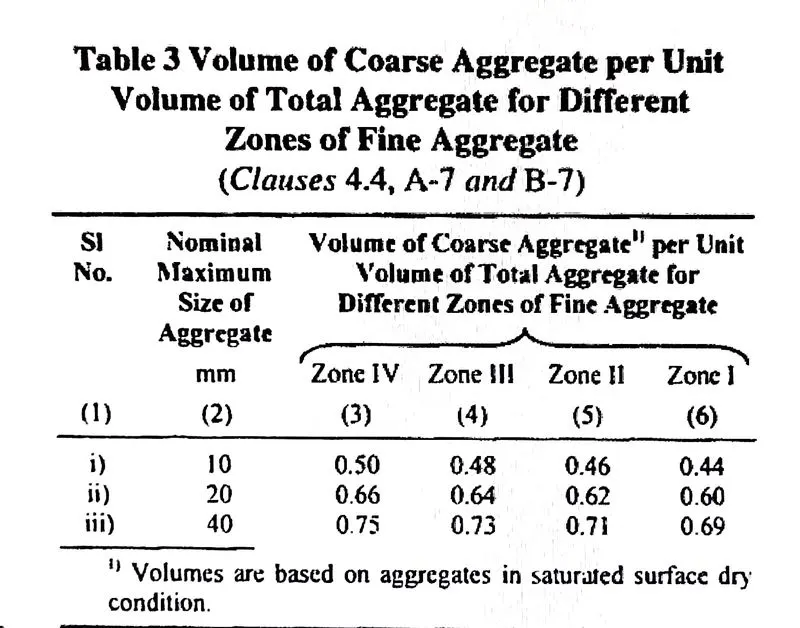
Volume of coarse aggregate corresponding to 20 mm size aggregate and fine aggregate (Zone II) for water-cement ratio of 0.50 =0.62 .
In the present case water-cement ratio is 0.44. Therefore, volume of coarse aggregate is required to be increased to decrease the fine aggregate content. As the water-cement ratio is lower by 0.06. The proportion of volume of coarse aggregate is increased by 0.02 (at the rate of -/+ 0.01 for every ± 0.05 change in water-cement ratio).
Therefore,
- Coarse Aggregate ratio for 0.45 w/c ratio = 0.63 (adding 0.01 for every decrease 0.05 and vice versa)
- Final Fine Aggregate ratio = (1-0.63) = 0.37
8. MIX CALCULATIONS
The mix calculations per unit volume of concrete shall be as follows:
a) Volume of concrete = 1 m3
b) Total Volume of cement = [Mass of cement] / {[Specific Gravity of Cement] x 1000}
= 275/(3.15*1000)
= 0.087 m3
c) Total Volume of Fly ash = [Mass of Fly ash] / {[Specific Gravity of Fly ash] x 1000}
= 118/(2.5*1000)
= 0.041 m3
d) Volume of water = [Mass of water] / {[Specific Gravity of water] x 1000}
= 160/(1*1000)
= 0.160 m3
e) Volume of Superplasticizers = Superplasticizers /(S.G*1000)
= 2.35/(1.12*1000)
= 0.002 m^3
f) Volume of all aggregate = [a-(b+c+d)]
= [1-(0.087 +0.041+0.160+0.002)]
= 0.71 m3
g) Mass of coarse aggregate= f x Coarse Aggregate ratio x Specific Gravity of Fine Aggregate x 1000
= 0.71*0.63 *2.74 *1000
= 1225.6 kg
h) Mass of fine aggregate= f x Fine Aggregate ratio x Specific Gravity of Fine Aggregate x 1000
=0.71*0.37*2.74 *1000
= 719.8 kg
RESULTS AND CONCLUSION: -
Trial Mix,
| S.No. | Materials | Quantity |
| 1. | Cement | 275 kg |
| 2. | Flyash | 118 kg |
| 3. | Fine Aggregate | 720 kg |
| 4. | Coarse Aggregate (20mm) | 1226 kg |
| 5. | WATER | 160 L |
| 6. | PCE based SuperPlasticizer | 2 L |
To find the design mix ratio,
- divide the calculated value of all materials by the weight of cement.
Therefore, Trial Mix Ratio of M35 Grade concrete by weight
= Cement : Flyash : F.A : C.A : Water
= 1 : 0.4 : 2.6 : 4.46 : 0.58
Note: - 1. This trial mix ratio should match the workabilty, durabilty and minimum strength of M35 grade concrete
2. If it does not satisfy the above criteria two or more trials for increase of 10 % should be done.
-----------------------------------------------------------------------------------------------------------------------
where,
- f'ck = target average compressive strength at 28 days,
- fck = characteristics compressive strength at 28 days, and
- s = standard deviation (IS 10262:2009, Table-1)
- Target mean strength, f'ck = fck +1.65 s
- Volume of concrete = 1 m3
- Volume of cement = [Mass of cement] / {[Specific Gravity of Cement] x 1000}
- Volume of water = [Mass of water] / {[Specific Gravity of water] x 1000}
- Volume of chemical admixture (superplasticizer) @ 2.0% by mass of cementitious material) = [Mass of admixture] / {[Specific Gravity of admixture] x 1000}
- Volume of fly ash: [mass of fly ash ] /{[Specific Gravity of fly ash] x 1000}
- Volume of all aggregates = [a - (b + c + d + e)] i.e., (volume of concrete-(volume of cement + volume of water + volume of fly ash + volume of admixture).
- Mass of coarse aggregates = volume of all aggregate x volume of coarse aggregate x specific gravity of coarse aggregate x1000
- Mass of fine aggregate = volume of all aggregate x volume of fine aggregate x specific gravity of fine aggregate x 1000
- IS 10262 : 2009
- IS 456 : 2000)
- IS 8112
- IS 9103
- IS 3812 (part 1)
- To achieve desired workability, durability and the required strength of the structure which is measured in compressive strength.
- To make the concrete mix design as economical as possible.
Concrete Mix Design for M50 grade concrete without fly ash is as follows
1. STIPULATIONS FOR PROPORTIONING
| a. | Grade designation | : | M50 |
| b. | Type of cement | : | OPC 43 Grade conforming IS 12269 |
| c. | Maximum nominal size of aggregate | : | 20 mm |
| d. | Minimum cement content | : | 320 kg/m^3 (IS 456:2000) |
| e. | Maximum water-cement ratio | : | 0.45 (Table 5 of IS 456:2000) |
| f. | Workability | : | 100 mm slump |
| g. | Exposure condition | : | Severe (for reinforced concrete) |
| h. | Method of concrete placing | : | Pumping |
| i. | Degree of supervision | : | Good |
| j. | Type of aggregate | : | Crushed Angular Aggregates |
| k. | Method of concrete placing | : | Pumping |
| l. | Degree of supervision | : | Good |
| m. | Type of aggregate | : | Crushed Angular Aggregates |
| n. | Maximum cement content | : | 450 kg/m^3 (As per code) |
| o. | Chemical admixture type | : | Super Plasticizer ECMAS HP 890 |
2. TEST DATA FOR MATERIALS
| a. | Cement used | : | OPC 43 Grade conforming IS 8112 |
| b. | Specific gravity of cement | : | 3.15 (Test – IS: 2720 ) |
| c. | Chemical admixture | : | Super Plasticizer conforming to IS 9103 (ECMAS HP 890) |
| d. | Specific gravity of: - | ||
|
: | 2.74 | |
|
: | 2.74 | |
|
: | 1.12 | |
| e. | Water absorption: - | ||
|
: |
0.5 % |
|
|
: | 1.0 % | |
| f. | Free (surface) moisture: - | ||
|
: | Nil (Absorbed Moisture also Nil) | |
|
: |
Nil |
|
| g. | Sieve analysis: - | ||
|
: |
Conforming to Table 2 of IS 383 |
|
|
: |
Conforming to Grading Zone II of Table 4 of IS 383 |
3. TARGET MEAN STRENGTH FOR MIX PROPORTIONING
f’ck = fck + 1.65 s
where
f’ck = target average compressive strength at 28 days,
fck = characteristics compressive strength at 28 days, and
s = standard deviation.
From Table I of IS 10262:2009,
Standard Deviation, s = 5 N/mm2.
Therefore,
Target mean strength, f'ck = 50 + 1.65 x 5 = 58.25 N/mm2.
4. SELECTION OF WATER-CEMENT RATIO
From the Table 5 of IS 456,
for Severe Exposure condition,
- Maximum Water Cement Ratio = 0.40
- Adopted W/C ratio = 0.40
Minimum cement content = 360 kg/m^3
5. SELECTION OF WATER CONTENT
From Table 2 of IS 10262:2009,
Maximum water content for 20 mm aggregate = 186 litre (for 25 to 50 mm slump range)
Therefore,
Estimated water content for 100 mm slump = 186+ (6/186) = 197 litre.
(Note: - If Super plasticizer is used, the water content can be reduced upto 20% and above.)
Based on trials with Super plasticizer water content reduction of 20% has been achieved,
Hence, the arrived water content = 197-[197 x (20/100)] = 158 litre.
Adopted Water Content = 160 litre
6. CALCULATION OF CEMENT CONTENT
- Adopted w/c Ratio = 0.40
- Cement Content = 158/0.40 = 395 kg/m3
- From Table 5 of IS 456, the Minimum cement content for ‘severe’ exposure conditions is 360kg/m3
= 395 kg/m3 > 360 kg/m3 hence ok.
7. PROPORTIO0N OF VOLUME OF COARSE AGGREGATE AND FINE AGGREGATE CONTENT
From Table 3 of (IS 10262:2009)
Volume of coarse aggregate corresponding to 20 mm size aggregate and fine aggregate (Zone II) for water-cement ratio of 0.50 =0.62 .
In the present case water-cement ratio is 0.40. Therefore, volume of coarse aggregate is required to be increased to decrease the fine aggregate content. As the water-cement ratio is lower by 0.06. The proportion of volume of coarse aggregate is increased by 0.02 (at the rate of -/+ 0.01 for every ± 0.05 change in water-cement ratio).
Therefore,
- Coarse Aggregate ratio for 0.40 w/c ratio = 0.62 (adding 0.01 for every decrease 0.05 and vice versa)
- Final Fine Aggregate ratio = (1-0.62) = 0.38
8. MIX CALCULATIONS
The mix calculations per unit volume of concrete shall be as follows:
a) Volume of concrete = 1 m3
b) Total Volume of cement = [Mass of cement] / {[Specific Gravity of Cement] x 1000}
= 395/(3.15*1000)
= 0.125 m3
c) Volume of water = [Mass of water] / {[Specific Gravity of water] x 1000}
= 160/(1*1000)
= 0.160 m3
d) Volume of Chemical admixture = Mass of Chemical admixture /(S.G*1000)
= 7/(1.145*1000)
= 0.006 m^3
e) Volume of all aggregate = [a-(b+c+d)]
= [1-(0.125 +0.160+ 0.006 m)]
= 0.71 m3
f) Mass of coarse aggregate= e x Coarse Aggregate ratio x Specific Gravity of Fine Aggregate x 1000
= 0.71*0.62 *2.74 *1000
= 1225.6 kg
h) Mass of fine aggregate= e x Fine Aggregate ratio x Specific Gravity of Fine Aggregate x 1000
=0.71*0.38*2.74 *1000
= 739.25 kg
RESULTS AND CONCLUSION: -
Trial Mix,
| S.No. | Materials | Quantity |
| 1. | Cement | 395 kg |
| 2. | Fine Aggregate | 739.25 kg |
| 3. | Coarse Aggregate (20mm) | 1225.6 kg |
| 4. | WATER | 160 L |
| 5. | Chemical admixture | 7 L |
To find the design mix ratio,
- divide the calculated value of all materials by the weight of cement.
Therefore, Trial Mix Ratio of M50 Grade concrete by weight
= Cement : F.A : C.A : Water
= 395 : 739.25 : 1225.6 : 160
= 1 : 1.87 : 3.102 : 0.405
Note: - 1. This trial mix ratio should match the workabilty, durabilty and minimum strength of M50 grade concrete
2. If it does not satisfy the above criteria two or more trials for increase of 10 % should be done.
----------------------------------------------------------------------------------------------------------------------