Project on Concrete Mix Design for various grades of Concrete
Aim:
To calculate the concrete mix design for M35 grade with fly ash and M50 grade concrete without fly ash as per Indian standards.
Introduction:
Concrete mix design is the scientific and systematic process of chossing economical relatie proportion of various ingredients from available material, which gives cohesive concrete of desired workability in fresh state and desired strength and durability in hardened stage.
The proportions of the ingredients are properly determined with their relative ratio to achive the desired strength of the concrete. Not only the desired strength but also in consideration with properties of fresh concrete like workability, performance of concrete with certain specification is taken in detail consideration.
Objectives:
- To achieve the desired workability in fresh state and desired strength and durability in hardened stage.
- To produce concrete as economical as possible.
Codes used:
- IS 10262:2009 Guidelines for Concrete mix proportioning.
- IS 456:2000 Code of practice for Plain and reinforced concrete.
- IS 3812-1(2003) Specification for Pulverized fuel ash:part 1for use as pozzolana in cement, cement mortar and concrete.
- IS 8112:1989 Specification for Ordinary portland cement, 43 grade.
- IS 9103:1999 Specification for concrete admixtures.
Concrete mix design for M35 grade of concrete with fly ash:
Procedure and calculations:
Step 1: stipulations for proportioning
- Grade designation : M35
- Type of cement : OPC 43 grade confriming to is 8112
- Type of mineral admixture : Fly ash confriming to IS 3812 (part 1)
- Maximum nominal size of aggregate : 20 mm
- Exposure condition : severe (Reinforced concrete)
- Minimum cement content : 320 Kg/m^3 ( From table 5 of IS 456:2000)
- maximum water-cement ratio : 0.45 ( From table 5 of IS 456:2000)
- workability : 100 mm (slum value for pumpable concrete)
- Method of placing : pumping
- Degree of supervision : good
- Type of aggregate : crushed angular aggregate
- Maximum cement content : 450 Kg/m^3
- Chemical admixture : superplastizer
Step 2: Test data for materials
a)Cement used : OPC 43 grade confriming to IS 8112
b)Specific gravity of cement : 3.15
c)Specific gravity of fly ash : 2.2
d)Chemical admixture : superplasticizer confriming to IS 9103
e)specific gravity of aggregate:
Coarse aggregate : 2.74
Fine aggregate : 2.74
f)Water absorption:
Coarse aggregate : 0.5%
Fine aggregate : 1.0%
g)Free surface moisture:
Coarse aggregate : nill
Fine aggregate : nill
h)Sieve analysis:
Coarse aggregate: Confriming to table 2 of Is 383
Fine aggregate : confriming to table 4 of IS 383
Step 3: Target mean strength for mix proportioning
f'ck = fck+1.65 S
Where, f'ck = target mean strength at 28 days
fck = characteristic compressive strength at 28 days
S = standard deviation
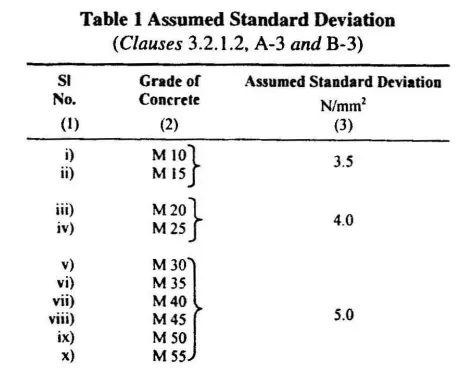
From table 1 of IS 10262: 2009, standard deviation, S = 5.0 N/mm^2
Therefore, Target mean strength = 35+1.65*5
= 43.25 N/mm^2
Step 4: selection of water-cement ratio
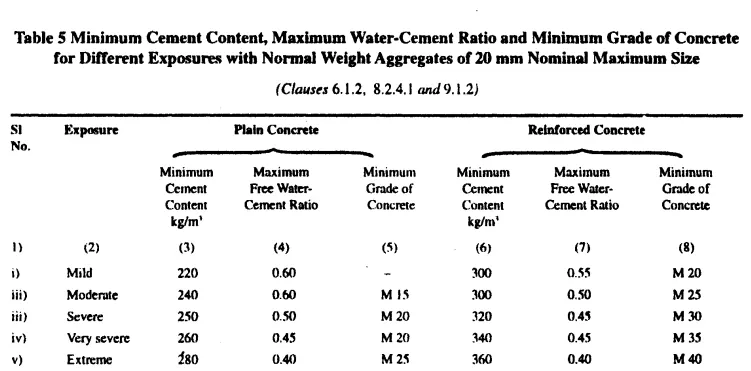
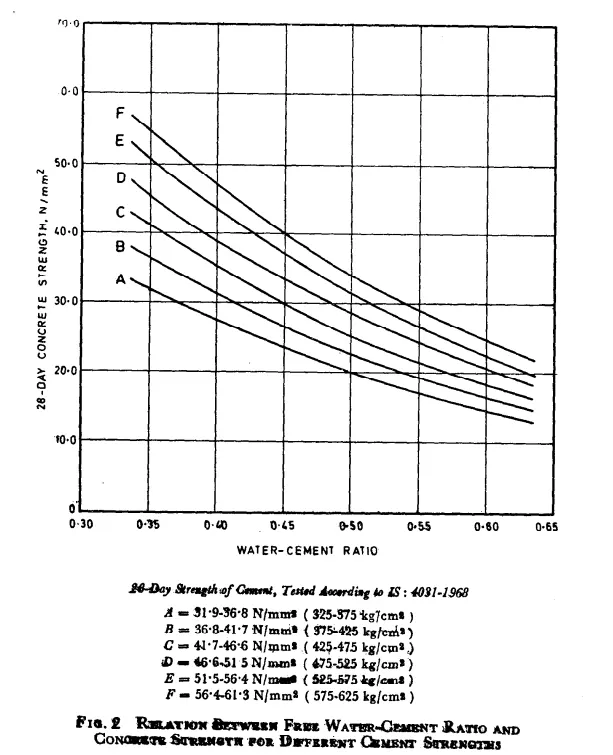
From the table 5 of IS 456: 2000 for severe exposure, maximum water-cement ratio = 0.45
based on experience, adopted water cement ratio is 0.35
0.35 < 0.45, hence ok
Step 5: Selection of water content
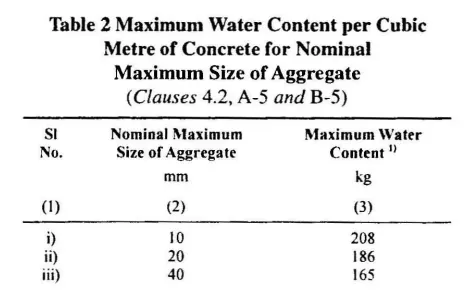
From table 2 IS 10262: 2009, maximum water content for 20mm aggregate = 186 litre (for 25 to 50mm slump)
Estimated water content for 100mm slump = 186+6/100*186
= 197 litre
As superplasticizer is used, the water content can be reduced upto 20% and above.
Based on trails with superplasticizer water content reduction of 29% is achived.
Hence the arrived water content = 197*0.71 = 140 litre
Step 6: Calculation of cement and fly ash content
Water-cement ratio = 0.35
Cementitious material(cement+fly ash) content = 140/0.35 = 400 Kg/m^3
From table 5 of IS 456: 2000, minimum cement content for severe exposure condition = 320 Kg/m^3
400 Kg/m^3 > 320 Kg/m^3. Hence ok.
Proportion a mix containing fly ash,
We increase 10% of cementitious material content.
Cementitious material content = 400*1.1 = 440 kg/m^3
Water content = 140 kg/m^3
So, water-cement ratio = 140/440 = 0.32
Fly ash at 30% of total cementitious material content = 440*30% = 132 kg/m^3
Cement (OPC) = 440-132 = 308 kg/m^3
Saving of cement while using fly ash = 400-308 = 92 kg/m^3
Fly ash being utilized = 132 kg/m^3
Step 7: Proportion of volume of coarse aggregate and fine aggregate content
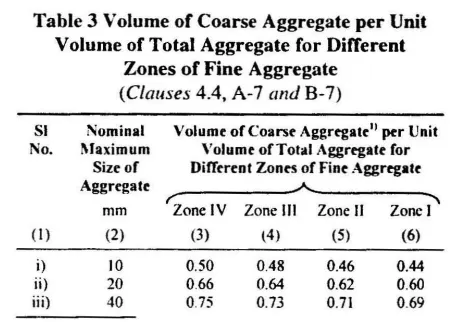
From table 3 of IS 10262: 2009, volume of coarse aggregate corresponding to 20mm size aggregate and fine aggregate zone 1 for water cement ratio of 0.50 = 0.60
The present water cement ratio is 0.35. Therefore, volume of coarse aggregate is required to be increased to decrease the fine aggregate content. As the water-cement ratio is lower by 0.15, the proportion of volume of coarse aggregate is increased by 0.03 (at the rate of +/- 0.01 for every +/- 0.05 change in water cement ratio). Therefore, corrected proportion of volume coarse aggregate for water cement ratio 0.35 = 0.63.
For pumpable concrete these values are reduced by 10%
Therefore, volume of coarse aggregate = 0.63*0.9 = 0.56
Volume of fine aggregate = 1 - 0.56 = 0.44
Step 8: Mix calculations
The mix calculation per unit volume of concrete shall be follows:
a) Volume of concrete = 1 m^3
b) Volume of cement = mass of cement/specific gravity of cement*1/1000
= 308/3.15*1/1000
=0.097 m^3
c) Volume of fly ash = mass of fly ash/specific gravity of fly ash*1/1000
= 132/2.2*1/1000
= 0.06 m^3
d) Volume of water = mass of water/specific garvity of water*1/1000
= 140/1*1/1000
= 0.140 m^3
e) Volume of chemical admixture = mass of chemical admixture/specific gravity of admixture*1/1000
(2% by mass of cementitious material)
= 8.8/1.145*1/1000
= 0.008 m^3
f) Volume of aggregate (C.A & F.A) = (a-(b+c+d+e))
= (1-(0.097+0.06+0.140+0.008))
= 0.695 m^3
g) Mass of coarse aggregate = f*volume of coarse aggregate*specific gravity of coarse aggregate*1000
= 0.695*0.56*2.74*1000
= 1066 Kg/m^3
h) Mass of fine aggregate = f*volume of fine aggregate*specific gravity of fine aggregate*1000
= 0.695*0.44*2.74*1000
= 838 Kg/m^3
Step 10: Mix proportions
Cement = 308 Kg/m^3
Water = 140 Kg/m^3
Fine aggregate = 838 Kg/m^3
Coarse aggregate = 1066 Kg/m^3
Chemical admixture = 8.8 Kg/m^3
Water-cement ratio = 0.32
Trail mix ratio = 1:2.72:3.46
Step 10: The slump shall be measured and the water content and dosage of admixture shall be adjusted for achieving the required slump on trail. The mix proportion shall be reworked for the actual water content and checked dor durability requiremens.
Step 11: Two or more trails having variation of 10% of water-cement ratio in cluase X shall be carried out and a graph between three water-cement ratios and corresponding strengths ahall be plotted to work out the mix proportions for the given target strength for field trails. However, durability shall be meet.
Concrete mix design for M50 grade concrete without fly ash:
Step 1: stipulations for proportioning
- Grade designation : M50
- Type of cement : OPC 43 grade confriming to is 8112
- Maximum nominal size of aggregate : 20 mm
- Exposure condition : Extreme (Reinforced concrete)
- Minimum cement content : 360 Kg/m^3 ( From table 5 of IS 456:2000)
- maximum water-cement ratio : 0.40 ( From table 5 of IS 456:2000)
- workability : 100 mm (slum value for pumpable concrete)
- Method of placing : pumping
- Degree of supervision : good
- Type of aggregate : crushed angular aggregate
- Maximum cement content : 450 Kg/m^3
- Chemical admixture : superplastizer
Step 2: Test data for materials
a)Cement used : OPC 43 grade confriming to IS 8112
b)Specific gravity of cement : 3.15
c)Chemical admixture : superplasticizer confriming to IS 9103
d)specific gravity of aggregate:
Coarse aggregate : 2.74
Fine aggregate : 2.74
e)Water absorption:
Coarse aggregate : 0.5%
Fine aggregate : 1.0%
f)Free surface moisture:
Coarse aggregate : nill
Fine aggregate : nill
g)Sieve analysis:
Coarse aggregate: Confriming to table 2 of Is 383
Fine aggregate : confriming to table 4 of IS 383
Step 3: Target mean strength for mix proportioning
f'ck = fck+1.65 S
Where, f'ck = target mean strength at 28 days
fck = characteristic compressive strength at 28 days
S = standard deviation
From table 1 of IS 10262: 2009, standard deviation, S = 5.0 N/mm^2
Therefore, Target mean strength = 50+1.65*5
= 58.25 N/mm^2
Step 4: selection of water-cement ratio
From the table 5 of IS 456: 2000 for extreme exposure, maximum water-cement ratio = 0.40
based on experience, adopted water cement ratio is 0.34
0.34 < 0.40, hence ok
Step 5: Selection of water content
From table 2 IS 10262: 2009, maximum water content for 20mm aggregate = 186 litre (for 25 to 50mm slump)
Estimated water content for 100mm slump = 186+6/100*186
= 197 litre
As superplasticizer is used, the water content can be reduced upto 20% and above.
Based on trails with superplasticizer water content reduction of 29% is achived.
Hence the arrived water content = 197*0.71 = 140 litre
Step 6: Calculation of cement content
Water-cement ratio = 0.34
cement content = 140/0.34 = 411 Kg/m^3
From table 5 of IS 456: 2000, minimum cement content for extreme exposure condition = 360 Kg/m^3
411 Kg/m^3 > 360 Kg/m^3. Hence ok.
Step 7: Proportion of volume of coarse aggregate and fine aggregate content
From table 3 of IS 10262: 2009, volume of coarse aggregate corresponding to 20mm size aggregate and fine aggregate zone 1 for water cement ratio of 0.50 = 0.60
The present water cement ratio is 0.34. Therefore, volume of coarse aggregate is required to be increased to decrease the fine aggregate content. As the water-cement ratio is lower by 0.16, the proportion of volume of coarse aggregate is increased by 0.032 (at the rate of +/- 0.01 for every +/- 0.05 change in water cement ratio). Therefore, corrected proportion of volume coarse aggregate for water cement ratio 0.34 = 0.632.
For pumpable concrete these values are reduced by 10%
Therefore, volume of coarse aggregate = 0.632*0.9 = 0.57
Volume of fine aggregate = 1 - 0.57 = 0.43
Step 8: Mix calculations
The mix calculation per unit volume of concrete shall be follows:
a) Volume of concrete = 1 m^3
b) Volume of cement = mass of cement/specific gravity of cement*1/1000
= 411/3.15*1/1000
=0.130 m^3
c) Volume of water = mass of water/specific garvity of water*1/1000
= 140/1*1/1000
= 0.140 m^3
d) Volume of chemical admixture = mass of chemical admixture/specific gravity of admixture*1/1000
(2% by mass of cementitious material)
= 8.22/1.145*1/1000
= 0.007 m^3
e) Volume of aggregate (C.A & F.A) = (a-(b+c+d))
= (1-(0.130+0.140+0.007))
= 0.723 m^3
f) Mass of coarse aggregate = e*volume of coarse aggregate*specific gravity of coarse aggregate*1000
= 0.723*0.57*2.74*1000
= 1129 Kg/m^3
g) Mass of fine aggregate = e*volume of fine aggregate*specific gravity of fine aggregate*1000
= 0.723*0.43*2.74*1000
= 852 Kg/m^3
Step 9: Mix proportions
Cement = 411 Kg/m^3
Water = 140 Kg/m^3
Fine aggregate = 852 Kg/m^3
Coarse aggregate = 1129 Kg/m^3
Chemical admixture = 8.22 Kg/m^3
Water-cement ratio = 0.34
Trail mix ratio = 1:2.07:2.74
Step 10: The slump shall be measured and the water content and dosage of admixture shall be adjusted for achieving the required slump on trail. The mix proportion shall be reworked for the actual water content and checked dor durability requiremens.
Step 11: Two or more trails having variation of 10% of water-cement ratio in cluase X shall be carried out and a graph between three water-cement ratios and corresponding strengths ahall be plotted to work out the mix proportions for the given target strength for field trails. However, durability shall be meet.
Results:
Mix proportion of M35 grade of concrete with fly ash is 1:2.72:3.46 and its water cement ratio is 0.32.
Mix proportion of M50 grade concrete without fly ash is 1:2.07:2.74 and its water-cement ratio is 0.34.
Conclusion:
Concrete mix design for M35 grade concrete with fly ash and M50 grade concrete without fly ash is calculated and the mix proportions by weight are determined.