Project - Design a Hospital Management system
1.To develop a basic Healthcare management system (HMS) using web technologies, DB and other technologies.
Healthcare management system (HMS)
Healthcare is not just about doctors and nurses anymore. Healthcare consists of hospitals, medical devices, clinical trials, outsourcing, telemedicine, medical tourism, health insurance and medical equipment. A well-tuned hospital management workflow involves lots of important decisions that should be made most efficiently and quickly. Nowadays it is hard to implement it without a distinct hospital management system. Such transitions in the healthcare industry have made the healthcare management system a necessity!
So, what is Hospital Management System (HMS)? The Hospital Management System (HMS) is integrated software that handles different directions of clinic workflows. It manages smooth healthcare performance along with administrative, medical, legal, and financial control. That is a cornerstone for the successful operation of the healthcare facility.
How is HMS useful for Hospitals?
The usefulness of a hospital management system can be judged by the number of benefits it offers. Most of the hospitals these days are known to make use of such software. The main benefits of hospital management software are as follows.
· You can easily avail information related to patients, doctors, staff etc. All you need to do is few clicks, and you will have all the required information flashing on the screen. The system can search for info about patience from different departments in the hospital. This helps the doctor to recheck the test reports whenever required.
· The use of a well-implemented hospital management system also saves you from the risk of making errors. This is made possible through the automation of the system. You can assign several tasks to the software, and it will perform with minimum human intervention and utmost accuracy.
· Implementing the use of a hospital management system means that the processes will be automated. In other words, the process will be managed with no human intervention. This improves the efficiency of the hospital. All the tasks assigned is done with utmost accuracy.
· The load of manual work is reduced to a great extent. In other words, the system helps in reducing the number of Manpower required and it will help save a lot of money. Besides, the system will help you to save a lot on storage as well.
It is because of this reason that most of the hospitals these days have started implementing this software within their system.
Features of Hospital Management Software
An efficient and well-implemented hospital management software is required to have the following features.
1. Speed
Since the system automates most of the hospital processes, there is no way the system should ever slow down. All the tasks including the communication between various departments, reporting of tests etc., are all speeded up with the help of a hospital management system. Therefore speed is considered to be so crucial for an HMS.
2. Error-free
Another essential feature of a hospital management system is that it should be error-free. In other words, it should be able to perform all the tasks with utmost accuracy and with minimum human intervention. The implementation of such a system also ensures that there are fewer errors resulted from the employees. Not just that, but it can also reduce the number of workforces required to perform the tasks.
3. Easy access of data
With the help of a hospital management system, you can easily access all the required data you want. A hospital daily produces a lot of data that needs to be stored safely. The software can do this. For example, doctors can access data related to patients whenever they want without any delay.
4. Cost-effective
The system also proves to be very cost-effective for hospitals. Implementing a hospital management system means less stationary use, less storage space required and less workforce. All these ultimately cuts down on the total cost of operations.
It is essential for a hospital management system to have all these features. This ensures a smooth flow of work within the medical centre. The best thing is that an HMS can be tailored according to the need of your hospital. With the help of hospital management software development& service providers like EZOVION: Intelligent Healthcare company, you can easily design/customise the software for your hospital and clinics.
Perks of Hospital Management Systems
Advantages of HMS
HMS ensures that a large amount of clinical, operational, and financial information is managed, collected, and integrated into a digitized space, you may wonder what precise benefits it renders for both clinicians and patients. Here we will explain what an ace up your sleeve a healthcare management software system is.
Lower cost and workload
The prosperity of the organization and the ability to provide good care are undeniably linked to adequate resource distribution. Proper budgeting and a judiciously-managed workload are the keys to the finest hospital performance planning procedure. HMS allows the management to scan various monetary tasks (i.e., costs, benefits, losses, as well as paying taxes and bills and outpatient billing). Moreover, are you thinking about investigating possible business prospects? The financial awareness has you covered: you’ll definitely know what would be the right path to take.
Additionally, if all records and transactions are retained in the system, it is possible to monitor all the clinical, financial, and of course, patient data.
Since the software provides wide-ranging scheduling capabilities and alternatives, it obviously improves doctor-patient communication greatly.
Better patient experience
By making the hospital administration software notably more scalable, dependable and consistent, we thus improve patient experience and ensure that any healthcare operations are significantly more effective.
In order to avoid such distressing issues as delayed care for patients requiring urgent medical attention, spot-on data management is a must. Proper management is the foundation for success, and it prevents lots of minor or major problems. A hospital management software, in particular, is going to upgrade not just the allure but also the efficacy of healthcare services for doctors and patients alike.
Refined workflow
Implementing a system software capable of capturing and managing all sorts of medical data, inventory, results, and reporting can lead to drastic improvements in a hospital’s cost-effectiveness. Given that the data filtering process is automated, the software ensures swift operational procedures, and humans are no longer required to undertake any repetitive and time-consuming tasks.
It’s no secret that the second biggest cause of healthcare mishandling is, of course, human errors, which are easily avoided or at least greatly minimized with a proper HMS in place. This means that the likelihood of accidental duplication, record typos, or any other kind of human error is dramatically reduced.
Key HMS Features
Lab Management
This feature not only allows managing test results and patient data but also increases workflow efficacy, improves data accuracy, and overall adds more value to the patient treatment procedure due to the system’s ability to interact with other lab systems.
Laboratory results management may consist of quality assurance and reporting, sample tracking, and so on. The process runs in the following manner: the HMS system incorporates lab systems, then collects necessary data, and finally sorts it all out while also allowing for any additional patient info to be layered if needed.
Electronic Medical Records (EMR) management
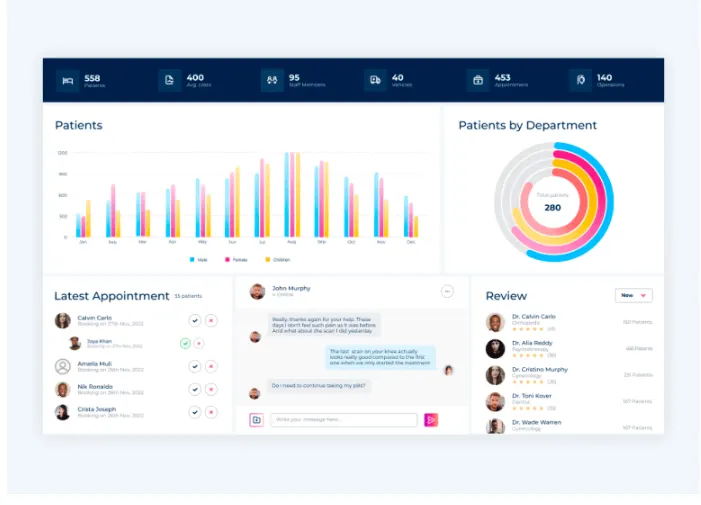
EMR software is a unified data nucleus containing all essential patient information (i.e., health records, medications, vaccines, doctor’s notes, visits, you name it).
As healthcare solutions evolved over the years and also due to the global pandemic and therefore increased digitization of the healthcare industry, effective, smooth-running EHR will be required exponentially more.
Mobile Applications
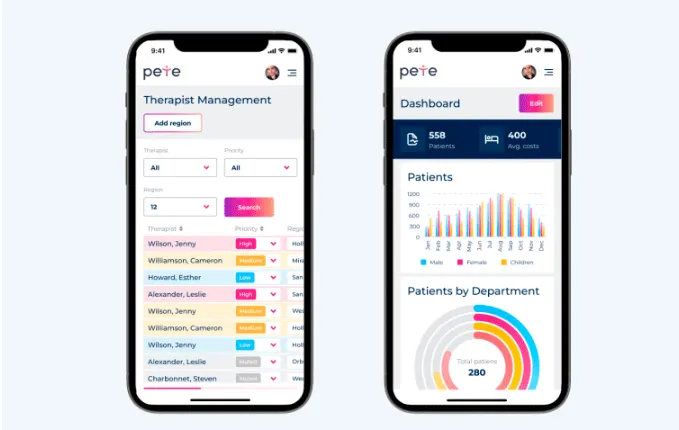
The hospital’s life cycle these days is highly dependent on healthcare mobile apps. Patient-targeted apps and products are essential components in the fast-growing health tech industry, showing the tendency to increase further in the upcoming years.
A simple, functional, and well-integrated app may significantly enhance the user as well as customer experience. As a user, you wish for the obvious advantages of a detailed and functional app design. Still, you also highly appreciate the benefits of speedier and more effective treatment as a customer.
The improved functionality of a simple interface is going to aid in providing the patients with the utmost medical experience, which may also result in improved disease treatment efficacy.
Inventory management
Prescribing and requesting pharmaceuticals is what most doctors and patients look for in any health service. Digital order management (typically that’s e-Prescribing, Medication Tracking, or EMAR, and Computerized Physician Order Entry or CPOE) not only diminishes the timewasting manual prescription process but also provides treatment security and agreements. Imagine a patient is supplied with several drugs. They would appreciate a system that could recognize which components conflict with one another and would send recommendations and possible warnings.
Billing
A wide range of payment options boosts the medical clinic’s reputation and reduces manual and administrative work. The feature enables insurance eligibility verification by real-time monitoring whether the insurance is operating legally or not, still valid or expired, and what services it covers.
Patient scheduling system
Plenty of scheduling options aid both physicians and patients in establishing effective communication. A well-designed hospital management system software helps you keep track of all your appointments as well as doctor’s notes. You'll never miss anything, thanks to the platform’s reminders, alerts, and follow-ups.
Data analytics and reporting
Hospital management system software uses cognitive analytics in order to inspect any gaps in performance (let’s say there’s an overspending problem or payment failure), thus providing insights on how to enhance user experience possibly.
Reporting in healthcare is as important as in any other industry: in such a way, we better understand procedures. Making use of copious amounts of data also renders more accurate financial statistics.
Upgraded clinical decision
A high-quality hospital management system ensures all the operational and clinical decision-making processes are speedy, efficient, and precise.
Advance data security
A system with centralized controls must be implemented if you want to avoid any security threat such as unauthorized access or even a cyber-attack. A top-notch management system with centralized controls is a security guarantee for the data of any health clinic.
Establish hospital as cutting-edge
In our day and age, every industry has competitors, and healthcare is no exception. If you claim to be technically advanced, you absolutely need a first-rate HMS to back it up. Digitized healthcare systems are the future, so you better implement a hospital management system that will make your doctors and patients satisfied
7 Steps to Build a Doctor Appointment App
The design and custom development of an online doctor appointment system is not a trivial task. Here are our recommendations that will help you develop a doctor appointment app that will succeed.
STEP 1: GET YOUR DOCTOR DATABASE READY
If you think of it, the development of a healthcare app is akin to on-demand doctor app development. From the user’s standpoint, what you offer is a marketplace, and doctors (and their services) are the product. And the way the user orders a product is by doctor appointment scheduling.
So, the first thing you need to do is ensure you have the product. If you are working with a specific clinic, do you have a database of doctors? Will you be able to access it via APIs?
You might want to explore publicly available doctor databases and APIs:
- 1upHealth
- Doctor.com
- BetterDoctor
- Doctor Database
STEP 2: VERIFY A PROTOTYPE
Once you have decided on the app’s data sources, the next item on your doctor on-demand app development agenda is a prototype. You need to develop the visuals of all screens in the app and verify its features with a clickthrough prototype.
Please note that the driving force for UI/UX iterations should be the feedback from your medical staff and test users. Make sure to bring in qualified personnel to verify online doctor consultation app development from the providers’ side.
STEP 3: REVIEW OFF-THE-SHELF SCHEDULING TOOLS
When you create a doctor scheduling app, the most time-consuming chunk will be developing a scheduling engine. That’s if you build it from scratch. A better option, however, is to pick an off-the-shelf scheduling API like those provided by Acuity, Timekit, or OnSched.
Using these or similar APIs, you can significantly speed up the custom mobile app development process, but mind that this choice will influence your UI. The thing with scheduling APIs / SDKs is that they don’t provide too much flexibility with the look and feel of a calendar.
That’s not to say, though, that you can’t use these tools to make your app look unique. It’ll just take more than a simple plug-in integration.
You are welcome to check out more plug-and-play solutions to accelerate your app development.
STEP 4: CODE
The boring stuff still needs to take place for your appointment app to materialize. As for us, we love that part, and we know how to turn it into a captivating experience for you too. Our development team moves with quick iterations and keeps the coding process entirely transparent for you by holding regular meetings. That way, you can easily track the project’s progress and make all the right calls in time.
Since you’ll need to code the web and mobile parts of your doctor booking app, we advise that you do this in sync to avoid prolonged code refactoring later on. In the process, your software development team will not only code the medical staff scheduling software but also build APIs to integrate the app with medical records.
If you want to build doctor appointment app for Android and iOS, using cross-platform development tools like React Native or Flutter will help you optimize the budget.
import datetime
Code:
def getdate():
# to get date and time
return datetime.datetime.now()
def selectname():
name = {1: "Nilesh", 2: "Shanu"}
b = {1: "Food", 2: "Exercise"}
for key, value in name.items():
# taking input of name
print("Press", key, "for", value, "\n", end="")
n = int(input("type here.."))
if n > 2:
print("error select 1 or 2")
exit()
else:
return n
def select_file_action():
a = {1: "Log", 2: "Retrieve"}
for key, value in a.items():
# taking input of function that user wants to
# do (either log or retrieve)
print("Press", key, "for", value, "\n", end="")
x = int(input("type here.."))
if x > 2:
print("error select 1 or 2")
exit()
else:
return x
def select_task():
b = {1: "Food", 2: "Exercise"}
for key, value in b.items():
# ask user to choose between food
# and exercise
print("Press", key, "for", value, "\n", end="")
y = int(input("type here.."))
if y > 2:
print("error select 1 or 2")
exit()
else:
return y
def action(n, x, y):
# condition no 1
if n == 1 and x == 1 and y == 1:
value = input("type here\n")
with open("nilesh food.txt", "a") as nileshfood:
# printing date and time
nileshfood.write(str([str(getdate())]) + ": " + value + "\n")
print("successfully written")
# condition no 2
elif n == 1 and x == 1 and y == 2:
value = input("type here\n")
# printing date and time
with open("nilesh exercise.txt", "a") as nileshexercise:
# printing date and time
nileshexercise.write(str([str(getdate())]) + ": " + value + "\n")
print("successfully written")
# condition 3
elif n == 2 and x == 1 and y == 1:
value = input("type here\n")
# printing date and time
with open("shanu food.txt", "a") as shanufood:
# printing date and time
shanufood.write(str([str(getdate())]) + ": " + value + "\n")
print("successfully written")
# condition 4
elif n == 2 and x == 1 and y == 2:
value = input("type here\n")
# printing date and time
with open("shanu exercise.txt", "a") as shanuexercise:
# printing date and time
shanuexercise.write(str([str(getdate())]) + ": " + value + "\n")
print("successfully written")
# condition 5
elif n == 1 and x == 2 and y == 1:
# printing date and time
with open("nilesh food.txt", "r") as nileshfood:
a = nileshfood.read()
print(a)
# condition no 6
elif n == 1 and x == 2 and y == 2:
# printing date and time
with open("nilesh exercise.txt", "r") as nileshexercise:
a = nileshexercise.read()
print(a)
# condition no 7
elif n == 2 and x == 2 and y == 1:
# printing date and time
with open("shanu food.txt", "r") as shanufood:
a = shanufood.read()
print(a)
# condition no 8
elif n == 2 and x == 2 and y == 2:
# printing date and time
with open("shanu exercise.txt", "r") as shanuexercise:
a = shanuexercise.read()
print(a)
n = selectname()
x = select_file_action()
y = select_task()
action(n, x, y)
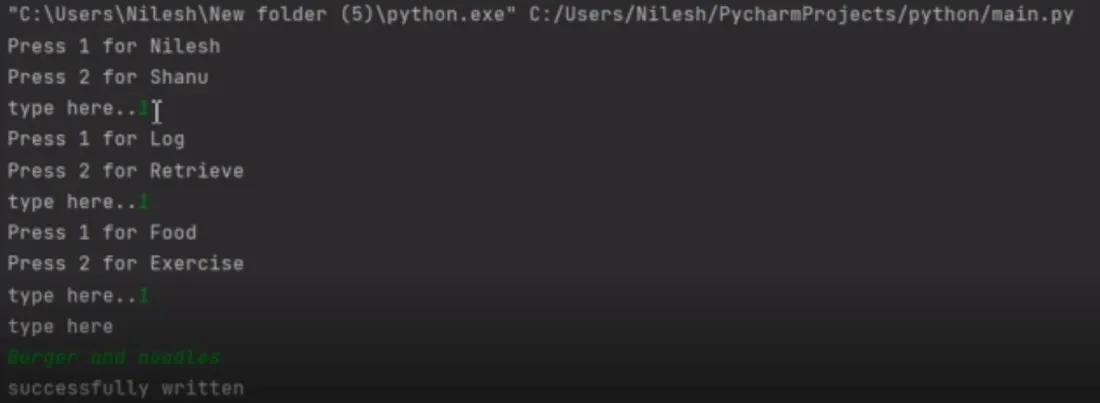
Output:
STEP 5: FACTOR IN HIPAA COMPLIANCE
As you continue to create a doctor appointment app, make sure you build it using a secure architecture aligned with the HIPAA regulations, especially HIPAA compliant video conferencing and messaging. Some of the things you need to consider:
- PHI data encryption
- SSL connections
- HIPAA-as-a-Service cloud platforms
- HITECH Act, GDPR, and other regulations
Related: How to Build a HIPAA Compliant App Development
STEP 6: TEST
Of course, you can’t make a doctor booking app without testing it thoroughly. In real life, the quality assurance phase begins simultaneously with coding and follows every development sprint. However, final testing covers all app functionality and includes such things as stress testing, security, and unit tests.
Related: The Complete Guide to User Testing: Steps, Tools, Best Practices
STEP 7: RELEASE AND MAINTAIN
And the last step is releasing the app so that users can make a doctor appointment. However, adding mobile apps to app stores and moving the web dashboard to a “live” server, e.g. on the AWS (Amazon Web Services) environment, is not the end of the story.
You will need to update the app regularly to support new mobile OS versions and enhance its functionality, depending on the user feedback.
As you can see, the design and development of online doctor appointment system can be quite tricky, and it’s advisable to consult with experts before starting such a project.
Doctor Appointment App Features
To develop a doctor appointment booking app, you must carefully pick every single feature. Let’s skim through the features that bring the most value in an appointment scheduling app.
SCHEDULING
Patients should be able to book a doctor’s appointment 24/7 — it’s the core of the product. With as few taps as possible, they should have an option to locate a free spot on a doctor’s calendar and book a meeting at a clinic or hospital.
PATIENT PROFILE
Let’s not forget that a doctor should come to the meeting prepared. And the way they do this is by reviewing patient health and demographics data that users fill in their profiles.
DOCTOR DIRECTORY
Naturally, before an appointment, a patient should be able to choose a healthcare professional from all available candidates. Having reviews from previous customers would definitely help, so consider including these.
SMART SEARCH
Besides reviewing doctor profiles, patients should be able to search for professionals using their own words and apply filters, e.g., to find female doctors only.
PAYMENTS
Patients should have multiple payment options to pay right through the medical consultation app. Allowing your patients to pay before the actual consultation can significantly improve your show-up rates. Picking a payment gateway like Stripe seems a no-brainer, but you should carefully consider all options and weigh them against your target audience’s needs.
REMINDERS
Another way to reduce no-shows is the nifty notification feature. Users should get app reminders via push notifications, so they don’t miss an appointment or have enough time to reschedule.
REAL-TIME CHAT
A chat can be used for customer support or for a preliminary (often remote) consultation.
That may be necessary when doctors need to find out more about patients’ disease history to provide as much value as possible during the meeting.
DOCUMENT UPLOAD
Just like a pre-consultation chat, document uploading allows patients to submit their health data if they have it as MRI or CT scans. This medical imagery will help them get more value out of the meeting.
E-PRESCRIPTIONS
Doctors should be able to prescribe medicines during the consultation. And patients should be able to review the prescription and get directions to where they can get the medicine via a doctor appointment booking app.