Project 1 - Design and Develop a IOT based Wireless Wearable Health Monitoring System or a Home Healthcare System to monitor the physiological parameters of ECG, Heart Rate, Pulse Oximetry, Cuffless Blood Pressure and Body Temperature.
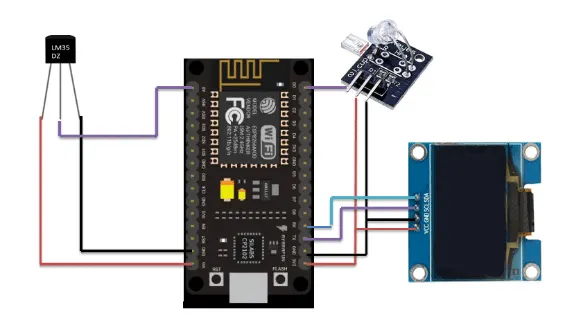
In this IoT project, we additionally proposed a portable Wearable IoT Health Monitoring System using a Heart rate and temperature sensor. The data will be sent to the ThingSpeak cloud using ESP8266 Node MCU which is also being used in this IoT Wi-Fi Temperature-Logging System. In this project, we have used the ESP8266 NODE MCU, Temperature sensor, Heart rate sensor, and OLED display. This proposed online health monitoring system is used to measure body temperature and pulse rate without any human intervention, and the data is sent to the cloud and mobile widget for doctor’s diagnosis purposes. It is beneficial during the Covid pandemic situation. An IoT technology has been used in this project for sharing the patient temperature and heart rate data to the doctor’s mobile phone for taking immediate care. These data are stored in the cloud and it can be used as a data set. In future, by using this data set the cardiovascular risk can be predicted by using the machine learning algorithm
IoT based patient health monitoring system is a generic term given to any medical equipment that has internet capability and can measure one or more health data of a patient who is connected to the device such as heartbeat, body temperature, blood pressure, ECG, steps etc. The equipment can record, transmit and alert if there is any abrupt change in the patient’s health.
By this definition, it includes devices such as smart-watches, fitness trackers, smart-phones to expensive hospital equipment which can connect to internet.
IoT based health monitoring system is used where the patient and heath expert(s) are at different locations. For example, a patient can stay at home and continue his/her routine life and a doctor can monitor patient’s heath. Based on the received data the heath expert can prescribe a best treatment or take an immediate action in case of an emergency.
Design procedure:
- The sensor pins are connected to the corresponding pins of ESP8266 NODE MCU as per the circit diagram.
- USB mini adapter cable used to power up the ESP8266 Module.
- Create the channel in the ThingSpeak app and channel API key copied in the program.
- Set WiFi connection to the NODE MCU type SSID and Password in the program.
- The analog voltage received from the temperature sensor and converted into temperature in degree Celsius by using the ADC with the following conversion formula.
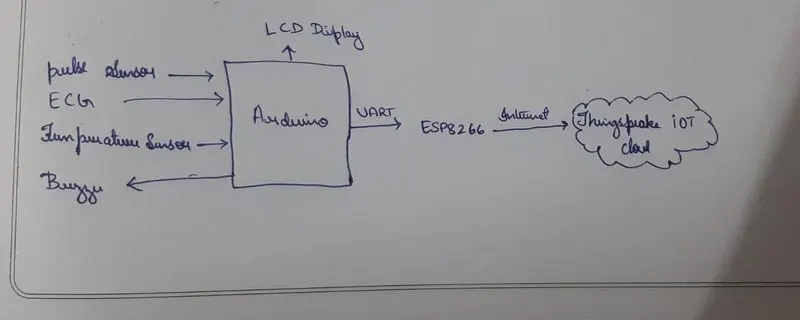
The proposed design of IoT based heath monitoring system is built around Arduino microcontroller which is the brain of the project.
Arduino collects real time health data from pulse sensor which measures heartbeat in minutes or BPM (beats per minute). A digital temperature sensor connected to Arduino measures body temperature of the patient.
A buzzer produces auditory beeps when the patient’s heartbeat occurs / detected. This gives a brief insight to a healthcare professional how a patient’s heart is performing in a particular health condition. Abnormal heartbeats can be detected by just listening to the beeps.
A generic ESP8266 IoT module is connect to Arduino via UART, it is responsible for connecting the machine to internet and also for sending health data to a IoT server (Thingspeak) for storing and monitoring.
This circuit is not only capable of sending patient’s health data to a server but also can show real time data on a 16×2 LCD display. This is useful for a healthcare professional who is actively monitoring a patient on site.
Arduino board:
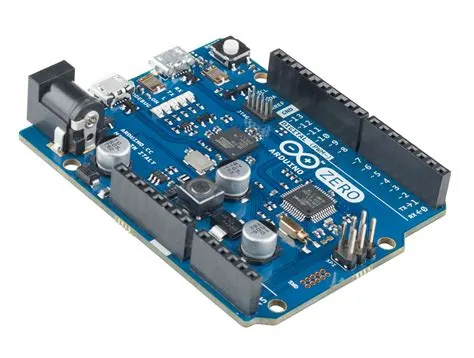
As mentioned earlier Arduino is the brain of the project and you may use any Arduino board that is available with you and you can connect to the same pin numbers that are shown in the schematic The arduino is responsible for collecting, displaying and sending the data to ESP8266. The whole circuit can be powered using USB or via “Vin” pin (9V-12V).
Generic ESP8266:
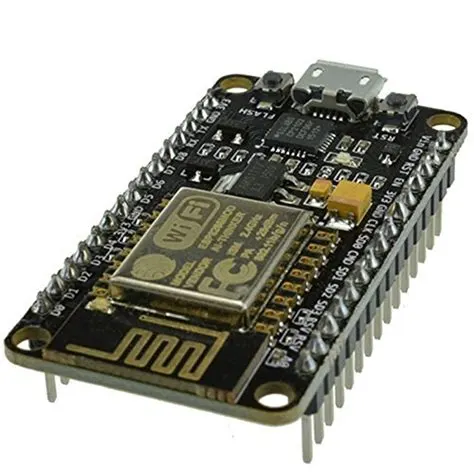
- The generic ESP8266 module is a miniature microcontroller board which has RAM, ROM, clock, communication protocols and I/O pins just like any other microcontrollers and it need to be programmed to make it functional.
- It does not come with a USB port so we need to use its UART pins to upload a code which will be discussed in the later part of this post.
- It operates at 3.3V (5V can kill) and it supports UART / serial communication protocol and it has (only) two GPIO pins which we are not going to use.
- Arduino collects and sends patient data to this ESP8266 over its UART pins. ESP8266 will connect to its designated server which is programmed to it and passes the data.
Pulse sensor:
- The pulse sensor / heartbeat sensor is an inexpensive analog sensor which can measure reasonably accurate pulse rate of human heart with the help of a microcontroller.
- A microcontroller like Arduino can be programmed to calculate its analog output to BPM or beats per minute.
- It can operate from 3.3V to 5V, but here we are connecting it to 5V supply. It has just 3 pins: Vcc, GND and signal (Analog out).
- Pulse Sensor- Heartbeat
Pulse Sensor- Heartbeat
On the front we have a green LED with a specific wavelength and a light sensor; you can place your finger (except thumb) on front part of the sensor with a slight pressure. - The process behind detecting heartbeat is when our heart pumps there will be blood flow in our nerves, this flow changes the light intensity reflected to the light sensor.
- On the back of the pulse sensor there is an amplifier and noise reduction circuit which outputs analog signal proportional to the changes in the reflected light.
- The pulse senor must be used with dry fingers and the back of the sensor must not be touched and since ambient light can interfere with the sensor while measuring, it is recommended to wrap your finger and the sensor with an insulation tape as shown below for the best result:
Temperature sensor:
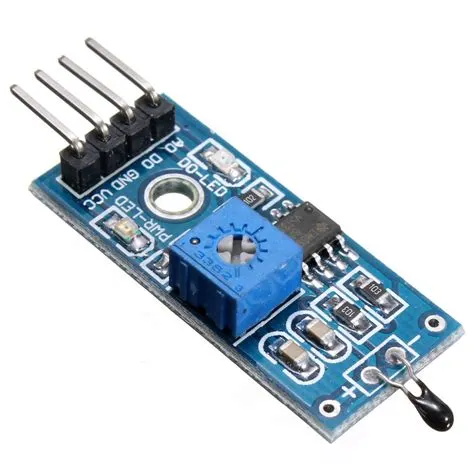
We are using a general purpose water proof digital temperature sensor DS18B20 to measure body heat which comes in a sealed metallic enclosure.Measuring body temperature can reveal a lot about patient’s health and a healthcare professional can identify abnormalities in a patient’s health.
Pin diagram:
DS18B20 Water proof temperature sensor
DS18B20 Water proof temperature sensor
Inside the metallic enclosure there is a transistor like sensor which measures the temperature (that’s why a transistor like component is shown in the circuit diagram).
- It has 3 wires: Vcc, GND and data, the data wire must be connected to a pull-up 4.7K resistor.
- We are using a water proof sensor because the sensor will be placed on human body for prolong amount of time and dust, sweat and other body fluids can accumulate on the sensor which could lead to inaccurate temperature measurement.
- A water proof sensor can be easily cleaned and dust and body fluids won’t able to clog the sensor much.
- Where the temperature sensor can be place on human body?
- There are several places on human body where temperature sensor can be placed like: oral, ear, underarm, rectal etc. Our best recommendation is underarm for the sensor placement after considering accuracy and convenience. You need to place it for at-least 2 minutes so that temperature gets settled properly.
LCD display:
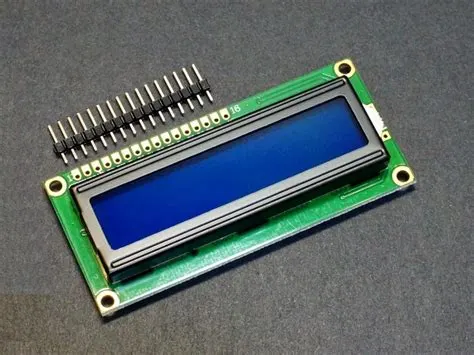
A LCD display is provided to see the real time data from the sensors; it is set to show the body temperature and heartbeat in BPM. A 10K potentiometer is provided using which you can adjust LCD contrast for optimum legibility.
Buzzer:
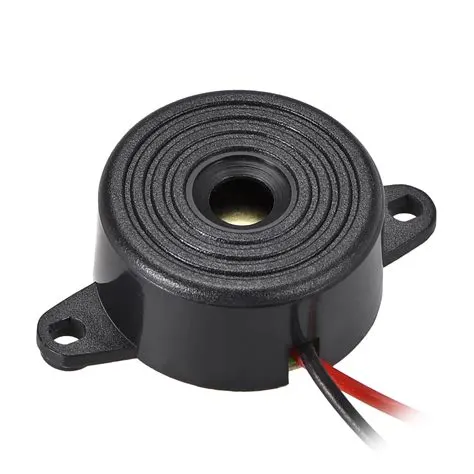
We are utilizing a 5V DC buzzer to detect heartbeat rhythm, just like in hospital rooms (or in TV serials/movies) where beep sound emerges when a patient is monitored using ECG / EKG etc. The DC buzzer has polarity, the –Ve of buzzer is connected to GND and +Ve is connected to pin 8 of Arduino.Audio beeps can give a healthcare professional an insight about pulse of a patient, for example, slow pulse indicates that the patient is sleeping or in coma or fast beep indicates that the patient is in some health trouble and need immediate medical attention.
Data Transmission procedure/protocols: Now comes the question how will the data be transmitted and how will the devices be communicated. What if the WiFi goes down? Connectivity downtime is a major problem in a country like India. So what can be done to prevent that? To prevent thisiisue we will have a sim service connected to the Monitoring board. This way there will be connectivity issue. The data will be transmitted to the hospitals via the server system and hourly report via email in the mailbox. The sim service will send an update sms to the family members every hour to notify them of the patient's condition. So the services that will be used for connection are LTE data and WiFi.
Data encryption and security method: The Internet of Things (IoT) utilises both symmetric and asymmetric encryption methods. Symmetric encryption is a way of encrypting and decrypting data with the use of a single cryptographic key. Since only one key is required to do both tasks, doing so is easy. The main benefit of symmetric encryption is this. This encryption process is simple, which means it works quickly, consumes little energy, and won't slow down your Wi-Fi or internet connection. As opposed to symmetric encryption, which uses a single key for both encryption and decryption, asymmetric encryption uses a set of keys. The "public key" and the "private key" are two separate keys that are mathematically related to one another. Asymmetric encryption's main benefit is the increased security it offers. The data is encrypted using the public key and decrypted using the private key, which is kept in a safe place. One other perk of asymmetric encryption is that it is authenticated, meaning that the data may be viewed by no one but the intended recipient. Blowfish encryption will be used to secure the data. To that end, Blowfish was developed as an alternative symmetric encryption technique to DES. It encrypts data one block at a time, using a 64-bit key. Being in the public domain has helped keep Blowfish's popularity high. This, however, does not detract from the fact that it is still a solid encryption choice. Many people argue that it has never been defeated. Blowfish has found widespread application in protecting sensitive information, including passwords and online transactions. It's one of the most adaptable and simple encryption methods out there.
Cloud Computing: Since, we would be using two servers it will be wise to have a method which can work seamlessly between these two. Thus hybrid cloud will be used for this method. The term "hybrid cloud" refers to a computing environment where an organization's private cloud services located on-premises are combined with public cloud services located in the cloud provided by a third party to create a single, adaptable infrastructure for running mission-critical applications and workloads. This novel combination of public and private cloud resources simplifies the process of determining which cloud is best suited for each application or workload and then transferring those workloads between clouds as needed. In comparison to using either a public or private cloud exclusively, a hybrid cloud infrastructure provides greater efficiency and lower costs in meeting technical and business goals. The cloud will have an AI program already in place for it work from and the data can be compared and data be sent timely to the hospital.