Project - Analysis of a practical automotive wiring circuit
1) Identify each of the major elements in the above automotive wiring diagram.
Ans:
The major elements are Battery, starter, breaker, generator, distributor, gas tank
2) Explain the purpose and working of any three elements briefly.
Ans:
BATTERY:
battery is the heart of vehicles electrical system. Lead acid battery is most commonly used for this application, its main functions are
a) It acts as a power storage for the car b)it provides energy to start the engine c) work with alternator to power the electronics d) Helps to regulate voltage
Working
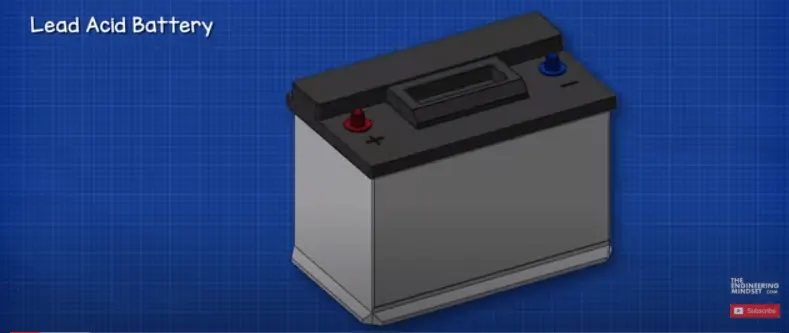
This is a lead acid battery. We call it a lead acid battery because inside the unit are lead plates which are submerged into an acid. This creates a chemical reaction which releases energy and provides us with a voltage and current. The battery is for storing energy in the form of Chemical energy. It doesn’t store electricity. This chemical energy is converted into electrical energy whenever we need it. This battery is also rechargeable, if we supply the battery with electricity then we can reverse the chemical reaction and recharge the battery.
Generator
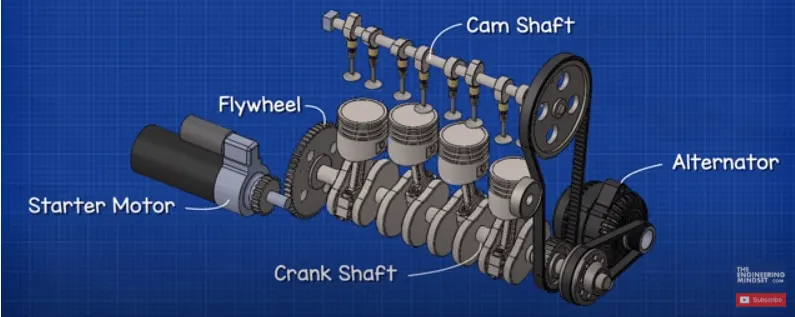
A Generator is a device that converts mechanical energy into electrical energy. It supplies the electrical energy for charging the battery of a vehicle. The generator gets the drive from the engine, generally thru’ the fan belt
Furthermore, the automotive generator produces Direct Current (DC). It is because the electric components need the Direct Current to function. Automotive applications most commonly use generators made of shunt winding. Initially, manufacturers employed generators to produce direct current (DC), which the other electrical components/gadgets could directly use/consume. However, the alternator now replaced the generator, generating alternating current (AC). It then converts the AC into the Direct Current (DC) with the help of diodes.
STARTER MOTOR:
When the car’s ignition is turned on, the engine turns over and then cranks. However, getting it to crank is actually much more involved than you might think. It requires a flow of air into the engine, which can only be achieved by creating suction (the engine does this when it turns over). If your engine isn’t turning over, there’s no air. No air means that fuel can’t combust. The starter motor is responsible for turning the engine over during ignition and allowing everything else to happen. When you turn the ignition on, the starter motor engages and turns the engine over allowing it to suck in air. On the engine, a flywheel, with a ring gear attached around the edge, is fitted to the end of the crankshaft. On the starter, the pinion is designed to fit into the grooves of the ring gear. When you turn the ignition switch, the electromagnet inside the body engages & pushes out a rod to which the pinion is attached. The pinion meets the flywheel and the starter motor turns. This spins the engine over, sucking in air (as well as fuel). As the engine turns over, the starter motor disengages, and the electromagnet stops. The rod retracts into the starter motor once more, taking the pinion out of contact with the flywheel and preventing potential damage.
3)If the total load is 10A from battery, what should be the fuse rating?
Ans:
The battery can provide a current of 10A, so if we provide a fuse of 10A or less the fuse will melt even before the peak current therefore the fuse rating should be above 10A so we can use a fuse of 15A.
4)If 500W is the load, what is the voltage and capacity of battery you recommend?
Ans:
Power=500w
power=V*I
lets assume a typical automotive application where we use 48V
then current I=500/48=10.41A
let us consider the power to be drawn for 1 hour, so energy=500wh
at 1C rating, 1C=10.41A
capacity= 500/48=10.41Ah
5) Identify any two elements which are connected parallel to each other. Why they are connected in parallel?
Ans:
a) starter motor: we need high ampere current for starter motor to work so we connect in parallel
b)Light and horn:has a constant voltage rating and different current to operate so they are connected in parallel
6) Identify any two elements which are connected in series. Why they are connected in series?
Ans:
a) Switches: it is used to on or off the circuit so they should connect in series so that circuit will complete.
b)Ammeter: a device used to measure the current in a circuit. It is generally connected in series in a circuit. This is because the current remains the same when devices are connected in series.