Project 6
- Product Life Cycle:
A product life cycle is the length of time from a product first being introduced to consumers until it is removed from the market.
Product life cycles are used by management and marketing professionals to help determine advertising schedules, price points, expansion to new product markets, packaging redesigns, and more. These strategic methods of supporting a product are known as product life cycle management. They can also help determine when newer products are ready to push older ones from the market.
There are 10 stages of Product Life Cycle in Automobile Industry,
- Concept Sketching
- Styling Class-A
- Feasibility check
- Concept Validation
- New Product Design
- Development Stage
- Prototype Build
- Design Validation
- Pilot Production
- Mass Production
- Concept Sketching:
Concept Sketching, often freehand, that are used by design engineers as a quick and simple way of exploring initial ideas for design. They are not intended to be accurate or definitive, merely a way of investigating and communicating design principles and aesthetic concepts. Concept drawings can also be used to explore more technical aspects of the site and so on.
- Styling Class-A:
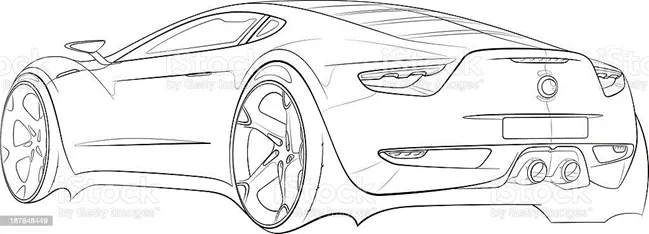
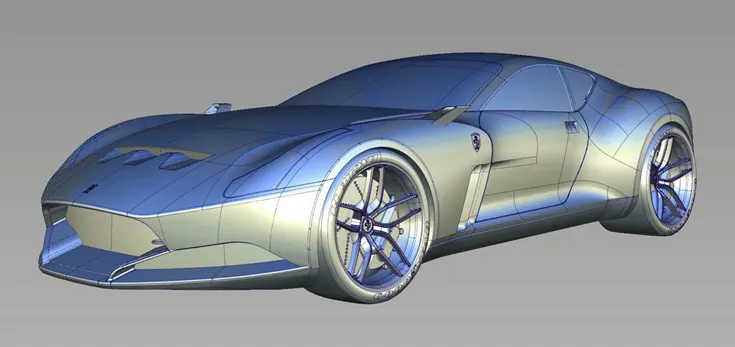
Class-A is a term used in specifically in automotive design. It describes the final production surface data for the aesthetic parts of the car. The term 'Class A' is often misunderstood, but it's generally seen as the 'Holy Grail' of surface modelling. This is because as it achieves the highest surface quality levels, and it demands a high level of automotive design knowledge as well as surface modelling skills. Class A represents the 'craftwork' end of the design process. Creating the main surface shapes to describe the vehicle is the primary design activity. But the painstaking, detailed craftsmanship of perfecting those surfaces, designing flanges and panel gaps is what guarantees that a beautiful design turns into a beautiful manufactured product.
- Feasibility Check:
A feasibility check is a procedure that aims to determine the project’s success, as well as its profitability. A cost-benefit analysis is inextricably linked to the feasibility study, which covers both technical issues, in terms of the production capacity of a given company, and economic aspects, concerning the actual benefits of a solution. A feasibility analysis is extremely important for minimising risk when manufacturing automotive components and, among other things, tooling for their production. It is vital to carry out this assessment correctly. It is necessary to use a company with appropriate knowledge and experience in the field of manufacturing the given parts. At the same time, this procedure is limited to a preliminary survey – the geometry and basic physical characteristics of the product are examined, without delving into the production process itself.
- Concept Validation:
Ensuring the design meets the Fit, Form and Functional requirements specified in the Statement of Requirement for a product, by means of analytical and / or physical testing, is commonly referred to as Design Validation. Analytical methods include Finite Element Analysis (FEA), Computational Fluid Dynamics (CFD), Kinematic Analysis of Mechanisms and Tolerance Stack Up Analysis. Physical testing includes deflection measurements, strain gauging, tri-axial vibration testing, measuring fluid flow parameters, temperature measurement, accelerated durability testing, on-road vehicle testing, four-post vehicle testing, frequency response measurements, hot-chamber and cold-chamber testing among others. For physical testing, a set of prototypes conforming to dimensional specifications are necessary. For analytical testing a 3-Dimensional CAD model of the design is sufficient.
- New Product Design:
Major work of product designer starts from this phase. After the Concept validation stage, the designer starts developing CAD sketches of every component in the car. The main objective of the product designer is to incorporate all the inputs from the previous stages and ensure it is 100% manufacturable in the upcoming stages. Then the role of designer is to do all the design work within the specified rules and design engineering standards of the organisation.
- Development:
New product development (NPD) is a process of taking a product or service from conception to market. The process sets out a series of stages that new products typically go through, beginning with ideation and concept generation, and ending with the product's introduction to the market. Product development strategies are important to ensure value for your potential customers, as well as ensuring that there is demand and that your final products are of the highest possible quality before your take the products to market.
- Proto-Built:
Automotive prototypes are integral parts of the entire automotive engineering process that allow engineers to figure out how to make new automotive products that appeal to consumers, to convince stakeholders to invest in a new automotive product, and to ensure that a vehicle will be safe for end users. Prototyping most importantly helps eliminate misunderstandings and miscommunications during the development process. Reduced time and costs: Nothing make customers happier than projects that come in under budget. Prototyping improves the quality of requirements and specifications provided to customers.
There are many great reasons to make prototypes and to include them early and often in your process, and the four main points: to understand, to communicate, to test and improve, and to advocate.
- Design Validation:
Validation is concerned with demonstrating the consistency and completeness of design with respect to the user needs. This is the stage where you actually build a version of the product and validate against the user requirements. Design validation is the process of evaluating the software during or at the end of the product development, to ensure the manufactured system satisfies the specification in end-user application or product and environment.
- Pilot Production:
There are always risks when launching production of a new product. Defining the process is the next phase, before mass production. This is why a short, limited production run (pilot run) is made to test the line and assure that any major kinks are ironed out.
Confirming the process is capable of delivering the right quality of products is a must for all relatively new and complex products, for orders of all sizes. We do not skip pilot runs in these cases as they help assure that the production line and its processes work properly and can deliver products correctly once real mass production begins. It is also important to confirm the assembly & packing process, including the testing stations and the inspection process.
It is a very standard approach across many industries. It is called “production validation test” (PVT) in consumer electronics, “production trial run” in automotive, and so on.
The goal of the Pilot Production phase is to successfully transfer the product design into manufacturing specifications for full scale production, and to validate and document the manufacturing processes for the developed product.
- Mass Production:
Mass production is the manufacturing of large quantities of standardized products, often using assembly-lines or automation technology. Mass production facilitates the efficient production of a large number of similar products. Mass production has many advantages, such as producing a high level of precision, lower costs from automation and fewer workers, higher levels of efficiency, and prompt distribution and marketing of an organization's products.
- Stages at which Automotive Designer’s involvement:
- Concept Sketching
- Styling Class-A
- Feasibility Check
- Concept Validation
- New Product Design
- Design Validation
- Software Which is majorly used for Class-A design:
In India, Majority OEM Industries use AUTODESK Alias software to develop the model.
The reason for using Alias Software:
Alias allows a great deal of freedom with the surfacing and the ability to create 'Class A surfaces'. There’re multiple ways to create the same surface so as you begin to understand the tools, you're able to create a surface in the specific way that will work best for your application. That could anything from creating surfaces to be used directly for tooling or moulds, or transferring it to an engineer who may be the one completing the 'B-surfacing' of the project.
Compared to other CAD software it allows a larger degree of form making freedom where others have a lot of restrictions or 'rules' to follow. You could say it's the bridge between actual clay sculpting and the more mechanical technical modelling of programs like Solid works or CATIA.
- Feasibility Check:
- Feasibility Check validates all the concept sketches and collaborate with Concept Validation and NPD to make the product feasible to manufacture
- This is the stage where carryover activities are done from the previous car versions to reduce the lead time and also this is the stage where all Feedback and market studies involved from customer are incorporated to the automotive life cycle.
- For an instance if there is feedback about an arm rest console about the lack of width for bottle holders. Those will be added to this newer version and it is the role of the feasibility check to inform the NPD team to make it corrected. Thus, NPD team will look in to ways to make the product changes and creates it to be doable by the manufacturing team
- Thus, Feasibility check ensures that the aesthetic and functional traits, as well as the manufacturability of interior and exterior surfaces, are achieved early in the lifecycle, and all of this must be achieved at the lowest possible cost.
- Design Life Cycle Stages:
The Stages of Design Life Cycle are,
- Concept Sketches
- CLASS A Creation
- Clay Modelling
- NPD CAD
Concept Sketches:
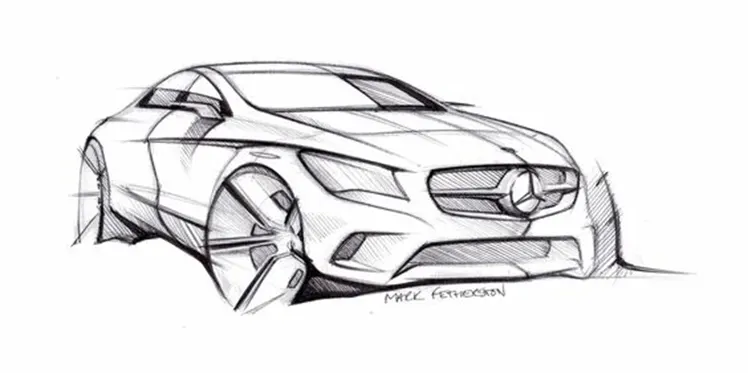
Concept sketches are rough idea of free hand sketch obtained through styling team and will be used to prepare the Model. It is usually done through pen and paper and through some of the painting software. This is will be used to generate the concept for preparing the model by incorporating various styles and information obtained through the stakeholders
The below image shows Free hand sketch of Mercedes Benz.
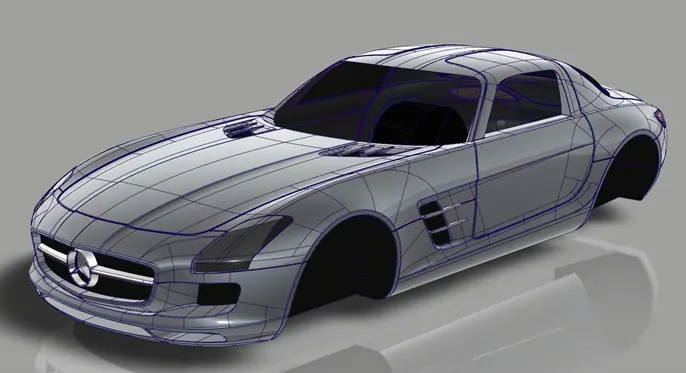
Class A Surface:
The Next Design Life Cycle is to create Class A skin out of concept sketches. This is done through 3D software and this embarks the head start of 3D design phase of the automotive components to be created by further design and manufacturing teams
Clay Modelling:
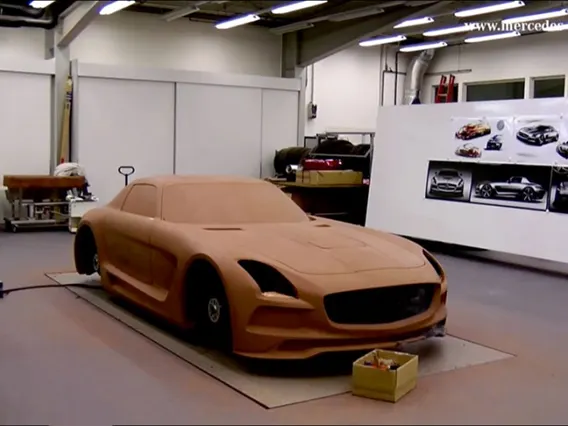
The Class A Surfaces are validated through Clay modelling and this gives the real visual representation of components that will be used to create input for the CAD Engineers to create 3D Sketches of automotive components. Clay Models are chiselled by hand to get the realistic experience by leading OEM and some of the interior components are done through machines. The role of this stage is to create model as per the concept sketch and scan using photometry to create 3D CAD model.
NPD Design:
The final stage of the design cycle is performed by the CAD Engineers who starts modelling the parts in the software with the design guidelines and ensures the functionality and feasibility of manufacturing and assembly. If the part violates or not possible to manufacture then suitable alternatives are worked out with by collaborating with the upstream and downstream processing teams.

- Concurrent Engineering:
Concurrent engineering is a method of designing and developing engineering products, in which different departments work on the different stages of engineering product development simultaneously. If managed well, it helps to increase the efficiency of product development and marketing considerably reducing the time and contributing to the reduction of the overall development cost while improving the final product quality.
Concurrent engineering, also known as Integrated Product Development (IPD) or simultaneous engineering was introduced a few decades ago to eliminate the issues from sequential engineering or the so called “over the wall” process. This systematic approach is intended to force all the stakeholders to be involved and the full engineering product cycle to be considered from concept to after-sale support. There are plenty of incentives to choose Concurrent engineering over sequential engineering product development.
- Clay Modelling:
A clay model is a 3D sculpture that allows the designer to search for the desired surfaces directly on the model. Using sketches, tapes and CAD information, the modeler and the designer are working together in order to create a new design.
Significance of Clay Modelling:
Cars didn’t always have the same style, aesthetic value, and design as they do now. Sure, there was the wealthy elite who bought the most fashionable cars from day one, but most people who bought a car did so because they needed one.
It was a utilitarian device used for transportation. When the industry was strong, consumers had the option to focus on more aesthetic qualities rather than utilitarian ones.
A useful, beautiful accessory rather than something to drive your way into town with. Earl noticed that blueprints and drawings of cars were not quite conveying the idea of what a car would be.
At the same time, you had to show ideas without devoting thousands of dollars to building real models of possible cars. His solution was modelling clay.
It allowed him to design a vehicle with extreme specificity. Additionally, people looking to purchase or distribute the vehicle could see and feel it before it was put into production.
- Functional Requirements:
The main stages of Functional Requirement are
- Design Intent
- Environment Consideration
- Material Thickness
For Instance, let’s say the OEM wants to Shades holder as part in the car interior to keep Glasses. This becomes the design intent and when working on the design the part has to fit the purpose. The Environment Considerations are the factors required to place that part in the interior. For Example, Car Inboard, Car Forward and Z position of the part in the interior and various considerations are taken into account. Finally, the desired material thickness and selection of materials were done and the developed product is manufactured along with another functional feature. Thus, whenever a purpose of design arises after-market study and concept validation design and analysis of the parts are done to incorporate into the existing master sections
Functional Reliability:
The factors considered are,
- Purpose
- Strength
- Resistance
For the above-mentioned example, the purpose of designing Sun shade holder needs to functional and also it should not hinder the other functional components. The possible defect occurrence will be validated and incorporated in the design to reduce rework and improve quality. The strength factors are how it will be fitted in the car console like clips and snaps will be considered. The best approach used in these Design are DFMEA Method (Design for Failure Mode Effect Analysis) which identifies the Failure Effective modes of the components and tries to reduce beforehand in the design stages.
- Design for Manufacturing (DFM):
DFM or Design for Manufacturing is a set of processes that are part of the technical analysis of a manufactured product. It consists of complex tests of various parameters, whose aim is to verify whether a given design meets the real needs of construction. In the automotive industry, DFM plays a special role.
Design for manufacturing includes tasks such as rheological analysis, kinematic analysis and heat balance analysis. The component is examined from many angles using professional software, usually CAD systems. Simulations of real-world conditions provide a great deal of data, and their appropriate use leads to an even better understanding of a part's characteristics and potential for improvement in production. However, this is not an easy process – you need to prepare your technological infrastructure and have access to a lot of knowledge.
Design for Assembly (DFA):
DFA is defined as a process to design such that it can be assembled easily and at low cost. In DFA analysis is done on child parts and final product for any assembly problem early in the design stage. It is important as it potentially reduces the assembly cost.
Purpose of DFA:
- To simplify the product so that cost of assembly is reduced.
- To improve quality and reliability of the product.
- It also reduces inventory cost and production equipment requirement.
- Economic Factors of design:
- Adhering to Functional Requirement, Reliability, DFM, DFA will reduce the cost of the part and improves the effectiveness. Hence these factors are carefully considered in design stages to avoid quality issues and rework.
- Serviceability is also an important factor to be considered.
- The Life cycle of the automotive not just ends with the production or sale with customer. It runs till the life of the automobile on road. After-Sales Team holds high priority in providing serviceability to the automotive.
- Thus, frequent parts that are to be replaced in different service cycle should be easily accessible for the service engineers.
- There will also be guidelines and procedure drawing made out to service engineers about the serviceability of various parts and how to detect life cycle of the components
- The final economic consideration is Recyclability. There is a law in EU legislative that automakers are responsible for the recycling of car and components after its end of life and also the parts used has to be 90% Recyclable.
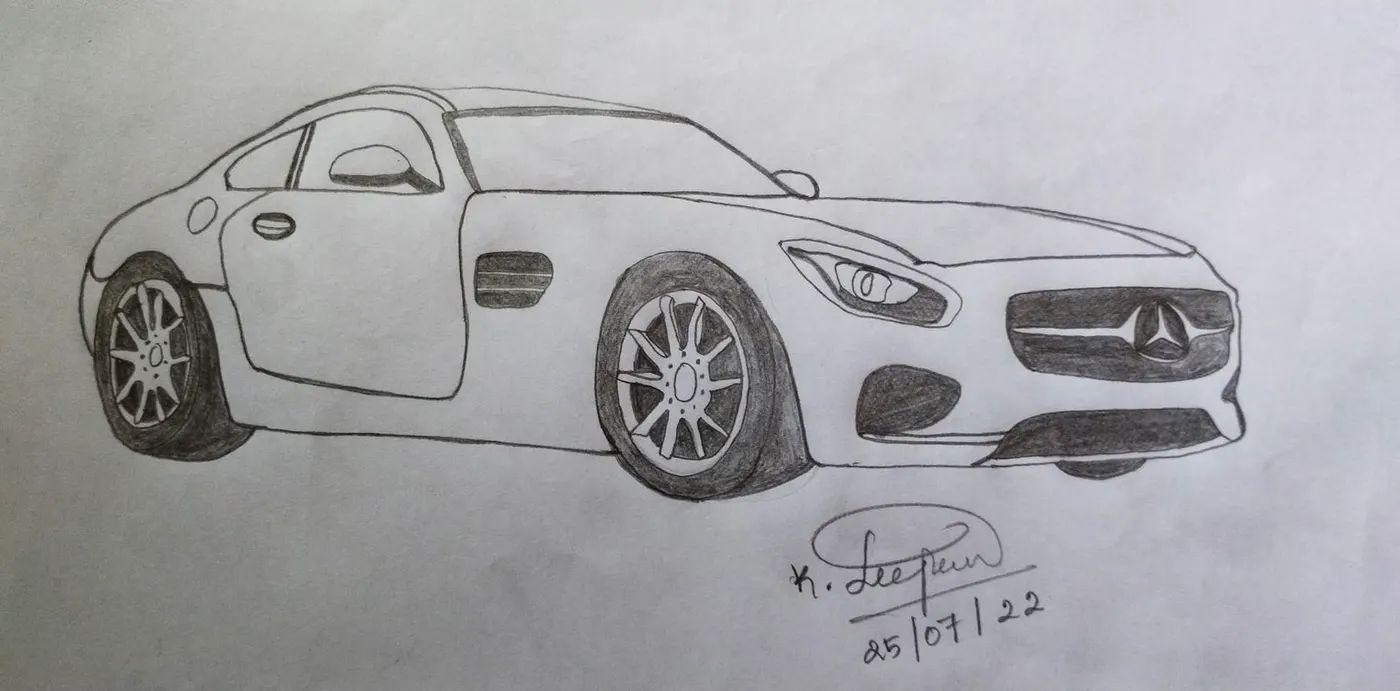
Free-Hand Sketching of Mercedes Benz: