Project
Aim: Carry out a system-level simulation of an all-terrain vehicle.
Report:
Definition of ATV:
An all-terrain vehicle (ATV) is defined as a motorized off-highway vehicle designed to travel on four low-pressure or non-pneumatic tires, having a seat designed to be straddled by the operator and handlebars for steering control. ATVs are subdivided into two types as designated by the manufacturer. Type I ATVs are intended by the manufacturer for use by a single operator and no passenger. Type II ATVs are intended by the manufacturer for use by an operator and a passenger, and are equipped with a designated seating position behind the operator. Similarly, riders must also consider the various ATV sizes.
ATVs are not “one size fits all.” The ATV industry recommends all riders operate an ATV intended for their age. Youth model ATVs are designed for smaller hands and feet, and travel at slower speeds appropriate for their age.
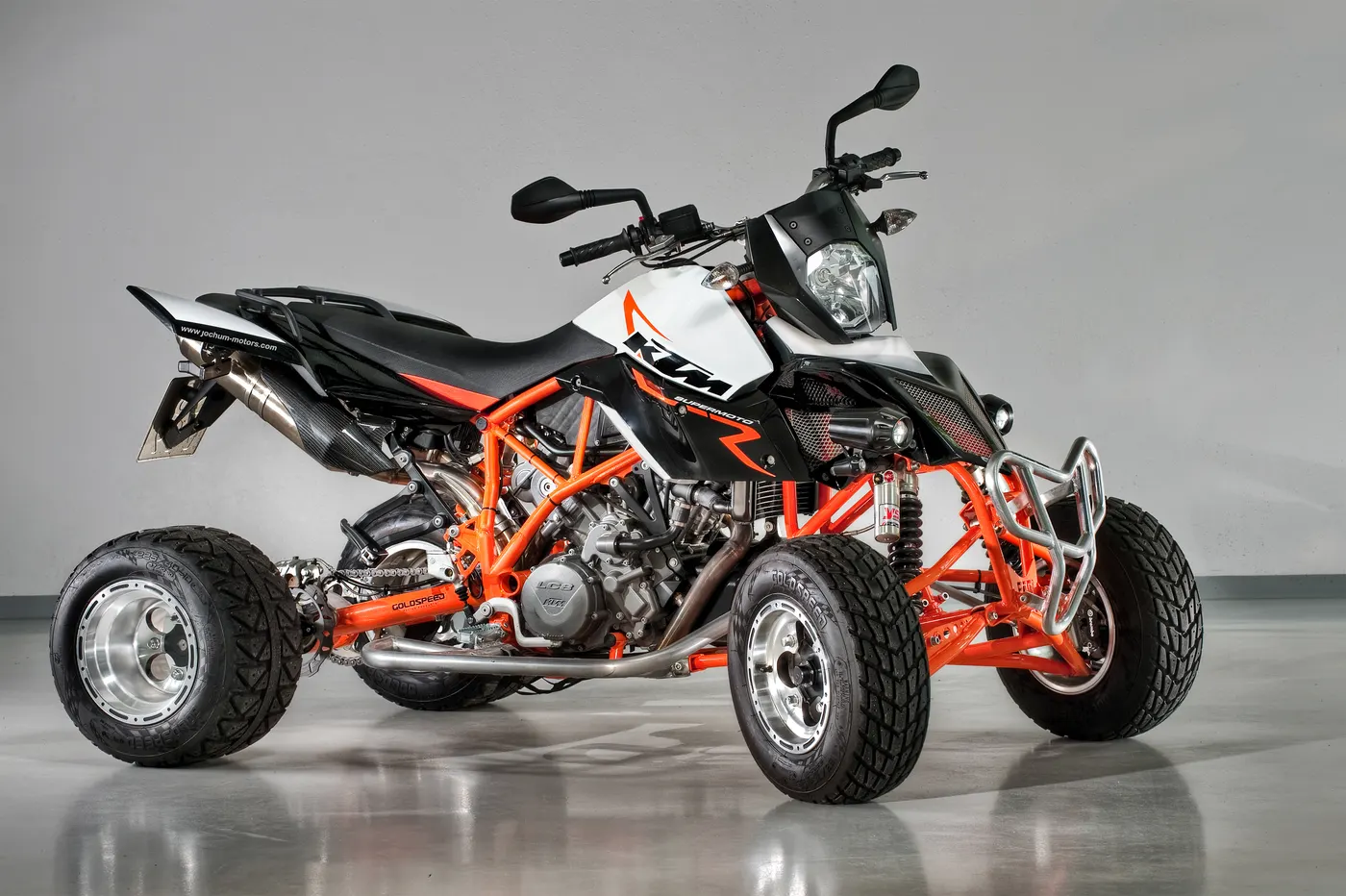
An All-Terrain motor vehicle could have three, four or even six wheels. Unlike a motorcycle, generally, the ATVs have more than two wheels. This vehicle runs on low-pressure tires. However, it has handlebars instead of wheel for controlling the steering.As the name indicates, an ATV is designed to handle a broader variety of terrain than regular vehicles. In some countries it is a street-legal motor vehicle and licensed for use on public roads. However, it is not street-legal or roadworthy within some states, territories, and provinces of some countries.
Riding an ATV:
The riders ride an All Terrain Vehicle by siting on it just like a motorcycle. However, you don’t need much effort to balance it because extra wheels give more stability at slower speeds. Also, most dirt bikes are considered the ATVs because they are designed for off-road use only. Generally most ATVs come with three or four wheels. However, some specialized applications require six-wheel models. Engine sizes of ATVs range from as low as 49cc to 1,000cc. However, the size of the engine depends upon the application.
Generally, the intended use of All Terrain Vehicles is by a single operator only. However, some manufacturers make ATVs for use by two. Of them, one is the operator and other is passenger. So, manufacturers refer these ATVs as Tandem ATVs. The rider or main operator must wear a helmet just like a motorcycle rider. However, in some countries, it is not mandatory for the passenger to wear a helmet.
Definition:
The development of the All Terrain Vehicles started way back in the early 19th century. In 1893, Royal Enfield manufactured and sold the first powered quadricycle. The vehicle employed many bicycle components such as the handle bars. However, it was mainly designed for use as a horseless carriage for road use.
A group of students first designed a three-wheeled ATV or Tri-cartin 1967 as a college project. The Tri-cart was a straddle-ridden with a sit-in rather than sit-on type. Later, many small manufacturers followed this trend and started making it. Then, Honda entered the market and launched its first sit-on type straddle-ridden three-wheeled ATVs in 1969.
Most earlier generation ATVs had large balloon tires instead of a mechanical suspension. However, by the early 1980s, manufacturers introduced All Terrain Vehicles with better components like suspension, racks and lower-profile tires. In the late 1980s, due to safety issues with three-wheel ATVs, manufacturers upgraded them to four-wheel models. Later, manufacturers like Polaris designed & developed the ATVs with six wheels for specialised operations such as military.
Modern ATVs employ advance features such as liquid-cooled engine and Twin spark-plugs. Some also offer independent suspension, automatic transmission, and a 4-wheel drive system etc. Manufacturers categorize modern ATVs in the following catogaries.:
- Utility
- Sport
- Children’s
- Side-by-Side or SxS
- 50cc Gas
Honda, Suzuki, Yamaha and Kawasaki are some of the ATV manufacturers in the world. CFMOTO, Tracker Offroad, and Polaris are some of the American ATV manufacturers.
CVT (Continuously Variable transmission):
The CVT or Continuously Variable Transmission have been the preferred choice of the automatic transmission for many automakers. These belt-driven transmission systems are known for their comparatively seamless gear changes with the advantage of infinite gear ratios, and that translates down to refined ride quality. The rpm levels remain more constant and the engine remains relaxed, at varying speeds, and that makes CVT fitted vehicles quite fuel-efficient as well. However, the towing capacity of a vehicle gets affected, and driving skills needs to be experienced when handling a car fitted with CVT, especially in high terrain situations and when reversing. Because of the later problem, many car owners and automakers swear against the viability of CVT engine options.
But the CVT is not a recently developed mechanism, Daimler and Benz, aka Mercedes Benz received a patent for it way back in 1886, and Zenit motorcycles used to come fitted with this transmission option. Speaking of bikes, the now-discontinued naked Aprilia Mana 850 used to come fitted with a CVT and it was an exception in a market where most automatic bikes choose Dual-Clutch transmissions. When it comes to cars, the Datsun GO, and GO+, Honda Amaze, Maruti Suzuki Baleno, Nissan Magnite, and the Renault Kiger are some of the household cars that come fitted with a CVT.
BAJA ATV model without dashboard:
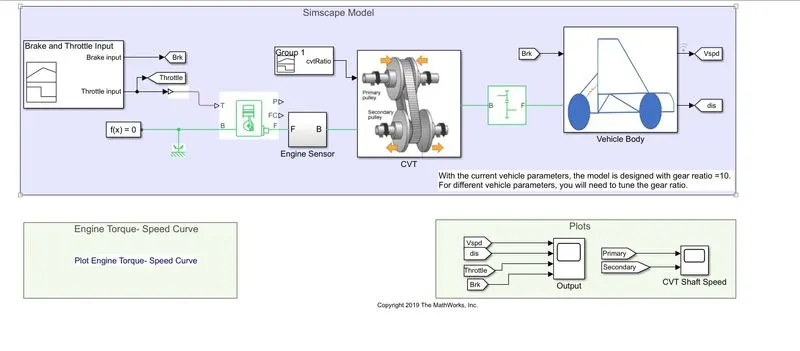
The above model reperesent the BAJA atv model which consists of cvt transmission. It has two inputs which is throttle and brank. These two inputs where generated by singnal builder.The inputs were feed through Generic engine. Then the engine sensor sense the rpm value.
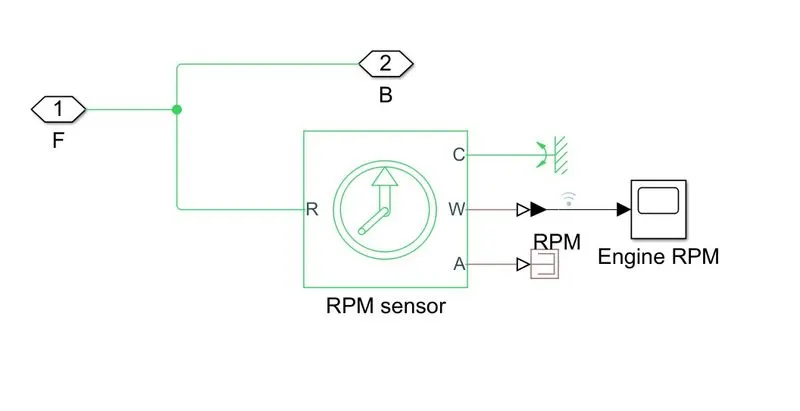
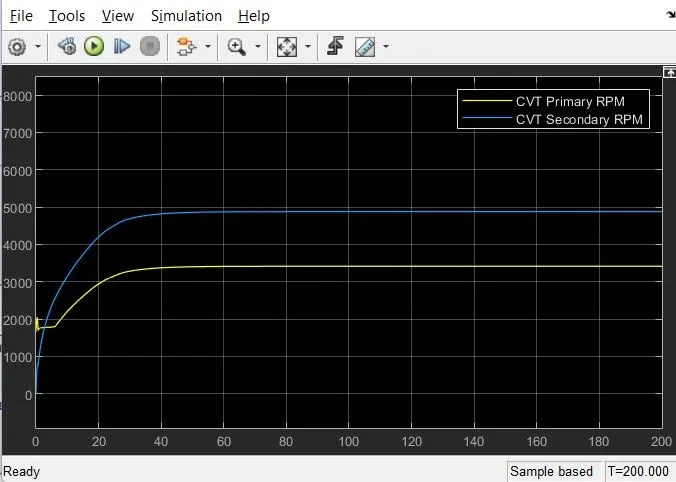
After that the signals get through the CVT model which consists of input shaft inertia,variable gear ratio,rotational sensor to sense CVT primary and secondary rpm and output shaft inertia.
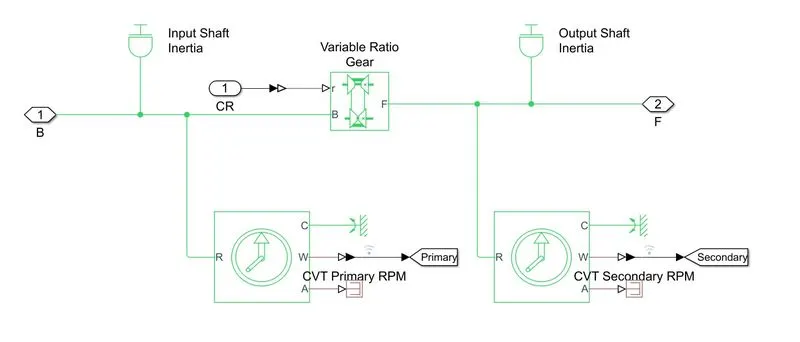
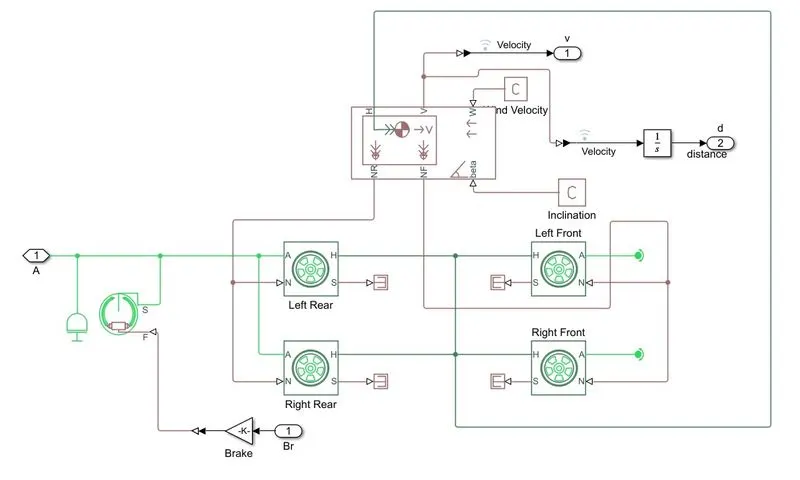
Then the secondary rpm signal passes through the simple gear setup to vehicle body, the vehicle body layout given below:
Steps:
i.The throttle signal is generated by signal builder block and inputted to generic engine.
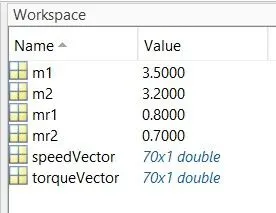
ii.The torque and speed vector are inputted from the matlab workspace
iii.The engine will generate the output rpm which can be taken from the crankshaft output. This speed will be given to the Ideal Rotational Motion Sensor to sense the output rpm.
iv.The same output speed will be given to a simple gear mechanism to reduce the speed where the Gear Ratio is '4!
v.Then the output speed from the gear reducer will be given to the Variable Ratio Transmission block (CVT).
vi.The CVT ratio is provided to the Variable Ratio Transmission (CVT) block through Signal Builder.
vii. The speed is controlled by the variable CVT ratios and the controlled output speed is inputted to the vehicle axle.
viii.The brake signal is generated by the signal builder and inputted to the vehicle body (Double Shoe Brake) for applying the brake to axle.
ix.The power from the CVT is inputted to the axle and the vehicle accelerates according to the speed.
x. Then the Velocity is taken as output from the vehicle body for further analysis.
Matlab workspace input:
RESULTS:
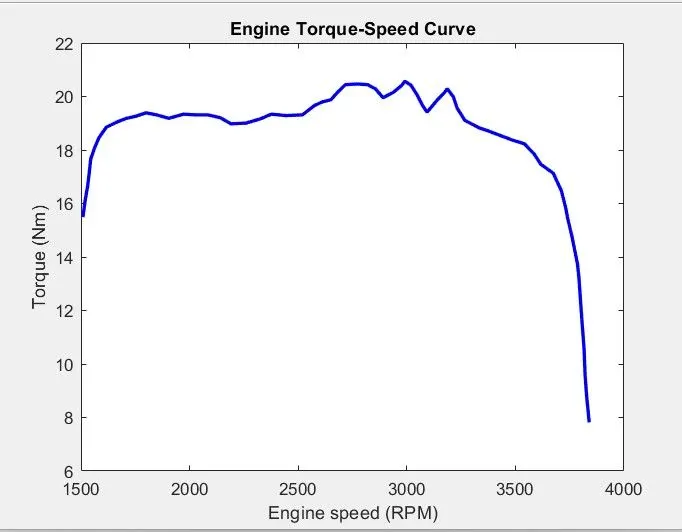
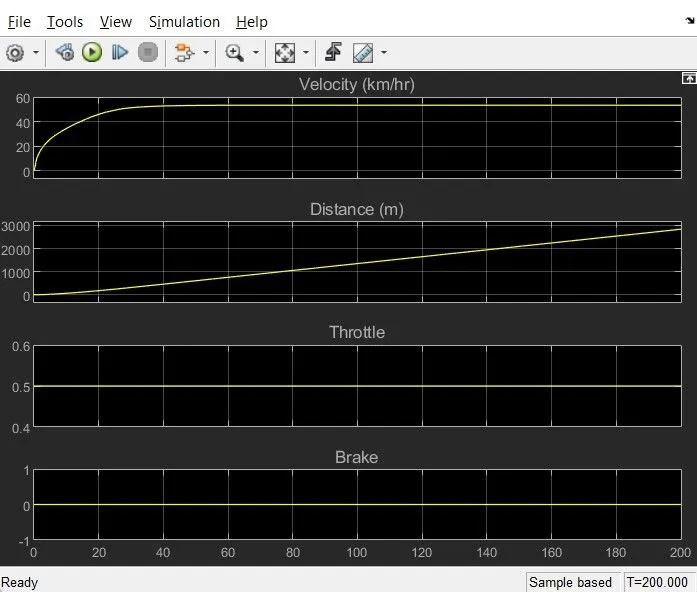
The above plot shows the result for engine speed and torque.
BAJA ATV model with dashboard:
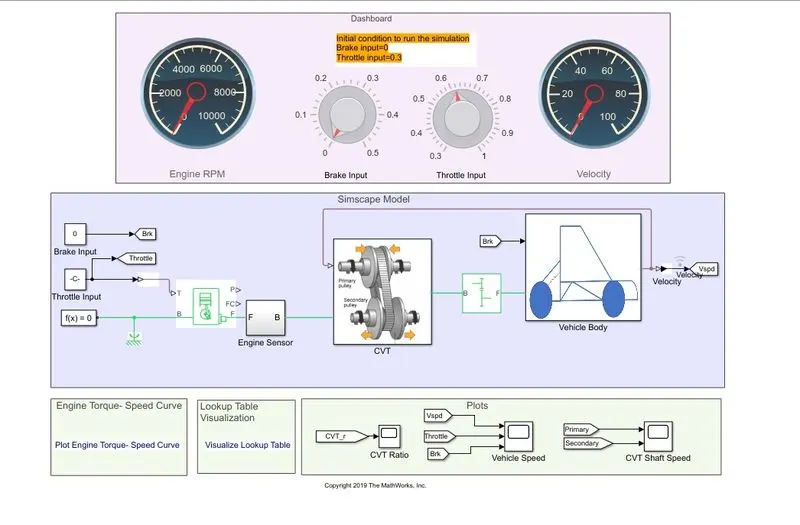
This BAJA atv model is also same as like the model which we have already studied. But the only difference is it has more components like dashbord and variable inputs.
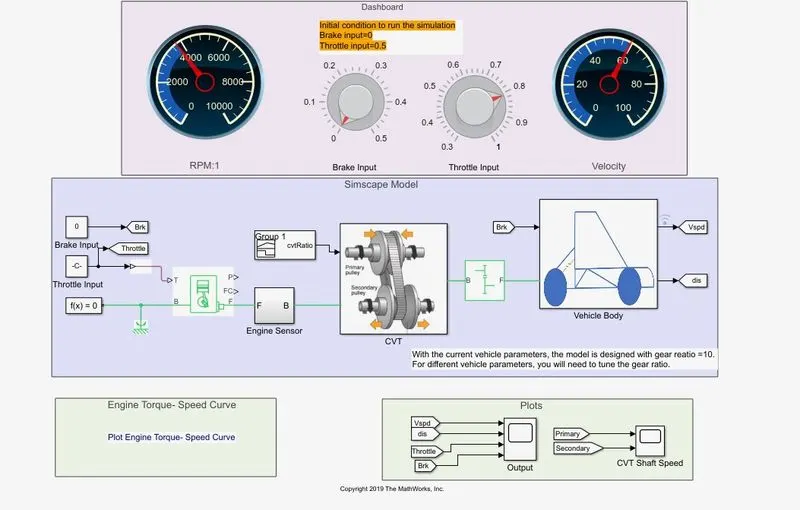
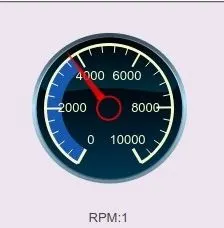
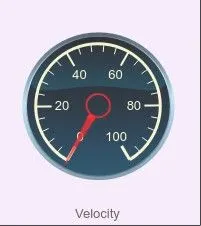
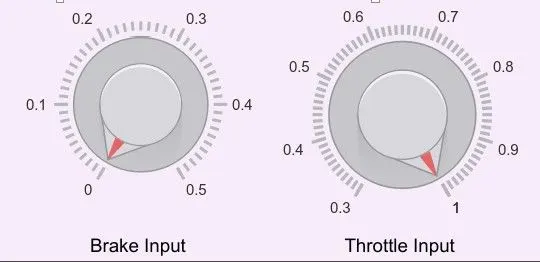
As you can see that is contains the same block and circuit as the first model. It also has a dashbord to showcase the RPM and velocity details. And it has a variable inputs for throttle and brake which can be variable depends on the user input.
The output blocks are:
Input blocks are:
BAJA ATV (cvt dashboard model with mapped lookup table):
Lookup table:
A lookup table is an array of data that maps input values to output values, thereby approximating a mathematical function. Given a set of input values, a lookup operation retrieves the corresponding output values from the table. If the lookup table does not explicitly define the input values, Simulink can estimate an output value using interpolation, extrapolation, or rounding, where:
-
An interpolation is a process for estimating values that lie between known data points.
-
An extrapolation is a process for estimating values that lie beyond the range of known data points.
-
A rounding is a process for approximating a value by altering its digits according to a known rule.
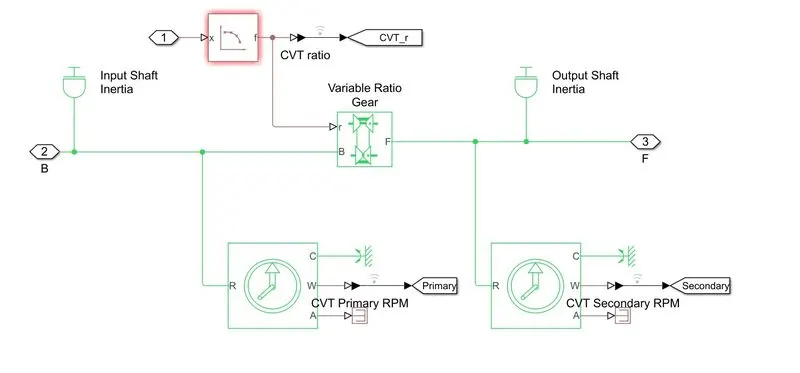
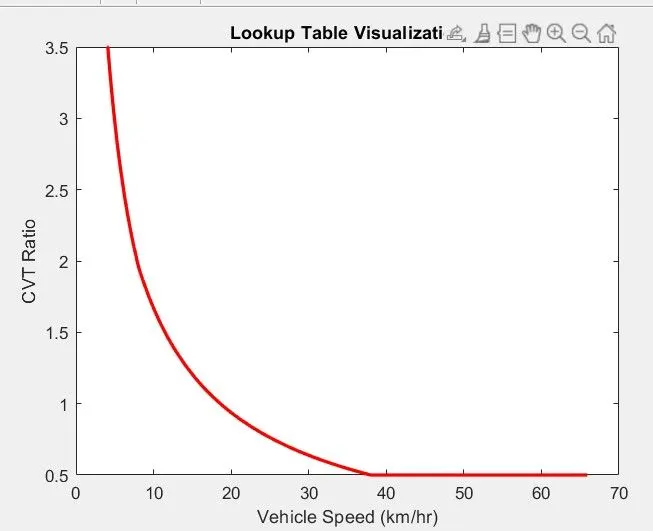
A lookup table block uses an array of data to map input values to output values, approximating a mathematical function. Given input values, Simulink performs a “lookup” operation to retrieve the corresponding output values from the table. If the lookup table does not define the input values, the block estimates the output values based on nearby table values.