Project
Introduction:
- This project is about the simulation of terrain vechicle. In this system we are going to desing a vechile which posses up to 3800rpm. CVT is used to increase the speed and decrease the speed accordingly.In the upcoming portions the detailed construction, working and the output of the system.
Construction:
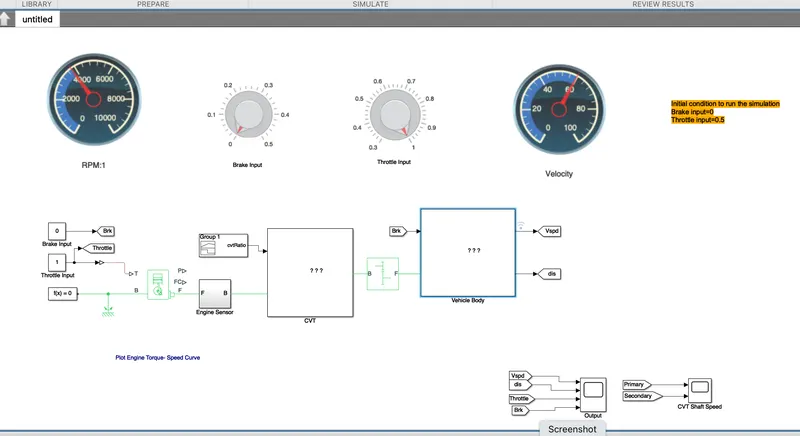
- Inputof this system is throtlle and brake, In simulation throtlle and brake is created as a constant block break value is given as 0 and throtlle value is given as 1. It can be changed using linear scale block.
- Throtlle signal is directly given to the Generic Engine where as Brake input is created as a subsystem to connect directly to the vehicle body block.
- Generic Engine will be feeded with throttle signal,inside the block the torque vector and the speed vector also will be provided which is used to give the response accordinly.
- Force output from the Engine is given to the Engine Sensor to sense the output and then output from the sensor is connected to CVT.
- CVT-Continuous Variable Transmission System which is used to change seamlessly through the continous range of gear ratio.In real system it has primary pully connected to the variator and secondary pully connected to the belt.
- But in simulink it is constructed using two inertia blocks, one is called as input inertia and another one is called as output inertia interconnected with the variable ratio transmission block and the rpm of each inertia is monitored using ideal rotational motion sensor.
- Then the CVT output F is connected to vechicle block which contains a value of mass and dynamics of the vechicle body and the basic tyre block is used in this system, double shoe break is connected to the tyers where the break input is also given.
Generic Engine:
- It is a mechanical simscape model of Engine where the data which is needed to design a virtual model of practical engine can be created and all the simscape model should be connected with respective referances here because of rotaional mechanical component , mechanical rotational referance is used.
- In this Engine, speedVector and velocity vector is feeded by creating a data with respective names in basic workspace.
- Force produced by this engine is feeded to engine sensor which is used to sense the output and the sensed value is given to CVT.
- CVT is used to increase or decrease the speed according to the input.
- In this model, input inertia and output inertia is conncected with variable transmissin ratio block which is used as variable gear ratio.which practicaly used to change the gearshaft automatically accorrding to the current speed.
- the speed of the primary shaft and secondry shaft which is called as input and output inertia is sensed using ideal rotational motion sensors.
Simple Gear:
- It is a gear box connected to CVT which changes the gear potitions accorrding to the CVT output .
- the teeth ratio of the gears is feeded in it.
- then the output is connected to the vehicle block.
Vechicle Body subsystem:
- It is subsystem which has a vechicle body block and tyer block.
- brake subsystem is connected to the gain block which manipulates the brake value and give it as a input force in double shoe brake block.
- double shoe block is connected with the tyers.
- output inertia is also connected with the tyers to slow down the speed accorrding to the throttle input.
Result:
- the input torque and brake , and the respective output of velocity and distance is given in the ploted with the help of scop.the graph is attached below.
- From the CVT system , the signal of Primary and secondary rpm is displayed by the scope. the attachment of that scope is also given below.
- The output response of changing the throtle and brake also screen recorded and attached below.