Project
AIM:
1. To carry out system level simulation of an all-terrain vehicle (BAJA)
2. To prepare a technical reprt explaining the model properties and comments on the results.
THEORY:
CVT (Continuous Variable Transmission)
Unlike traditional automatic transmissions, continuously variable transmissions don't have a gearbox with a set number of gears, which means they don't have interlocking toothed wheels. The most common type of CVT operates on an ingenious pulley system that allows an infinite variability between highest and lowest gears with no discrete steps or shifts.
There are 3 types of CVT:
1. Pulley-based CVTs
2. Toroidal CVTs
3. Hydrostatic CVTs
1. Pulley Based CVT
In this assignment, Pulley based CVT is discussed in brief.
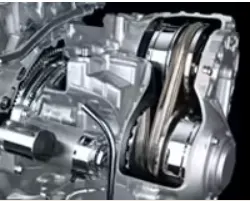
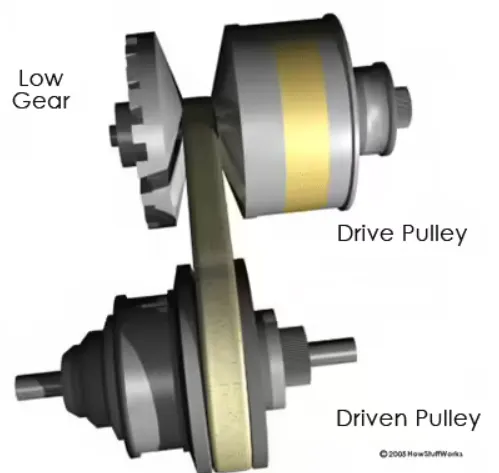
The variable-diameter pulleys are the heart of a CVT. Each pulley is made of two 20-degree cones facing each other. A belt rides in the groove between the two cones. V-belts are preferred if the belt is made of rubber. V-belts get their name from the fact that the belts bear a V-shaped cross section, which increases the frictional grip of the belt.
When the two cones of the pulley are far apart (when the diameter increases), the belt rides lower in the groove, and the radius of the belt loop going around the pulley gets smaller. When the cones are close together (when the diameter decreases), the belt rides higher in the groove, and the radius of the belt loop going around the pulley gets larger. CVTs may use hydraulic pressure, centrifugal force or spring tension to create the force necessary to adjust the pulley halves.
The variable-diameter pulleys must always come in pairs. One of the pulleys, known as the drive pulley (or driving pulley), is connected to the crankshaft of the engine. The driving pulley is also called the input pulley because it's where the energy from the engine enters the transmission. The second pulley is called the driven pulley because the first pulley is turning it. As an output pulley, the driven pulley transfers energy to the driveshaft.
When one pulley increases its radius, the other decreases its radius to keep the belt tight. As the two pulleys change their radii relative to one another, they create an infinite number of gear ratios -- from low to high and everything in between. For example, when the pitch radius is small on the driving pulley and large on the driven pulley, then the rotational speed of the driven pulley decreases, resulting in a lower “gear.” When the pitch radius is large on the driving pulley and small on the driven pulley, then the rotational speed of the driven pulley increases, resulting in a higher “gear.” Thus, in theory, a CVT has an infinite number of "gears" that it can run through at any time, at any engine or vehicle speed.
The simplicity and stepless nature of CVTs make them an ideal transmission for a variety of machines and devices, not just cars. CVTs have been used for years in power tools and drill presses. They've also been used in a variety of vehicles, including tractors, snowmobiles and motor scooters. In all of these applications, the transmissions have relied on high-density rubber belts, which can slip and stretch, thereby reducing their efficiency.
The introduction of new materials makes CVTs even more reliable and efficient. One of the most important advances has been the design and development of metal belts to connect the pulleys. These flexible belts are composed of several (typically nine or 12) thin bands of steel that hold together high-strength, bow-tie-shaped pieces of metal.
Metal belts don't slip and are highly durable, enabling CVTs to handle more engine torque. They are also quieter than rubber-belt-driven CVTs.
PROCEDURE:
1. The model files are downloaded from the link.

2. The simulink files are opened in the Simulink and run for analysing the system level simulation.
"cvtModel.slx":
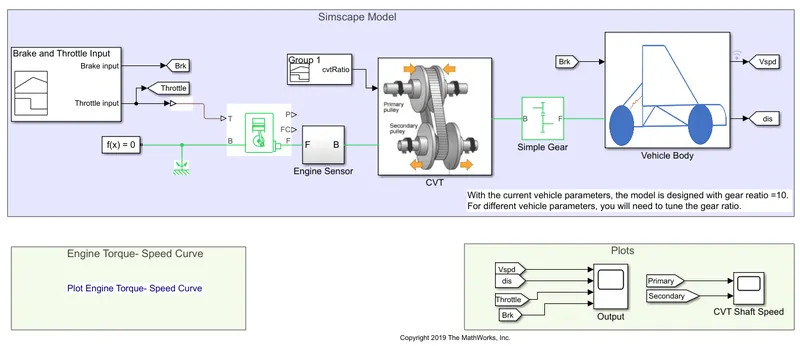
DESCRIPTION:
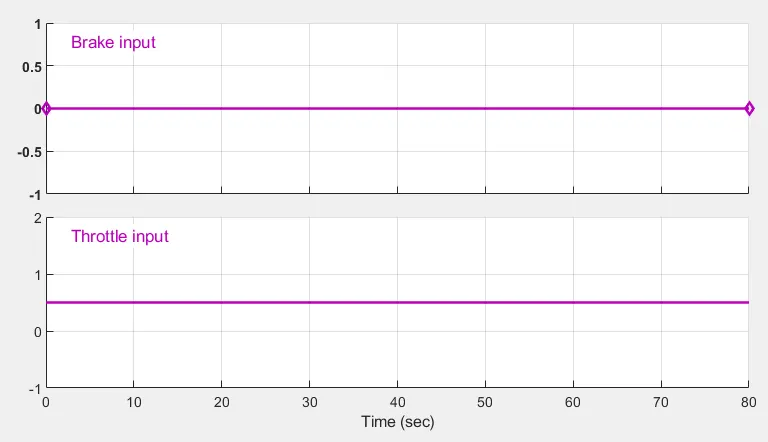
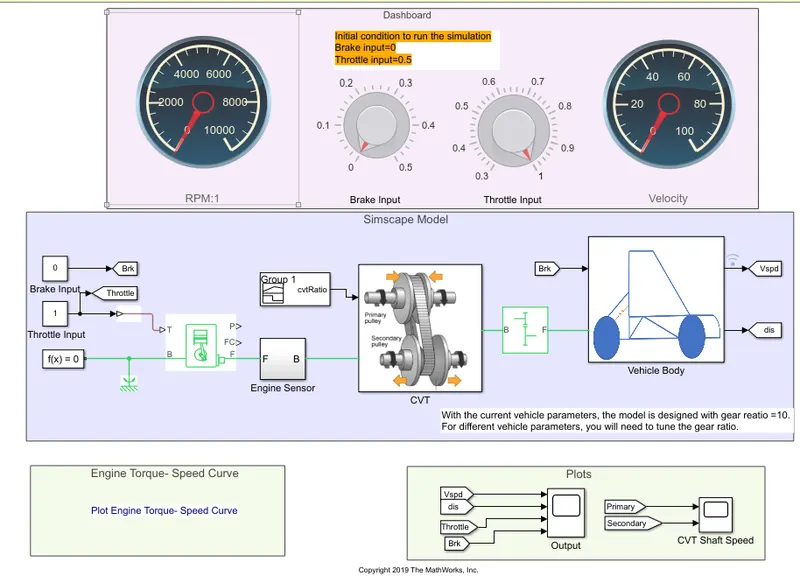
1. The throttle and brake input is given using signal builder block as shown below. Throttle(0.5) and brake(0)
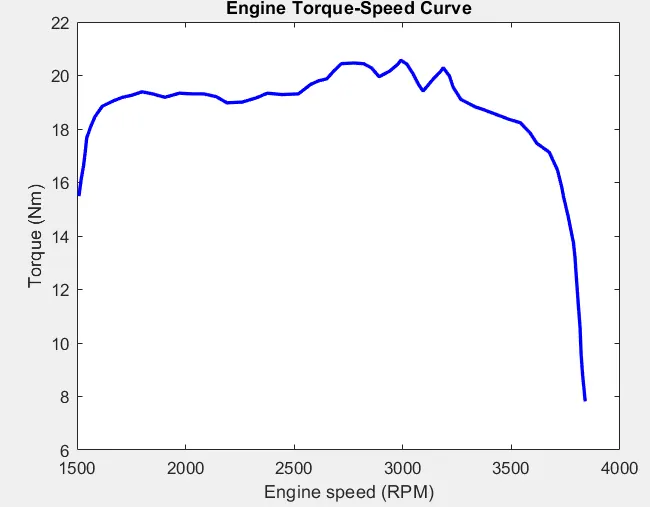
the brake used in the vehicle body is double shoe brake and the input throttle will be converted as torque to the generuc engine
2. A generic engine block is created to input the throttle which takes as torque demanded from the engine and torque to engine speed table is shown below
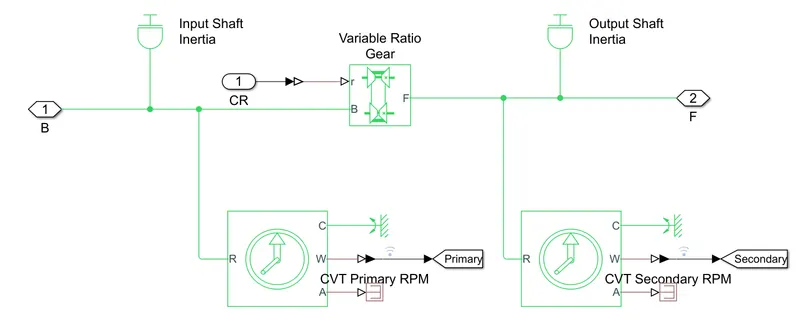
3. The cvt ratio subsystem has the following arrangement, where the variable gear ratio defines the CVT arrangement in the vehicle and with input shaft and output shaft inertia is also given as input to determine the primary and secondary rpm of the CVT shaft.
4. The vehicle body system has the following arrangement.
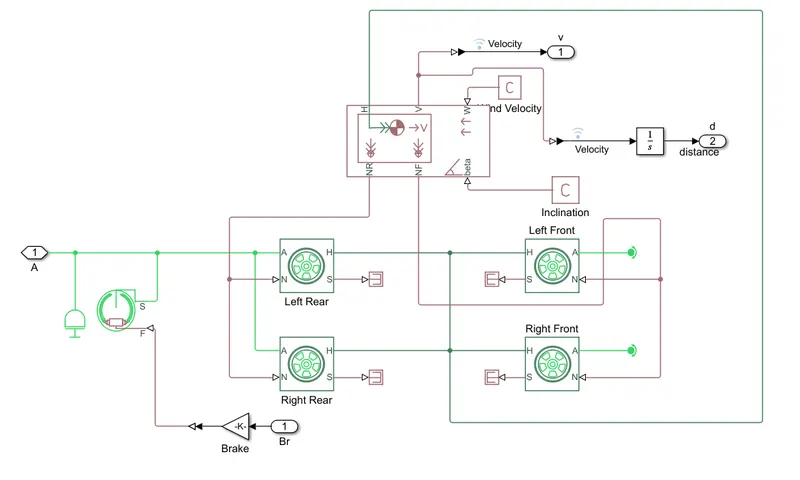
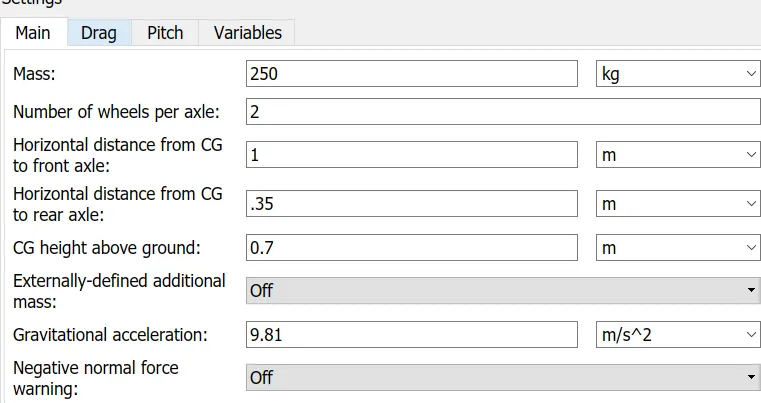
the vehicle body parameters are given as below
5. The simulink model "cvtModel_dashboard.slx" is shown below
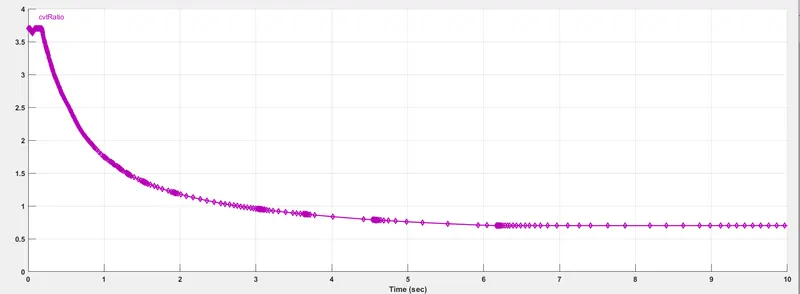
The signal builder block in the CVT ratio gives the relation between the time and the CVT ratio where the time increases the CVT ratio decreases - as the CVT ratio decreases, the output velocity from the secondary shaft increases as the diameter of the secondary pulley (belt contacting the pulley) decreases.
RESULTS and CONCLUSION:
1. The output scope displays the velocity, distance, throttle and brake as follows.
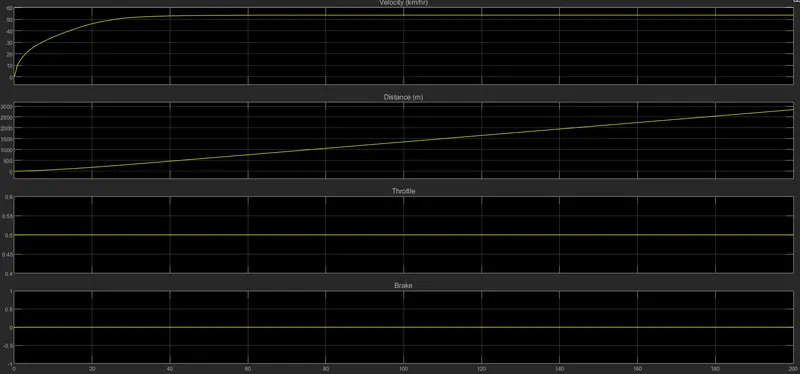
2. The throttle input (0.5) and brake input (0) is constant throughout the simulation process.
3. The distance linearly varies with respect to time.
4. The velocity of the vehicle reaches the top speed and when it reaches the maximum rpm of 3800 rpm, the velocity remains constant.
5. The CVT shaft speed scope displays the following results
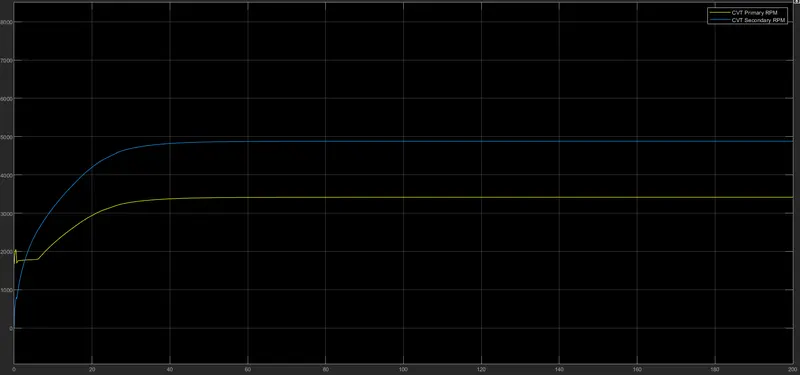
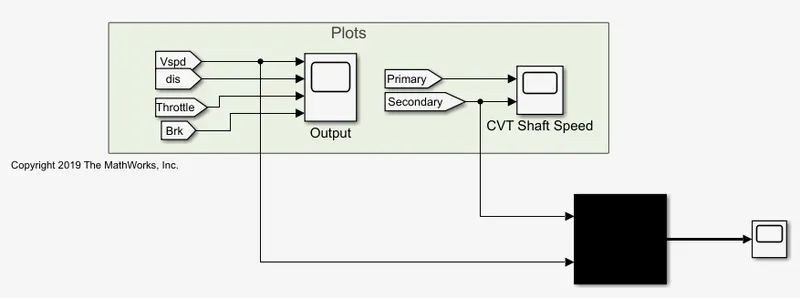
Below arrangement with MUX block is used to study the behaviour of the CVT secondary shaft and the output velocity.
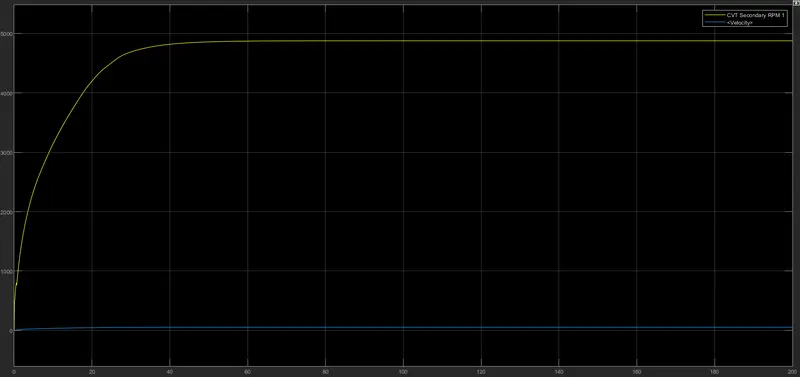
both the secondary shaft speed in rpm and velocity in kmph behaves in a similar way and hence the results can be justified better.
CONCLUSION:
Hence the system level simulation is carried out and the results are observed with proper justifications.