Project
Aim : To carry out the system level simulation of the all terrain vehicle
1) Following fig shows the Simulnik model of the All terrain vehicle - BAJA Model
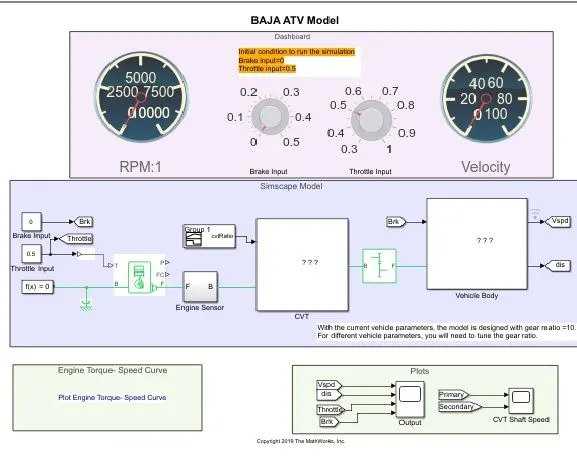
- As shown above the , Throttle and Brake are taken from the Dashboard and the constant block which is further given to the "Generic Engine " block with help of the "Simulink -PS" Converter
- The Force ouput from the "Generic Engine" is further given to "Engine Sensor" Subsystem
2) As shown in the Above Model , the All terrain vehivle consists of the Different subsystem such as
- Engine Sensor
- CVT
- Vehicle Body
3) The following fig Shows the "Engine Sensor "Subsystem
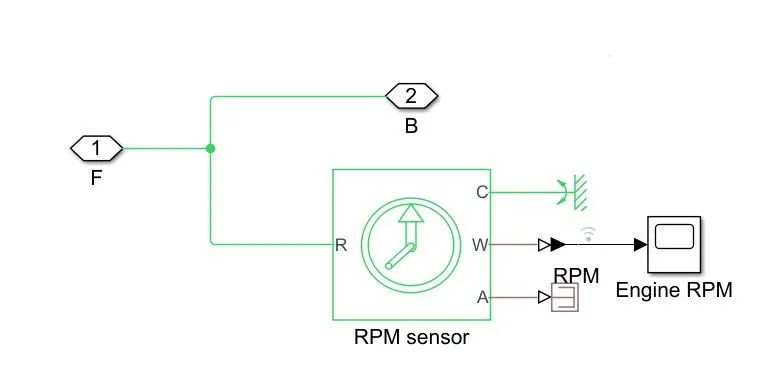
- The force input taken from the "Generic Engine" blcok is given to the "R" input of the "RPM SENSOR " block
- the ouput "W" is taken to the scope connected to see the Engine RPM as shown above
- The same input is taken to the "B" Connection port(2) , which is further given to the CVT subsystem
4) The following fig shows the CVT Subsystem
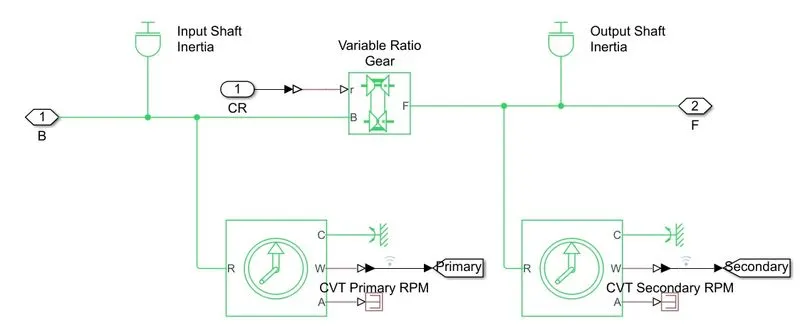
- Above fig shows the CVT - Countinuously Variable Trasmission Subsystem
- As name Induactes it is Countinously Varying the transmission with help of the "Variable Gear Ratio " block and the To RPM sensor named as CVT Primary and the CVT Secondary
- The input for this subsystem is taken from the port 2 of the "Generic Engine " named as B
- Depending upon the CR input to the "Varaible Gear ratio" and the input B recived from the "CVT Primary " the F is being calculaed and further given to as input to the "Simple Gear" System
5) The following fig shows the "Vehicle Body " Subsystem
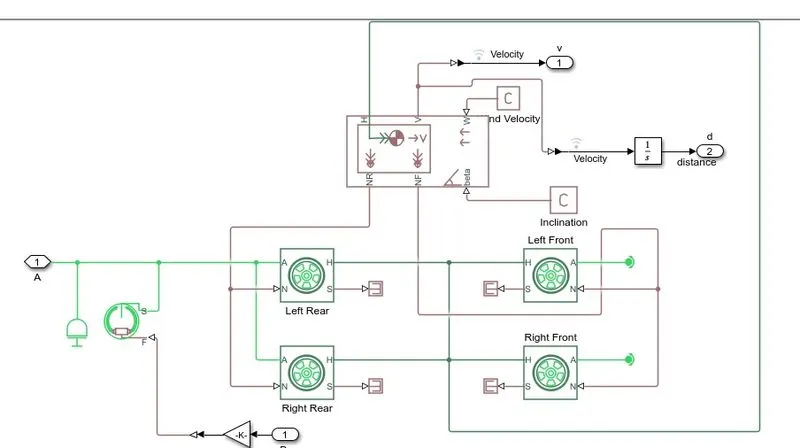
As shown , in aove diagram the Vehcile subsystem is created for the Four wheel ,
- the Four wheel system consits of the Rear and Front part of the Vehicel
- The above subsstem shows the "Rear Wheel " Drive vehicle system as , the Force applied is given to the Rear part (Rear tyre) of the vehicle
- The vehicle velocity , is taken for the ouput with "PS-Simulink "Converter
- The distance travelled is further measured using Inverter block and the same taken outside for the Analysis
- The Brake input is given to the "Gain " block as shown above
Case 1: When the Brake Input = 0 , Throttle Input =0.5
1) Followng is the Simulink model for the Brake Input =0, and the Throttle Input = 0.5 , which is the Default condition for the Baja model
2) Following is the Simulink Model for the case mentioned above
3) Following fig shows the Output for the Above Input condition , it also shows the Brake Input and the Throttle Input for the given model
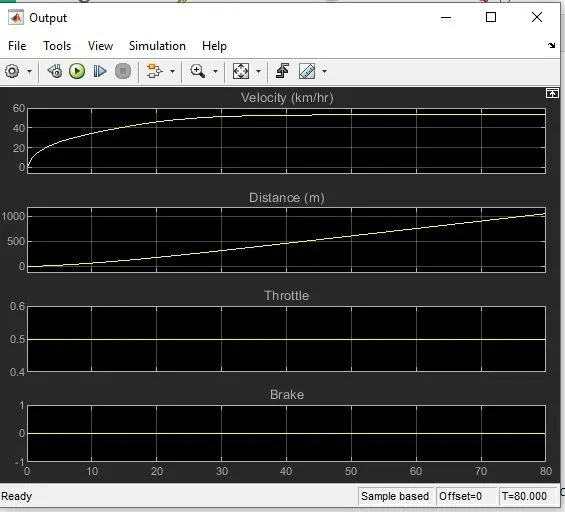
3) As shown in above output , the Velocity intially is "Zero " as vehicle engine gets starts , and eventually it reaches to the desired level where it remain almost constant .
4) Distance travelled by the vehicle as expectedly incereses along with applied Velocity
Case 2: Brake Input = 0.2 , and Throttle Input = O.5
1) Followng is the Simulink model for the Brake Input =0.2, and the Throttle Input = 0.5 , for the Baja model
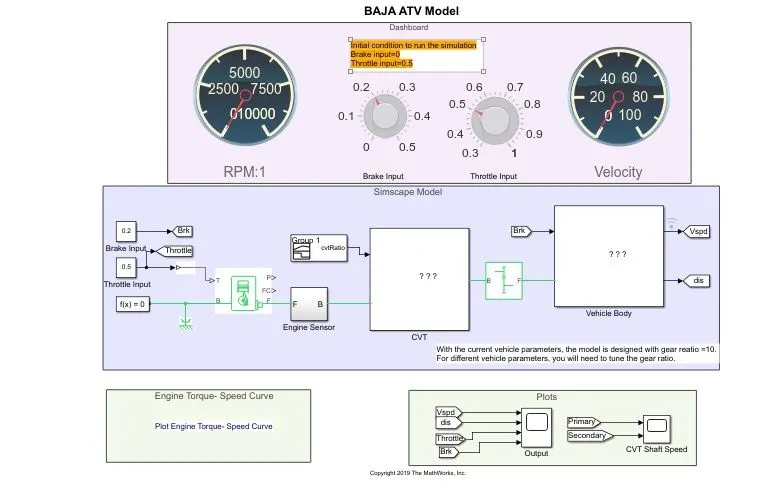
2) Following fig shows the output for the case -2
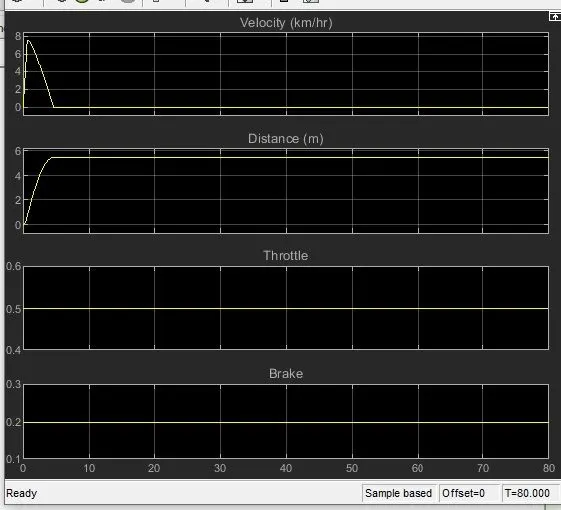
3) As shown in the Above image , the Velocity goes down after the 5 sec(Appox) as brake applied is now 0.2 , so Velocty reduces after some time and eventually goes to zero
4) Simillarly , the distance travelled graph goes upside for the intial time , when the brake applied is zero , but eventually it settled at one point very soon as brakes are applied at 0.2
Case 3: Brake Input = 0 , and Throttle Input = O.8
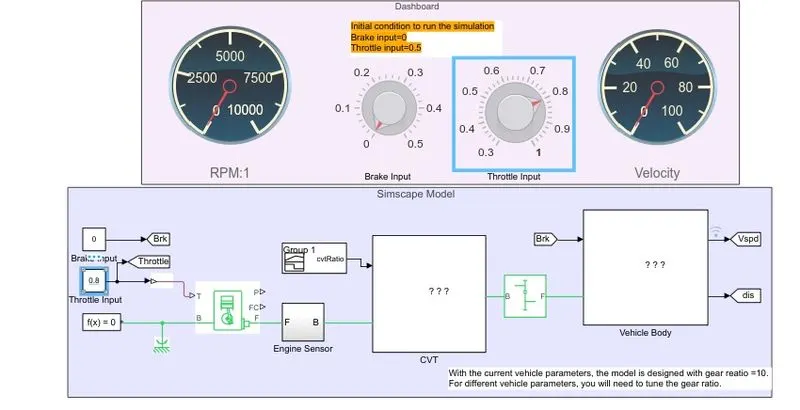
1) Following fig shows the scope ouput for the Case -3 , for the above mentioned conidtion
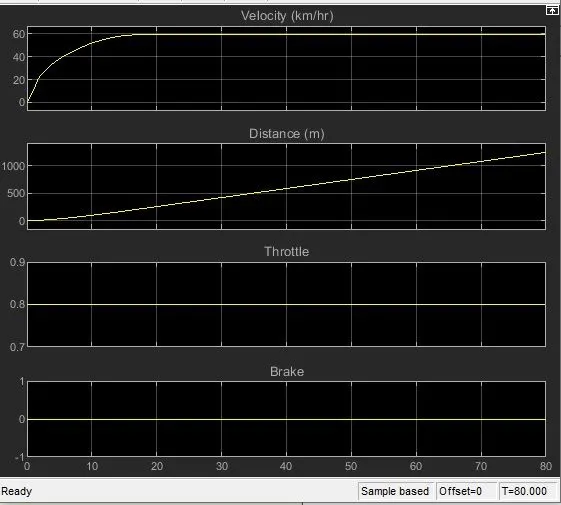
2) As shown above the Velocity goes on increasing from the Intial 0 km/hr positon and settlle downs at the 60Km/hr
3) Simillarly , the Distance travelled by the Vehicle goes on increasing as expected from the 0 m to the more than 1000 m , and still countinues further
4) As compared to the Case - 1, here the throttle Input is more(0.8) with the same brake input , so in this case the Vehcile attains the maximum speed of the 60Km/hr early as compared to the Case 1 when the Throttle input was less( 0.5 )
5) So vehicle attains the Maximum speed at the 15 Sec (Approx) as compared to the 60 Sec(Approx) in the Case -1
Conclusion :
Effect of change in the Brake Input with Constant Throttle Input
1) From above observation we can conclude the relationship between the Brake , Throttle , Velocity of the Vehicle , and the distance travelled by the Vehicle
2) The Brake apllied is inversley propotional to the Velocity of the vehicle and the distance travelled by the Vehicle.
3) As we Increase the "Brake " apllied the "Velocity " of the vehicle gets reduced proportionally , the Higher is the Brake applied the More Velocity gets reduced , which slower down the Speed of the Vehicle as expected
4) Simillarly,the Brake apllied is also inversley proportional to the "Distance " Travelled by the vehicle . The more "Brake " apllied the "Less" distance gets travelled by
Effect of the Change in Throttle Input with Constant Brake
On the Velocity of the Vehicle :
1) From the Case 1 and Case 3 , we can study the Effect of the change in Throttle Input on the "Velocity " of the Vehicle with constant Brake
- The Velcoty of the Vehicle is very drastically gets changed with the change in "Throttle " Input
- With little change in throttle input (With constant Brake ) the velocity of the vehicle gets increase rapidly for the given time duration
- With same Brake apllied the , Velocity of the Vehicel attains high value in shorter duration of time , if the Throttle input is incrased
- With Little change in Throttle inout from 0.5 (Case 1) to 0.8 (Case 3 ) the vehicle acheives the High speed of 60 Km/hr in shorter duation of 15 Sec , as compared to the Case 1 where it takes almost more than 60 sec , and still does not goes to the 60km/hr of the velocity
On the Distance Travelled by the Vehicle :
1) From the Case 1 and Case 3 , we can study the Effect of the change in Throttle Input on the "Distance " travelled by the Vehicle
- The "Distance" travelled by the vehilce as expected also gets changed with change in throttle input as result of the "Change in velocity " of the vehicle
- As "Velocity of the vehicle " gets changed with change in "Throttle " input , the distance travelled also gets changes proportionally
- So for the Higher "Throttle " input as the "Velcity " of the vehicle gets increased rapidly , so the more gets distance travelled by the vehicle in same time
- So as shown in the Ouput of the Case 3- With incrase in "Thorttle " input (0.8) the more vehicle gets to the distance of the 1000 m earliear at around 85Sec (Approx) as compared to the Case 1 where it takes almost 100 sec to achive the same distance