Project 3 - Design and Development of Disposable Syringe (Medical Technology)
Task 1 : Perform market analysis for this product, and write a summary that includes the following topics
Disposable syringes are widely used for administering medications and vaccinations or for collecting blood. In an attempt to prevent transmitting a disease, they are also used instead of reusable syringes.
Disposable Syringes are sterile used in the field of medical and veterinary science. Disposable syringes are ready to use, cost effective and increase safety concerns. The demand for disposable syringes rapidly increased during covid period.
The global disposable syringes market size was valued at USD 13.45 billion in 2021 and is expected to expand at a compound annual growth rate (CAGR) of 6.12% from 2022 to 2030.
Since the introduction of disposable syringes, patients no longer have to rely solely on the doctors' sterilization protocols for their safety, as they are discarded after one use. As a result, there is no risk of cross-contamination. Other advantages of disposable syringes include their low cost and environmental friendliness. These factors are positively impacting sales growth.
https://www.grandviewresearch.com/industry-analysis/disposable-syringes-market
Key competitors in the disposable syringe market include
- Albert David Ltd.
- Baxter International India Pvt Ltd.
- B. Braun Medical India Pvt Ltd.
- Becton, Dickinson India Pvt Ltd.
- Cardinal Health India Pvt ltd.
- Hindustan Syringe and Medical. Ltd.
- Nipro Medical Corporation India Pvt Ltd.
- Novo Nordisk India Pvt Ltd.
Task 2 : Now work on the concept development phase. The following tasks should be completed:
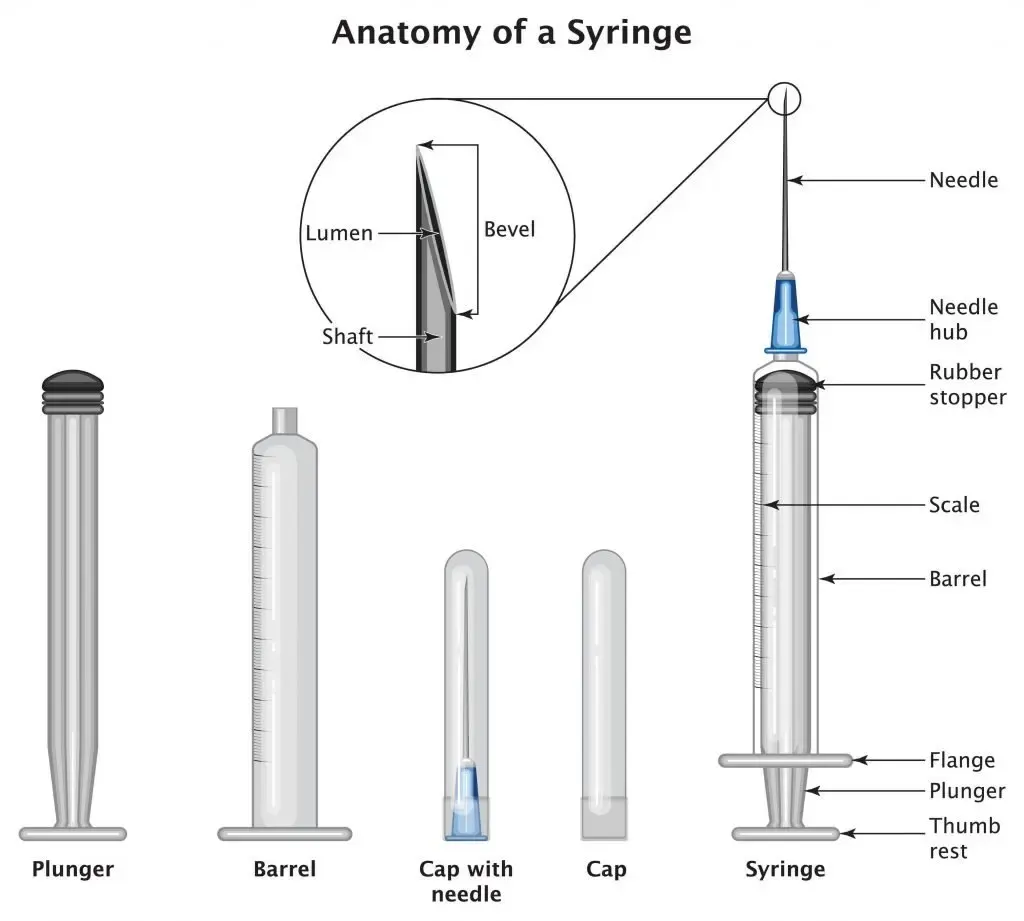
https://www.kmedhealth.com/what-is-a-3-part-syringe/
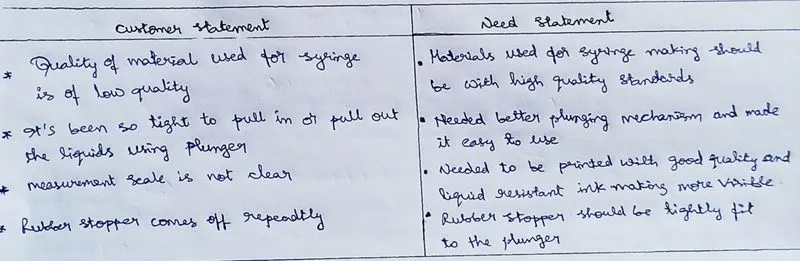
Mission statement
Let us together create a a world with advanced healthcare solutions and improve patient safety
Value proposition of my product
Outstanding quality, cheap, convenient and easy to use with utmost safety standards.
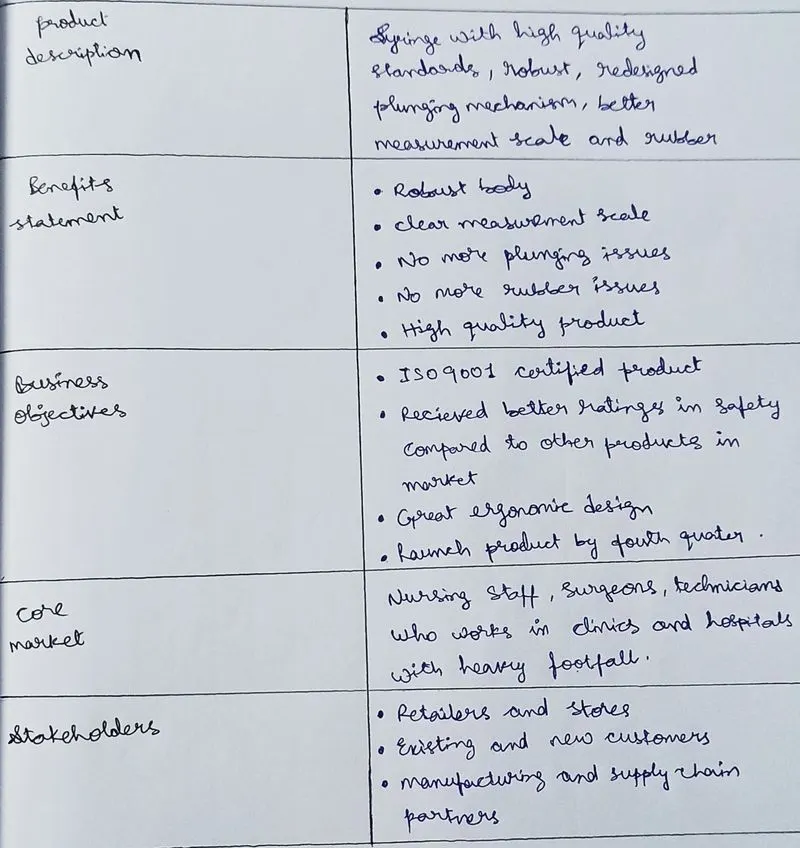
Product roadmap
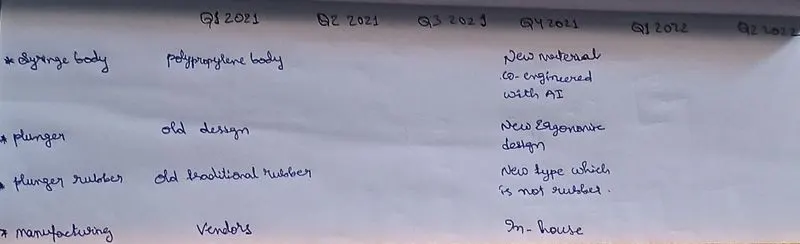
Resource allocation would not be an issue as the manufacturing of the product does not involve any third party manufacturers as all the manufacturing would be done in home based lab within the house. Design is guided by AI i.e., generative design.
Task 3 : Work on the preliminary design and development phase. The following tasks should be completed:
Scope : Better grip and easier movement of syringe
Feasibility : Fabric touch based material depends upon the algoritim of AI to be used. Chances range upto 45-50% or may be even more depends upon the AI algoritim which is used. Getting the fabric touch based material into production and 3D printable can be upto 40%. Substitue identification which is alternative for rubber is upto 60%
Materials used : Different material other than traditional material which has some fabric touch.
Product Architecture : I would prefer modular architecture. In case any fault in production we can replace the parts. Modular architecture of syringe also allows part upgarde and cost effective. Syringe allows allows traditional part to be fit onto it. It is flexible and conveinent for the vendor to use the syringe also with traditional part.
Work breakdown structure :
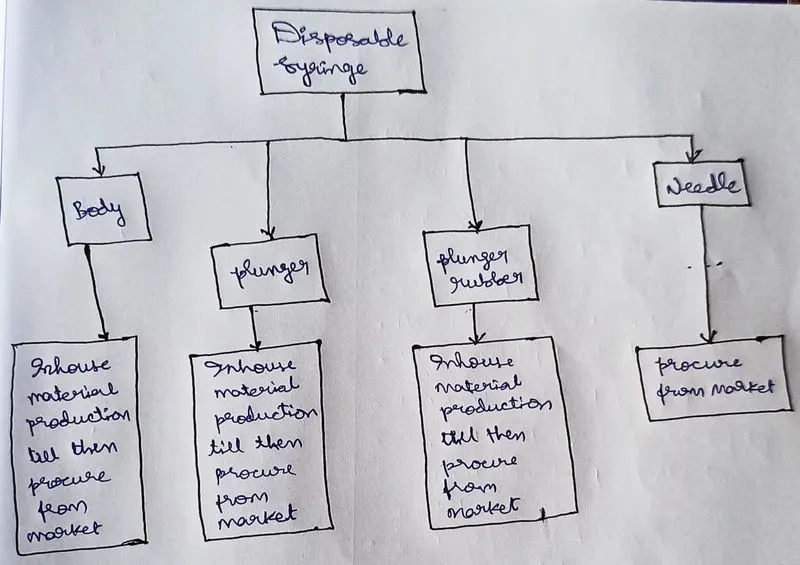
Verification and validation : Send the document to proper authorities and get the dimensions verified and if they are in compliance with the dimensions. Once the certificate is recieved we can launch the product.
Schematics :
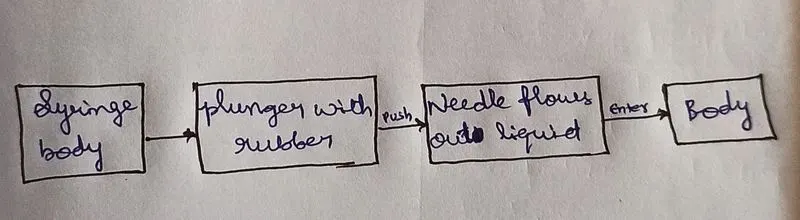
Interface document :
Mechanical interface : The plunger will move in the syringe body and with the help of the rubber at the end push the medicine into human body.
Human interface : The user needs to push the plunger with the help of their thumb while holding the syringe with the help of two fingers giving the user a grip to hold the syringe.
To simplify the design we need not add any extra hooks in the syringe just keeep it plain for the user to understand that the plungere moves and the medicine gets pushed into the body and that is it nothing else needs to be done to the design. The body should have only the markings that are needed and for the body aesthetics and making it egronomical, the body needs to have minimal marking and easier to hold and read and work with.
Task 5 : Perform a safety and reliability study.
https://docs.google.com/spreadsheets/d/1TxqtZCuT-W2nZdUVtr7tOJgMyjgx9zZol29P2tGcYNU/edit?usp=sharing
Task 6 : Design for manufacture and assembly, and design for environment and sustainability
DFMA involves designing products in a way that optimizes their manufacturability and ease of assembly. The goal is to streamline production processes, minimize costs, and enhance product quality. Here are some key considerations in DFMA:
Simplified Parts: Reduce the number of components in a product and design them to be easily manufactured using common manufacturing techniques. This reduces assembly time and cost.
Modular Design: Use modular components and assemblies that can be easily interchanged or replaced, simplifying assembly, maintenance, and repair processes.
Design for Automation: Consider automated manufacturing processes and design product features that can be efficiently produced by machines, reducing manual labor and improving efficiency.
Minimize Tolerances: Design parts with appropriate tolerances to ensure proper fit and alignment during assembly, reducing the need for rework or adjustments.
Design for Testability: Incorporate design features that facilitate testing and quality control during manufacturing, making it easier to identify and resolve issues early in the process.
Design for Environment and Sustainability (DFES): DFES focuses on reducing the environmental impact of products throughout their lifecycle, including raw material extraction, manufacturing, distribution, use, and disposal. Here are some strategies for DFES:
Material Selection: Choose materials that are environmentally friendly, renewable, recyclable, and have a low carbon footprint. Avoid hazardous substances and consider the entire lifecycle of the material.
Energy Efficiency: Design products with energy efficiency in mind, reducing energy consumption during manufacturing and use phases. This can include optimizing designs for lighter weight, reducing friction, and utilizing energy-efficient components.
Lifecycle Assessment: Conduct a lifecycle assessment to evaluate the environmental impact of the product from cradle to grave. Identify areas where improvements can be made, such as reducing waste generation, carbon emissions, or water usage.
Recyclability and Disposal: Design products with ease of disassembly and recyclability in mind, enabling components and materials to be separated and recycled at the end of their life. Consider implementing take-back programs or recycling initiatives.
Packaging Optimization: Minimize packaging materials, use recyclable or biodegradable packaging, and optimize packaging size to reduce waste and transportation costs.
Extended Product Life: Design products that are durable, repairable, and upgradable, extending their lifespan and reducing the need for replacement.
By incorporating DFMA and DFES principles into product design, manufacturers can improve efficiency, reduce costs, enhance product quality, and minimize the environmental impact of their products. These approaches contribute to sustainable and responsible manufacturing practices.
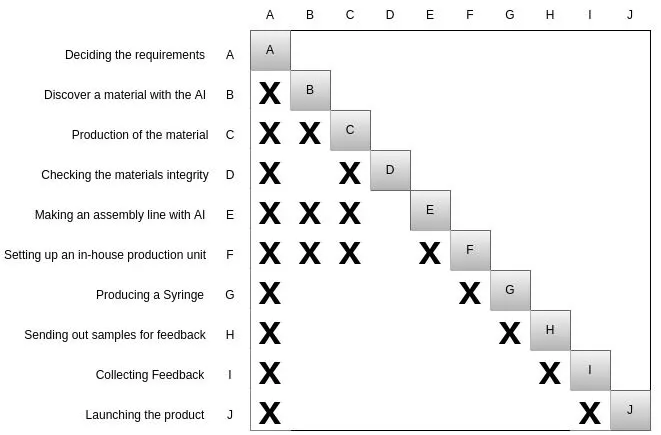
Task 7 : Project Management of the product

Task 8 : Invention disclosures and patent preparation
https://patents.google.com/patent/USRE37439E1/en?q=(disposable+syringe)&oq=disposable+syringe
Disposable self-shielding aspirating syringe
https://patents.google.com/patent/US4955871A/en?q=(disposable+syringe)&oq=disposable+syringe