Project 3 - Design and Development of Disposable Syringe (Medical Technology)
TASK 1:
The global disposable syringes market size was valued at USD 14.1 billion in 2022 and is expected to grow at a compound annual growth rate (CAGR) of 6.21% from 2023 to 2030. The growth is attributed to the growing prevalence of chronic disorders, increasing adoption of safety syringes, and a growing number of surgeries globally. For instance, according to Mölnlycke Health Care AB, 70 million surgical procedures are performed every year in Europe. Since the introduction of disposable syringes, patients no longer must rely solely on the doctors' sterilization protocols for their safety, as they are discarded after one use. As a result, there is no risk of cross-contamination. Other advantages of disposable syringes include their cost efficiency and environmental friendliness. These factors are positively impacting sales growth and hence, in future years, the market is predicted to expand.
Manufacturers are focused on efficient sterilizing procedures to avoid infections among healthcare practitioners and patients, especially in the post COVID-19 pandemic era. As a result, companies operating in the market are focusing on improving operational performance to increase their global credibility.
However, according to the World Health Organization (WHO), there will be a 2.0 billion needle deficiency by 2022. This is due to increased demand, supply-chain disruptions, and ‘syringe nationalism' that "may pose” substantial hurdles in 2022. As a result, most countries throughout the world have begun to reduce security regulations and resume certain elective treatments, indicating that the market will continue to develop during the projection period.
Additionally, organizations are gaining knowledge in their end-to-end supply chains to reduce product prices and improve the quality and services associated with disposable syringes. Such operational ideas help organizations save money by eliminating third-party expenses. These characteristics are projected to generate lucrative market growth prospects.
Moreover, increasing prevalence of chronic disorders such diabetes can be managed by self-injecting medication. For instance, as per the International Diabetes Federation 2021 report, the number of people living with diabetes are approximately 537 million adults (20-79) in 2021 to nearly 783 million by 2045. Syringes are required for most diagnostic and therapeutic approaches for chronic diseases, since they play an important role during medication administration and tests, resulting in rising demand for the product.
Furthermore, major companies are focusing on producing syringes designed exclusively for chronic disease therapy to increase their market position. For instance, Hypak SCF PRTC glass pre-fillable syringe from BD is used to treat chronic disorders. Along with that in May 2021, BD has announced plans to spin out its Diabetes Care division as a separate, publicly traded company ("NewCo"). BD Diabetes Care has been a major force behind the adoption of insulin syringes and other products, generating roughly 8 billion injection devices each year and supporting approximately 30 million patients. Also, in January 2023, Transcoject and Stevanato Group came together to provide pre-fillable syringe polymer options for pharmaceutical industry.
Along with the above factors, the need for disposable syringes in various healthcare settings is likely to increase with the growing aging population, a demographic that is more susceptible to chronic illnesses such as diabetes and other lifestyle-related disorders. In addition, according to CDC, adults aged 65 years and above are more likely to acquire heart disease, COPS, diabetes, cancer, neurological problems, and other chronic illnesses. Patients with such illnesses require emergency and nonemergency hospital services which is expected to spur the market growth soon.
China dominated the market with a market revenue share of 27.09% in 2021. Government initiatives to encourage the adoption of disposable medical supplies to prevent infections in operating rooms is the key factor responsible for growth of the market in this region. The increasing prevalence of chronic diseases and the growing geriatric population are the factors that drive the market growth in China.
According to Front. Public Health in 2020, chronic NCDs account for about 80% of mortality in China among adults aged 60, with Ischemic Heart Disease, Stroke, Chronic Obstructive Pulmonary Disease (COPD), and Type 2 Diabetes is the most common. Additionally, market growth is being driven by continued medical infrastructure construction, as well as growing government and private sector investments to promote the usage of safer and more cost-effective healthcare solutions.
Safety syringes led the market and accounted for a revenue share of 64.15% in 2022. However, conventional disposable syringes have been in use for a long time, safety syringes are more preferred nowadays due to their benefits. Safety syringes also eliminate the risk of patient-to-patient transmission of infections due to which safety syringes are likely to retain their position throughout the forecast period. The safety syringes are majorly used for administering medications by utilizing specialized and standard techniques.
Every year, over 33,800 HIV infections, 315,000 hepatitis C transmissions, and 1.7 million hepatitis B infections are caused by hazardous injecting practices around the world. Unsafe practices such as multiple use of a syringe & needle without taking precautionary measures as guided by the healthcare professionals lead to needle stick injuries. In addition, conventional disposable syringes provide protection to the recipient, but do not assure the safety of patients. Such factors are anticipated to boost the segment growth.
The conventional syringes are the second leading segment and account for market revenue share of 35.8% in 2022. Conventional syringes are mostly made of plastic with visible graduation and are intended for single use. Some of the advantages of disposable conventional syringes are that they eliminate the risk of infections from blood-borne pathogens, such as HIV, Ebola virus, and Hepatitis B & C.
The governments in emerging countries are undertaking initiatives to increase the use of conventional disposable syringes & needles with an aim to reduce the transmission of diseases in patients; thereby, propelling the segment growth over the forecast period.
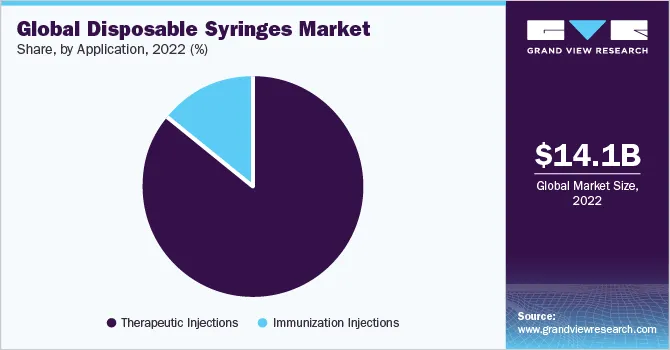
Asia Pacific dominated the market and accounted for market revenue share of 31.1% in 2022. Various government measures to reassure the use of single-use medical supplies to prevent infections, as well as the presence of prominent market participants in the region, are expected to help to the region's growth.
Furthermore, the increase in aging population and prevalence of chronic diseases in the region coupled with high awareness regarding the safety of disposable products are likely to increase the demand for disposable syringes in this region. For instance, in March 2021, a new government order for 265 million (auto disposable) AD syringes has been placed with Hindustan Syringes & Medical Devices Ltd (HMD). in September 2021. By the end of March, HMD had finished its past orders of 177.5 million AD syringes of 0.5 ml.
The MEA market is likely to grow at a 6.9% rate. According to U.N. children’s agency in 2021, the shortage might affect up to 2.2 billion auto-disposable syringes that spontaneously lock to prevent re-use. The looming shortfall comes as the delivery of COVID-19 vaccine doses to Africa picks up after months of delay. Due to such a shortfall the demand for disposable syringes will continue to grow.
Moreover, the market is being driven by increased healthcare spending and adoption of modern healthcare facilities. The South African government, for example, budgeted 13.5% of overall government spending on healthcare program, according to UNICEF Health Budget South Africa 2017/2018. Such occurrences are projected to provide new and significant players in the MEA market with growth prospects.
Task 2
| # | Customer Statement | Needs Statement |
| 1 | The plunger gets jammed and does not move smoothly. | Need a scratch-free material. |
| 2 | The material feels of less than average quality. | The syringe needs to be of high quaiity |
| 3 | The rubber comes off easily. | The rubber needs to be secure in the plunger. |
| 4 | Feels like reloading a gun when you push the medicine with the plunger. |
Need a better plunging mechanism. |
TASK 3:
| Mission Statement | |
| Product Description |
|
| Benefits Statement |
|
| Buisness Objectives |
|
| Core Market |
|
| Stakeholders |
|
Value Proposition: Clean Healthcare for everyone.
Roadmap for syringe
| Q1 2021 | Q2 2021 | Q3 2021 | Q4 2021 | Q1 2022 | Q2 2022 | |
| Syringe Body | Polypropylene body | New material co-engineered with AI | ||||
| Plunger Rubber | Old Traditional Rubber | New type of rubber that is not actually rubber | ||||
| Plunger | Old Design | New Egronomic Design | ||||
| Manufacturing | Vendors | In-house | ||||
Now as for resource allocation, that would have been the case if the products would have been made by the manufacturer that is a third party but since all of the manufacturing done will be like made to be in-house starting from 4th quarter of 2021, resource allocation will not have to be a problem. All of the material will be made in-house as well in the home lab. The design would be co-engineerred with AI also known as generative design.
Task 3
Scope: To get better grip and easier movement
Materials to be used: A different material other than the traditonal onesngoing around with some fabric touch.
Feasibility: The chances of the such a material to be found alonmg with fabric touch is 50-55% or may7be even more depending upon the algorithm of the AI to be used. Getting that into production and being 3D printable can be upto 30%. Finding a substitute that is eco friendly for the rubber >60%.
Product Architecture: Now the product architecture for the syringe yea will be modular for the reason that if somehow due to a product fault during production gets some part to be non-fucntioning then it can be brought back to the company by the vendor and till then the part of the traditional syringe can be used in the syringe and will be acceptable since it will be made to even accomodate old syringen part without any problem.
work breakdown structure :
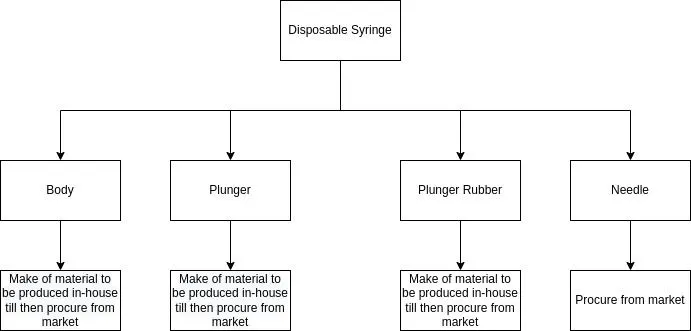
Verification and validation Plan: Send the document to proper authorities and get the dimensions cehcked and if they are in compliance with the dimensions. Once the certifdicate is recieved we can launch the product.
Schematics:

Product Name: Disposable Syringe
Table of Contents
Introduction
Chapter 1: Mechanical Interface
Chapter 2: Human Interface
Introduction
We know the syrionges are used for multiple things such as taking out blood from a patient, injecting some drug into the body etc. Now before the time disposable syringes were a thing doctors would use the same syringe on multiple patients before apparently changine the needle. Doctor's apparently "sterlized" syringe still led to a lot of blood borne diseases become transmitted between the patients. Once the data became enough to prove that the diseases were spread due to the use of same syringe on multiple patients by the same doctor. That is when the alternative to traditional syringes became a hot topic thus leading to one time use syriinges also commonly known as the disposable syringes.
Chapter 1: Mechanical Interface
The plunger will move in the syringe bosy and with the help of the rubber at the end push the medicine into human body.
Chapter 2: Human Interface
The user needs to push the pulunger with the help of their thumb while holding the syringe with the help of two fingers.
To simplify the design we need not add any extra hooks in the syringe just keeep it plain for the user to understand that the plungere moves and the medicine gets pushed into the body and that is it nothing else needs to be done to the design. The body should have only the markings that are needed and for the body aesthetics and amking it egronomical, the body needs to have minimal marking and easier to hold and read and work with.
Task 4
All of the solidworks answers are tyhere in this link: https://drive.google.com/drive/folders/1zLt9yAIBe_bdnH5hm5TddNoTBUXbgF8e?usp=share_link
Task 5
The problems with the syringes are a different breed and nothing like the problems with the machines. So here is FMEA for the syringtes. A lil bit diferent than the machines:
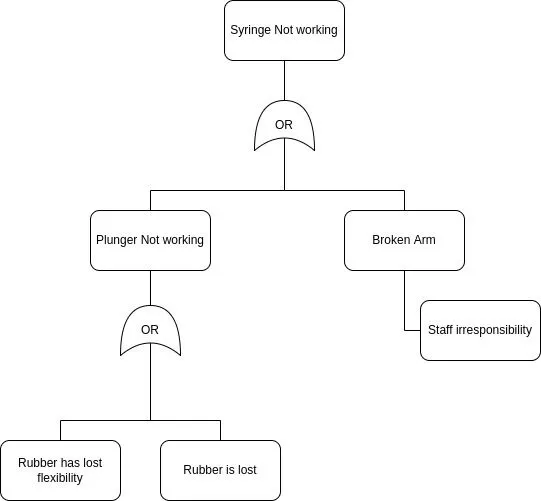
| Process/Component | Failure Mode | Failure Effect | SEV | Potential Causes | OCC | Existing Detection Method | DET | RPN |
| Rubber | Too much friction | The wals are getting scracthed and is impossible to move the arm | 8 |
Rubber got hard. |
6 | Check for the line marks on the walls. | 1 | 48 |
| Arm | Is broken | Medicine does not get injected properly. | 9 | Got damaged due to hnegligence. | 2 | Visible to the eye. | 1 | 18 |
| Syringe |
No availability at the Hospitalization
Units.
|
The promotion of the use of a safety device is not achieved
|
6 |
No stock at Supplies. The supervisor does not include stock in the Agreement for Use. Their use has not been widely adopted.
|
9 | Check the inventory regularly. | 8 | 432 |
| Syringe |
Lack of knowledge
of their existence.
|
Oral medication might
get administered
intravenously.
|
6 |
The supervisor is not aware of the existence of syringes. The supervisor does not inform the nurse about their existence.
|
8 | Doing Market Research | 8 | 384 |
| Syringe |
Difficulties in
syringe handling.
|
The promotion of the use of a safety device is not achieved
|
7 |
Difficulties for labelling syringes. The device does not meet the expectations by professionals (adequate material due to the tip lumen / syringe colour). Difficulties to use the oral syringe in nasogastric tubes due to their port.
|
8 | Regular work evaluation. | 8 | 448 |
| Process/Component | Recommended Actions | Responsibility | Target Date | Action Taken | SEV | OCC | DET | NEW RPN |
| Rubber | Having spare Syringes | Owner | Immediately | The rubber is taken out once in a while and wqashed properly by hot water. | 2 | 6 | 1 | 12 |
| Arm | Having spares | Owner | Immediately | Some spares are kept at arjms length and the faulty is reported back to the supplier. | 2 | 2 | 1 | 4 |
| Syringe | Be well Informed. |
Chief of the Safety
Committee
|
Immediately |
Policy of use and recommendation of use mandatory for the Nursing Management. Include in the annual objectives for Nursing Units. Review of the availability at hospitalization units.
|
3 | 9 | 8 | 216 |
| Syringe | Be well Informed. |
Chief of the Safety
Committee.
ICU Supervisor.
|
Immediately |
Training. Awareness posters. Update in the protocol for oral medication administration.
|
2 | 8 | 8 | 128 |
| Syringe |
Get training
|
Chairwoman of the
Safety Committee.
Supervisor
|
In a few days |
Standardize the process of use of oral syringes. Establish as Mandatory Rule
|
2 | 8 | 8 | 128 |
Task 6
So while searching about the syringes I can around to a material it is made of is "Polypropylene". Now apparently if you google that if the material is biodegradable or not that is what all of us mostly do while understanding if the product is actually good for the environment or not but to my surprise, the search had a line extra with biodegradable stating that the recycling of the biodegradable material requires a long process and is apparently costly too, thus the companies do not actually go and recycle it and it ends up in the landfills. Now if the material used can be easily recycled or just made to disappear without leaving behind any residue? Since AI algorithms now a days are getting more and more intelligent, they seem to help in everything be it making human faces or what not? So along with the help of AI and running some tests we can develop a material that will possibly change the disposable materials we use now. And along with using AI to design the assembly line as well for the production of the material with keywords such as save energy, cost efficient, we can actually achieve more than just a product that is completetly eco friendly but a sound infrastructure. We can also also skip the costs for the shipping and manufacturing by doing the thing in house and making the formula for the material a trade secret. This will help with getting a grip on the market. Also the company would encourage the syringes to be delivered back to the company so that they can be recycled if it is safe to use them again or just decompose them.
Task 7
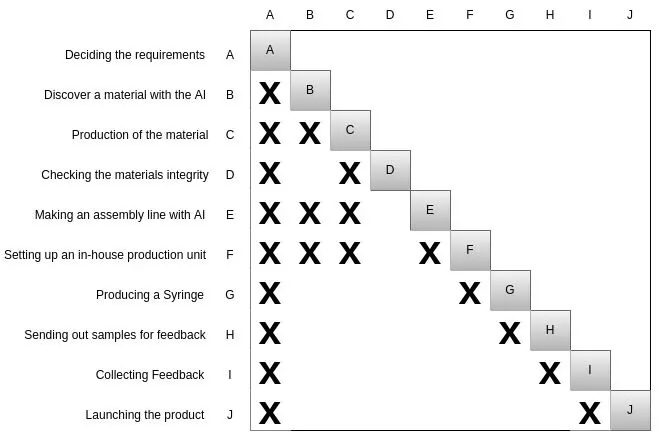


Everything in the syringe is in series and nothing is in parallel because the 3D printing will print all of the parts at once and everything is linked to each other and nothing is working independent of each other. Now if I actually want to fattrack the work I can either work on the earlier material for production and discover the material in the meantime. Either I can get everything outsourced, these solutions are definetly for the time if I have decided to amke the thing alone and dop not have any company. Now if I have a company I can ask my employees do it and have myself monitor it. Or just let the AI monitor them. Or just make the machines do the experiments and present me the final product.
Task 8
After going through several patents I have found 5 patents regarding the same buit also not conflicting with my idea.The patents are cited below:
| # | Patent Code | Abstract | Link |
| 1 |
US4955871A |
A single-use disposable syringe. In the syringe, a reservoir is formed of two sheets of thermoplastic material having expanded central portions that form a pair of convex domes. Both of the domes are compressible, and a connecting member spaces apart the domes. In response to complete compression of both of the central portions together, the reservoir substantially collapses and each of the domes becomes concave to prevent the reservoir from being reformed and to prevent reuse of the syringe. After partial compression of both of the central portions together and partial collapse of the reservoir, the central portions expand to reform the reservoir and draw fluid into the reservoir, thereby aspirating a hypodermic needle. | https://patents.google.com/patent/US4955871A/en?q=disposable+syringe&oq=disposable+syringe |
| 2 |
USRE37439E1 |
There is disclosed herein a syringe with a protector case which holds a carpule and permits the injection of fluid contained in the carpule into the patient. The syringe is molded of plastic or other suitable material which is sterilizable. The device comprises several parts including a body, protector case, needle, needle cap, plug, plunger and harpoon. The harpoon can be integrally molded on the plunger. The major components of the device preferably are molded from a suitable plastic and may be clear or of a color like or similar to a surgical glove. | https://patents.google.com/patent/USRE37439E1/en?q=disposable+syringe&oq=disposable+syringe |
| 3 |
EP0379560B1 |
The invention is a pre-charged, disposable syringe capable of use by patients. The syringe has a housing (10) with a cover (40) having a central aperture (36) which receives an actuator button (33). The actuator button (33) extends to an internal piston which is mounted over a medication ampoule (24). The ampoule (24) has a dependent hypodermic needle (22) which is slidably received in the housing (10) and moves between recessed and projected positions. In its recessed position, the ampoule is totally contained within the housing, and in its projected position, the hypodermic needle (22) projects from the housing. The housing (10) contains an actuator spring (70), which is compressed and biased to move the piston and the ampoule into its projected position. The medication is discharged from the ampoule by the mechanically coupled piston, or by the release of air from an internal air pressure chamber (43). The actuator button (33) is covered with a protective, removable cap (38). | https://patents.google.com/patent/EP0379560B1/en?q=disposable+syringe&oq=disposable+syringe |
| 4 |
CN103239781A |
The invention provides a biodegradable disposable medical syringe needle which comprises a needle tube and a needle base, wherein the lower end of the needle tube is connected with the needle base, the upper end of the needle tube is provided with a needle tip, and a cavity of the needle tube is communicated with a cavity of the needle base. The biodegradable disposable medical syringe needle is characterized in that the needle tube is made of polylactic acid fiber, and the needle base is made of polylactic resins. The invention further provides a manufacturing method of the biodegradable disposable medical syringe needle. The disposable medical syringe needle is totally made of polylactic acid materials, can be totally degraded into water and carbon dioxide after being destroyed and disinfected after use in an ecological environment, cannot pollute the environment, reduces environment pollution caused by medical rubbish and reduces the damage of the syringe needle capable of infecting germs and viruses in public places. Further, the disposable medical syringe needle uses soft materials, the surface of the needle tip is smooth and has no sharp edges, and the damage to the skin of a patient is reduced. | https://patents.google.com/patent/CN103239781A/en |
| 5 |
US20210301138A1 |
A bioplastic resin (BIOSYN) includes corn flour; a biodegradable plasticizer selected from the group consisting of: vegetable oil, polyesters made from glycerin, glycerin, and derivatives of glycerin; and polylactic acid (PLA); further, the bioplastic resin has been subjected to trace element extraction. A second, biodegradable resin includes PLA and acetyl tributyl citrate (ATBC). A syringe includes a bioplastic plunger and needle cap made from BIOSYN, and a biodegradable barrel and tip made from the PLA/ATBC resin. | https://patents.google.com/patent/US20210301138A1/en |
Now none of them inventions are contradicting my hypothesis since, I wish to make a material that feels plastic but is not plastic and is soft to touch like fabric and is easier to use and does not get infected easily with bacteria. Claims for the same are given below:
- The material will be rigid like plastic but not plastic.
- Would have a bit of fabric touch.
- This means that claim 2 claims that product will have some fabric touch to it but will not be fabric entirely.
- Easier to work with and no rubber issue.
Task 9
The product does meet the updated trends in market for product generation since thew device is like made with the help of AI along with the assembly line will also set in with the help of AI for better efficiency. No it will not be able to be IoT enabled and will be sold to the customer as a product rather than a service.