Project 2
Analysing methods :
After you've selected a transplant center, you'll be evaluated to determine whether you meet the center's eligibility requirements for a kidney transplant.
The team at the transplant center will assess whether you:
- Are healthy enough to have surgery and tolerate lifelong post-transplant medications
- Have any medical conditions that would interfere with transplant success
- Are willing and able to take medications as directed and follow the suggestions of the transplant team
The evaluation process may take several days and includes:
- A thorough physical exam
- Imaging studies, such as X-ray, MRI or CT scans
- Blood tests
- Psychological evaluation
- Any other necessary testing as determined by your doctor
Before the procedure
Finding a match
A kidney donor can be living or deceased, related or unrelated to you. Your transplant team will consider several factors when evaluating whether a donor kidney will be a good match for you.
Tests to determine whether a donated kidney may be suitable for you include:
-
Blood typing. It's preferable to get a kidney from a donor whose blood type matches or is compatible with your own.
Transplants involving a donor and recipient with incompatible blood types are also possible but require additional medical treatment before and after transplant to reduce the risk of organ rejection. These are known as ABO incompatible kidney transplants.
- Tissue typing. If your blood type is compatible, the next step is a tissue typing test called human leukocyte antigen (HLA) typing. This test compares genetic markers that increase the likelihood the transplanted kidney will last a long time. A good match means it's less likely that your body will reject the organ.
-
Crossmatch. The third and final matching test involves mixing a small sample of your blood with the donor's blood in the lab. The test determines whether antibodies in your blood will react against specific antigens in the donor's blood.
A negative crossmatch means they are compatible and your body isn't as likely to reject the donor kidney. Positive crossmatch kidney transplants also are possible but require additional medical treatment before and after the transplant to reduce the risk of your antibodies reacting to the donor organ.
Additional factors your transplant team may consider in finding the most appropriate donor kidney for you include matching age, kidney size and infection exposure.
Living kidney donation
Finding a willing living kidney donor is an alternative to waiting for a compatible deceased-donor kidney to become available.
Family members are often the most likely to be compatible living kidney donors. But successful living-donor transplants are also common with kidneys donated from unrelated people, such as friends, co-workers or religious congregation members.
Paired donation is another type of living kidney donation if you have a willing kidney donor whose organ isn't compatible with you or doesn't match well for other reasons. Rather than donating a kidney directly to you, your donor may give a kidney to someone who may be a better match. Then you receive a compatible kidney from that recipient's donor.
In some cases, more than two pairs of donors and recipients may be linked with a living kidney donor who hasn't named a specific person to receive the kidney. They form a donation chain with several recipients benefiting from the nondirected donor's gift.
If a compatible living donor isn't available, your name will be placed on a waiting list for a deceased-donor kidney. Because there are fewer available kidneys than there are people waiting for a transplant, the waiting list continues to grow. The waiting time for a deceased-donor kidney is usually a few years.
Staying healthy
Whether you're waiting for a donated kidney or your transplant surgery is already scheduled, work to stay healthy. Being healthy and as active as you're able can make it more likely you'll be ready for the transplant surgery when the time comes. It may also help speed your recovery from surgery. Work to:
- Take your medications as prescribed.
- Follow your diet and exercise guidelines.
- Don't smoke. If you need help quitting, talk to your doctor.
- Keep all appointments with your health care team.
- Stay involved in healthy activities, including relaxing and spending time with family and friends.
Stay in touch with your transplant team and let your team know of any significant changes in your health. If you're waiting for a donated kidney, make sure the transplant team knows how to reach you at all times. Keep your packed hospital bag ready and make arrangements for transportation to the transplant center.
Robotic surgery :
During the procedure
Robot Assisted Kidney Transplantation (RAKT) is a minimally invasive technique that uses a robotic support to perform the KT. As a high level of expertise is required in KT and robotic surgery, RAKT is performed by transplant surgeons with extensive training and experience in robotics and .
How does robot assisted kidney transplant surgery work?
The Technique:
Compared to conventional open kidney transplant surgery, a much smaller incision (about 7cm) is made in RAKT to remove the diseased kidney and insert the donor kidney into the abdomen., and then to stitch the blood vessels and the ureter. Another four or five small (0.5 to 1cm) incisions are used to insert the instruments into the abdomen.
One of the arms holds a high magnification 3D camera which is inserted into the abdomen through one of the key holes and provides a high-definition, magnified (12×), 3-D view of the surgical site. The other mechanical arms have surgical instruments attached to it that are designed to mimic the movement of the human hands and wrists.
The surgeon uses the console of the computer to manipulate the small surgical instruments that are more flexible and manoeuvrable as compared
to the human hand.
What is robot assisted surgery?
Robotic surgery, or robot-assisted surgery, is an advanced surgical procedure where small surgical tools are attached to a robotic arm that is controlled by a surgeon through a computer.
Preoperative care
What preparations are required before robotic kidney transplant surgery?
Before transplant instructions include:
- Stop smoking or drinking
- Lose any excess weight
- Regular exercise
- Vaccinations as advised
- Dialysis before transplant
- Necessary lab tests
What is the success rate of kidney transplant using robot assisted surgery?
The graft survival rate i.e the survival rate of the donor kidney is dependent on the inherent characteristics of the recipient’s body, hence there are no significant differences between the open surgery and robot assisted kidney transplant surgery. However, the robotic kidney transplant surgery offers significant benefits in terms of
- Low surgical site infection (range 0-8%)
- Incisional hernia rates (range 0-6%)
- Improved aesthetic outcomes
What factors should be considered while choosing a hospital for robotic kidney transplant?
Since kidney transplant is a major surgery, it is important to ensure that the hospital has the infrastructure and trained team to support the pre-operative and post-operative needs. Certain factors to be considered are:
- State-of-the-art robotic surgery, latest transplant technology and organ preservation facilities.
- Expertise of the kidney transplant surgeons and his team. Specialized training in robotics, number of surgeries performed and success rate indicate the expertise of your surgeon.
- Number and type of robotic kidney and other organ transplants that the center performs every year.
- Transplant center’s organ donor and recipient survival rates.
- Support servi
 ces such as diagnostics, pharmacy, modular OT, ICU et.
What factors govern the cost of robotic kidney transplant?
The cost of surgery usually depends on a multitude of factors, the primary ones being:
- Experience and expertise of the kidney transplant surgeon and team.
- Length of surgery and post surgical complications.
- Underlying co-morbidities and age of the patient which may affect the – additional tests and medicine requirement.
- Hospital stays – Room category availed; depending on the hospital’s billing policy.
What are the advantages of robotic kidney transplant surgery over open kidney transplant surgery?
The technical advantage of robotic kidney transplant surgery over open kidney transplant surgery
- The robot replicates the surgeon’s hand movements, while minimizing hand tremors. The surgeon thus can not only make use of his/her experience and skills, but also operate with precision, dexterity and control in complex procedures.
- Especially useful when the operative field is deep and narrow, and requires fine dissection and micro suturing.
Improved patient outcomes:
Robotic surgery in KT offers many benefits like:
- Decreased chances of complications as compared to open surgery, especially in immunocompromised and end-stage renal disease patients undergoing KT.
- Safer and more efficacious for obese patients who are otherwise not recommended for transplants.
- Minimal invasive surgery helps in reduced
- – blood loss
- – hospital stays
- – pain
- – postoperative complication rate
- – recovery time
- – surgical scars
What are the risks of kidney transplant using robot assisted surgery?
Risks related to kidney transplants are drastically minimized with the robotic assistance. Still, possible risks that are specific to kidney transplant procedure include:
- Damage to surrounding structures
- Development of a hernia due to the small incisions made for the instruments, known as ‘port site hernia’
- Twisting of the kidney (torsion) after the transplant
- Scarring affecting the bowel in the long term (adhesive obstruction)
- Trapping of carbon dioxide used during surgery in the abdomen
- Nerve compression
- Life threatening risks are miniscule
Post operative care :
After a kidney transplant, you can expect to:
-
Spend several days to a week in the hospital. Doctors and nurses monitor your condition in the hospital's transplant recovery area to watch for signs of complications.
Your new kidney will make urine like your own kidneys did when they were healthy. Often this starts immediately. In other people, it may take several days, and you may need temporary dialysis until your new kidneys begin to function properly.
Expect soreness or pain around the incision site while you're healing. Most kidney transplant recipients can return to work and other normal activities within eight weeks after transplant. Avoid lifting objects weighing more than 10 pounds or exercising other than walking until the wound has healed (usually about six weeks after surgery).
-
Have frequent checkups as you continue recovering. After you leave the hospital, close monitoring is necessary for a few weeks to check how well your new kidney is working and to make sure your body is not rejecting it.
You may need to have blood tests several times a week and have your medications adjusted in the weeks following your transplant. During this time, if you live in another town, you may need to make arrangements to stay near the transplant center.
- Take medications the rest of your life. You'll take a number of medications after your kidney transplant. Immunosuppressant drugs help keep your immune system from attacking and rejecting your new kidney. Additional drugs help reduce the risk of other complications, such as infection, after your transplant.
Results
After a successful kidney transplant, your new kidney will filter your blood, and you will no longer need dialysis.
To prevent your body from rejecting your donor kidney, you'll need medications to suppress your immune system. Because these anti-rejection medications make your body more vulnerable to infection, your doctor may also prescribe antibacterial, antiviral and antifungal medications.
It is important to take all your medicines as your doctor prescribes. Your body may reject your new kidney if you skip your medications even for a short period of time. Contact your transplant team immediately if you are having side effects that prevent you from taking the medications.
After the transplant, be sure to perform skin self-checks and get checkups with a dermatologist to screen for skin cancer. Also, staying up to date with other cancer screening is strongly advised.
RAKT
Minimally invasive surgery has been enhanced by the introduction robots (Figure 4), which has a well-established role across several surgical specialties. A robot offers more dexterity, increased geometric accuracy, enhances the abilities to measure surgeon performance and reduces tremors and fatigue.
Robotic systems established in clinical practice. (A) Hugo Robotic System by Medtronic. (B) Versius by CMR Surgical. (C) The da Vinci surgical system by Intuitive Surgical.
The da Vinci surgical system (Intuitive Surgical, Sunnyvale, CA, USA) is the most widely used robotic system in many surgical specialities and has demonstrated significant clinical benefits to patients over the last two decades [27, 28]. The three-dimensional views restore hand–eye coordination, with wristed instruments and tracking of movements thousands of times per second providing tremor filtration and scaled motion. These features provide significant operative advantages over laparoscopic surgery, particularly when the operative field is narrow and deep and fine dissection and microsuturing are required [28], as with the intrapelvic anastomoses of kidney transplantation. Seeking the benefits provided by the robot, several groups have pioneered robot-assisted donor nephrectomy and renal transplantation [29–32], with a significant reduction in surgical complications and graft outcomes compared with OKT. The first robot-assisted kidney transplant was performed in France in 2001 [33], when a cadaveric kidney was transplanted into a 26-year-old male using the da Vinci robot by a remote surgeon in another hospital, with an assistant in the operating theatre. While this ground-breaking achievement demonstrated the feasibility of RAKT, the authors commented that the operative time was greater than standard OKT and the cost of the procedure was extremely high.
Seven years later, Giulianotti et al. [29], from Chicago, performed the first full RAKT in a 29-year-old female with a BMI of 41 kg/m2 via a 7-cm midline incision. The outcome was excellent, with immediate graft function, no perioperative complications and the patient safely discharged at day 5 with normal renal function. In 2011, Boggi et al. [30] reported the second European case of RAKT, a successful living-donor transplant from a 56-year-old mother to her 37-year-old daughter. The success of these pioneering single-case reports was built upon by a number of safety and feasibility studies [34, 35], which provided improved methods of robotic positioning, access and use of regional hypothermia and graft cooling for implant. Vascular anastomoses take longer when performed robotically, leading to longer warm ischaemic times (WITs), which are known to partially compromise renal function when >30 min [36]. A phase 2a innovation study [35] introduced the technique of RAKT with regional hypothermia provided by a reproducible technique that allows cooling of the graft through a wrapped gauze filled with ice slush, delivered intraperitoneally during implant, creating safe regional hypothermia (see supplementary video). The benefits of RAKT have been reproduced since [31, 32, 37–40] and the results confirmed by the large prospective multicentre studies of the European Association of Urology: Robotic Urology Section (ERUS)–RAKT working group [41–44]. These reported experiences suggest RAKT achieves comparable patient and graft survival outcomes as compared with OKT, with the added benefits of minimally invasive surgery [45, 46]. The ERUS–RAKT group [42] is currently the largest international collaborative on RAKT, with 10 centres across Europe maintaining a prospective dataset of >300 patients undergoing RAKT [35]. Their recent update demonstrates good surgical and functional results, comparable with those of OKT [47].
RAKT in the obese patient
Positive outcomes inspired groups to use RAKT in an increasing number of settings, including deceased donation [48], polycystic kidney disease [40] and multiple vessel grafts in living donation [44]. However, most important is the use of RAKT in obese patients. The only current universal indication for RAKT, performed in the context of appropriately monitored prospective studies, is for those obese patients who would not otherwise be able to have a kidney transplant due to an unacceptable risk of morbidity. Obesity in renal transplantation is a growing problem, with the BMI of patients on the waiting list increasing annually [49]. In developed countries, the BMI of the population overall has continued to increase [50] and renal transplant candidates are no exception. An earlier study from the USA reported that between 1987 and 2001, the proportion of obese transplant recipients rose by 116% [51]. Traditionally, increased BMI was seen as a relative contraindication to renal transplantation, but recent data show considerable benefit in obese recipients [52]. Despite this, analysis of the United Network for Organ Sharing (UNOS) database revealed that 21% of transplant centres do not list morbidly obese patients [53], which may be an underestimation. Those listed wait an average of 50 months for a transplant compared with the 40 months of non-obese patients [53]. The issue is further compounded by the ‘BMI paradox’, i.e. the fact that in the dialysis population, a high BMI is, up to a point, a marker of improved prognosis [54]. The obese population is at higher risk of post-operative SSI [55], with obese transplant recipients experiencing higher incidences of SSI, prolonged operative times and longer hospital stays [56–58]. Taken together, these facts have prompted a rethink and search for new strategies to address the issue. Bariatric surgery has been advocated in very obese transplant candidates [59], but access to this type of surgery is not universal. New approaches to successfully transplant the obese recipient are therefore eagerly awaited.
RAKT provides one such hope, with Oberholzer et al. [31] demonstrating successful transplant and favourable outcomes in RAKT compared with OKT in 28 morbidly obese patients. A group from Chicago compared 28 cases (average BMI 42.6) undergoing RAKT to a frequency-matched retrospective cohort of obese patients (average BMI 38.1) undergoing OKT. RAKT patients experienced significantly lower rates of SSI compared with the control group: 28.6% versus 3.6%, respectively. Patient and graft survival were 100% in both groups at 6 months and 6-month creatine was comparable between the two groups: 1.5 mg/dL versus 1.6 mg/dL in RAKT and OKT, respectively. This clearly shows superior outcomes in terms of SSI and the ability to offer transplantation to groups at high risk of complications. The group continues to demonstrate excellent outcomes [31], with recent data on 239 RAKTs with a mean BMI of 41.4 kg/m2 highlighting a post-operative SSI rate of just 0.4%. Graft survival at years 1 and 3 was 98% and 93%, respectively, with a mean eGFR at 1 year of 56.5 ± 17.3 mL/min. Importantly, the group also demonstrated a low mortality of 4.6%, with patient survival of 98% and 95% at 1 and 3 years, respectively. While encouraging, the underlying message is that these results are from a dedicated single-centre experience with experienced surgeons who have passed associated LCs.
In addition to RAKT for obese patients, many teams have performed sleeve gastrectomy, and the safety was demonstrated by a randomized trial performed by Spaggiari et al. [60]. Eleven patients were recruited to a robotic sleeve gastrectomy and RAKT group and nine patients to RAKT alone. At the 1-year follow-up there was a significant (P = 0.0041) change in the BMI between the robotic sleeve gastrectomy and RAKT group (8.76 ± 1.82) compared with the RAKT-alone group (1.70 ± 2.30). There was no significant difference between the eGFR, serum creatinine, readmission rates and graft failure rates up to 12 months, although the length of surgery was longer in the robotic sleeve gastrectomy RAKT group (405 versus 269 min; P = 0.00 304) with no difference in estimated blood loss.
Patient selection for RAKT
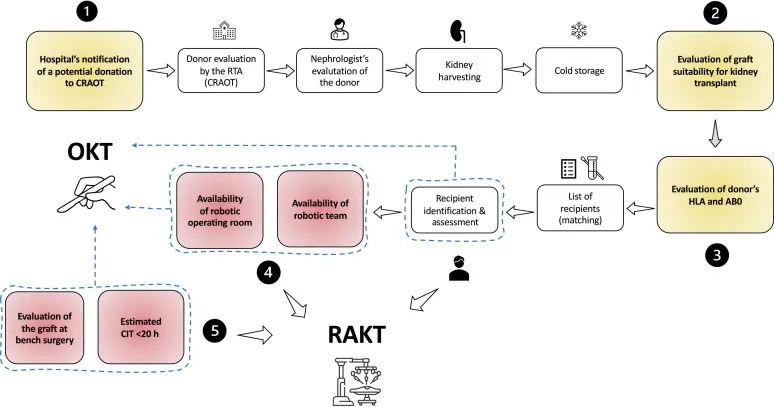
It is imperative that patients offered RAKT are selected on the basis of the following parameters: physiological reserve to undergo surgery using pneumoperitoneum, complexities in the donor kidney and the surgical team's experience in performing RAKT. Many teams will consider multiple lower abdominal procedures, calcified aorto-iliac vessels and a lack of appropriate team members as absolute contraindications for RAKT. Robotic teams, after the LC, may consider transplanting grafts with multiple vessels and perform RAKT for patients receiving kidneys from deceased donors. However, most units offer RAKT for transplants from live donors only and Vignolini et al. [48] showed a five-phase approach to consider for teams to perform RAKT from deceased donors. They follow the same principles used to perform RAKT from live donors: availability of a team, operating room with a robot, suitable recipient, anatomical variation of the kidney and cold ischaemia time (CIT). Many units may consider offering RAKT from deceased donors in the time ahead, and the experience gained will offer the advantages of minimally invasive kidney transplant to more recepiants.
ETHICAL CONSIDERATIONS
While creativity and the introduction of novel technologies to improve outcomes and patient experiences is the norm in modern surgical practice, RAKT is perhaps a surgical field that highlights the ethical challenges of surgical innovation [81]. The primary endpoint of surgical transplantation is successful graft function that lasts for a lifetime. The ethical criteria that need to be considered by departments and individual surgeons seeking to introduce RAKT is whether robot-assisted transplantation provides a similar or better technical vascular anastomosis than an open approach and if incision-related morbidity is less than with an open procedure. These ethical considerations are similar to Knight's assessment of innovations in cardiothoracic surgery, including minimally invasive cardiac surgery [82]. Based on these, any surgeon carrying out an RAKT should ask, ‘Can I, with my skill set, in my demographic practice, provide as good or better transplant graft and patient outcomes, when compared with an open implant, with a similar tariff?’ The variables addressed in such self-reflection should be openly discussed with the patient during the consent process, alongside the overall effectiveness of robotic procedures relative to other approaches.
Regular appraisal of surgical ability and outcomes, combined with institutional support for pioneering intervention, will allow safe and efficient progress. With every new approach that evolves, it is essential to continually assess the goals and outcomes that must be achieved, ensuring the procedure is held to the correct standard and patient safety preserved. Robotic surgery is still maturing and long-term follow-up of RAKT patients is as yet not available; we may find that outcome measures and early perceived benefits must be reassessed in light of long-term results. This is essential for all multidisciplinary teams and should be sought by referring physicians and funding bodies as well as surgical teams. Cost must also be borne in mind, ensuring a fair distribution of funding, particularly when transplant patients comprise a relatively small proportion of the wider populations that healthcare services treat.
Ultimately it is of the utmost importance that patients chose the right procedure for them, with the support of their team and careful explanation of appropriate literature, alongside honest conversations about risk, local expertise and the LC involved—true evidence-based medicine.
Mobility is a big factor in the mechanical design of a medical device. On the surface are the big obvious questions: Will it move? Does it have wheels? Does it have to be small, light, and portable? But for medical devices, it’s a lot more than that. Under the IEC 60601-1 Medical Electrical Equipment standard, the mobility classification of a device defines which tests need to be conducted in order to evaluate safety in reasonably foreseeable use scenarios. That means incorrectly defining device mobility (or failing to define it at all) may not only result in a different product than you had envisioned, but it may also result in a design that is not suitable for some of the most rigorous mechanical tests that will be required. Failing to plan for this means your device may require major re-designs right before you thought you were ready for regulatory submission and transfer to manufacturing.
For example, we once changed a device from a mobile cart design to a portable design, as the bottom half of the cart design was mostly empty and users had ready access to benchtops. The device could essentially be sliced in half, and the bottom discarded. The remaining top half became a portable unit. Because the portable version had to pass drop testing, have strong handles, and survive impact tests, making the change was not nearly as simple as it seemed on the surface. Luckily, the designers were aware of the implications and discussed the impacts on the development program early enough to allow for effective planning of the new approach.
Mobility is only one of several categorizations defined as part of 60601-1, including (for example) applied parts and patient supports. However, mobility definitions are spread throughout Clause 9 and 15 of the standard, and this has been challenging to navigate in my experience. This article endeavours to bring clarity to this critical categorization and give examples of why mobility is so important. This flowchart will guide you through all possible classifications and their associated tests:
What Is 60601-1 Anyway?
IEC 60601-1 is a widely recognized standard for medical device safety. This means adherence is either mandatory or very helpful (depending on the region) to obtain regulatory clearance. Within the standard, tests are defined and must be completed in order to verify the safety and efficacy of the device. Not every test in the regulation is required for every device; they vary depending on which classification of device you’re designing. For example, a device that never touches patient tissue (such as many types of benchtop analyzers) doesn’t need to be tested for biocompatibility, but devices that do (such as a contact lens) are subject to biocompatibility testing (more about biocompatibility here). Similarly, devices that can be moved (are transportable) have different expectations and are tested differently than devices that are stationary. The standard has seven different classifications for each type of mobility plus an eighth, a parent term as shown in the chart above.