Project 2 Thermal modeling of battery pack
Creating a 10 Cell series lithium ion batter model:
- Open a new simulink model window.
- Load a Generic Battery block from specialized power system library.
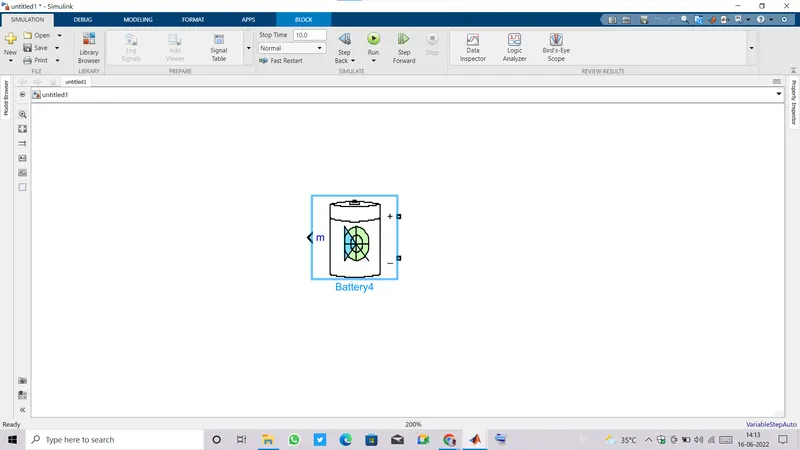
- To enable aging effect and temperature effect,open block parameters and tick on checkbox of Simulate temperature effects and Simulate aging effect.
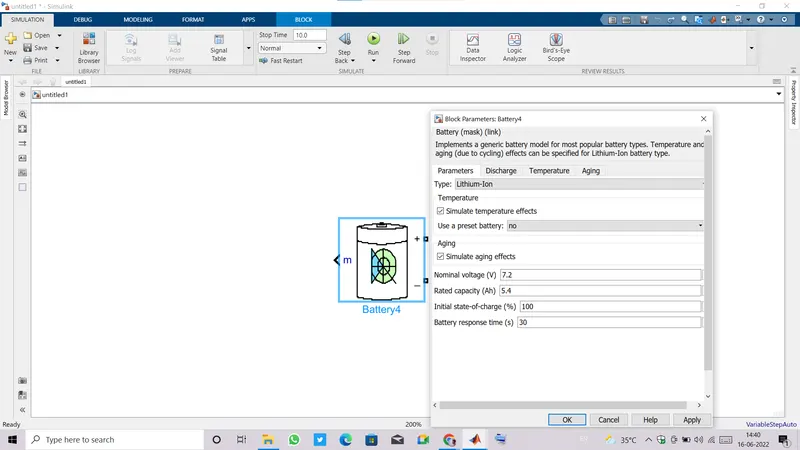
- Let the dafault values of parameters and Discharge like Nominal voltage, Rated Capacity and Intial SOC , Discharge remain same, we can can some values in temperature and againg.
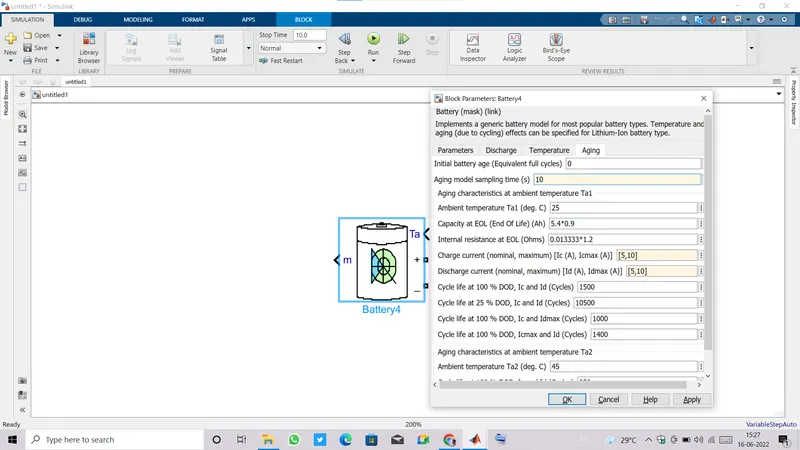
- Change aging model sampling time to somewhat lower value say 10 and Put charging discharging current values [5, 10].
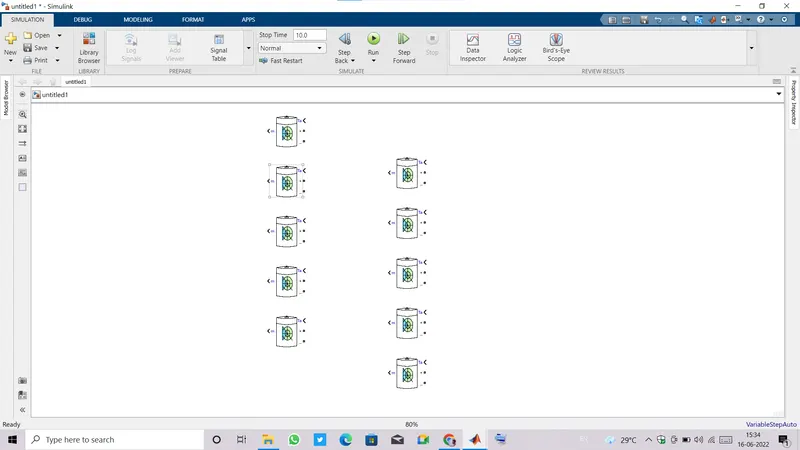
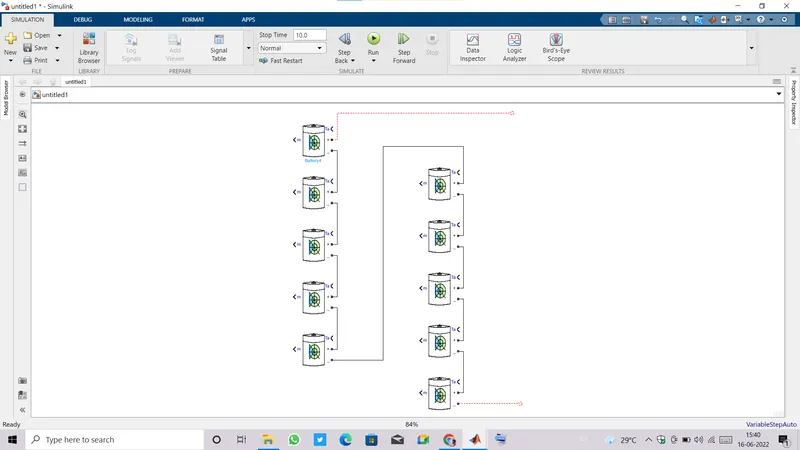
- For 10 cells in series , We need 9 more as such copies of this battery, atotla of 10 cells.
- Make a proper series connection by joining negative terminal of one to the positive of next battery and so on till the last battery as shown in image below.
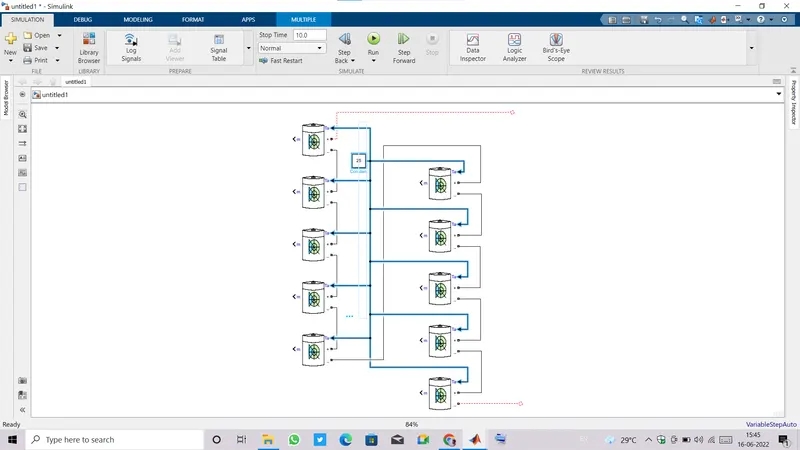
- Now provide a constant block for ambient temperature, and make all temperature ports connected to this constant block as shown below.
- Initially providing 25 deg celcuis as ambient temperature block.
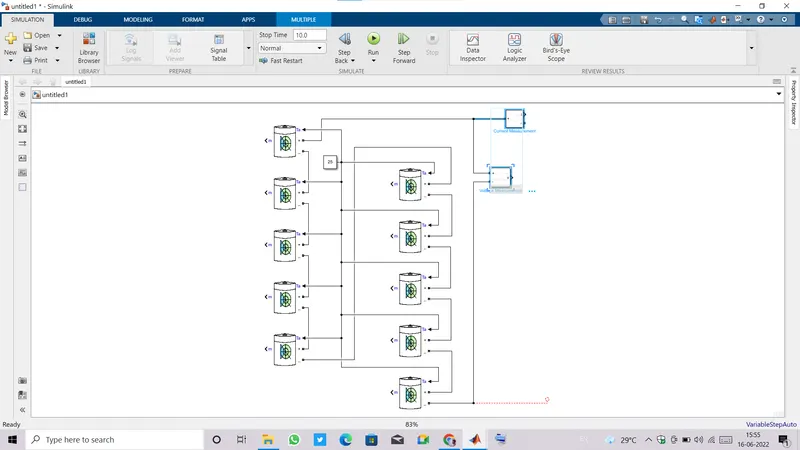
- Let's connect an current and voltage measurement for overall current and voltage measurement at
- terminals.
- Now to charger and discharge battery as our desire, we need to connect a controlled current source in series with battery terminals.
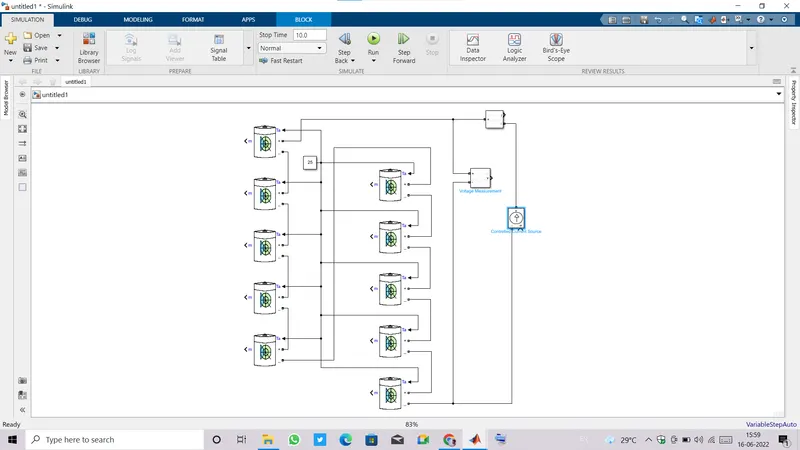
- We can give any type of wave either standard(square, sin , triangular) or customized.
- For charging and discharging of batterypack we are going to provide a square wave with amplitude such that battery charging and discharging currents are in 0.1C, 0.2C, 0.5C and 1C rates.
- As our battery will take 7200 sec (2 hour) to complete one cycle(One cycle includes complete charge and discharge), the square wave one cycle must match with this so that setting of the frequency of squarewave such that it take 7200 secs(2 hours).
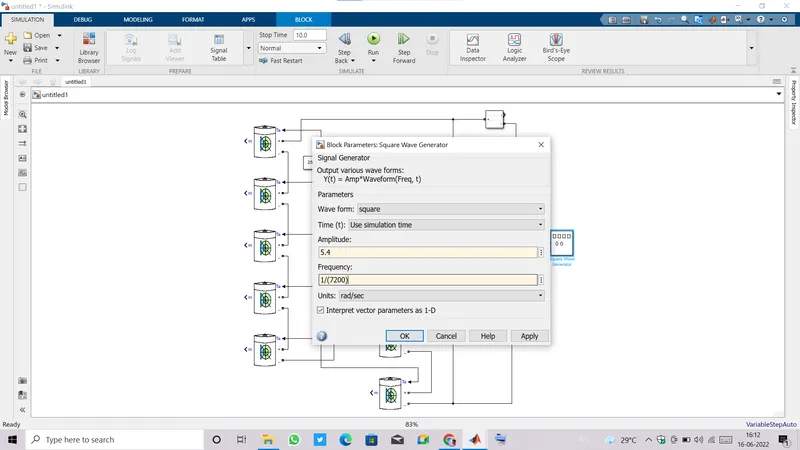
- Connecting a scope to current measurement devices in order to observe curves.
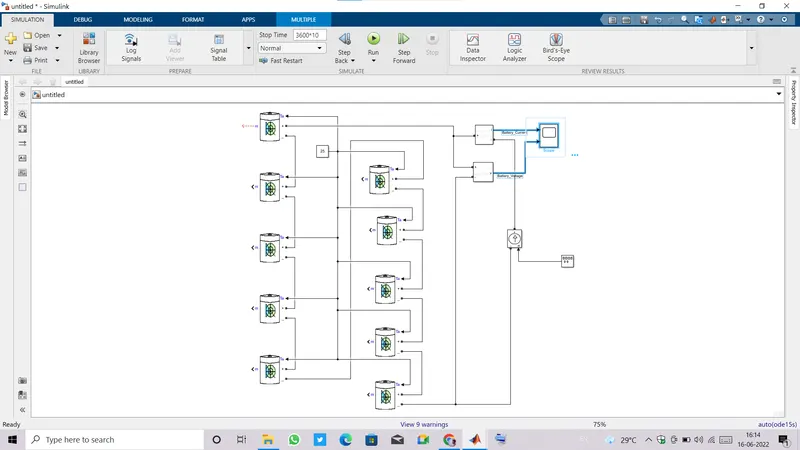
- As all 10 cells are connected in series, we are taking one cell m-port and from this port the values like SOC, Age, cell temperature, ambient temperature, Cell Voltage ,Current and Maximum capacity of cell can be taken and observed in scope.
- Take a bus selector and then connect a scope after it.
- Open bus selector parameters and choose values to be oberved in scope window.
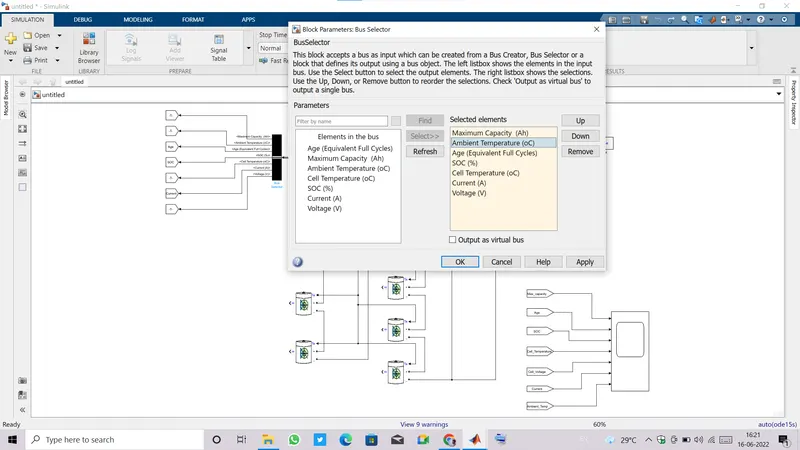
- We used Goto and From blocks to avoid creating a mess.
- Now model is ready to simulate.
- One cycle is taking 7200 sec to complete so that we are going to set simulation time such that we can get 5 such cycles to observe aging and temperature effects.
- So that run time will be 7200*5 secs.
RESULTS:
First of all, we are going to take a constant 1C charge and discharge rate with varying temperature.
1.At 5.4 A , 25 deg ambient temperature:
- Give Amplitude of 5.4 to Square wave generator and a value 25 to constant block then run the simulation.
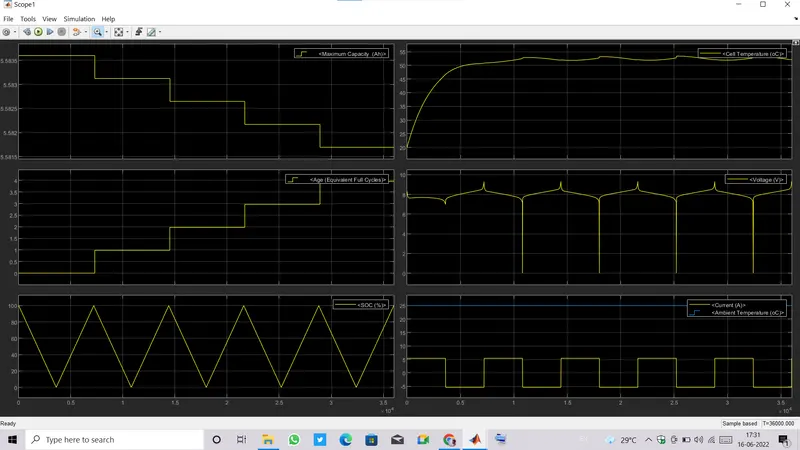
- Initially, SOC was 100% but we are discharging the battery pack at 1C rate so it is taking 3600 sec for discharging and 3600 sec for charging as well, a total of 7200 secs for one complete cycle.
- Battery maximum capacity was nealry 5.5836 Ah and it will remain same till once complete cycle.
- As this is new batterypack so Aging factor was initially at 0.
- Initial Temperature was at 20 Deg celcius, when battery started charging temperature started increasing from 20 deg and it keeps on increasing till charging and discharging takes place.After each dischargeing cell temeperaure gets slight down and after each charging cell temperature is slightly increasing. At the end of 5 cycles temperature becomes 52.5 degrees.
- Maximum charging voltage is 8.3V and till discharging takes place voltage also drop and goes upto 7V.
- And when charging takes place voltage started biulding from 7V to Max voltage of 8.4V.
- After each cycles aging effect is increasing insteps (oone step in one complete cycle)and the maximum capacity of battery keeps on decreasing and at the end of 5 cycles the battery remained maximum capacity is 5.5817 Ah (a very small reduction of 0.0019 Ah).
2. At 5.4 A, 30 deg ambient temperature:
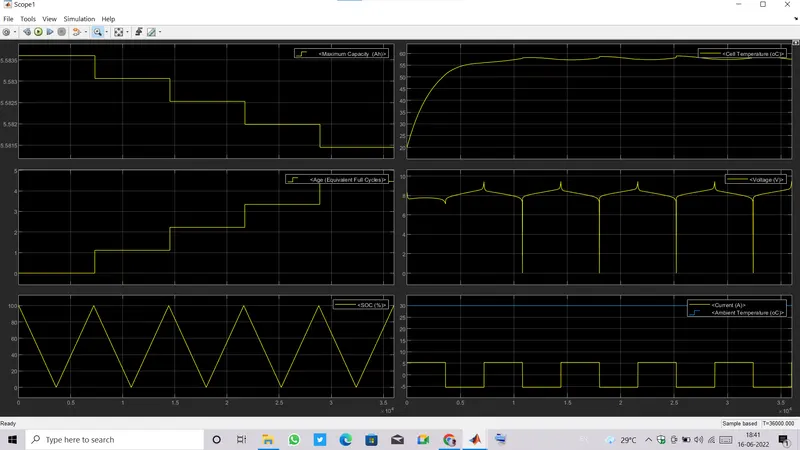
- Initially, SOC was 100% but we are discharging the battery pack at 1C rate so it is taking 3600 sec for discharging and 3600 sec for charging as well, a total of 7200 secs for one complete cycle.
- Battery maximum capacity was nealry 5.5836 Ah and it will remain same till once complete cycle.
- As this is new batterypack so Aging factor was initially at 0.
- Initial Temperature was at 20 Deg celcius, when battery started charging temperature started increasing from 20 deg and it keeps on increasing till charging and discharging takes place.After each dischargeing cell temeperaure gets slight down and after each charging cell temperature is slightly increasing. At the end of 5 cycles temperature becomes 57.8 degree celcius.
- Maximum charging voltage is 8.3V and till discharging takes place voltage also drop and goes neraly 7V.
- And when charging takes place voltage started biulding from 7V to Max voltage of 9.4V, this is because of temperature rise.
- After each cycles aging effect is increasing in steps (1.15 in one complete cycle)and the maximum capacity of battery keeps on decreasing and at the end of 5 cycles the battery remained maximum capacity is 5.5814 Ah .
- This time maximum capacity dropped more than previous case because of high ambient temperature and also the aging factor increasing more rapidly.
3. At 5.4 A, 40 deg ambient temperature:
- Battery maximum capacity was nealry 5.5836 Ah and it will remain same till once complete cycle.
- As this is new batterypack so Aging factor was initially at 0.
- Initial Temperature was at 20 Deg celcius, when battery started charging temperature started increasing from 20 deg and it keeps on increasing till charging and discharging takes place.After each dischargeing cell temeperaure gets slight down and after each charging cell temperature is slightly increasing. At the end of 5 cycles temperature becomes nearly 70 degree celcius.
- Maximum charging voltage is 8.3V and till discharging takes place voltage also drop and goes neraly 7.45V.
- And when charging takes place voltage started building from 7V to Max voltage of 9.67V, this is because of temperature rise.
- After each cycles aging effect is increasing in steps (1.4 in one complete cycle)and the maximum capacity of battery keeps on decreasing and at the end of 5 cycles the battery remained maximum capacity is 5.5809 Ah .
- This time maximum capacity dropped more than previous case because of high ambient temperature and also the aging factor increasing more rapidly.
Now we are going to take a constant temperature of 25 degree celcius and charge and discharge battery at different C rates.
1. At 0.1 C rate and 25 deg celcius:
- For 0.1C rate, give 0.54 amplitude in square wave generator and frequency of 1/(7200*10) to get Full charge and dishcharge cycle(one complete cycle).
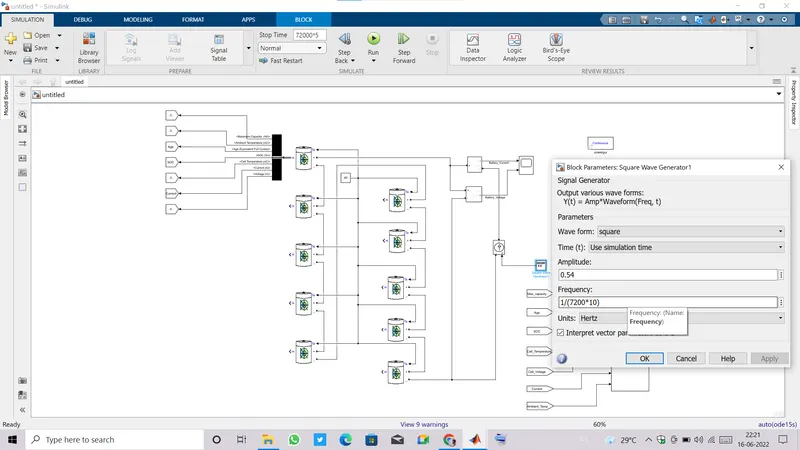
- Run simulation for 72000*5 secs to get five full cycles.
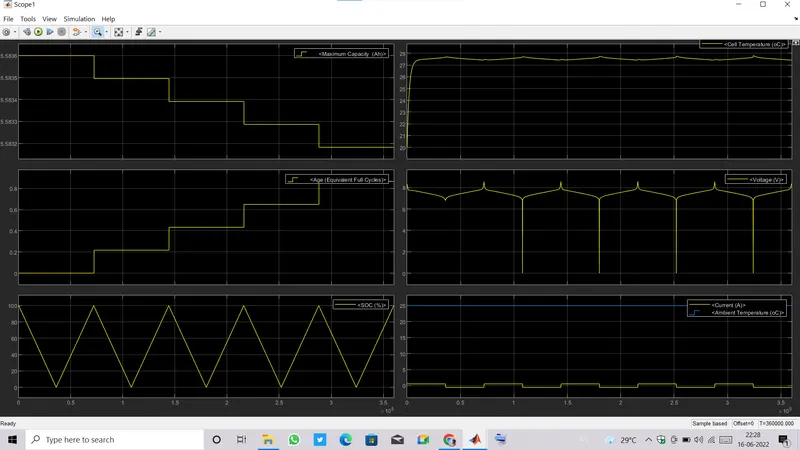
- Initially maximum capacity was 5.5836 Ah but after one complete cycle it goes on decreasing in a very small step of 0.0001, at the end of simulation it became 5.5832 Ah
- As battery is new, aging effect is zero till the one complete cycle but after that it started increasing in step of 0.22 , this value is very small because the C rate is low.
- Battery is dischraging and discharging gradually so that SOC is going from 100 to 0 and again to 100.
- Initially Cell temperature keeps on increasing from 20 deg to almost 27.8 degree celcius while charging and again it fell down to 27.45 deg celcius while discharging.
- Cell voltage is dropping from 8.35V to nealry 6.9V but as cell temperature increases voltage is also increasing very slowly after each complete cycle, at the end of five cycles cell voltage becomes 8.6V.
- Current is changing from +0.54 to - 0.54 Amperes.
2. At 0.5 C rate and 25 deg celcius:
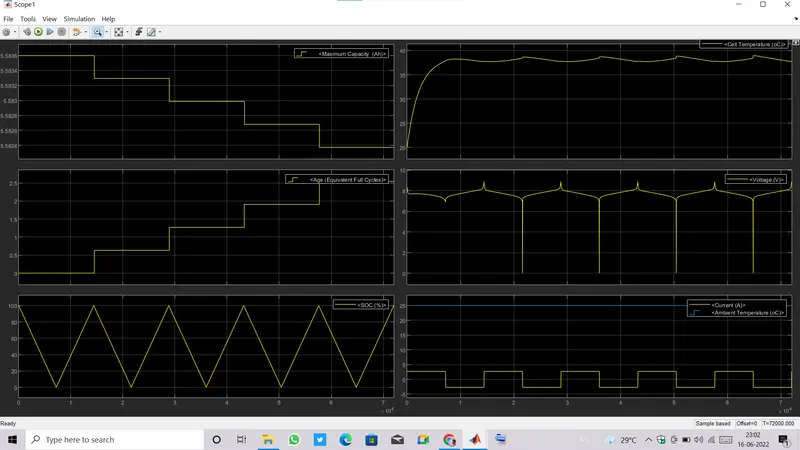
- Run simulation for 14400*5 secs to get 5 full cycles and by changing the amplitude of square wave generator to 2.7 and frequency to 7200*2 secs.
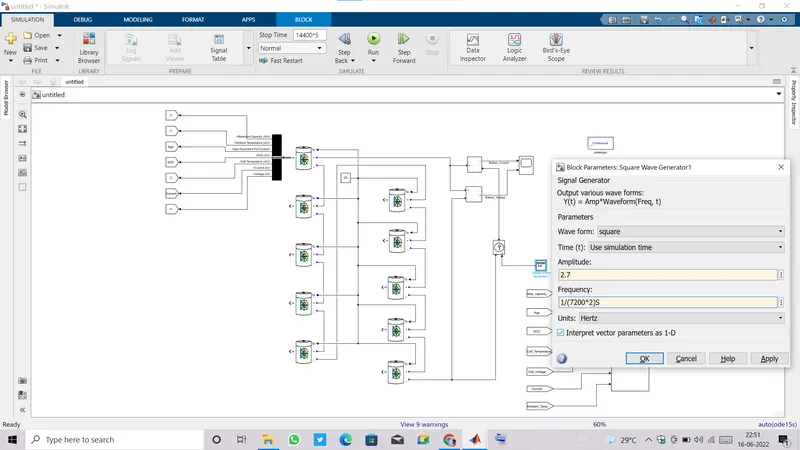
- Initially maximum capacity was 5.5836 Ah but after one complete cycle it goes on decreasing in a very small step of 0.0003, at the end of simulation it became 5.5824 Ah
- As battery is new, aging effect is zero till the one complete cycle but after that it started increasing in step of 0.635 , this value is still small because the C rate is still low.
- Battery is dischraging and discharging gradually so that SOC is going from 100 to 0 in 2 hours and again to 100 in 2 hours , a total of 4 hrs for a complete cycle.
- Initially Cell temperature keeps on increasing from 20 deg to almost 38.65 degree celcius while charging and again it fell down to 37.8 deg celcius while discharging.
- Cell voltage is dropping from 8.35V to nealry 6.9V but as cell temperature increases voltage is also increasing very slowly after each complete cycle, at the end of five cycles cell voltage becomes 8.91V.
- Current is changing from +2.7 to - 2.7 Amperes.
3. At 1 C rate and 25 deg celcius:
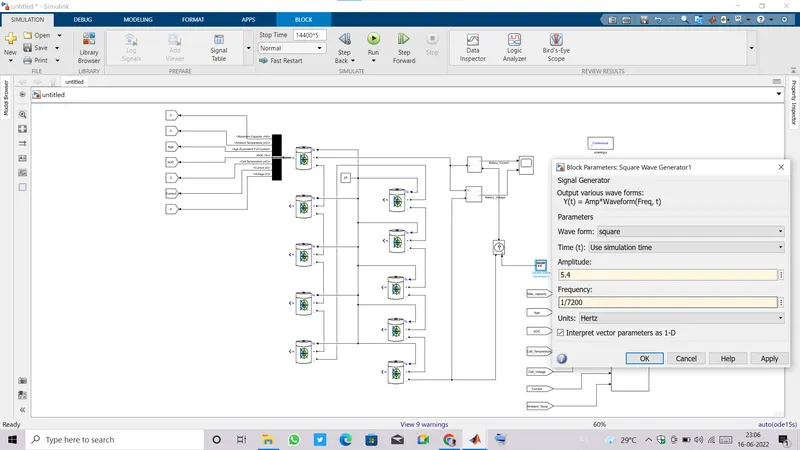
- Run simulation for 7200*5 secs to get 5 full cycles and by changing the amplitude of square wave generator to 5.4 and frequency to 7200 secs.
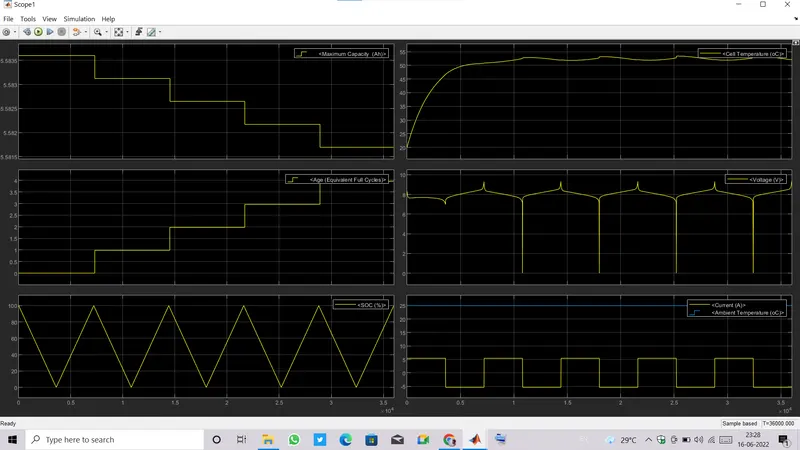
- Initially maximum capacity was 5.5836 Ah but after one complete cycle it goes on decreasing in a very small step of 0.0003, at the end of simulation it became 5.5824 Ah
- As battery is new, aging effect is zero till the one complete cycle but after that it started increasing in step of 0.635 , this value is still small because the C rate is still low.
- Battery is dischraging and discharging gradually so that SOC is going from 100 to 0 in 2 hours and again to 100 in 2 hours , a total of 4 hrs for a complete cycle.
- Initially Cell temperature keeps on increasing from 20 deg to almost 53.15 degree celcius while charging and again it fell down to 52.2 deg celcius while discharging.
- Cell voltage is dropping from 8.31V to 7V but as cell temperature increases voltage is also increasing very slowly after each complete cycle, at the end of five cycles cell voltage becomes 9.32V.
- Current is changing from +5.4 to - 5.4 Amperes.
CONCLUSION:
- The cell performance depends upon both ambient temperature as well as charging, discharging rates.
- If we put very low C rates there is less temperature rise in cells and aslo the againg effect increases slowly, also the maximum capacity decays slowly.
- Giving high ambient temperature keeping C rate same as low there will be large decay in maximum capacity and also aging effect will increase quickly.
- Similarly, if putting high C rate and Low ambient temperature and vice versa there will be more aging effect as well as vollatge will rise with rise in cell temperture. Allso the maximum capacity will decay at faster rate.
- So conclusion is that if want more capacity and less againg effect we need to give low C rate with low ambient temperature.