Project 2 Thermal modeling of battery pack
Objective:
- To develope a model for 10S1P lithium ion battery model,Simulate the thermal effects and compare life cycle performance at various temperatures, charge & discharge rates using MATLAB.
Temperature Effect on Lithium ion Chemistry:
Temperature, both hot and cold, can have a significant effect on the lifecycle, Depth of Discharge(DOD), performance, and safety capablities of solar storage systems.
Effect of Heat:
- When temperatures increase this affects the rate at which the chemical reactions that occur inside a battery.
- As the temperature of the battery increases the chemical reactions inside the battery also quicken.
- At higher temperatures one of the effects on lithium-ion batteries’ is greater performance and increased storage capacity of the battery.
- A study found that an increase in temperature from 25 degrees Celsius to 45 degrees Celsius led to a 20% increase in maximum storage capacity.
- However there is a side effect to this increased performance, the lifecycle of the battery is decreased over time.
- In that same study, it was found that when the battery is charged at 113 degrees versus 77 the lifecycle degradation was much more significant at the higher temperature.
- For the first 200 cycles the battery performance only degraded 3.3% at 77 degrees; at 113 degrees the performance decreased by 6.7%. That’s more than double the amount of degradation! Based on the greater degradation at higher temperatures, the battery lifecycle can be severely diminished due to consistent exposure to extreme heat.
- While heat exposure does temporarily increase battery capacity the damage that it does to the lifecycle can cause long term problems and prolonged heat exposure should be avoided.
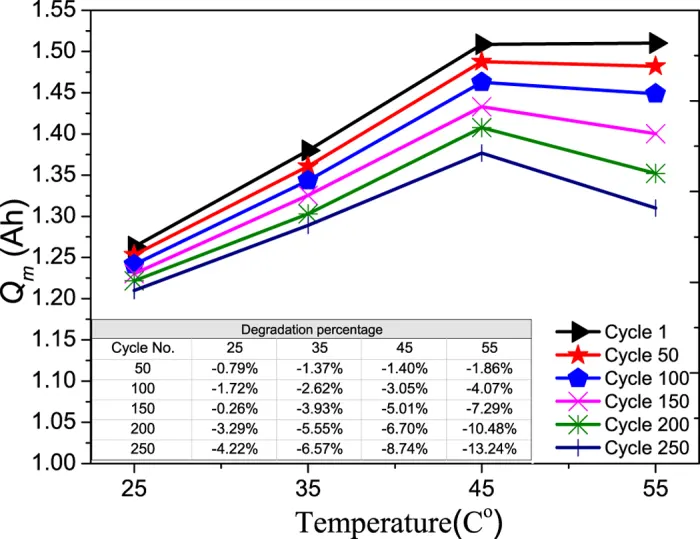
- As from the above graph it is clear that at high temperature we can get the max capacity of the cell,But over the period of time ie the no.of charge and discharge cycle increases the cell capacity decreases.
Effect of Cold Temperature:
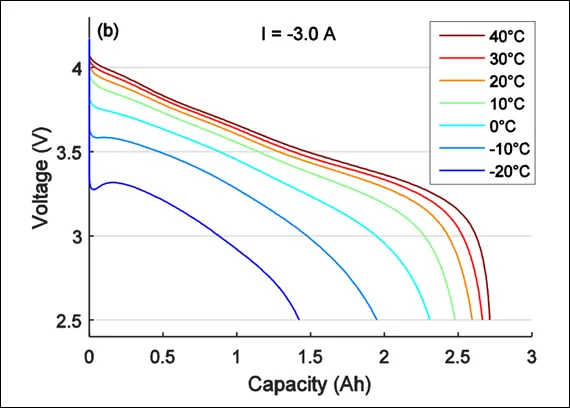
- Prolonged exposure to cold temperatures also has a big impact on battery performance and safety.
- When temperatures drop the internal resistance of the battery is increased.
- This means that it requires more effort by the battery to charge, in turn lowering the capacity.
- However, it is important to note that the loss of capacity also depends on the charge and discharge rates and the effect of the cold weather is different for batteries made with different chemistries.
- For example, a lead-acid battery may provide just half the nominal capacity at 0 Deg Fahrenheit.
- The operating temperatures of batteries are also different based on the type of battery you are working with.
- For example, lithium-ion batteries can be charged from 32°F to 113°F and discharged from –4°F to 140°F (however if you operate at such high-temperature levels you do run into the problems mentioned earlier). But Lead-acid batteries can be charged and discharged from -4°F to 122°F.
- It’s very important to be aware of the charging temperatures that a battery can accommodate. If batteries don’t operate at the accepted temperature, charge acceptance will be decreased because ion combination will be slower. Forcing high current can build up pressure causing explosions of sealed batteries.
Model:
- To model the the thermal effects of battery i used Table based battery block from simscape.
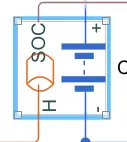
- The block contain four ports +ve and -ve terminal port and two measurement ports SOC and Thermal port.The thermal ports gives the cells internal temperature.
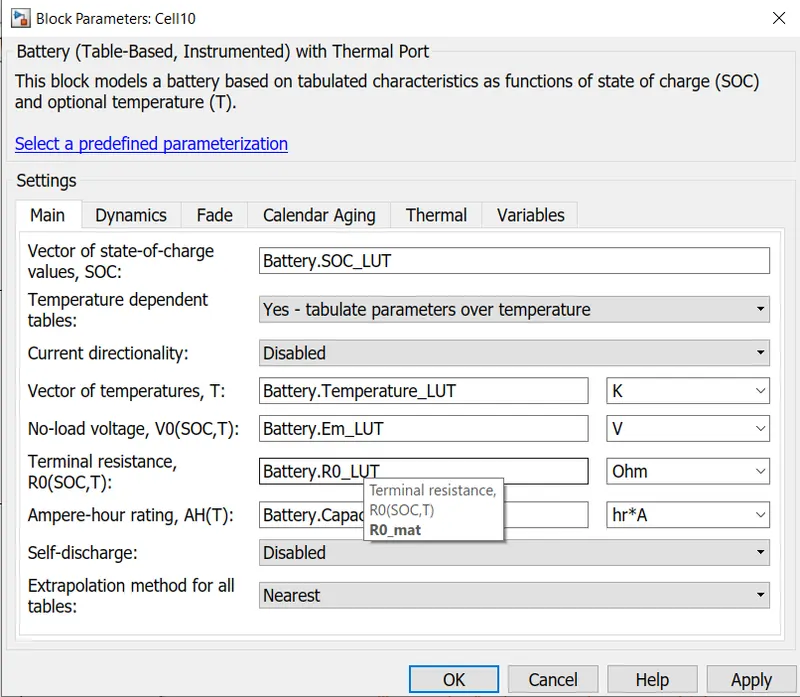
- The parameters of the battery is
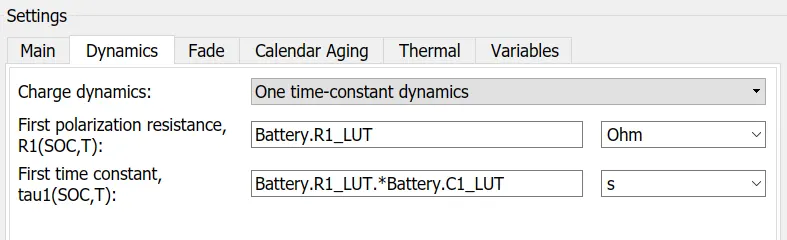
To Model the thermal behaviour of a Cell:
- For modelling the atmospheric temperature effect we use a controlled heat source block and to model the heat transfer a convective heat transfer block is used and to measure the temperature of cell a temperature sensor block is used and the model is connected as shown
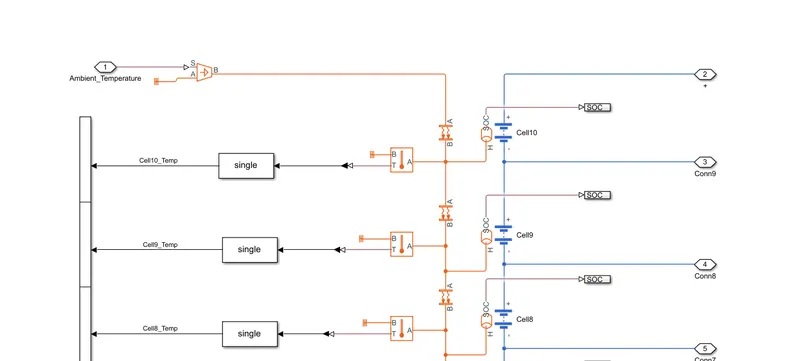
- The parameters are scripted in a .m files and the file is loaded to workspace before running the model.
-
% -------------------------------------------------------------------
%  Generated by MATLAB on 28-May-2022 10:46:24
%  MATLAB version: 9.10.0.1602886 (R2021a)
% -------------------------------------------------------------------
saveVarsMat = load('battery_init.mat');

Battery = struct;
Battery.SOC_LUT = [0; 0.1; 0.25; 0.5; 0.75; 0.9; 1];
Battery.Temperature_LUT = [278.15 293.15 313.15];
Battery.Capacity_LUT = [28.0081 27.625 27.6392];
Battery.Em_LUT = ...
  [3.4966 3.5057 3.5148;
   3.5519 3.566 3.5653;
   3.6183 3.6337 3.6402;
   3.7066 3.7127 3.7213;
   3.9131 3.9259 3.9376;
   4.0748 4.0777 4.0821;
   4.1923 4.1928 4.193];
Battery.R0_LUT = ...
  [0.0117 0.0085 0.009;
   0.011 0.0085 0.009;
   0.0114 0.0087 0.0092;
   0.0107 0.0082 0.0088;
   0.0107 0.0083 0.0091;
   0.0113 0.0085 0.0089;
   0.0116 0.0085 0.0089];
Battery.R1_LUT = ...
  [0.0109 0.0029 0.0013;
   0.0069 0.0024 0.0012;
   0.0047 0.0026 0.0013;
   0.0034 0.0016 0.001;
   0.0033 0.0023 0.0014;
   0.0033 0.0018 0.0011;
   0.0028 0.0017 0.0011];
Battery.C1_LUT = ...
  [1913.6 12447 30609;
   4625.7 18872 32995;
   23306 40764 47535;
   10736 18721 26325;
   18036 33630 48274;
   12251 18360 26839;
   9022.9 23394 30606];
Battery.cell_mass = 1;
Battery.cell_Cp_heat = 810.5328;
Battery.Qe_init = 15.6845;
Battery.T_init = 298.15;

cell_area = 0.101908;

cell_height = 0.22;

cell_rho_Cp = 2.04E+6;

cell_thickness = 0.0084;

cell_volume = 0.00039732;

cell_width = 0.215;

h_conv = 5;

h_conv_end = 5;

out = saveVarsMat.out; % <1x1 Simulink.SimulationOutput> unsupported class

clear saveVarsMat;
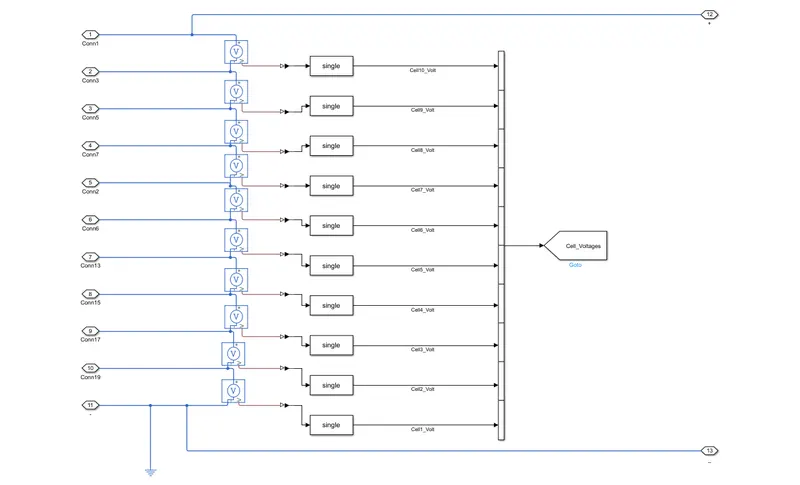
To measure individual cell Voltage:
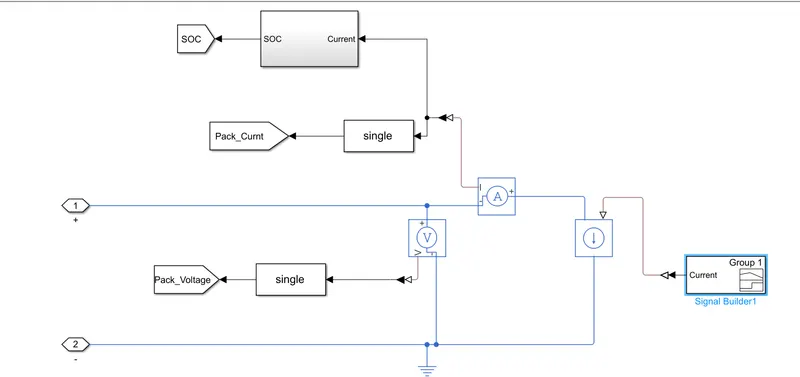
To measure Pack current and Voltage and SoC:
Note:
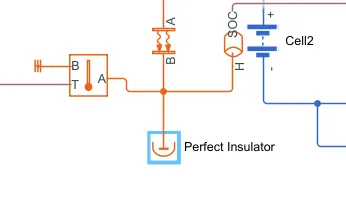
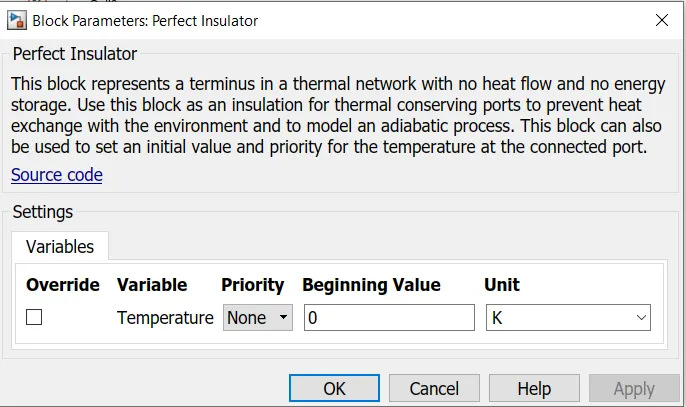
- A perfect insulator block is used at cell1
Simulation and Result:
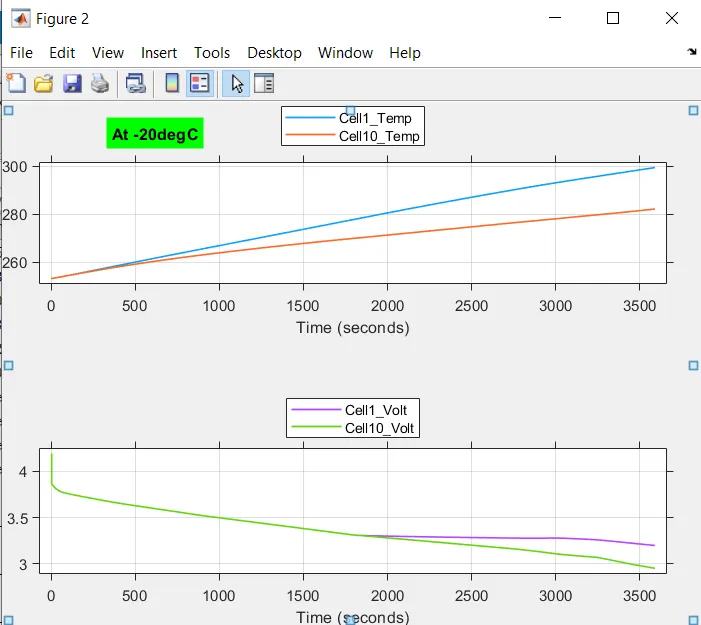
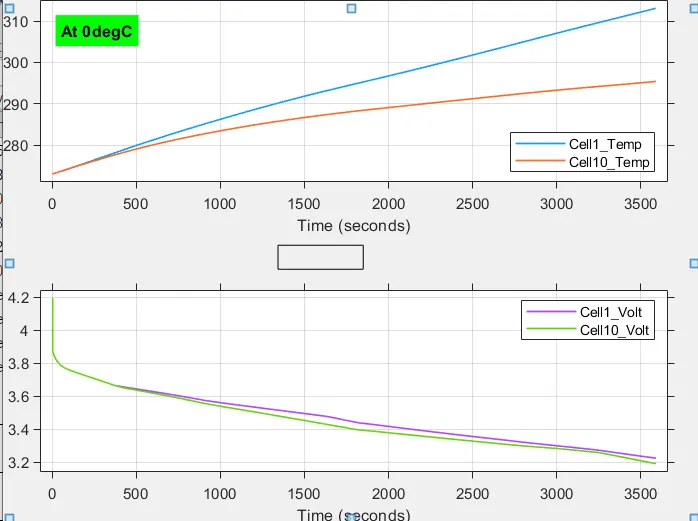
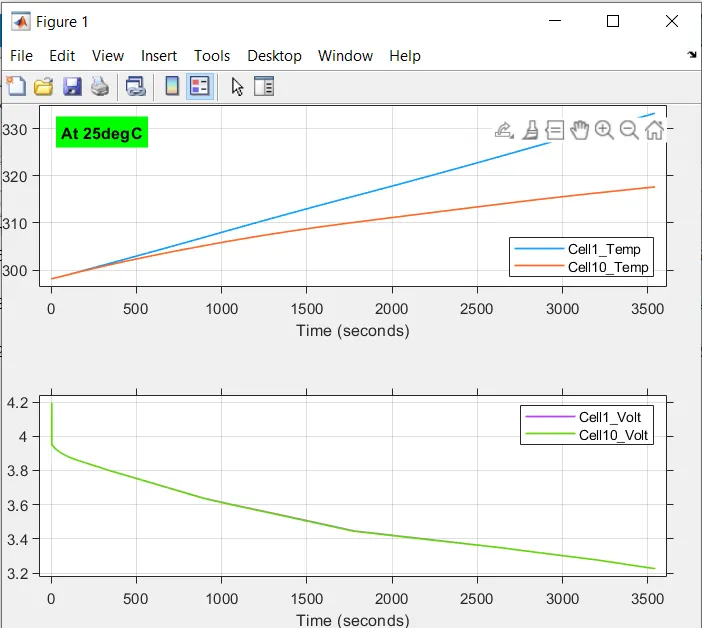
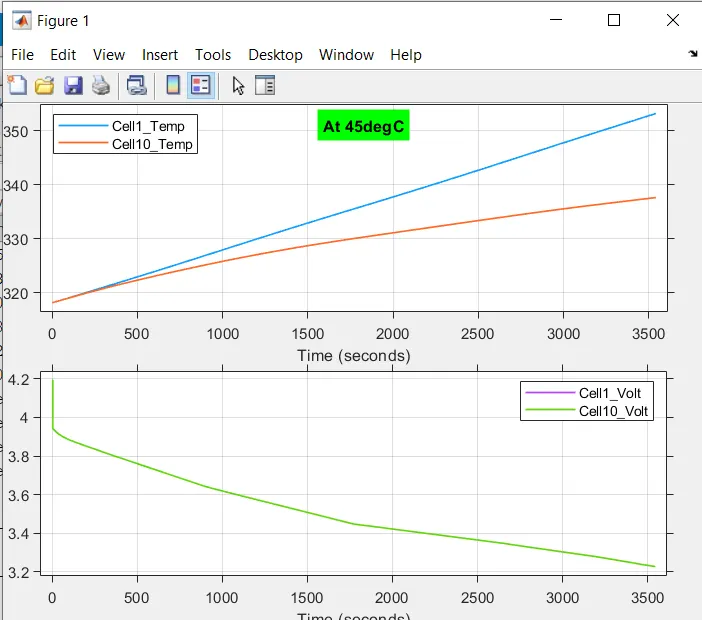
Case1: Discharged at 1C rate.
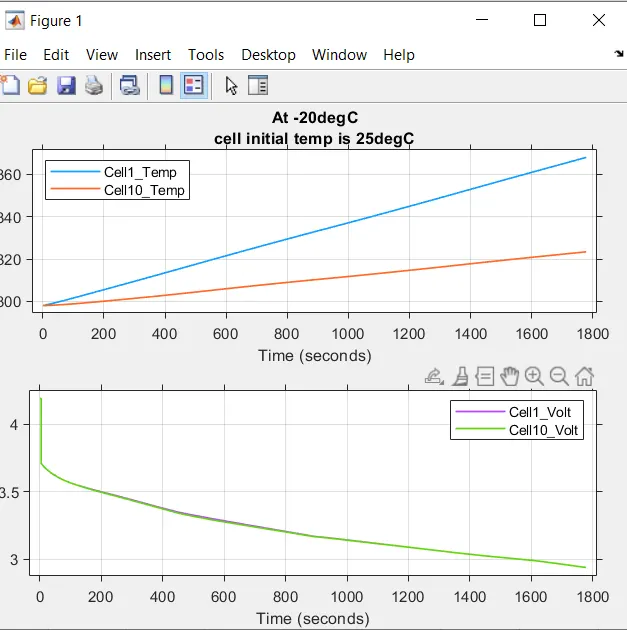
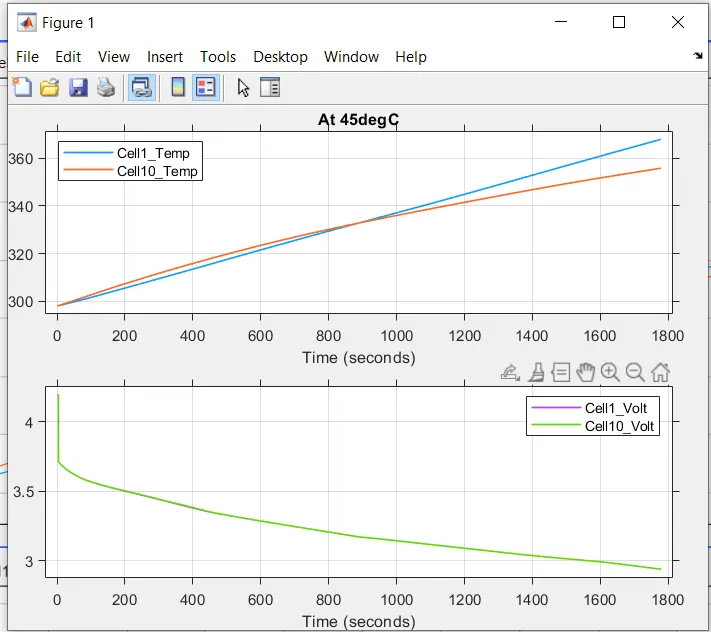
Case2: Discharged at 2C rate
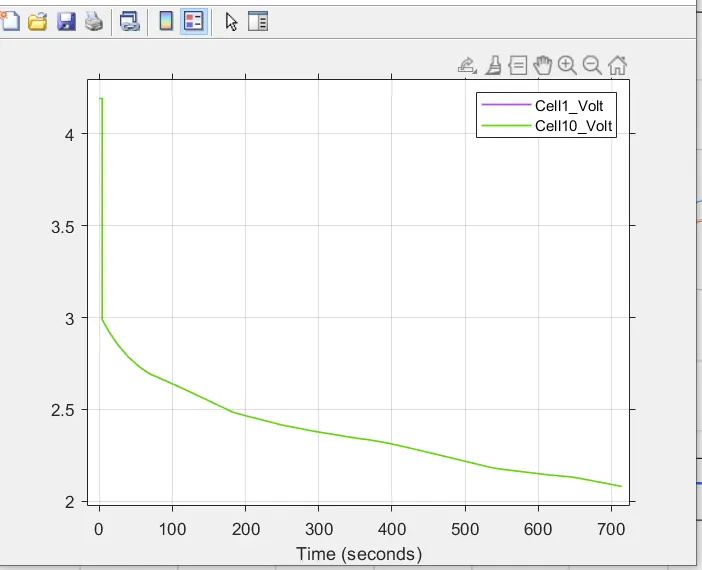
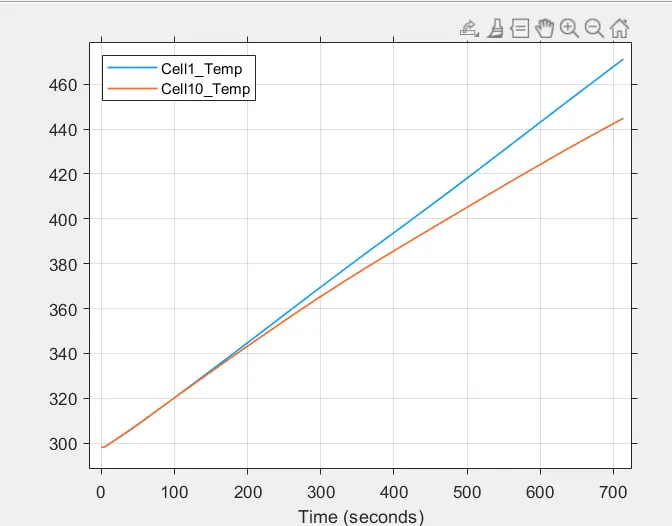
Case3: At 5C and 35degCelsius
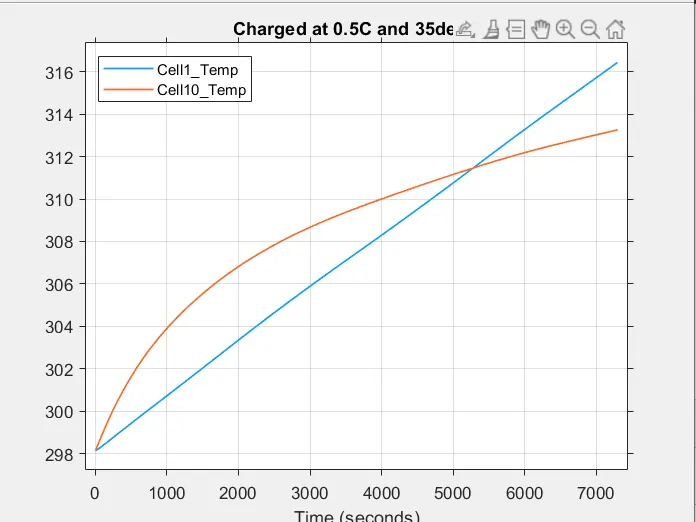
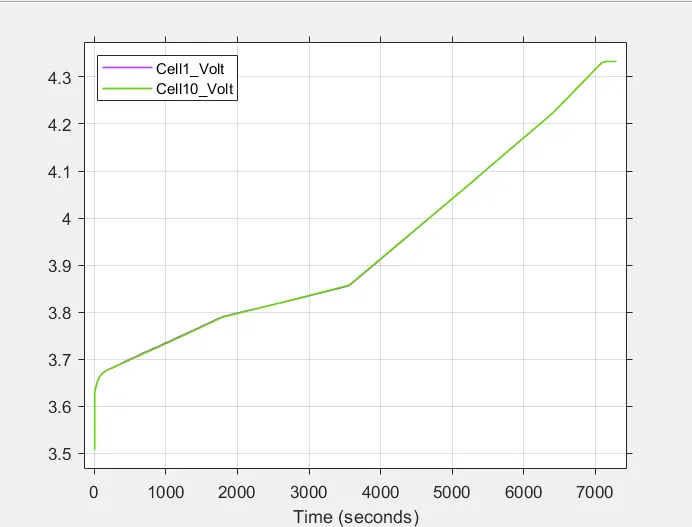
Case3:Charged at 0.5C and 35degC
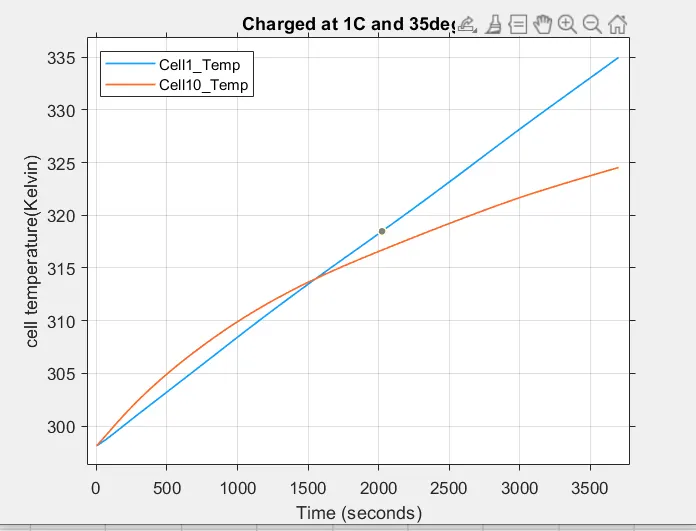
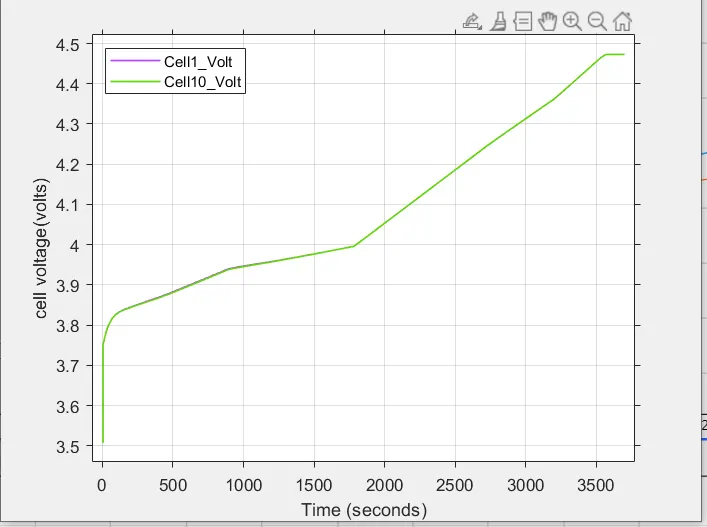
Case4: Charged at 1C rate and 35degC
Observation:
During discharge:
- At low temperature(below 0degC) the cell performance is reduced greatly,each cell behaves differently,Whereas at high temperature(45degC) we get the max performance and each cell behaves identically.
- At higher C rate the minimum voltage reaches quicly hence the performance gets reduced.
During charging:
- Most of the lithium ion chemistry cells are normally charged at 0.5-0.7C rates,some chemistry like LFP and LTO can be charged at 1C rate.
- Here at 0.5C rate charge causes a increase in temperature of 14-16 degCelsius for obtaining a full charge from 0 to100%.
- For 1C rate charging causes a increase in temperature of around 35 degCelsius for obtaining a full charge from 0 to100%.
Reference:
https://www.ncbi.nlm.nih.gov/pmc/articles/PMC4526891/
https://batteryuniversity.com/article/bu-205-types-of-lithium-ion