Project 2 Thermal modeling of battery pack
Aim: Create a 10-cell series lithium-ion battery model and observe the thermal effects and life cycle performance.
Objective:
- To simulate the model and observe the thermal effect at various temperatures, and charge & discharge rates.
- To simulate the model and observe the life cycle performance at various temperatures, and charge & discharge rates.
Introduction:
The battery pack of HEVs and EVs are made of an enormous number of individual cells. They are organized in series, parallel, or the arrangement of both based on the requirement of voltage, current, and power. The chemical reaction gets impacted by the temperature. Whenever the temperature increases, the chemical reaction inside the battery also get increases. The high temperature of the Li-ion battery increases the battery performance and storage capacity. According to a study, if the temperature increases from 77 F to 113 F the storage capacity of the battery increases by 20%. However, the battery aging is considerably more significant at higher temperatures. Batteries have been designed to work in the adequate range so any overcharge/ discharge can accelerate battery degradation and shorten life. However, the degradation rate of the battery in the acceptable range is not constant and depends on the rate of charge or discharge (stress factors).
Simulink model:
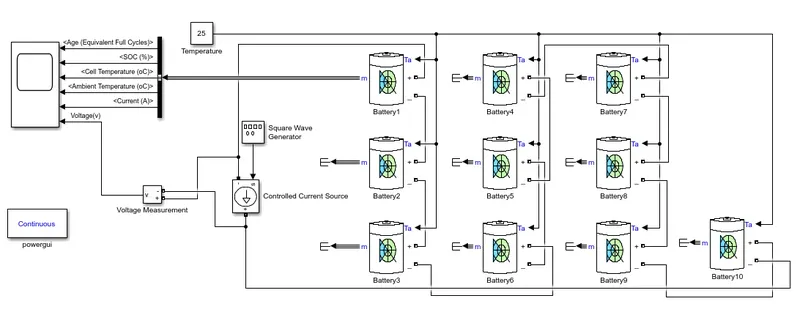
The above-shown model includes the following blocks.
Battery: Carries out a generic battery model for the most popular battery types for the voltage and current of the system.
Constant block: To define the temperature.
Square wave generator: Give input signal to the controlled current source.
Controlled current source: Discharge the current from the battery as defined by the input signal.
Bus selector: block that defines its output using a bus object.
Powergui: Defines the solver configuration to the model.
In order to simulate the battery pack of 10 cells in series, the following parameters are considered.
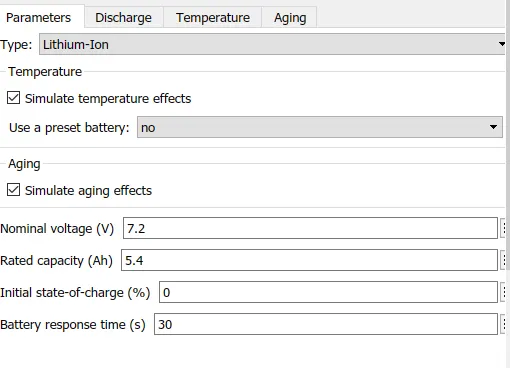
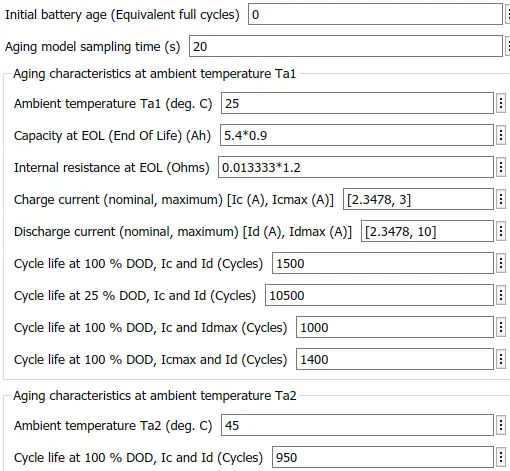
Here the considered single cell voltage is 7.2 V and the capacity is 5.4 Ah. These individual cells are connected in series to form a battery pack of 10 cells in series. The battery pack voltage is 72 V and the capacity is 5.4 Ah. This battery pack is connected with the controlled current source. The output of the one cell is given to the bus selector and other block terminals are connected to the terminator block. To study the battery aging, SOC, temperature, current, and voltage, the bus selector is connected to the scope. The aging model sampling time is set to 20 sec. as shown below. Rest all parameters are set to the default value.
The square wave generator block parameters are shown below.
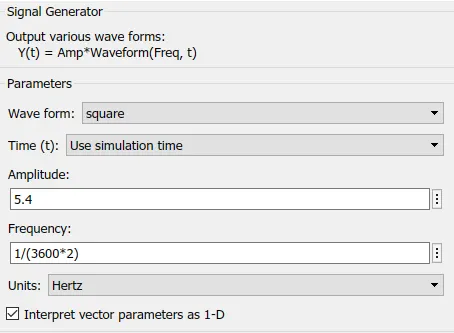
The amplitude of the square wave generator is set to 5.4, which defines the charging and discharging rate of the battery. And the frequency is set to 1/(3600*2).
Simulation result:
Case 1: Set the temperature to 25°C(77°F ) and the charge-discharge current is 5.4 A
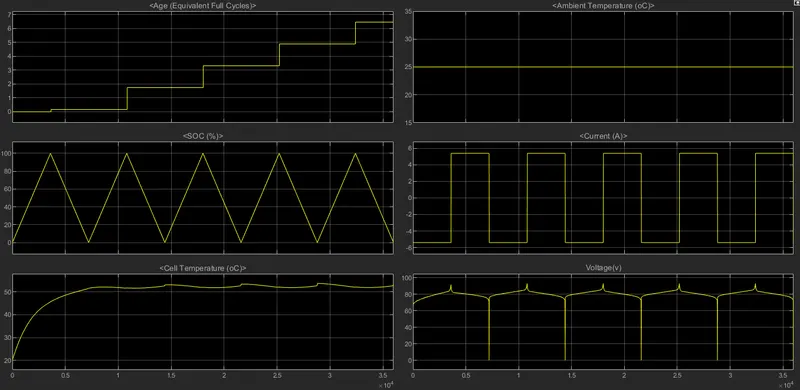
From the above figure, it can be observed that cells charge and discharge at the same rate(1 C). The battery pack SOC is discharged completely in an hour. Therefore the battery pack completed 1 cycle life in 2 hours. So the battery aging occurred every 2 hours. In 10 hours the battery pack completes the 5 cycle life and 5 agings and battery capacity reduces to 93.5%. The cell temperature is gradually increased from 20°C to 52°C and keeps fluctuating from 52°C to 53°C. When the battery is charging the temperature increases and drops when the battery is discharging. And the voltage is fluctuating between 74 V to 84 V.
Case 2: Set the temperature to 10°C(50°F ) and the charge-discharge current is 5.4 A
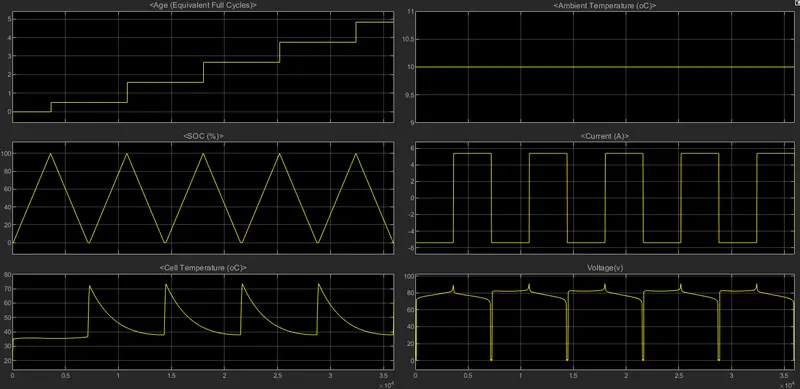
Here the ambient temperature is decreased to 10°C and the C rate remains the same. In 10 hours the battery pack completes the 5 cycle life and 5 agings and battery capacity reduces to 95.2%. The cell temperature suddenly increased from 38°C to 72°C during the charging process due to significant changes in temperature. And gradually decreases to 38°C.
Case 3: Set the temperature to 45°C(113°F ) and the charge-discharge current is 5.4 A
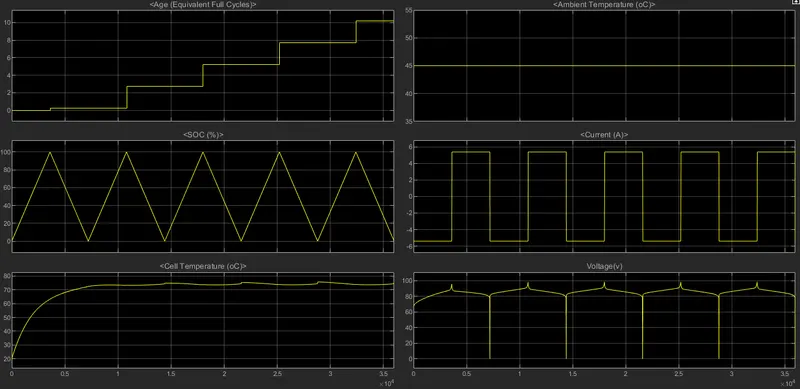
From the above figure, it can be observed that the ambient temperature is increased to 45°C and the C rate remains the same. In 10 hours the battery pack completes the 5 cycle life and 5 agings and battery capacity reduces to 89.8%. The cell temperature is gradually increased from 20°C to 73°C and keeps fluctuating from 73°C to 75°C. When the battery is charging the temperature increases and drops when the battery is discharging.
Case 4: Set the temperature to 25°C(77°F ) and the charge-discharge current is 2.7 A
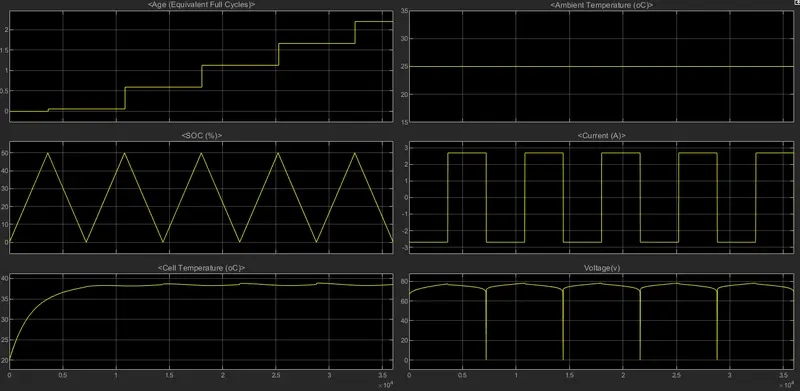
From the above figure, it can be observed that the ambient temperature is increased to 25°C and the C rate is 0.5, so the battery consumes up to only 50% of its charges. In 10 hours the battery pack completes the 5 cycle life and 5 agings and battery capacity reduces to 97.8%. The cell temperature is gradually increased from 20°C to 38°C and keeps steady at 38°C. When the battery is charging the temperature increases and drops when the battery is discharging.
Case 5: Set the temperature to 45°C(113°F ) and the charge-discharge current is 2.7 A
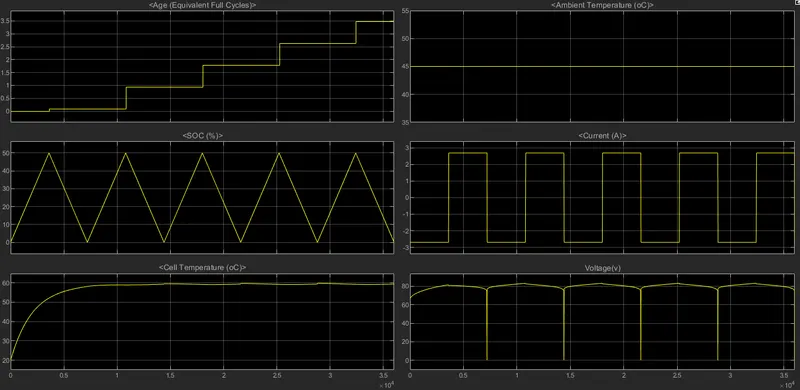
From the above figure, it can be observed that the ambient temperature is increased to 45°C and the C rate is 0.5, so the battery consumes up to only 50% of its charges. In 10 hours the battery pack completes the 5 cycle life and 5 agings and battery capacity reduces to 96.5%. The cell temperature is gradually increased from 20°C to 59°C and keeps steady at 59°C. When the battery is charging the temperature increases and drops when the battery is discharging.
Conclusion:
- It is observed that as the ambient temperature increases the battery pack temperature also increases. This increase in temperature increases the battery's aging rapidly.
- As the charge & discharge rates fully will increase the battery aging fast than the less charge & discharge rates.