Project 2 Thermal modeling of battery pack
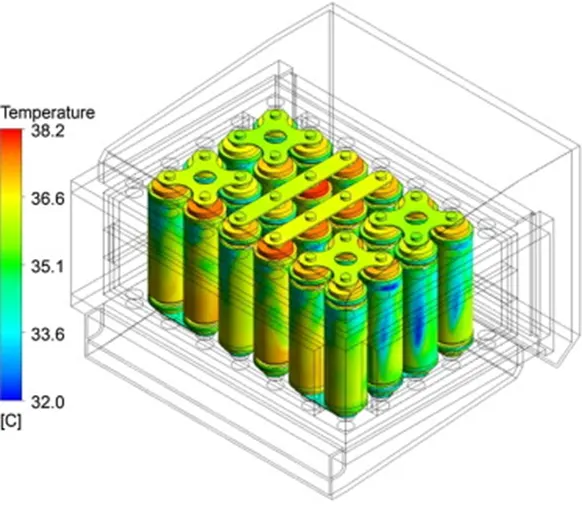
Project 2
Thermal modeling of battery pack
Abhishek Anil Patil | Introduction to Battery Technology | 01/05/2022
Objective
For a 10-cell series lithium ion battery model, simulate the thermal effects and compare life cycle performance at various temperatures, charge & discharge rates using MATLAB.
Simulink model
The following model was downloaded from the MathWorks website. The link is provided below,
https://in.mathworks.com/help/physmod/simscape/ug/lithium-ion-battery-pack-with-fault.html
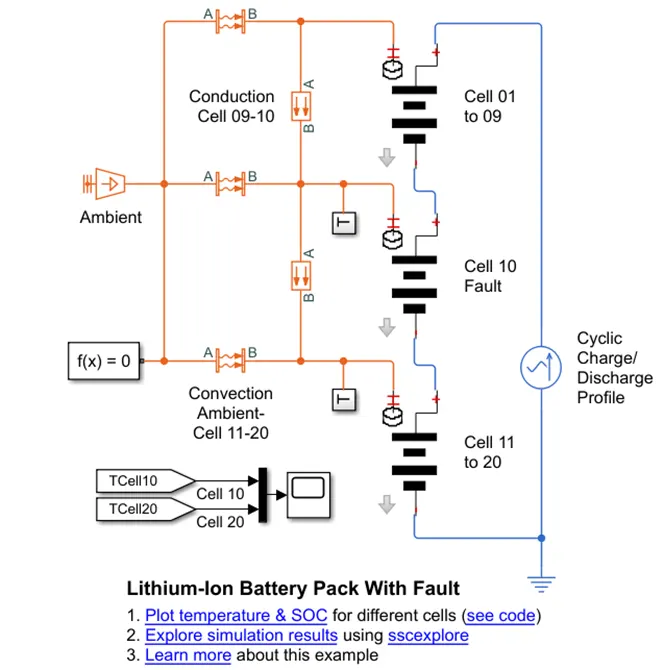
Battery
The mathworks model has 20 cells connected in series.
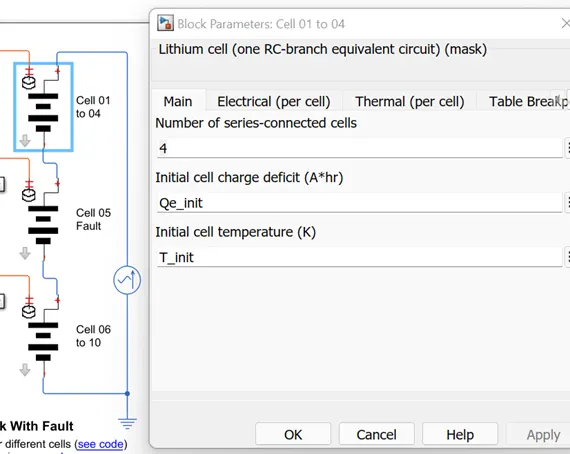
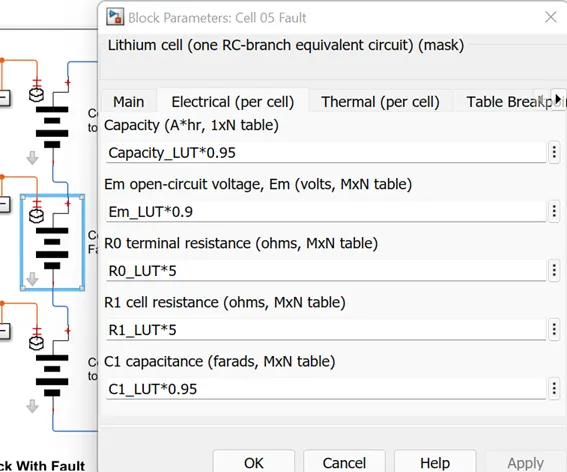
I have changed that to 10 cells with the 5th cell being faulty.
5th faulty cell parameters
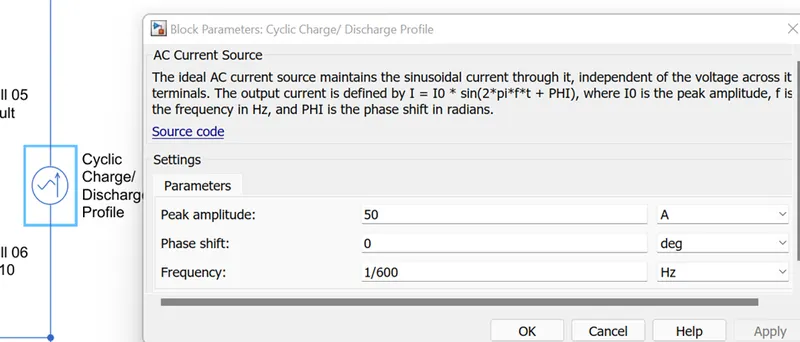
AC current source
The ideal AC current source maintains the sinusoidal current through it, independent of the voltage across its terminals.
Conductive heat transfer
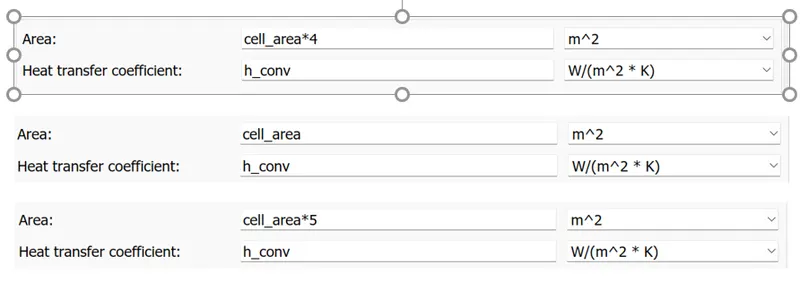
This block models heat transfer in a thermal network by conduction through a layer of material. The rate of heat transfer is governed by Fourier's law and is proportional to the temperature difference, material thermal conductivity, area normal to the heat flow direction, and inversely proportional to the layer thickness.
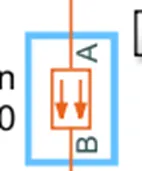

Convective heat transfer
This block models heat transfer in a thermal network by convection due to fluid motion. The rate of heat transfer is proportional to the temperature difference, heat transfer coefficient, and surface area in contact with the fluid.
Results
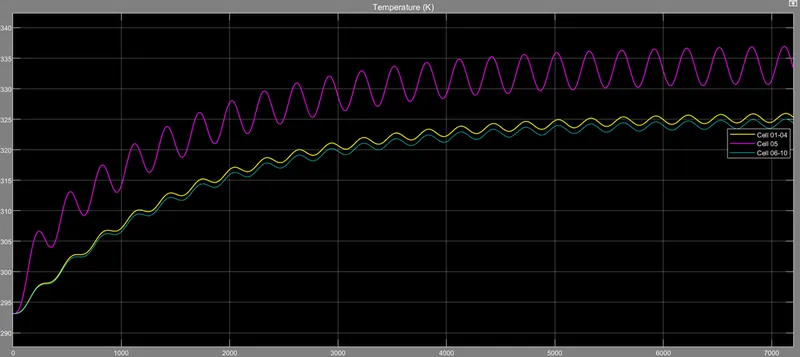
Varying charge discharge rates but keeping the temperature constant.
Ambient temperature is 300k
Current amplitude = 50A
Frequency = 1/600
Current amplitude = 100A
Frequency = 1/600
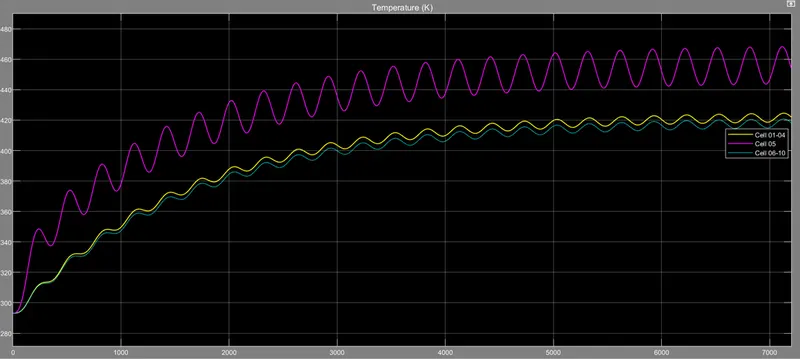
As heat is dependent on square of the current, hence when the current amplitude increase the temperature of the cells also increase significantly.
Current amplitude = 50A
Frequency = 1/300
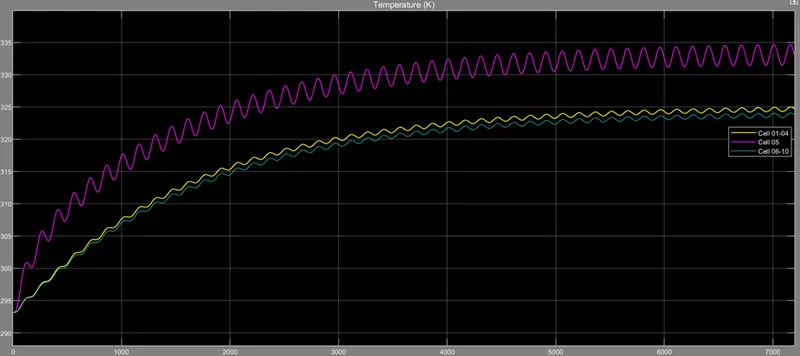
By doubling the frequency, we cannot see any change in the temperature profile.
Varying temperature but keeping the current parameters constant.
Current amplitude = 50A
Frequency = 1/600
Ambient temperature = 300K
Cell temperature = 300K
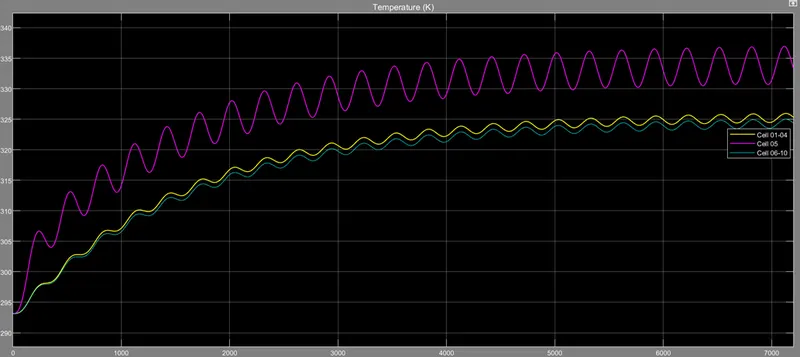
Ambient temperature = 350K
Cell temperature = 300K
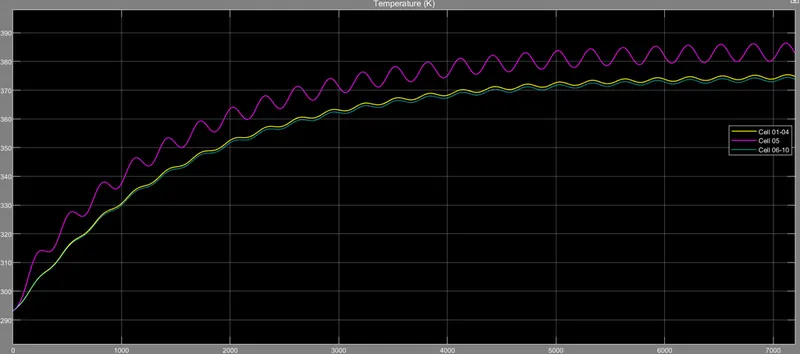
The temperature of the faulty and the other cells increase by a factor of 50.
Ambient temperature = 300K
Cell temperature = 350K
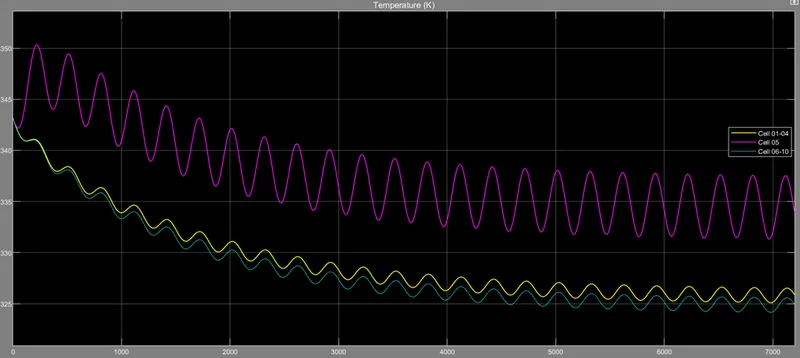
The cell temperatures start from 350K and then reach the same steady state temperatures as in case 1.
The faulty cell obviously reaches higher temperature values.
Ambient temperature = 300K
Cell temperature 1-4 = 300K
Cell temperature 5 = 350K
Cell temperature 6-10 = 300K
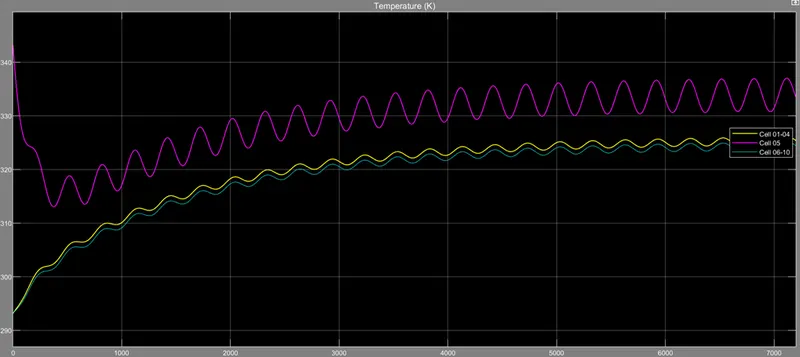
The other cells show same temperature profile as in case 1.
The faulty cell starts from 350K and reaches to the same steady state value of 335K
Ambient temperature = 300K
Cell temperature 1-4 = 350K
Cell temperature 5 = 300K
Cell temperature 6-10 = 350K
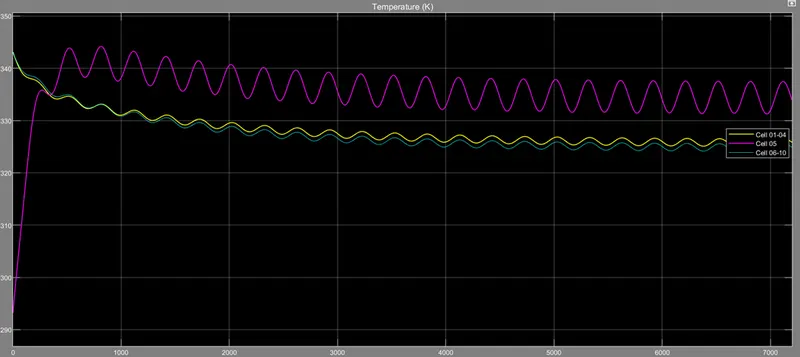
The other cells start from 350K and decrease to steady state value of 325K
The faulty cell starts at 300k and rapidly rises to its steady state value of 335K in jus a few seconds.