Project 2 Thermal modeling of battery pack
Objective-For a 10 cell series lithium ion battery model, simulate the thermal effects and compare life cycle performance at various temperatures, charge & discharge rates using MATLAB.
Introduction-
A lithium-ion battery or Li-ion battery is a type of rechargeable battery composed of cells in which lithium ions move from the negative electrode through an electrolyte to the positive electrode during discharge and back when charging. Li-ion cells use an intercalated lithium compound as the material at the positive electrode and typically graphite at the negative electrode. Li-ion batteries have a high energy density, no memory effect (other than LFP cells) and low self-discharge. Cells can be manufactured to either prioritize energy or power density. They can however be a safety hazard since they contain flammable electrolytes and if damaged or incorrectly charged can lead to explosions and fires.
A battery is a device consisting of one or more electrochemical cells with external connections for powering electrical devices. When a battery is supplying electric power, its positive terminal is the cathode, and its negative terminal is the anode. The terminal marked negative is the source of electrons that will flow through an external electric circuit to the positive terminal.
When a battery is connected to an external electric load, a redox (reduction-oxidation) reaction converts high-energy reactants to lower-energy products, and the free-energy difference is delivered to the external circuit as electrical energy. Historically the term "battery" specifically referred to a device composed of multiple cells; however, the usage has evolved to include devices composed of a single cell.
The Cell
A lithium-ion battery is made up of several parts. The cell, serving as the workhorse of the battery, is the most critical component of the battery.
The cell is comprised of the following battery materials:
- Electrodes are the two battery ends. One is the anode and the other is the cathode.
- The anode stores the lithium and is typically made from carbon.
- The cathode also stores the lithium and is made from a chemical compound that is a metal oxide.
- The separator blocks the flow of negative and positive electrons inside the battery but allows for ions to pass through.
- The electrolyte liquid sits between the two electrodes. It carries the positively charged lithium ions from the anode to the cathode and vice versa depending on whether the battery is charging or discharging.
The Battery Pack
The battery pack, which holds the lithium-ion cells, operates much like a computer. It contains the following:
- At least one temperature sensor to monitor the battery’s temperature.
- A voltage converter and regulator circuit that focuses on keeping the voltage and current at safe levels.
- A Euro connector, which allows power and information to move in and out of the battery pack.
- The cell tap, which oversees the cells’ voltages in the battery pack.
- A battery monitoring system, a small computer that oversees the whole battery and ensures safety to the user.
How does a lithium-ion battery work?
Most Li-ion batteries share a similar design consisting of a metal oxide positive electrode (cathode) coated onto an aluminum current collector, a negative electrode (anode) made from carbon/graphite coated on a copper current collector, a separator and electrolyte made of lithium salt in an organic solvent.
While the battery is discharging and providing an electric current, the electrolyte carries positively charged lithium ions from the anode to the cathode and vice versa through the separator. The movement of the lithium ions creates free electrons in the anode which creates a charge at the positive current collector. The electrical current then flows from the current collector through a device being powered (cell phone, computer, etc.) to the negative current collector. The separator blocks the flow of electrons inside the battery.
During charging , an external electrical power source (the charging circuit) applies an over-voltage (a higher voltage than the battery produces, of the same polarity), forcing a charging current to flow within the battery from the positive to the negative electrode, i.e. in the reverse direction of a discharge current under normal conditions. The lithium ions then migrate from the positive to the negative electrode, where they become embedded in the porous electrode material in a process known as intercalation.
Lithium-ion battery applications
Lithium-ion batteries are popular because of their high energy density and other properties – and as the technology improves and prices reduce, they are proliferating in many applications. Here are some examples for Li-ion battery applications:
- Portable power packs: Li-ion batteries are lightweight and more compact than other battery types, which makes them convenient to carry around within cell phones, laptops and other portable personal electronic devices.
- Uninterruptible Power Supplies (UPSs): Li-ion batteries provide emergency back-up power during power loss or fluctuation events. Office equipment like computers, as well as IT servers and complete data centers, must be protected from power interruptions to prevent data loss. Back-up power is also needed in the medical and health care industries to guarantee consistent power supply to life-saving medical equipment.
- Electric vehicles: The automotive industry is creating a demand for Li-ion battery packs to provide power sources for electric, hybrid or plug-in hybrid electric vehicles. As Li-ion batteries can store large amounts of energy and can be recharged many times, they offer good charging capacity and long lifespans.
- Marine vehicles: Li-ion batteries are emerging as an alternative to gasoline and lead-acid batteries in powering work or tug boats and leisure craft like speed boats and yachts. Li-ion batteries provide quiet and efficient power sources and can also be used to provide electricity to appliances inside the boat while it is in dock.
- Personal mobility: Lithium-ion batteries are used in wheelchairs, bikes, scooters and other mobility aids for individuals with disability or mobility restrictions. Unlike cadmium and lead batteries, lithium-ion batteries contain no chemicals that may further harm a person’s health.
- Renewable energy storage: Li-ion batteries are also used for storing energy from solar panels and wind turbines as they can be charged quickly. They are lighter, more compact and can hold higher amounts of energy than lead-acid batteries. Within battery energy storage systems, they fulfil a valuable role in balancing supply and demand, and in grid stabilization.
Lithium-ion battery safety
A lithium-ion battery comprises not only cells, but also a Battery Management System (BMS) that manages its operation and ensures that it does not depart from its safe operating area. This is vital for Li-ion batteries as they are sensitive to overcharging, shorts and excessively deep discharge, and can be permanently damaged. Battery management systems can contain a switch that can disconnect the battery once charged to capacity, to prevent continued charging and consequent damage.
Battery management systems can monitor almost everything that the battery does, ensuring that temperature is regulated, that power output is kept even and that battery pressure does not exceed advisable limits. These systems can even detect if the battery has shifted and may be discharging its current incorrectly, for example into the conductive body of a vehicle.
The Simulink model-
In this project we need to simulate the thermal effect and life cycle of performance of lithium ion battery at various temperature,charge ,discharge rate. The simulink model is following-
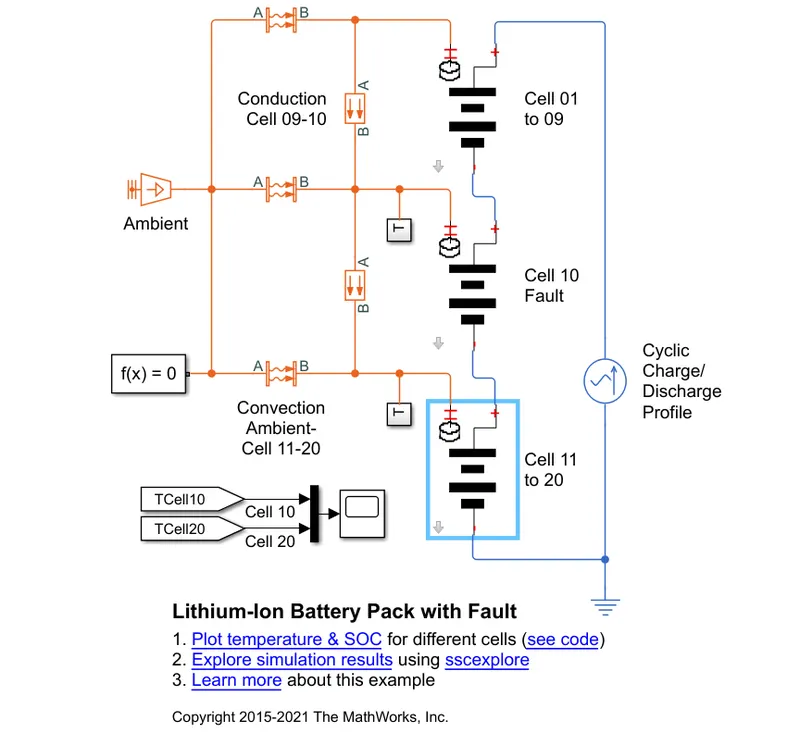
In this model the 3 battery pack connect in series. The 1st battery pack contain cell 01 to 09 in series and 3rd pack contain cell 11 to 20 in series.
The 2nd pack contain cell10 which is at fault condition because of thermal effect from system.Block parameters are shown below-
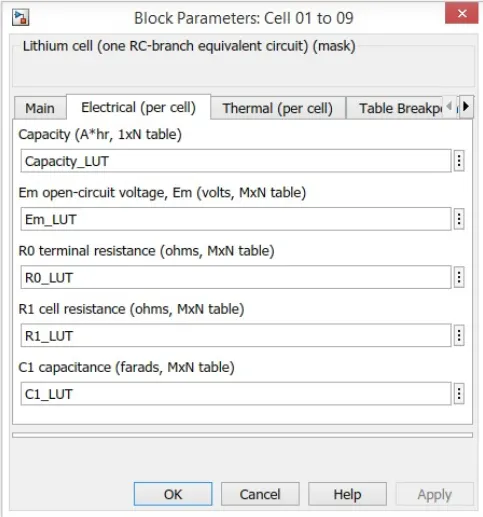
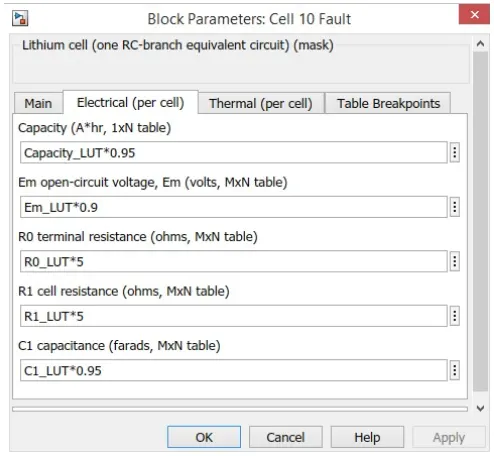
Changing this model according to the convenience-
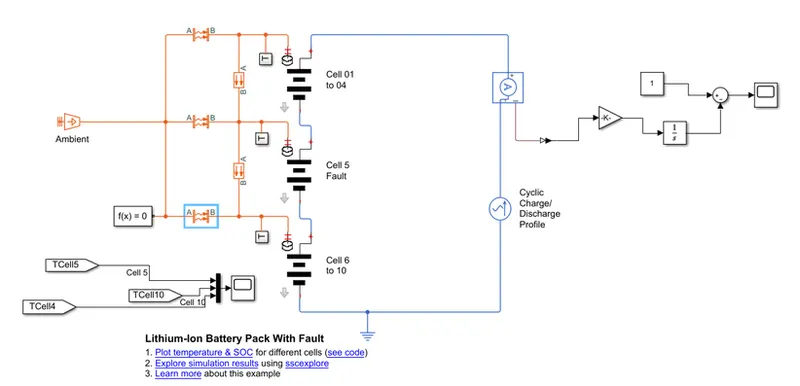
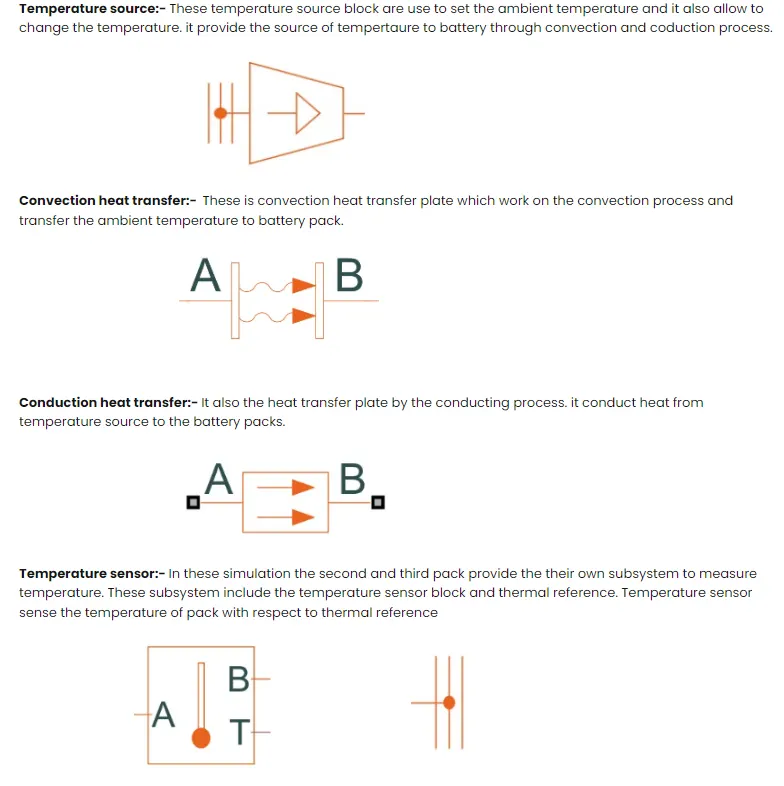
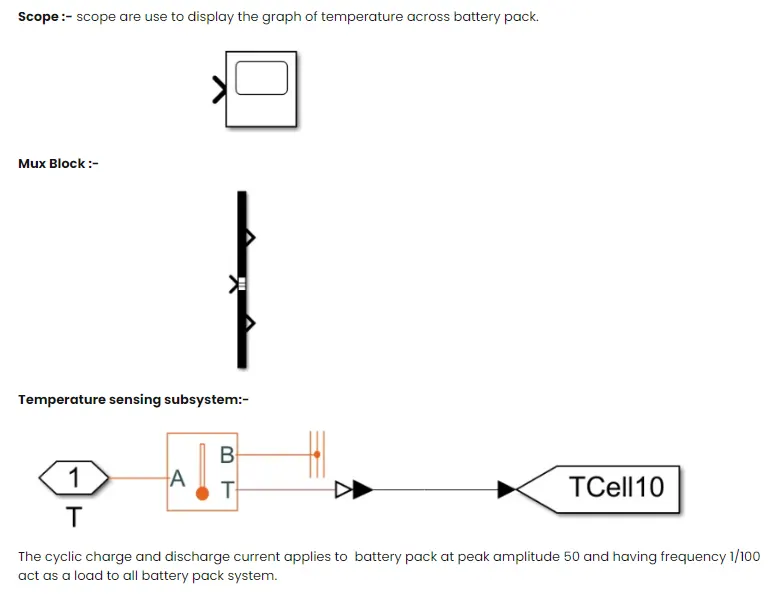
In this model various blocks are used which are following-
Results-
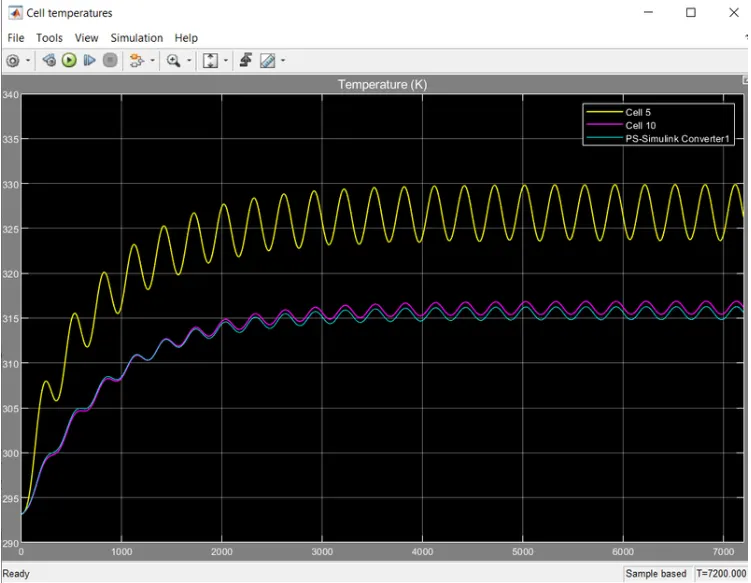
1)At 300K That means 26.85 degree celcius
2)At 310K That means 36.85 degree celcius
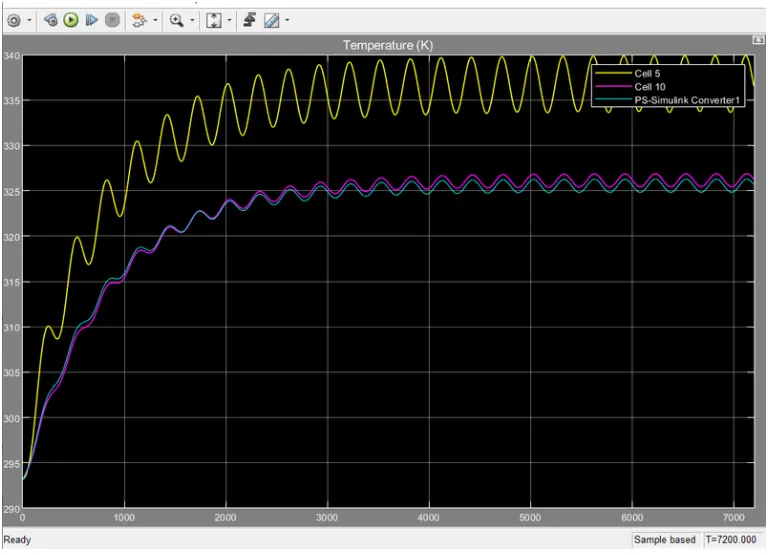
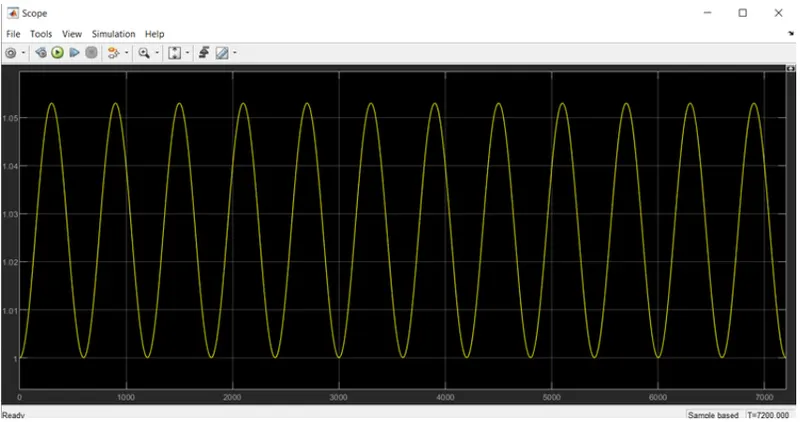
3)At 324K That means 50.85 degree celcius
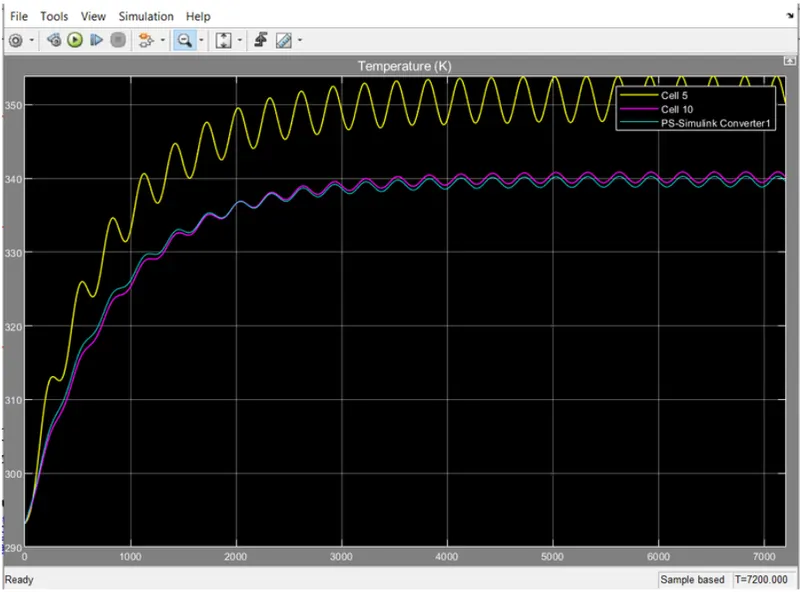
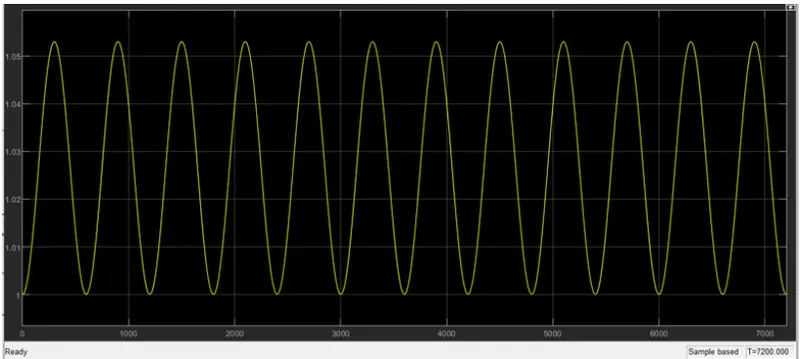
Explanation-
1-4 cells are normal cells 5th cell is faulty 6-10 cell is normal as we are simulating thermal effect on given charge/discharge profile to circuit waveform you can see the results but when circuit is run on this drive cycle profile 5th cell show temperature rise higher than any other cell and the life cycle of cell get reduced and cell even can damage.
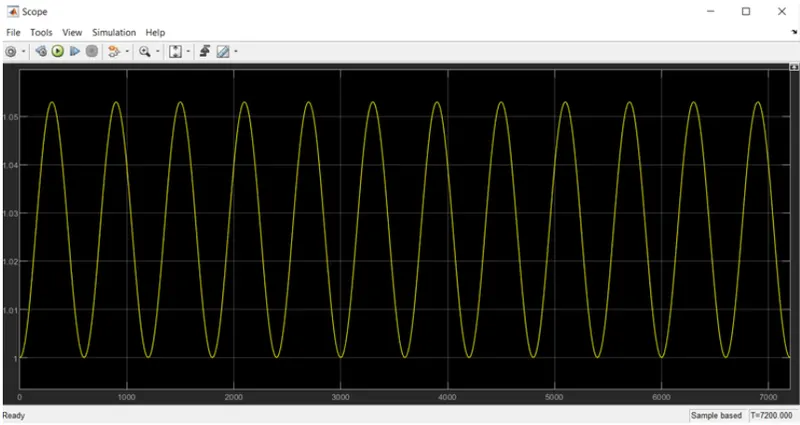
So as we give temperature of results at 300K the 1-4 and 6-10 cell temperature is near 316K but 5th faulty cell temperature goes to 330K and the drive cycle is shown which is cyclic charge/discahrge drive cycle.
In that condition we give temperature 310K and 1-4 and 6-10 cell temperature is near to 326K but 5th faulty cell temperature goes to 340K and the drive cycle is cyclic charge/discharge drive cycle.
In 3rd condition we give temperature 324K and 1-4 and 6-10 cell temperature is near to 340K but 5th faulty cell temperature goes to 354K and the drive cycle is cyclic charge/discharge drive cycle.
Conclusion- We simulated the thermal effect and compared at varius temperature, faulty cell temperature rise more than normal cell charge and discharge cycle given and due to tempearture rise it can damage the cell and reduce the performance of the battery. Simulink model is also attched.