Project 2 Thermal modeling of battery pack
For a 10 cell series lithium ion battery model, simulate the thermal effects and compare life cycle performance at various temperatures, charge & discharge rates using MATLAB.
soluction:
A lithium-ion battery is a type of rechargeable battery that is charged and discharged by lithium ions moving between the negative (anode) and positive (cathode) electrodes. (Generally, batteries that can be charged and discharged repeatedly are called secondary batteries, whereas disposable batteries are called primary batteries.)Because lithium-ion batteries are suitable for storing high-capacity power, they are used in a wide range of applications, including consumer electronics such assmartphones and PCs, industrial robots, production equipment and automobiles.
As California accelerates its push toward 100% zero-emission new car sales by 2035, hundreds of thousands of electric-vehicle batteries will be finishing their freeway lives — and it’s not clear what’s going to happen to them.Currently, many of the massive used batteries — the Tesla version weighs about 900 pounds — appear to be stockpiled in hopes of greater reuse and recycling markets. But eventually those batteries, along with the toxic chemicals that can leach out of them, could end up in hazardous waste landfills.
There are no EV-battery recycling plants in California, and only five up and running nationwide, according to CalEPA. That’s despite the fact that used lithium-ion batteries contain valuable minerals that otherwise must be mined from the earth, mostly from overseas operations.“There still aren’t enough people who understand (retired) batteries well enough to responsibly handle them,” said Zora Chung, co-founder of Signal Hill’s ReJoule Inc. “Ultimately, we need more education, and to have a more efficient marketplace to re-deploy these batteries into a second-life application.”
cell connected in series and one of the cell is faults so what will be thermal effect.this exmple shows how to simulate a battery pack consisting of mulitiply series-connected cells in an efficient manner.the fault is represented by changing the parameters for the cell 10 fault subsystem,reducing both capacity and open -circuit boltage,and increasing the resistance values.
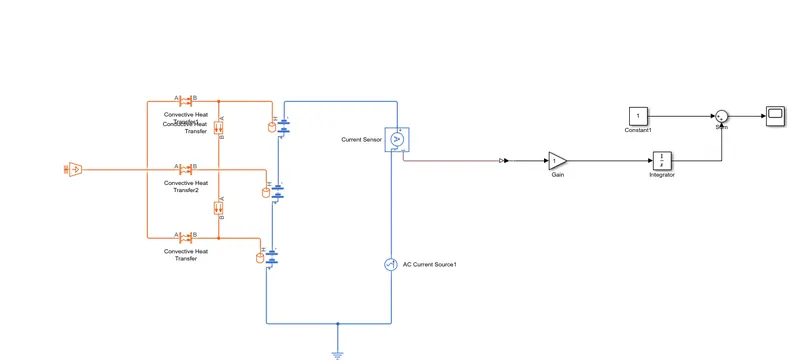
cell construction and working:
cell 01 to 04 subsystem
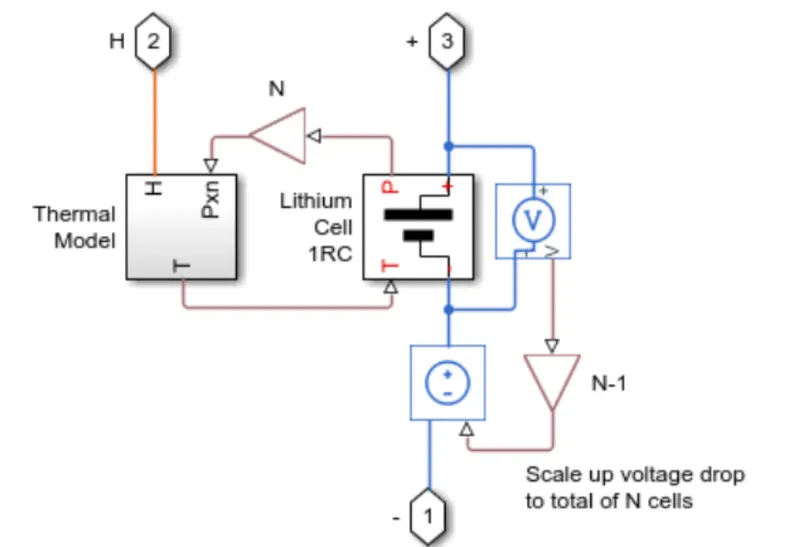
TEMPERATURE SOURCES

The Temperature Source block represents an ideal source of thermal energy that is powerful enough to maintain specified temperature at its outlet regardless of the heat flow consumed by the system.
The source generates constant absolute temperature, defined by the Temperature parameter value.
CONNECTIONS A AND B ARE THERMAL CONSERVING PORTS THAT CONNECT TO THE TWO POINTS WHERE TEMPERATURE ID BEING MONITORED.PORT T IS A PHYSICAL SIGNAL PORT T IS A PHYSICAL SIGNAL PORT THAT OUTPUTS THE TEMPERATURE DIFFERETIAL VALUE.
THE BLOCK POSITIVE DIRECTION IS FROM PORT A AND PORT B.THE MASURED TEMPERATURE IS DETERMINED AS T=Ta-Tb.THIS BLOCK IS USEDE FOR AMBIENT TEMPERATURE EHICH WE CAN SET AND CHECK RESULTS.
CONVECTIVE HEAT TRANSFER
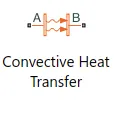
The Convective Heat Transfer block represents a heat transfer by convection between two bodies by means of fluid motion. The transfer is governed by the Newton law of cooling and is described with the following equation:
Q=k·A·(TA−TB)
STATE CHARGE ESTIMATION
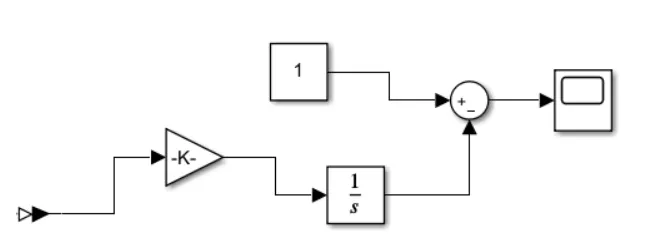
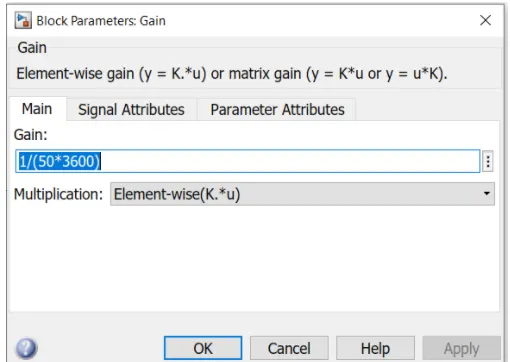
THE COULOMB COUNTING METHOD mesures the discharging current of a battery and integrates the dischrging current over time in order to estimate SOC.
THIS system takes current as input and gives the battery soc%as output.a current sensor block is used and connected for SOC estimation.
results:
results at 300k i.e 26.85c
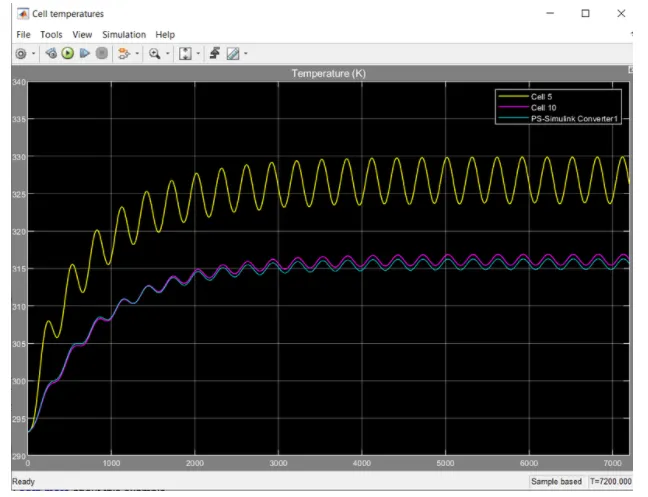
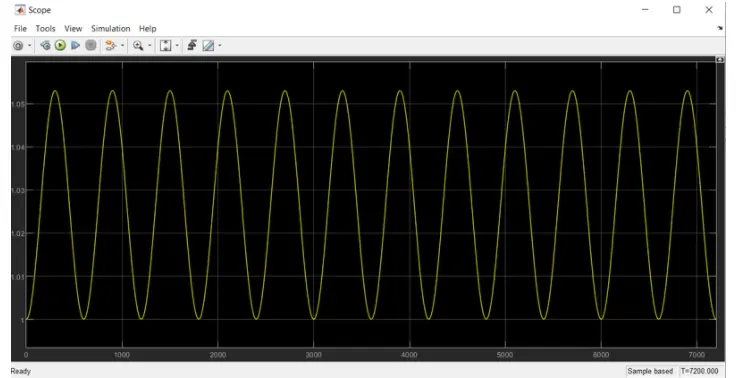
2.results at 30k i.e 36.85c
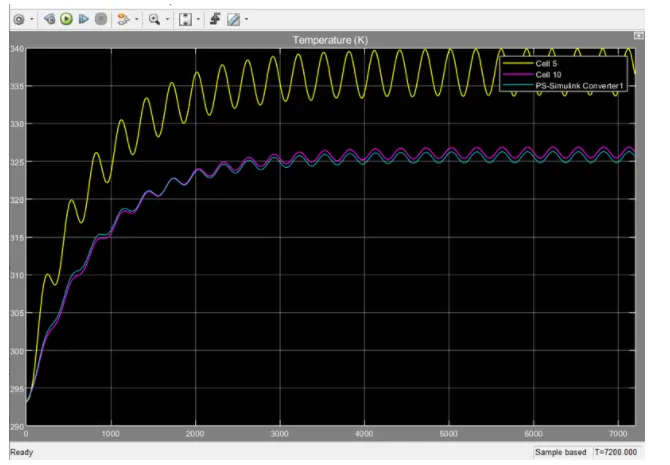
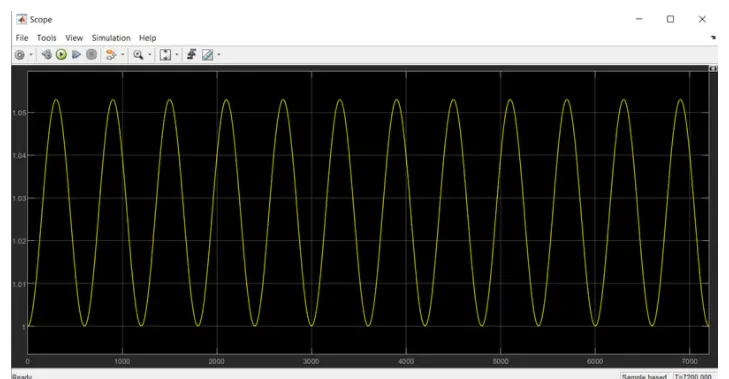
3.result at 324k ie 50.85c
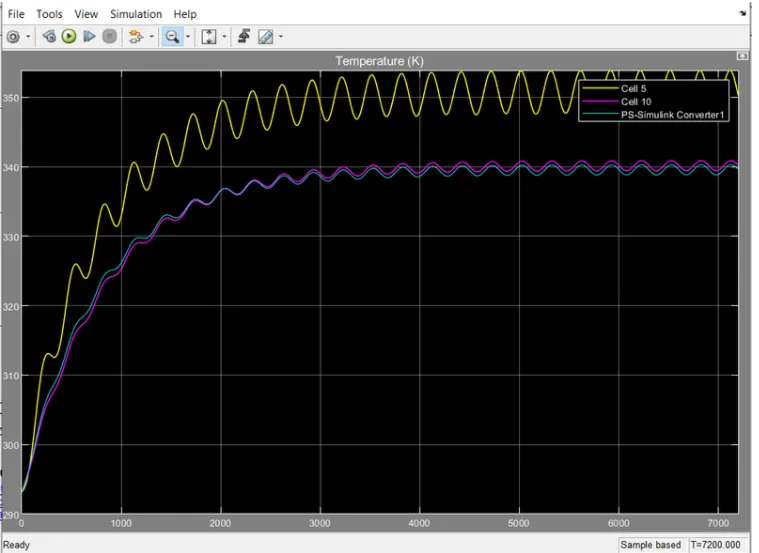
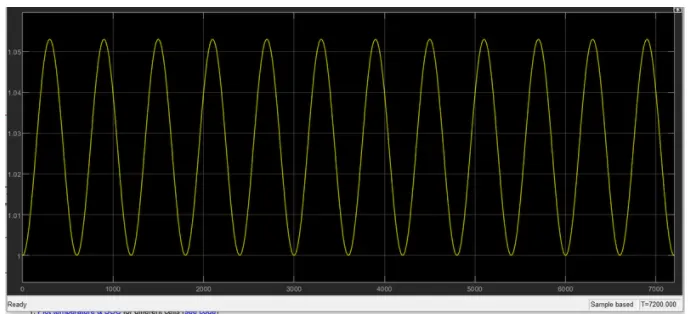
For a 10 cell series lithium ion battery model, simulate the thermal effects and compare life cycle performance at various temperatures, charge & discharge rates using MATLAB. results as follows.
we give temperature of results at 300k ie 26.85c the 1-4 and 6-10 cell temp is near to 316k.but 5th faulty cell temp goes to 300k ie 56.85c and the drive cycl;e is shown ehich is cyuclic charge/discharge drive cycle.in condition two we give temp goes to 330k ie 36.85c and drive cycle is shown which is cyclic charge/discharge drive cycle.
in condiction two we give temp 324k ie 50.85c and 1-4 and 6-10 cell temp is near to 340 k but 5th faulty cell temp goes to 354k ie 80.85c and the drive cycle is showb which is cyclic charge/discharge drive cycle.
CONCLUSION:
WE simulated the thermal effect and compared at various temperature faulty cell temp rise more than normal cell charge and discharge cycle given and due to temp rise it can domage the cell and reduce the performance of the battery.
THE---END