Project 2 Thermal modeling of battery pack
1RC model of Lithium cell
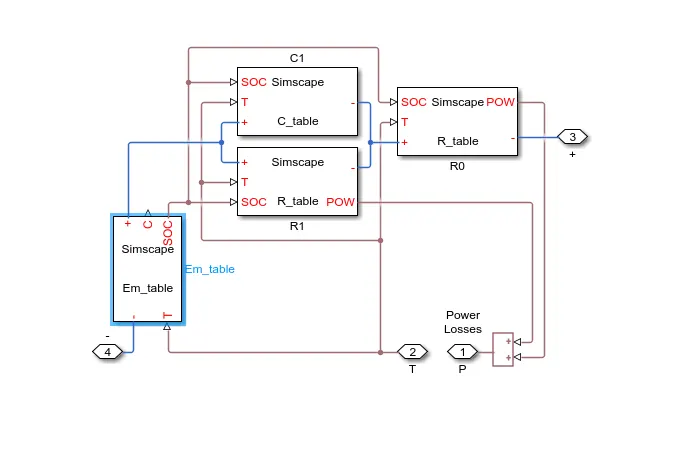
1.when a cell is discharging at constant current and suddenly load is disconnected cell voltage gradually settles down to steady state with some delay.This transient or dynamic behaviour can be approximated by resistor and capacitor combination.
2.Here in 1RC MODEL R1 and C1 represents transient behaviour of cell voltage and R0 represents terminal cell voltage drop when cell loaded.
3.open circuit voltage , R1 , C1 and R0 are functions of SOC and Temperature.
4.power losses will occur due to R1 and R0 and these two losses due to R1 and R0 were added and given to thermal model of cell for calculation of temperature of cell.
Building N series connected lithium ion battery pack using one RC model of cell
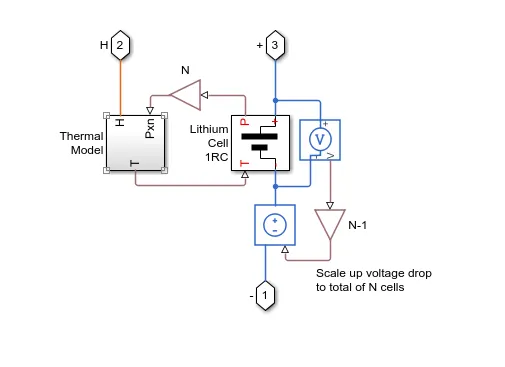
5.The terminal voltage of one cell is sensed and multiplied with N-1 and this resultant voltage is added to 1RC model lithium cell terminal voltage to get total N series connected lithium cells terminal voltage.
Thermal model of N series connected Lithium cells
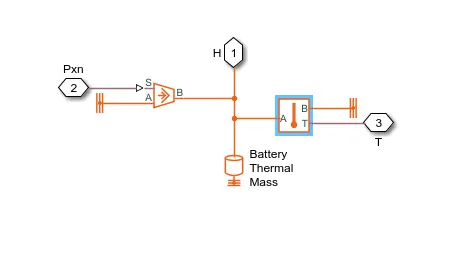
6.Here power loss from one lithium cell is multiplied with N and given to thermal model of N cells which has total N cells mass and heat capacity. in this thermal model temperature of cell is calculated and again feeded back to lithium cell 1RC model for calculation of R1 ,R0,C1 again.
Thermal model of 10 series connected cells without fault and constant 10A current discharge/charge
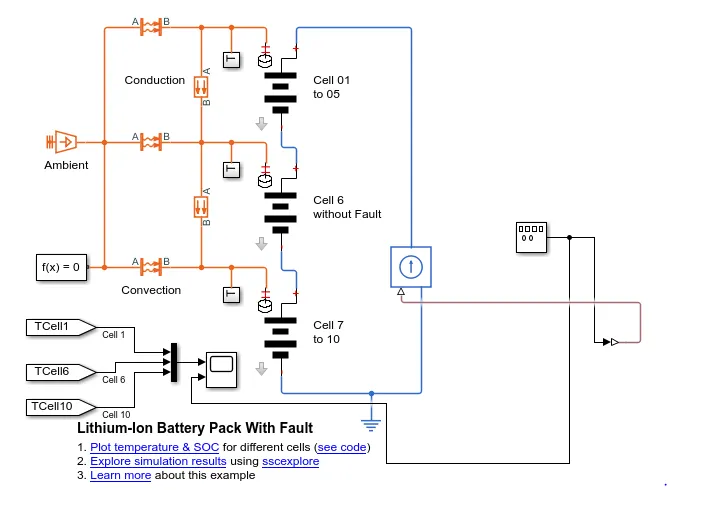
7. Here cell 6 is in middle of the pack.There is conduction heat transfer media between cell 5 and cell6 and also between cell 6 and cell7 with conductive area 1e-3, thickness 0.1 m and thermal conductivity 200 W/(m*K).
8.Ambient temperature is 293 kelvin.there is also heat transfer takes palce between each cell to ambient through convection.
9.the battery pack is discharged and charged by constant current source.first 10A current is discharged for one hour from battery and later battery is charged with 10A for one hour.
10.Tcell1 is average temperature of first 5 cells in series connection.Tcell 6 is temperature of inner cell6.Tcell 10 is average temperature of bottom cells 7 to 10.
cell temperatures after running simulation
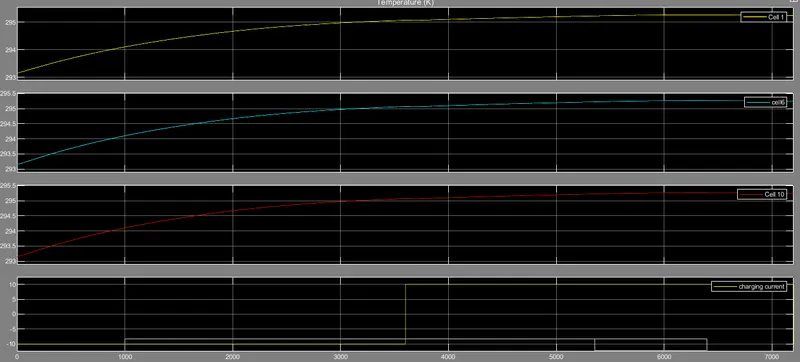
11. cell temperatures are same if there is no fault in the system.
Thermal model with cell 6 faulted
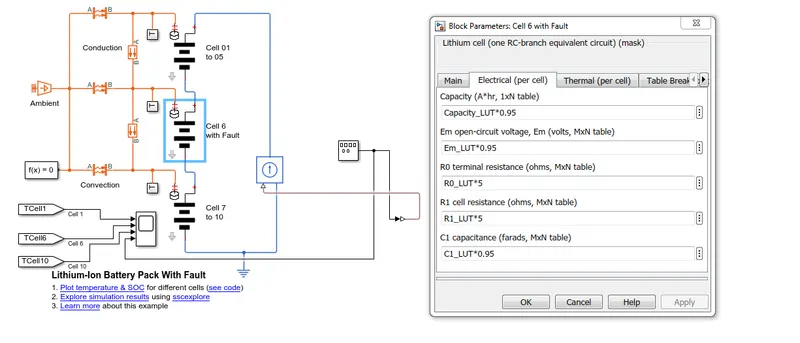
cell temperatures with one cell fault with 10A constant current discharging/charging in 2 hours
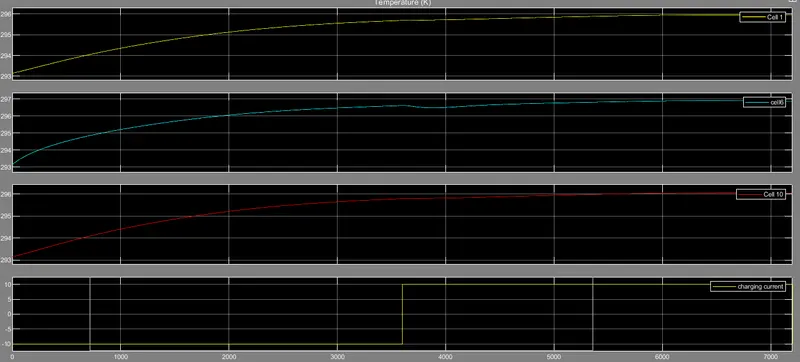
12. with 10A constant current simulation with fault cell the temperature of faulted cell6 is 297 Kelvin which is more than remaining cells temperature ie 296 kelvin from above result.
cell temperatures without any fault with 20A discharge/charge current for 40 hours
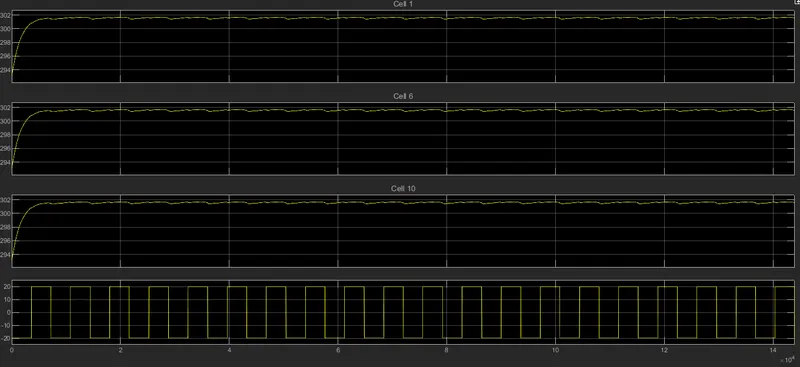
cell temperatures with fault cell with 20A discharge/charge current for 40 hours
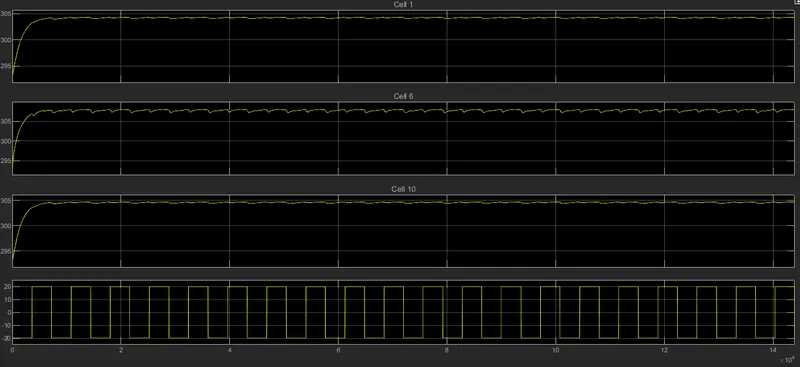
13.with 20A current the cells temperature are same which is 302kelvin when there is no fault in system. but with faulted cell6 in the system the temperature of cell6 is 308 K in study state and temperature of all other cells is 304 k.
13.so with increase in discharge /charge current magnitude from 10A to 20A the temperatures of all cells increases but same from 296k to 302 k when there is no fault in system. but if there is fault in system the temperature of un fault cells increases from 296 k to 304 k and fault cell temperature increases from 296k to 308k.
14.with 10A current the temperature difference between faulted cell and unfault cell is 297-296 =1k.
15. with 20A current the temperature difference between faulted cell and unfault cell is 308-304=4k.
16.from above results we say that if any cell temperature is more than other cells in the system and also if temperature difference between this cell and other cells increases as magnitude of discharge current increases then the cell is faulted.