Rankine cycle Simulator
Aim :
To create a Rankine cycle simulator and code the program which can solve the state points of the Rankine cycle.
Objective :
- Create a Rankine cycle simulator.
- Plot T vs S and H vs S for a given set of points.
Theory :
The Rankine cycle is an idealized thermodynamic cycle describing the process by which certain heat engines, such as steam turbines or reciprocating steam engines, allow mechanical work to be extracted from a fluid as it moves between a heat source and heat sink Heat energy is supplied to the system via a boiler where the working fluid (typically water) is converted to a high-pressure gaseous state (steam) in order to turn a turbine. After passing over the turbine the fluid is allowed to condense back into a liquid state as waste heat energy is rejected before being returned to the boiler, completing the cycle. Friction losses throughout the system are often neglected for the purpose of simplifying calculations as such losses are usually much less significant than thermodynamic losses, especially in larger systems.
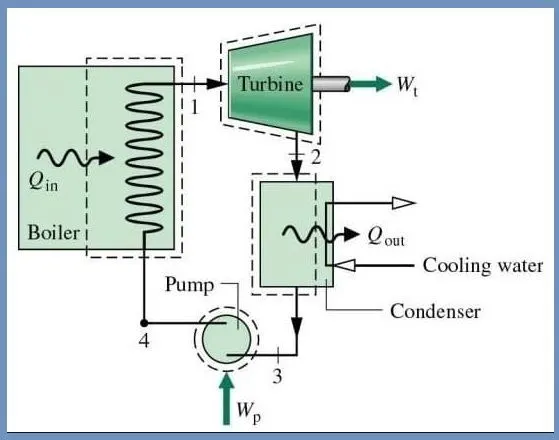
There are four processes in the Rankine cycle. The states are identified by numbers in the T-S diagram.
- Process 1-2 : The working fluid is pumped from low to high pressure. As the fluid is a liquid at this stage, the pump requires little input energy.In other words, Process 1-2 is [isentropic compression].
-
Process 2-3 : The high-pressure liquid enters a boiler, where it is heated at constant pressure by an external heat source to become a dry saturated vapour. The input energy required can be easily calculated graphically, using steam tables.In other words, Process 2-3 is [Constant pressure heat addition in boiler].
- Process 3-4 : The dry saturated vapour expands through a turbine, generating power. This decreases the temperature and pressure of the vapour,and some condensation may occur.The output in this is process can be easily calculated using the chart or tables noted above.In other words,Process 3-4 is [Isentropic expansion].
- Process 4-1 : The wet vapour then enters a condenser, where it is condensed at a constant pressure to become a saturated liquid.In other words,Process 4-1 is [Constant pressure heat rejection in condenser].
Entropy :
Entropy, the measure of a system's thermal energy per unit temperature that is unavailable for doing useful work. Because work is obtained from ordered molecular motion, the amount of entropy is also a measure of the molecular disorder, or randomness of a system.
Enthalpy :
Enthalpy is a property of a thermodynamic system, defined as the sum of the system's internal energy and the product of its pressure and volume, H=U+PV. It is a convenient state function standardly used in many measurements in chemical, biological and physical systems at a constant pressure.
Equations :
Governing Equation :
1) Turbine Work(`W_T`) :
`W_T=H_1-H_2`
2)Pump Work(`W_P`) :
`W_P=H_4-H_3`
3)Net Work :
`W_(NET)=W_T-W_P`
4)Thermal Efficiency (`eta`) :
`eta=W_(NET)/(H_1-H_4)`
5)Back Work Ratio(BWR) :
`BWR=W_P/W_T`
6)Specific Steam Conductivity(S.S.C) :
`S.S.C=3600/W_T`
Where,
`H_1,H_2,H_3,H_4` are the enthalpies at the respective state points.
MATLAB Code :
Explanation :
1. Initially, we display the different processes from 1-4 by using the 'disp' command.
2. After that, we assign the values to input parameters like P1,T1 and P2.
3. Then we calculate the value of pressure,temperature,enthalpy, and entropy at different state points by using the 'XSteam library'.
4. Then we find the values of Turbine work,Pump work,Net work,Thermal Efficiency,Back Work Ratio and Specific Steam Conductivity by using their suitable formulas.
5. We print the values of all the quantities that we have found in the earlier steps by using the 'fprintf' command.
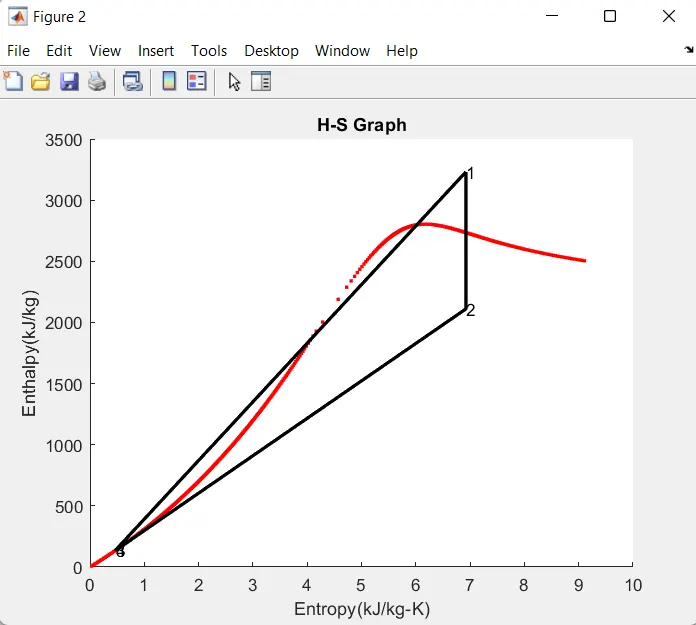
6. At last, we plot the curve of T-S and H-S for the Rankine Cycle.
Output :
The below figure shows the output we get in the command window :-
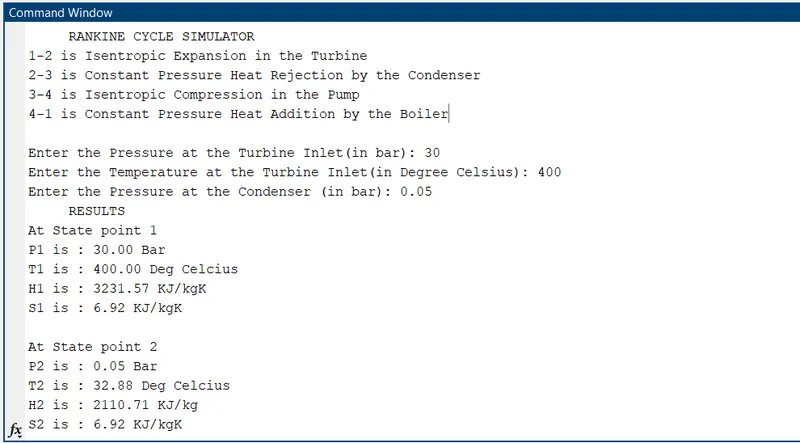
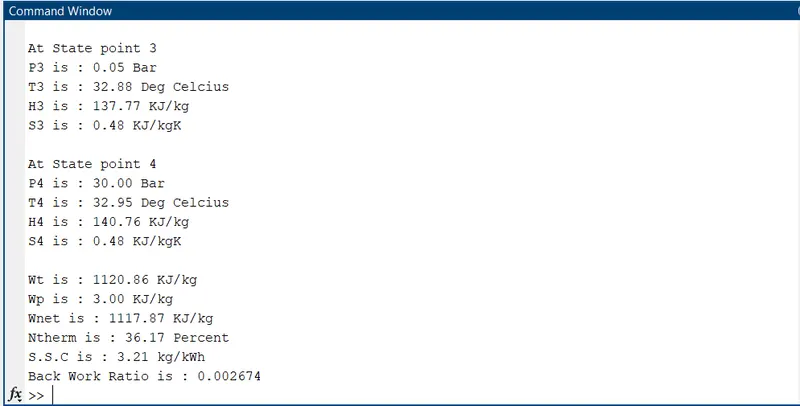
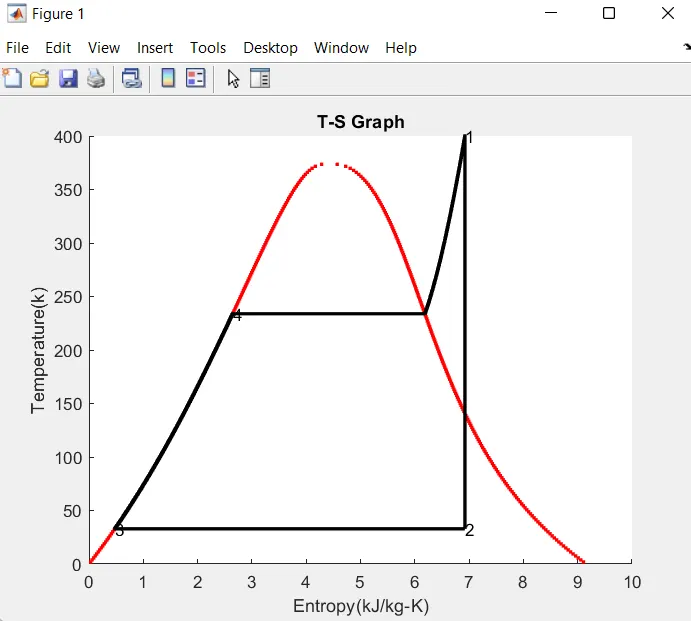
The below curve shows the T-S Graph of the Rankine Cycle :-
The below curve shows the H-S Graph of the Rankine Cycle :-
Conclusion :
Thus we have obtained the values of P,T,H and S for different state points and also the Work,Efficiency,Back work ratio and Specific steam conductivity was calculated.Also the plots of T-S and H-S of Rankine Cycle was drawn.