Project 2 - Measuring the distance of an object using ultrasonic sensor and also smoothen the sensor data using moving average filter
Objectives:
- To Measure the distance in terms of inches of an object using Ultrasonic Distance Sensor (28015 Ping).
- The sensor data is smoothened by using Moving average filter technique to eliminate the high frequency variations from the sensor data.
Normally an analogue sensor sends a voltage level, usually between 0 and 5V, representing a physical value. This voltage can be subject to measurement noise (electronic interference, electromagnetic interference, measurement accuracy, etc.). In some applications, We will need a fairly stable value to make our calculations or to detect the events we are interested in. A simple method to set up is the sliding average method which allows modifying the value read according to the measurement history.
Ultrasonic Distance Sensor (28015)
The Parallax PING))) ultrasonic distance sensor provides precise, non-contact distance measurements from about 2 cm (0.8 inches) to 3 meters (3.3 yards). It is very easy to connect to microcontrollers such as the BASIC Stamp, Propeller chip, or Arduino, requiring only one I/O pin. The PING))) sensor works by transmitting an ultrasonic (well above human hearing range) burst and providing an output pulse that corresponds to the time required for the burst echo to return to the sensor. By measuring the echo pulse width, the distance to target can easily be calculated.
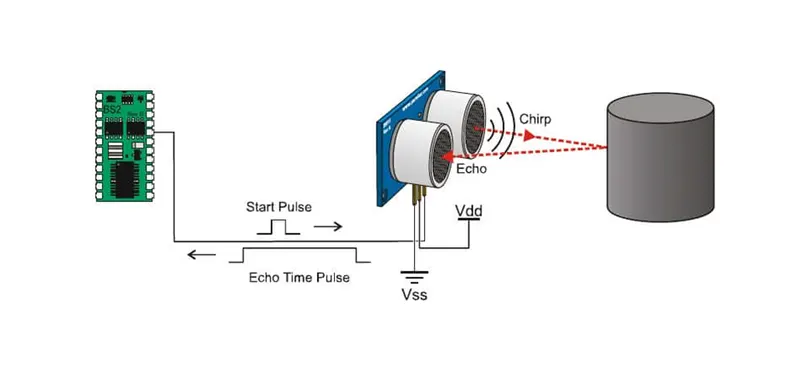
Features of PING)))28015:
- Range: 2 cm to 3 m (0.8 in to 3.3 yd)
- Burst indicator LED shows sensor activity
- Bidirectional TTL pulse interface on a single I/O pin can communicate with 5 V TTL or 3.3 V CMOS microcontrollers
- Input trigger: positive TTL pulse, 2 µs min, 5 µs typ.
- Echo pulse: positive TTL pulse, 115 µs minimum to 18.5 ms maximum.
- RoHS Compliant.
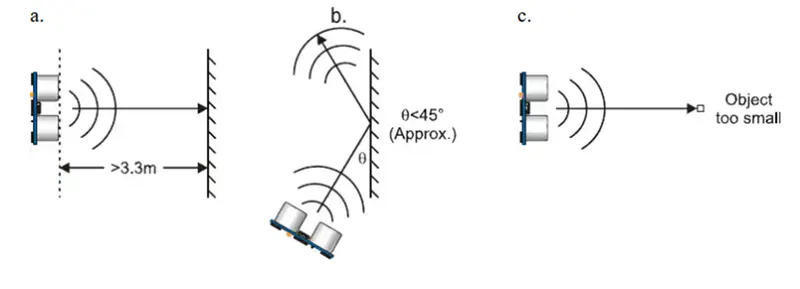
Practical Considerations for Use Object Positioning The PING))) sensor cannot accurately measure the distance to an object that: a) is more than 3 meters away, b) that has its reflective surface at a shallow angle so that sound will not be reflected back towards the sensor, or c) is too small to reflect enough sound back to the sensor. In addition, if your PING))) sensor is mounted low on your device, you may detect sound reflecting off of the floor.
Communication Protocol:
The PING))) sensor detects objects by emitting a short ultrasonic burst and then "listening" for the echo. Under control of a host microcontroller (trigger pulse), the sensor emits a short 40 kHz (ultrasonic) burst. This burst travels through the air, hits an object and then bounces back to the sensor. The PING))) sensor provides an output pulse to the host that will terminate when the echo is detected, hence the width of this pulse corresponds to the distance to the target.
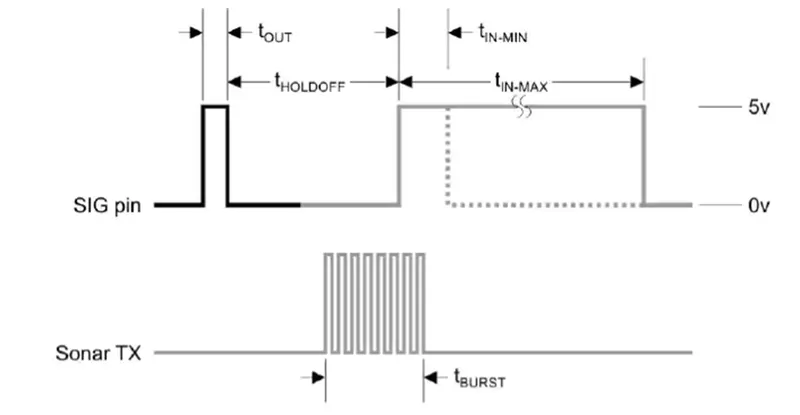
|
Host Device |
Input Trigger Pulse |
tOUT |
2 µs (min), 5 µs typical |
|
|
PING))) Sensor |
Echo Holdoff |
tHOLDOFF |
750 µs |
|
|
Burst Frequency |
tBURST |
200 µs @ 40 kHz |
||
|
Echo Return Pulse Minimum |
tIN-MIN |
115 µs |
||
|
Echo Return Pulse Maximum |
tIN-MAX |
18.5 ms |
||
|
Delay before next measurement |
200 µs |
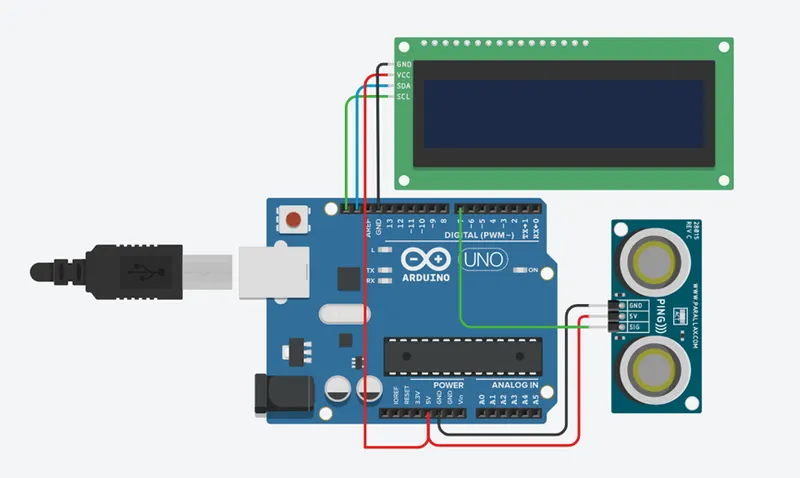
Schematic :
An analogue input is preferably connected to an analogue pin on the microcontroller. There is no additional connection required to operate the sliding average. It is a purely algorithmic solution. For more controlled results, it is possible to put electronic filters on your measurement circuit.
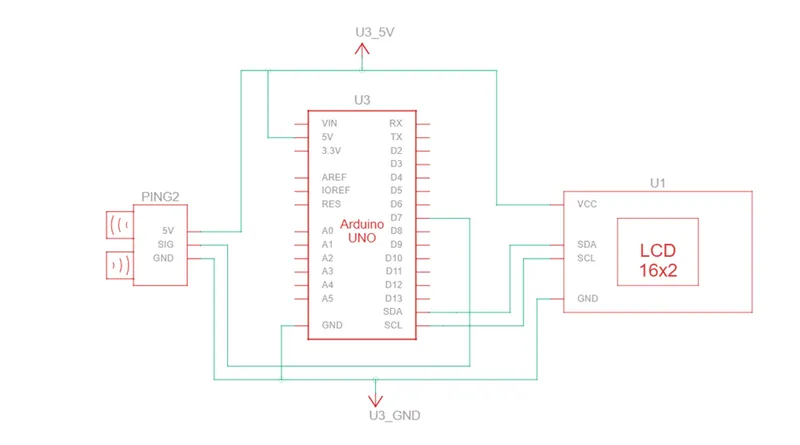
Moving average filter technique
The principle of moving average is to record a certain number of measurements in an array and then average these values at each reading.
There are several shortcomings to this:
The array takes a while to fill in, therefore, a delay in establishing the average. Please take this into account when starting the microcontroller. The variation of the measurement will be slower, so it will be impossible to detect “fast” phenomena. Check carefully the behaviour of what you want to measure. The array takes up more memory space and requires more management time.
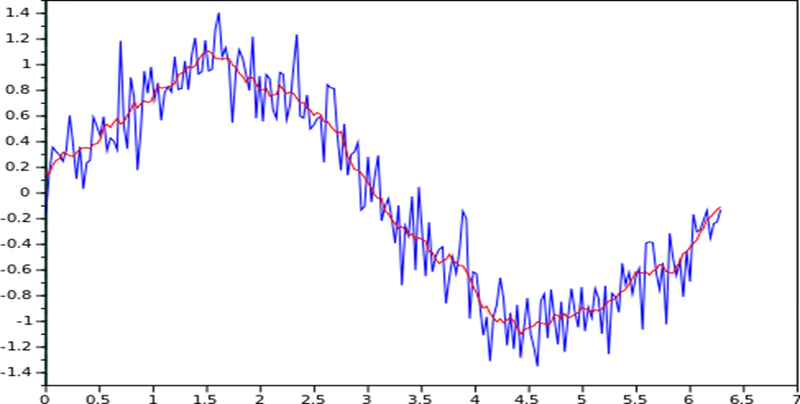
The above sample fig shows the different between Actual (Blue) reading and Averaged readings(Red).
The Code:
// Project-2 "Find the Distance of an object"
#include <Adafruit_LiquidCrystal.h> //I2C LCD header file
#include <Wire.h> //I2C communication header file
Adafruit_LiquidCrystal lcd(0); //Initialze LCD
int inches = 0; //Variable initialization for Inches
int cm = 0; // Variable initialization for CM
const int echoPin = 7; //set Signal Pin 7, both trigger and echo are same pin
// Ultrasonic sensor reading function declaration for 28015
long readUltrasonicDistance(int triggerPin, int echoPin)
{
pinMode(triggerPin, OUTPUT); // Enable the trigger as output
digitalWrite(triggerPin, LOW); // To stop the trigger
delayMicroseconds(2); // For clear the trigger
digitalWrite(triggerPin, HIGH); // Start sending wave
delayMicroseconds(10); // For 10 Micro seconds
digitalWrite(triggerPin, LOW); // Stop wave
pinMode(echoPin, INPUT); // Eco pin get back the wave
// Reads the echo pin,and send the sound wave travel time
return pulseIn(echoPin, HIGH); // Eco pin getting high
}
void setup()
{
Serial.begin(9600); // Start serial communication
lcd.begin(16,2); // Start 16x2 LCD
Wire.begin(9); // Start I2C Communication
}
void loop()
{
smooth(); //smooth function calling
cm = 0.01723 * readUltrasonicDistance(7, 7);// measure the ping time
inches = (cm / 2.54); // convert to inches by dividing by 2.54
lcd.setCursor(0,0); // LCD cursor set
lcd.print("The distance is "); //LCD print the string
lcd.setCursor(0,1);
lcd.print(inches); //LCD Print distance value in inches
lcd.print(" INC, ");
lcd.setCursor(8,1);
lcd.print(cm); //LCD Print distance value in cm
lcd.print(" CM, ");
Serial.print(inches); //Serial monitor Print distance value in inches
Serial.print("INC, ");
Serial.print(cm); //Serial monitor Print distance value in cm
Serial.println("CM");
delay(100); // Delay for 100 millisecond(s)
}
long smooth() // Moving average function
{
long average=0;
const int numReadings = 10;//Declare the average range
int readings [numReadings]; //Sample readings stored in a array
int readIndex = 0;
int total = total - readings[readIndex]; // subtract the last reading
readings[readIndex] = analogRead(echoPin); // read the sensor
total = total + readings[readIndex]; // add value to total
readIndex = readIndex + 1; //increase the sampling count
if (readIndex >= numReadings)
{
readIndex = 0;
}
average = total / numReadings; // calculate the average
return average; //return the average
}
The output:
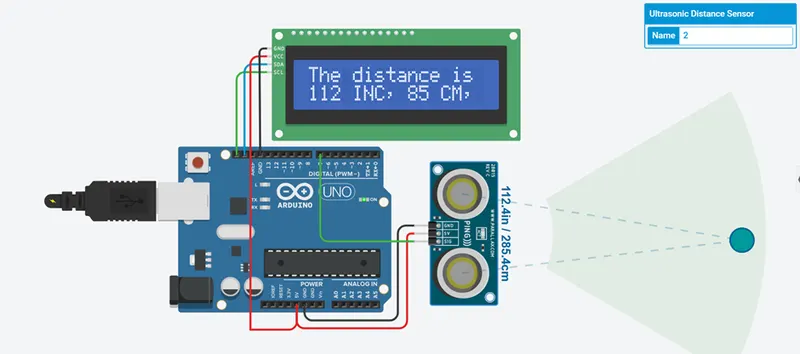
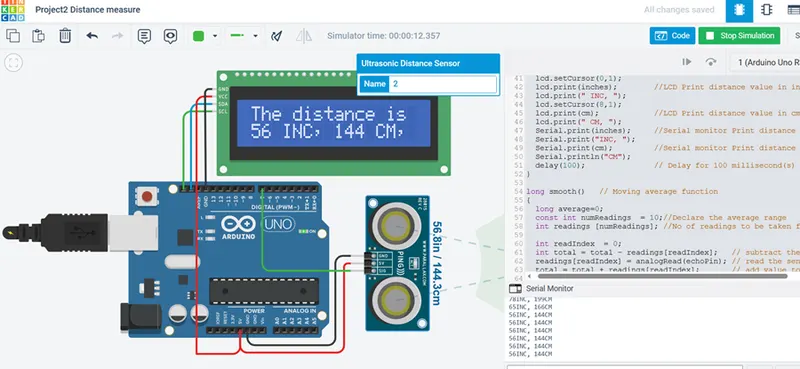
Conclusion:
Distance measure by using ARDUINO with 28015 PING))) Ultrasonic sensor and smoothen the sensor output by using the Moving Average Filter method was done.