Project
Aim:
To carry out a system level simulation of All Terrain vehicle. Download the model from MATLAB source and learn the BAJA ATV behavers by simulation and explain the same.
ATV(All Terrain Vehicle)
Baja ATV is an Collegiate Design Series competition run by the Society of Automotive Engineers International (SAE International). Teams of students from universities all over the world design and build small off-road cars.
The cars all have engines of the same specifications. As of 2018 the engine has been an unmodified Briggs & Stratton Model 19 Vanguard engine single-cylinder with a displacement of 305cc and power output of approximately 10 bhp (7.5 kW).
The goal in Baja ATV racing is to design, build and race off-road vehicles that can withstand the harshest elements of rough terrain. The vehicles used in Baja SAE racing are often similar in appearance to dune buggies, the Fig.1 shows the ATV.
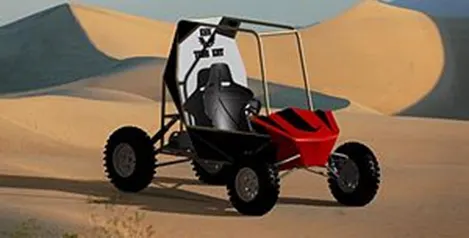
Fig.1
History of BAJA ATV:
Origins:
The Baja ATV(SAE) Competition originated at the University of South Carolina in 1976, under the supervision of Dr. Harit Mehta. Only 10 teams took part in the very first race. Since that time, the competition has grown to become a premier engineering design series with over 110 university teams participating in each race.
Baja SAE is an intercollegiate engineering design competition for undergraduate and graduate engineering students. The object of the competition is to simulate real-world engineering design projects and their related challenges. Each team is competing to have its design accepted for manufacture by a fictitious firm. The students must function as a team to design, build, test, promote and compete a vehicle within the limits of the rules, also to generate financial support for their project and manage their educational priorities.
Each team's goal is to design and build a prototype of a rugged, single seat, off-road recreational vehicle intended for sale to the non-professional weekend off-road enthusiast. The vehicle must be safe, easily transported, easily maintained and fun to drive. It should be able to negotiate rough terrain without damage. As of 2010, the SAE Baja Series consisted of three competitions, though in the past there have been as many as seven sanctioned events. A Baja SAE competition event consists of three to four days.
The Simulink Model #1
The fig.2 Shows the ATV Simscape model with the Simple gear rato is 1:10, the following Blocks used for buld the ATV simulation
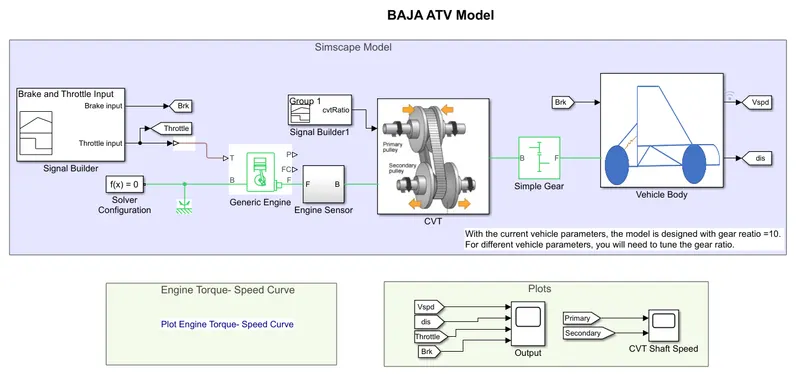
Fig.2
1.Signal Buileder- Used for create input signals like, Throttle, Brake and CVT ratio.
2.Generic Engine- Used as a IC Engine to produce Torque and Aceleration properties.
Represents a system-level model of spark-ignition and diesel engines suitable for use at initial stages of modeling when only the basic parameters are available. Optional idle speed and red line controllers are included.
The throttle input signal T lies between zero and one and specifies the torque demanded from the engine as a fraction of the maximum possible torque. If the engine speed falls below the Stall speed, the engine torque is blended to zero. If the engine speed exceeds the Maximum speed, the simulation stops and issues an error message.
Connections F and B are mechanical rotational conserving ports associated with the engine crankshaft and engine block, respectively. Connections P and FC are physical signal output ports through which engine power and fuel consumption rate are reported.
3.CVT-Continuous Variable Transmission - It is like a gear box, we can change the speed and torque from the engine.
Fig.3 shows the internal construction of the CVT, variable gear ratio and CVT primary and Secondary Speed sensors attached for measuring purpose
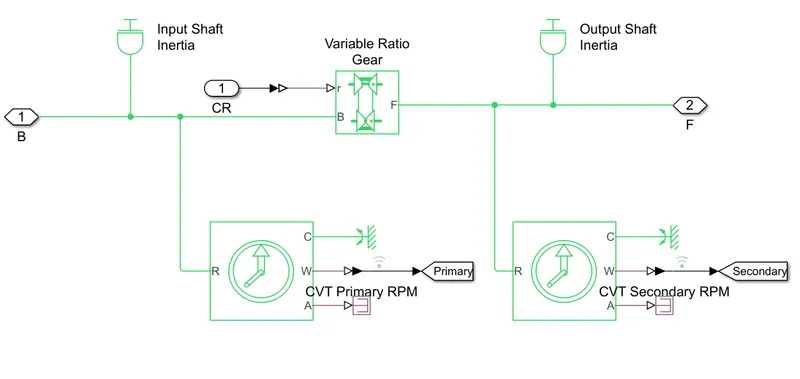
Fig.3
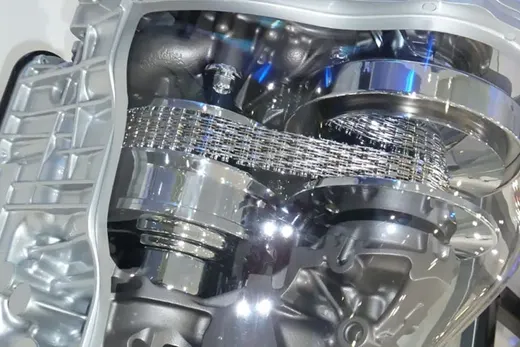
Fig.4
4.Variable Ratio Gear
Represents a variable ratio gearbox such as implemented by mechanical belt CVT, electric, or hydraulic transmissions. The physical signal input r defines the ratio of input to output angular shaft velocities.
Connections B (base) and F (follower) are mechanical rotational conserving ports. Specify the relation between base and follower rotation directions with the Output shaft rotates parameter.
In this system, since the Drive-shaft plays a dual role of power transmission and handling the forces due to road irregularities, it has to be designed to handle the compressive load from the wheel axle and also torsional stresses due to engine torque.
5.Vehicle Body
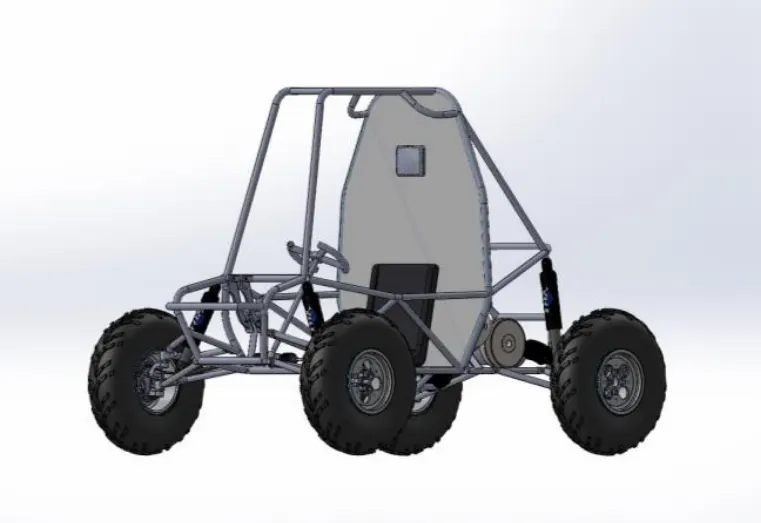
Fig.5
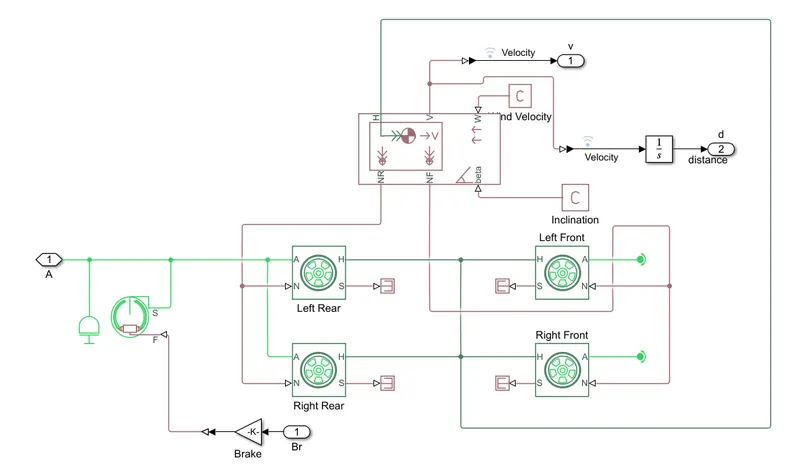
Fig.6
As show in the Fig.5 the ATV body structure is constructed to ensure the safety of driver as well as the engine also, in the Simulink model engine body has the variable parameters like Wind velocity, inclination, Break input and Front back Tyres, Double shoe break, as show in the Fig.6
Represents a two-axle vehicle body in longitudinal motion. The block accounts for body mass, aerodynamic drag, road incline, and weight distribution between axles due to acceleration and road profile. The vehicle can have the same or a different number of wheels on each axle. Optionally include pitch and suspension dynamics or additional variable mass and inertia. The vehicle does not move vertically relative to the ground.
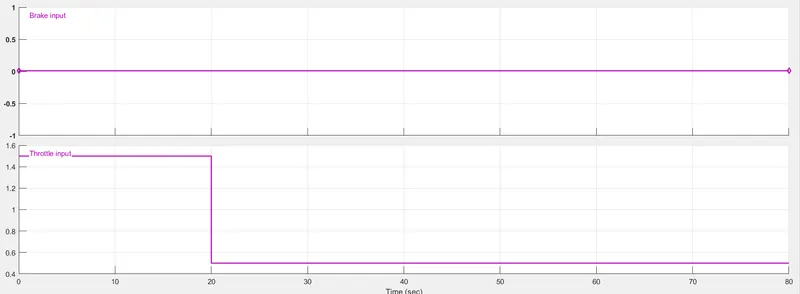
Signal Builder Input
 .
.
Fig-7
Fig-8
Output of ATV
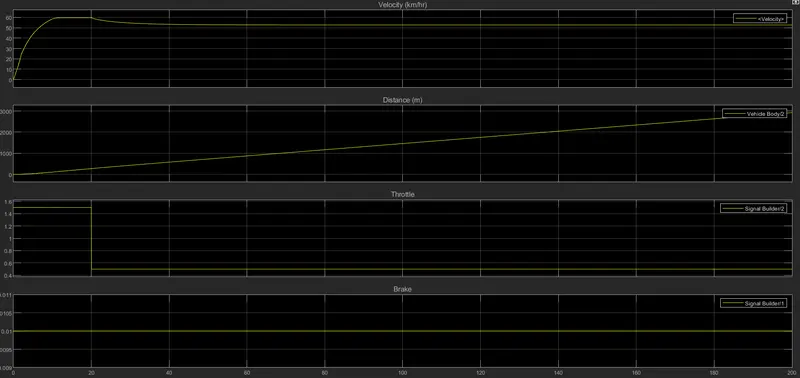
Fig.9
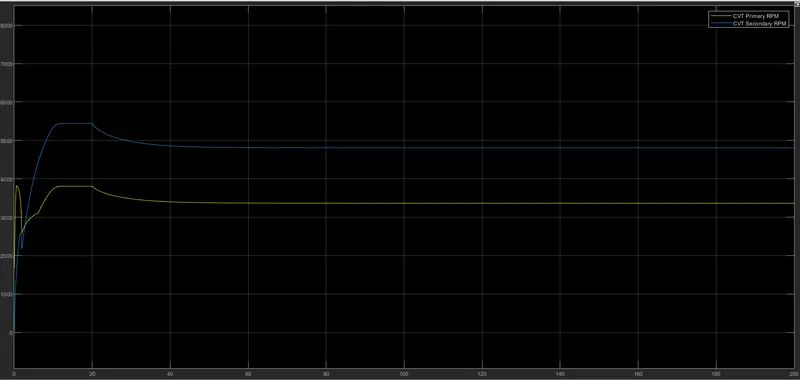
Fig-10
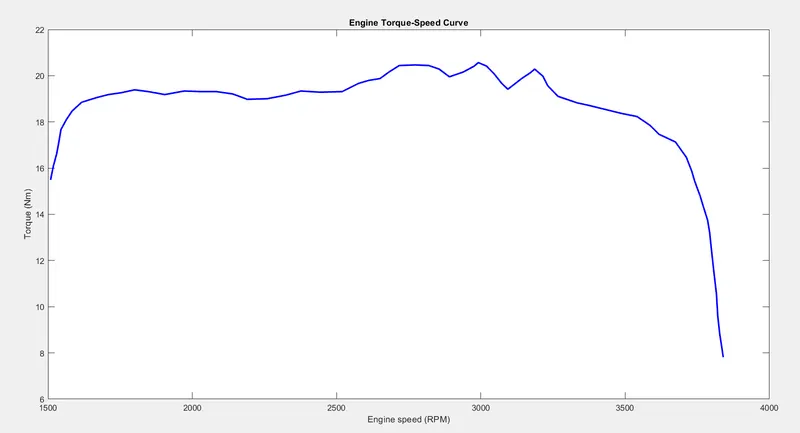
Fig:11
The Simulink Model #2 (Dashboard)
This Model contain the dashboard that shows the Engine RPM and Velocity meaters with variable Break and Throttle input as shown in the Fig.12
In tis model the signal generator for break and throttle was replaced with veriable knob settings as the break input is 0 to 0.5 and the Throttle input is 0.3 to 1.
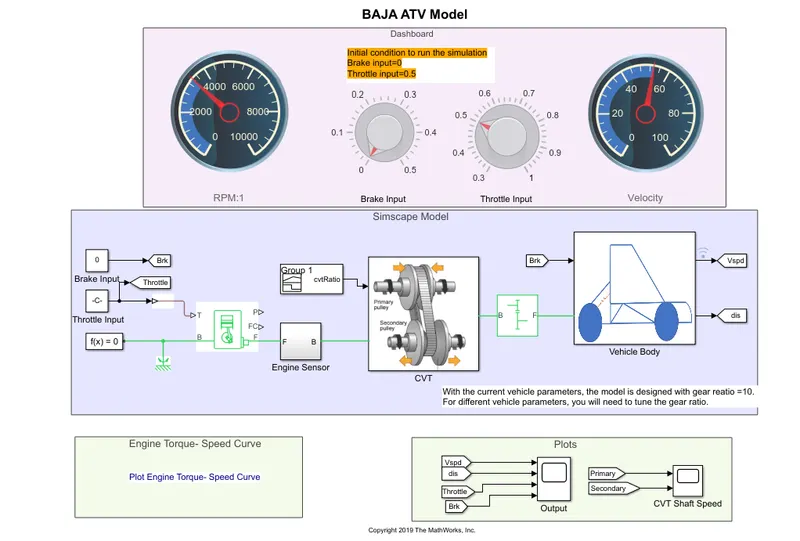
Fig.12
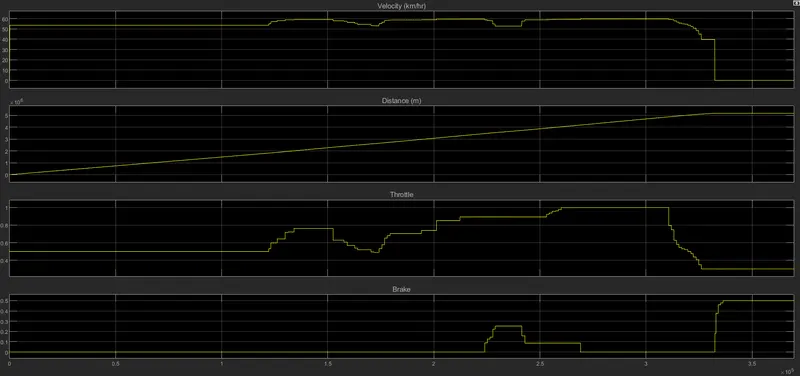
Fig.13
Fig13 shows the output characteristics of Dashboard Model, initially the throttle level is 0.5 break input is zero the vehicle is move from zero and gradually rice the motion and we Varey the throttle as per the input the velocity of the vehicle changed, when the break input applied the engine velocity is reduced,
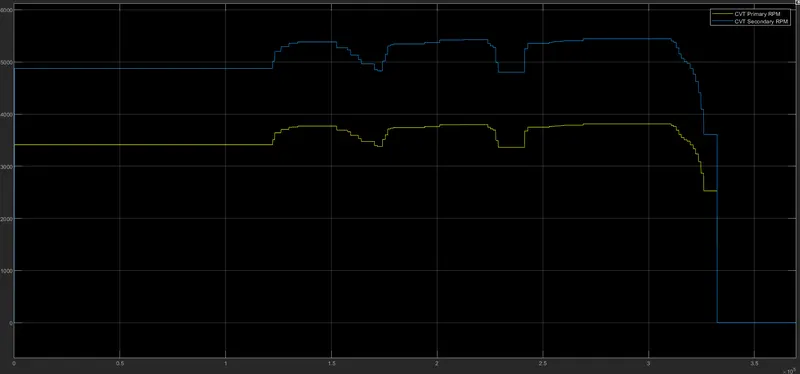
Fig.14
Fig14 Shows the CVT primary and CVT secondary characteristic’s whenever the throttle input was changed the CVT primary and the CVT secondary speed are varied simultaneously and the torque is not changed.
The Simulink Model #3 (Lookup Table)
This Model shows the CVT input is given throught a Lookup Table and the brake and throttle input was created by a signal generator block, all other blocks remains same as our first model shows on Fig.15.
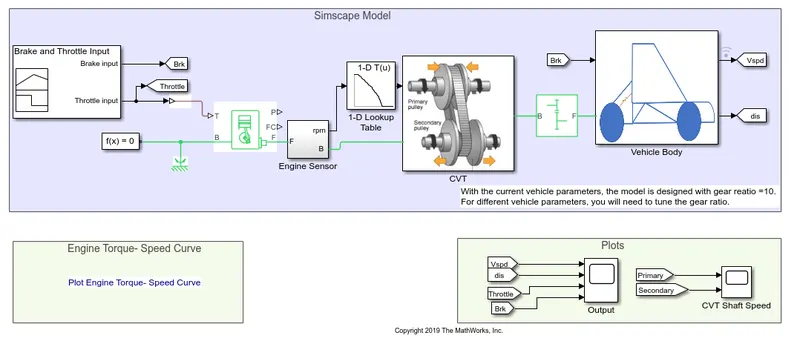
Fig.15
Table 1. Lookup Table Data Types
| Data Type | Value |
|---|---|
| Table data type | double |
| Intermediate results data type | double |
| Output data type | double |
| Fraction data type | double |
| Breakpoints data type for dimension 1 | double |
Note:
- The reported lookup table values result from evaluating the expression 'cvtr' during report generation. The values during simulation may differ from the reported values.
- The reported 'BreakPoint1' result from evaluating the expression 'speedV' during report generation. The values during simulation may differ from the reported values.
- Fig.16 Show the Lookup Table values
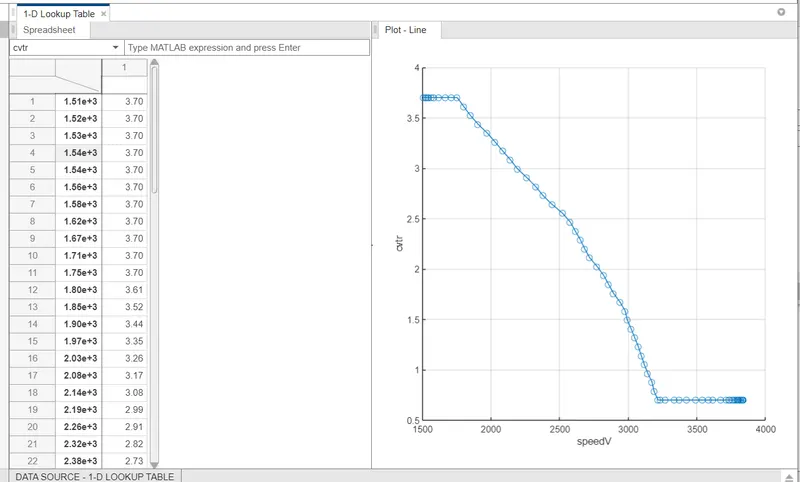
Fig.16
Fig.17 shows the signal builder inputs for throttle and brake for the simulation.
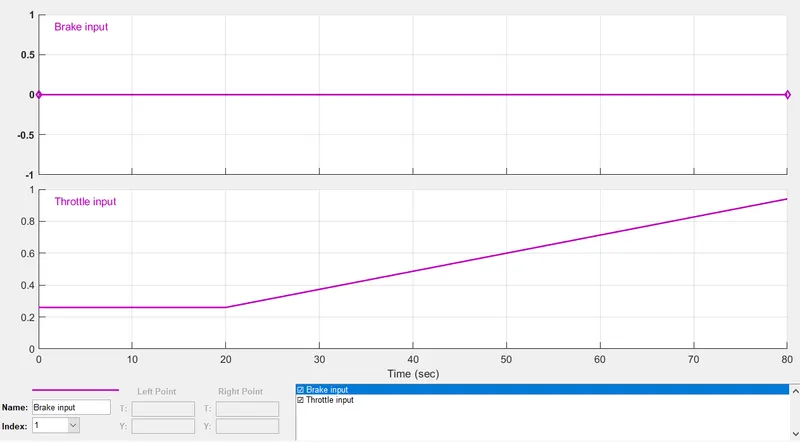
Fig.17
Fig.18 Shows the Output characteristic of the simulation, related to Velocity, Distance, Throttle and Brake as per the input shown in Fig17.
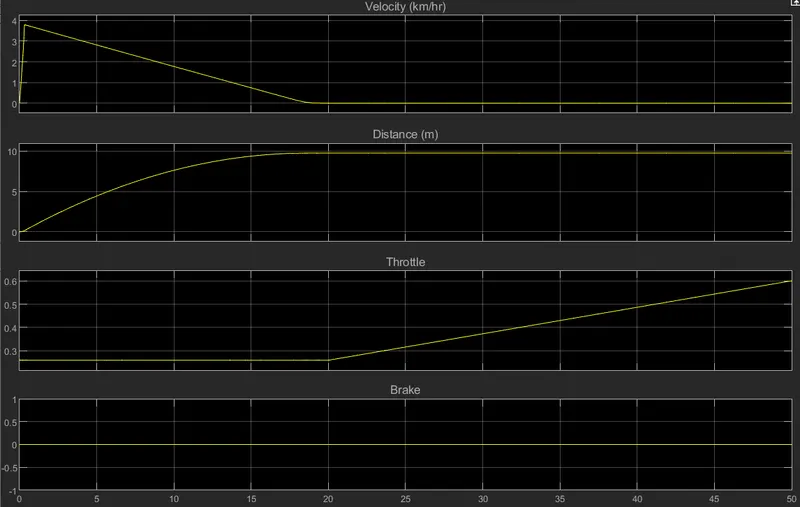
Fig.18
Fig.19 shows the CVT Primary and Secondary RPM relation
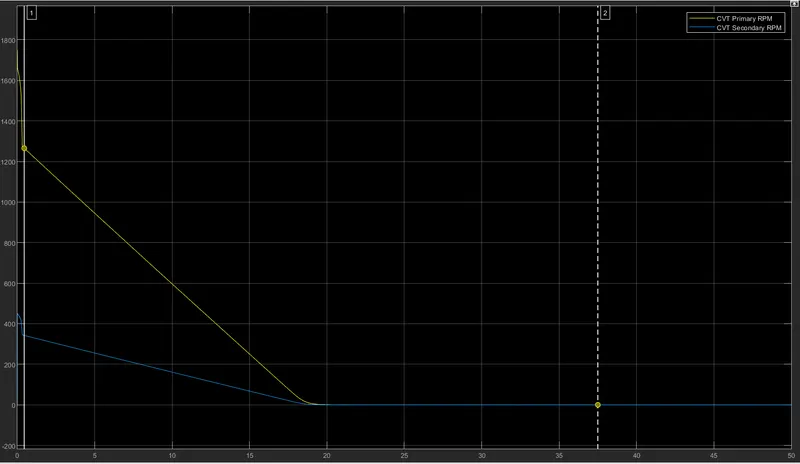
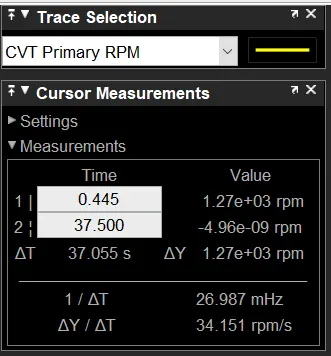
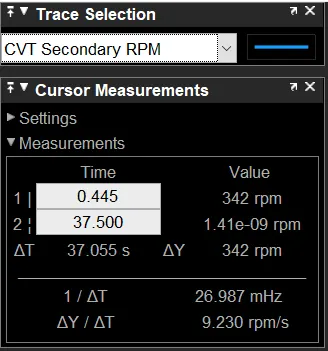
Fig.19
The Simulink Model #4 (Lookup table with Dashboard mapped)
This model is mapped with Lookup table and Dashboard that was shows the graphical vehicle model, the primary speed of the CVT is get from the feedback of vehicle velocity output as input.
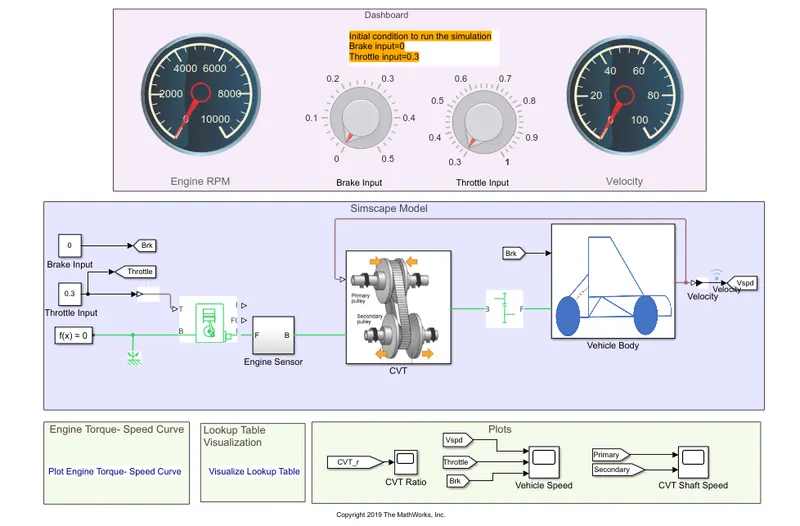
Fig.20
Fig.21 shows the Lookup table visualization between vehicle speed and CVT ratio.
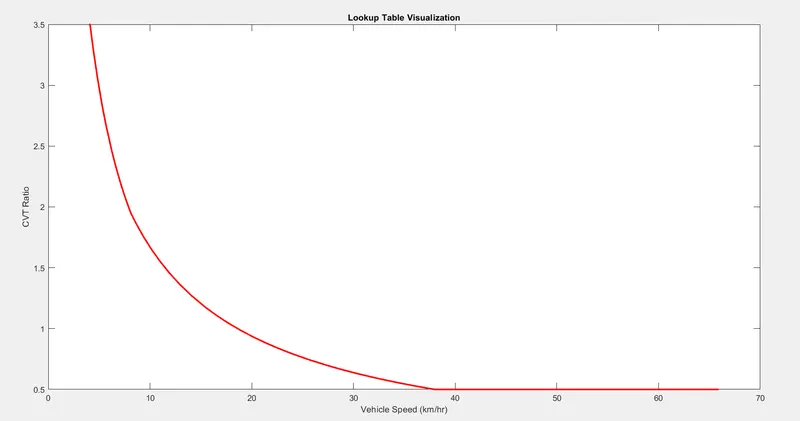
Fig.21
Fig.22 shows the CVT ratio plot.
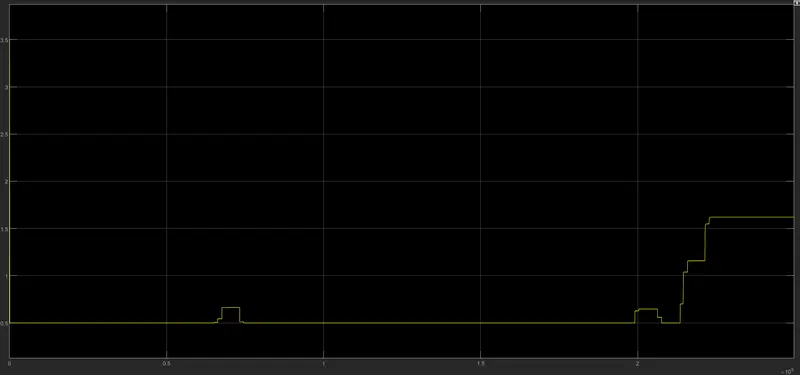
Fig.22
Fig23 shows Speed VS Throtle and Breake input.
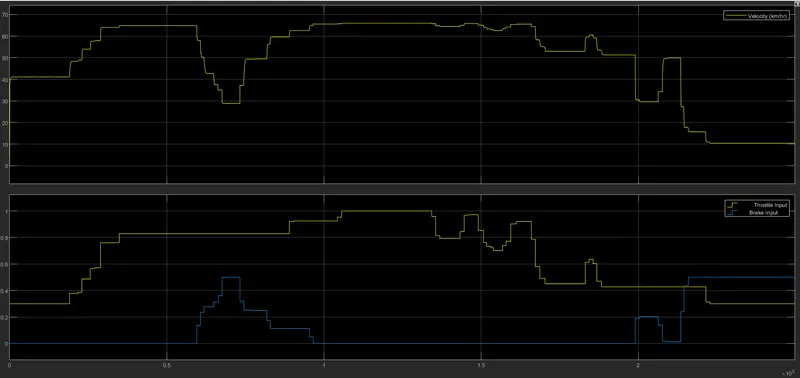
Fig.23
Fig24 shows the CVT primery and Secondry RPM Changes as per the input.
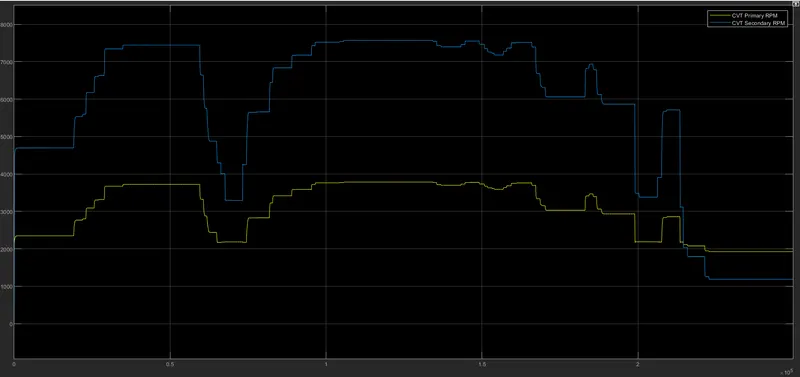
Fig.24
Conclusions:
These models show how to build an ATV with CVT which is mostly used in BAJA competitions. Simscape and Simscape Driveline have been used to complete the system. The engine data used in the model is provided as an image which shows the Engine Speed (RPM) Vs Torque curve.
The below models downloaded and studied.
cvtModel
Contains Simscape model of BAJA ATV with Continuous Variable Transmission.
cvtModel_dashboard
The model is similar to, "cvtModel" with addition of dashboards.
cvtModel_cvtratio_rpm
Contains model based on cvt ratio and engine rpm lookup table.
cvtModel_mapped
Contains Simscape model of BAJA ATV with Continuous Variable Transmission where the CVT ratio varies based on 1D lookup table.
cvtModel_dashboard_mapped
The model is similar to, "cvtModel_mapped" with addition of dashboards.
cvtModel_data
The model is used to log the CVT ratio and vehicle speed for the look table visualization
lookuptable_visualization
Script to load and run the model, "cvtModel_data".
The Baja ATV Model were downloaded and the Behavers analysed by various types of the inputs and Outputs.
________________________________ Thank you __________________________________