Project 2 - Measuring distance of an object using ultrasonic sensor (HC-SR04)
Project #2
Aim
To write a C program to Measuring the distance of an object using Ultrasonic Distance Sensor (HC-SR04) by using of Input Capture Mode in the Microcontroller timer1.
Program :
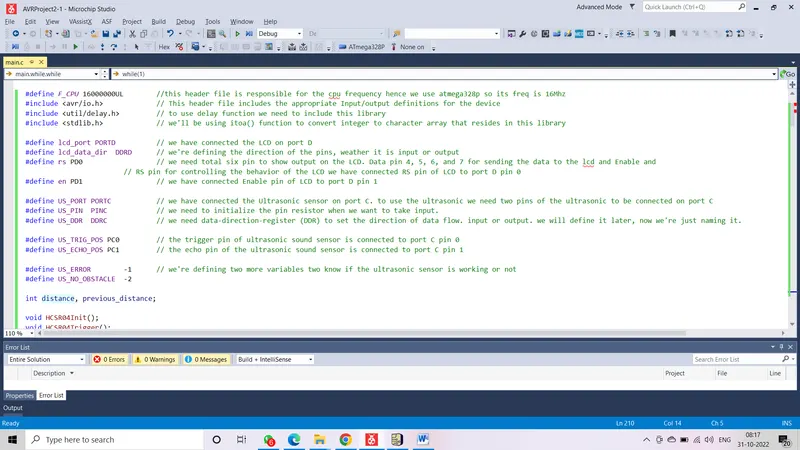
#define F_CPU 16000000UL //use atmega328p so its freq is 16Mhz
#include <avr/io.h> // This header file includes the appropriate Input/output definitions for the device
#include <util/delay.h> // to use delay function we need to include this library
#include <stdlib.h> // we'll be using itoa() function to convert integer to character array
#define lcd_port PORTD // we have connected the LCD on port D
#define lcd_data_dir DDRD // we're defining the direction of the pins, weather it is input or output
#define rs PD0 // we need total six pin to show output on the LCD. Data pin 4, 5, 6, and 7 for sending the data to the lcd and Enable and RS pin for controlling the behavior of the LCD we have connected RS pin of LCD to port D pin 0
#define en PD1 // we have connected Enable pin of LCD to port D pin 1
#define US_PORT PORTC // we have connected the Ultrasonic sensor on port C. to use the ultrasonic we need two pins of the ultrasonic to be connected on port C
#define US_PIN PINC // we need to initialize the pin resistor when we want to take input.
#define US_DDR DDRC // we need data-direction-register (DDR) to set the direction of data flow. input or output. we will define it later, now we're just naming it.
#define US_TRIG_POS PC0 // the trigger pin of ultrasonic sound sensor is connected to port C pin 0
#define US_ECHO_POS PC1 // the echo pin of the ultrasonic sound sensor is connected to port C pin 1
#define US_ERROR -1 // we're defining two more variables two know if the ultrasonic sensor is working or not
#define US_NO_OBSTACLE -2
int distance, previous_distance;
void HCSR04Init();
void HCSR04Trigger();
void lcd_command( unsigned char );
void HCSR04Init()
{
US_DDR|=(1<<US_TRIG_POS); // we're setting the trigger pin as output as it will generate ultrasonic sound wave
}
void HCSR04Trigger()
// this function will generate ultrasonic sound wave for 15 microseconds Send a 10uS pulse on trigger line
{
US_PORT|=(1<<US_TRIG_POS); //high pulse
_delay_us(15); //wait 15uS
US_PORT&=~(1<<US_TRIG_POS); //low pulse
}
uint16_t GetPulseWidth()
{
// this function will be used to measure the pulse duration. When the ultra sound echo back after hitting an object
// the microcontroller will read the pulse using the echo pin of the ultrasonic sensor connected to it.
uint32_t i,result;
// Section - 1: the following lines of code before the section - 2 is checking if the ultrasonic is working or not
// it check the echo pin for a certain amount of time. If there is no signal it means the sensor is not working or not connect properly
for(i=0;i<600000;i++)
{
if(!(US_PIN & (1<<US_ECHO_POS)))
continue; //Line is still low, so wait
else
break; //High edge detected, so break.
}
if(i==600000)
return US_ERROR; //Indicates time out
// Section -2 : This section is all about preparing the timer for counting the time of the pulse. Timers in microcontrllers is used for timing operation
TCCR1A=0X00; // Setup Timer1
TCCR1B=(1<<CS11); // This line sets the resolution of the timer. Maximum of how much value it should count. input capture mode of timer1.
TCNT1=0x00; // This line start the counter to start counting time
// Section -3 : This section checks weather the there is any object or not
for(i=0;i<600000;i++)
// the 600000 value is used randomly to denote a very small amount of time, almost 40 miliseconds
{
if(US_PIN & (1<<US_ECHO_POS))
{
if(TCNT1 > 60000)
// if the TCNT1 value gets higher than 60000 it means there is not object in the range of the sensor
break;
else continue;
}
else
break;
}
if(i==600000)
return US_NO_OBSTACLE; //Indicates time out, Falling edge found
result=TCNT1;
// microcontroller stores the the value of the counted pulse time in the TCNT1 register. So, we're returning this value to the main function for utilizing it later
TCCR1B=0x00; //Stop Timer
if(result > 60000)
return US_NO_OBSTACLE; //No obstacle
else
return (result>>1);
}
void initialize (void)
{
lcd_data_dir = 0xFF; // this will set the LCD pins connected on the microcontroller as output
_delay_ms(15); // to show data on the LCD we need to send commands first then the data
lcd_command(0x02); // this command returns the cursor to the first row and first column position
lcd_command(0x28); // display 4 bit data in two line in 5x7 matrix
lcd_command(0x0c); //Making the cursor off and also display off
lcd_command(0x06); //auto Increment cursor
lcd_command(0x01); //Clearing the complete display including RAM DATA
_delay_ms(2);
}
void lcd_command( unsigned char cmnd )
{
// in order to send command to the lcd first we need to write the command on the data pins. then set the RS pin to zero and enable pin to high
// then wait for one microseconds and set the enable pin to low, this process repeats again. We're using 4 bit data communication but the data is 8-bit
// so we will send the data dividing it into two section. Higher 4 bit and lower 4 bit
// the following lines of codes are used to send higher 4 bits of data
lcd_port = (lcd_port & 0x0F) | (cmnd & 0xF0);
// this line writes the command on the data pins of the lcd connected to th microcontroller portD pin 4 to 7
lcd_port &= ~ (1<<rs); // LCD Command register select
lcd_port |= (1<<en);
_delay_us(1);
lcd_port &= ~ (1<<en);
_delay_us(200); // wait 200 microseconds
lcd_port = (lcd_port & 0x0F) | (cmnd << 4); // send the lower 4 bits of the data
lcd_port |= (1<<en);
_delay_us(1);
lcd_port &= ~ (1<<en);
_delay_ms(2);
}
void lcd_clear()
{
lcd_command (0x01); // this line clears the LCD screen
_delay_ms(2); // waits for two milliseconds
lcd_command (0x80); // this line sets the cursor to the row 1 column 1
}
void lcd_print (char *str)
{
// this function will be used to display the string on the LCD screen
int i;
for(i=0; str[i]!=0; i++)
{
// we can not send the whole string to the LCD we need to send character by character
// data sending is same as sending a command. there is one difference, in this case the RS pin will be set to HIGH while
// the RS pin was set to zero in case of the command sending
lcd_port = (lcd_port & 0x0F) | (str[i] & 0xF0);
lcd_port |= (1<<rs); //Data register select
lcd_port|= (1<<en);
_delay_us(1);
lcd_port &= ~ (1<<en);
_delay_us(200);
lcd_port = (lcd_port & 0x0F) | (str[i] << 4);
lcd_port |= (1<<en);
_delay_us(1);
lcd_port &= ~ (1<<en);
_delay_ms(2);
}
}
void lcd_setCursor(unsigned char x, unsigned char y)
// this function will be used to set cursor. the place where we want to display the data
{
unsigned char adr[] = {0x80, 0xC0};
// the 16x2 LCD has two rows first row has a value of 0x80. So let's say we want to go to the seconds column of first row
// we just need to send the command with adding 2 with the initial value. So, it will be (0x80 + 2) this is how the code works
lcd_command(adr[y-1] + x-1);
_delay_us(100);
}
int main()
{
initialize(); // we're initializing the LCD port and set the basic thinks
char numberString[4]; // we're defining an array of character. It will be utilized later to store integer to be displayed on the LCD screen
while(1)
{
uint16_t r;
_delay_ms(100); //Let the LCD Module start
HCSR04Init(); //Set io port direction of sensor
while(1)
{
//Send a trigger pulse
HCSR04Trigger(); // calling the ultrasonic sound wave generator function
//Measure the width of pulse
r=GetPulseWidth(); // getting the duration of the ultrasound took to echo back after hitting the object
//Handle Errors
if(r==US_ERROR) // if microcontroller doesn't get any pulse then it will set the US_ERROR variable to -1
// the following code will check if there is error then it will be displayed on the LCD screen
{
lcd_setCursor(1, 1); //lcd_setCursor(column, row)
lcd_print("Error!");
}
else
{
distance=(r*0.034/2.0); // This will give the distance in centimeters
if (distance != previous_distance) // the LCD screen only need to be cleared if the distance is changed otherwise it is not required
{
lcd_clear();
}
lcd_setCursor(1, 1); // set the row and column to display the data
lcd_print("Distance = "); // Show the String"Distance="
lcd_setCursor(12, 1); // lcd_setCursor(column, row)
itoa(distance, numberString, 10); // distance is an integer number, we can not display integer directly on the LCD. this line converts integer into array of character
lcd_print(numberString); // Show the Distance value
lcd_setCursor(14, 1); // set the row to 1 and and column to 14 to display the data
lcd_print(" cm"); // Show the String"cm"
previous_distance = distance;
_delay_ms(30);
}
}
}
}
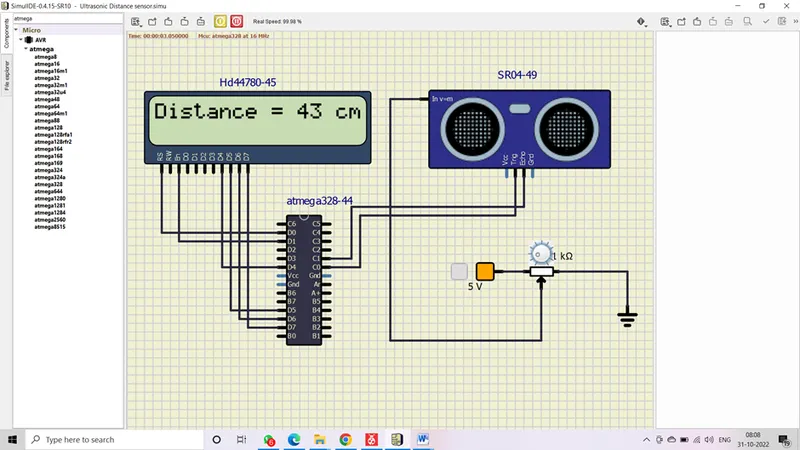
Output: Display the Distance in ‘cm’
While change the Potentiometer for the reference input of SR04 the distance value shows on the 16x2 LCD display.
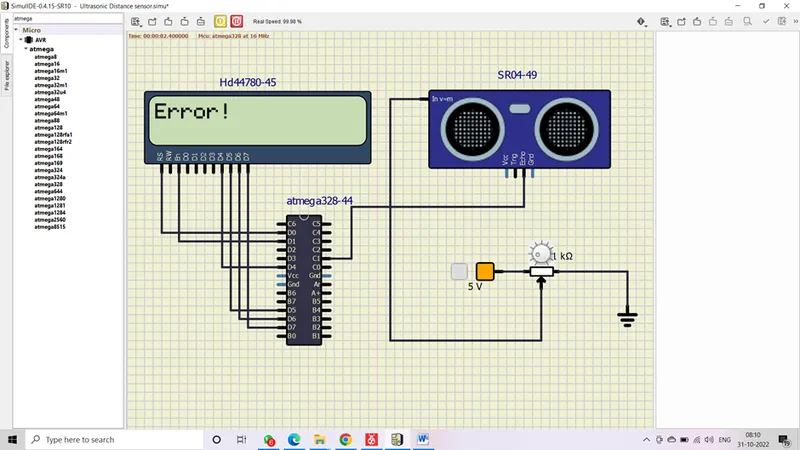
Output : Display the 'Error!' message
If the sensor is not working or the Trigger and Echo pins are not inserted correctly, it will shows the Error message on the LCD.