Project 2 - Design and Development of Pulse Oximeter (Medical Technology)
Project 2
1.Market analysis of Pulse oximeters
Pulse oximeter is a device that measures the tissue oxygenation level. It gives the oxygen saturation level of arterial blood.
In terms of revenue, the global pulse oximeter market is estimated to be worth 2.8 billion USD in 2022 and is expected to reach 4.3 billion USD by 2027 growing at a CAGR of 8.8%.
Growth in this market can be attributed to the increasing prevalence of respiratory diseases, congenital heart diseases in children, outbreak of infectious respiratory diseases, increasing geriatric population with chronic diseases.
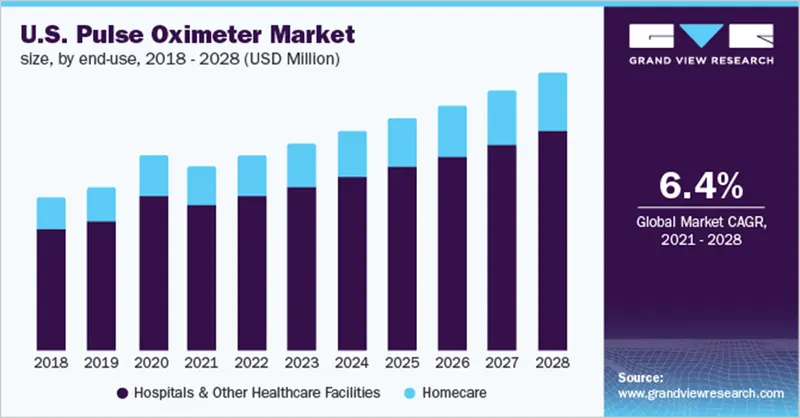
North America accounted for the largest share of pulse oximeter
Market players:
- Medtronic
- Carefusion
- GE healthcare
- Philips Healthcare
- Masimo
https://www.marketsandmarkets.com/Market-Reports/pulse-oximeter-market-68168578.html
State-of-the-art products
- Finger-held pulse oximeters are the most common pulse oximeters nowadays.
- Wearable pulse oximeters
- Portable pulse oximeters
- Wireless pulse oximeters
- Ambulatory pulse oximeters
- Customer needs, product specifications
The below mentioned are the customer requirements for a portable finger pulse oximeter
|
S. No |
Customer needs |
Needs statement turned into product specifications |
|
1 |
There is gap between fingertip and the device |
Finger slot should be tight enough to secure the finger |
|
2 |
Alarm should be loud enough |
Audible range should be large |
|
3 |
Should indicate sensor error or disconnection |
Alarm should indicate disconnection |
|
4 |
Should operate without power supply |
Should be operable by battery |
|
5 |
Should be able to transmit data to healthcare worker |
Wireless data transmission |
|
6 |
Should automatically call emergency services in case of hypoxia or SpO2 levels below 90 |
Automatic calling services |
|
7 |
Display should be vigilant |
Large LCD display |
|
8 |
Should indicate battery life |
Battery state indication |
Design specifications
- For use in adults and children and all skin pigmentations
- Suitable for cleaning and disinfection
- Should be usable in shock and vibration
- Should not cause electric shock to the user
Technical specifications
- SpO2 detection range: 70-100
- Resolution: 1% or less
- LCD display
Functional specifications
- Alarm messages
- Data interface
- Automatic power-off
Mission statement (Philips pulse oximeter)
To meet the needs of providers and patients, Philips offers a full range of quality pulse oximeters that light in weight yet have exceptional memory and battery life.
Resources required for pulse oximeter(technical)
- LED bulbs- one red and one infrared
- Photodiode
- Casing
- Microcontroller
- Battery
- Work Breakdown structure for pulse oximeter
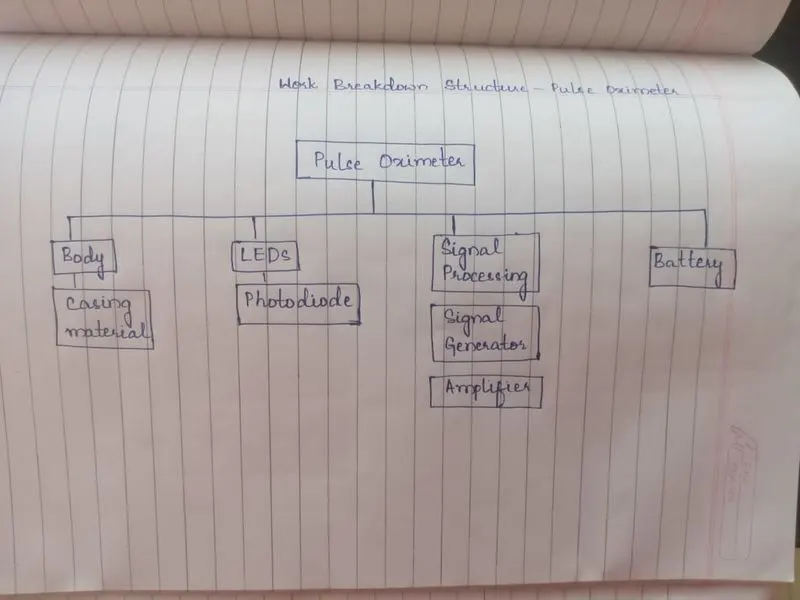
Work breakdown structure of pulse oximeter has 4 arms.
- Body: The casing of the pulse oximeter should be designed. The material has to be chosen such that it is economical, durable and flexible.
- Sensor/ Detection circuit: It consists of two LEDs-one red and the other infrared. They flash the respective lights and record the signals. These signals are detected by a photodiode.
- Signal processing: This part is involved with signal processing algorithms, includes amplification, filtering and ADC
- Battery
Product architecture: pulse oximeter can have a modular architecture considering the long usage of the device. If the damaged parts are replaceable, it can increase their life, reduce the cost.
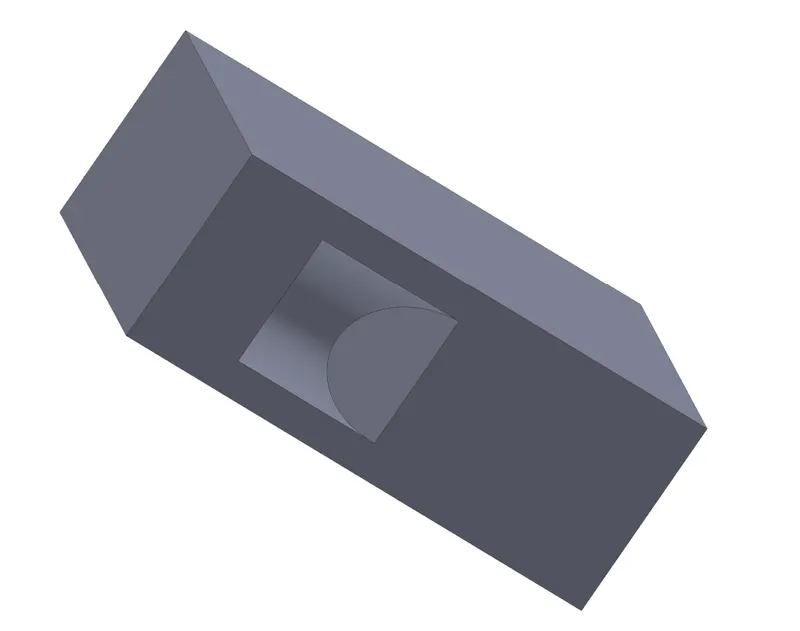
Please visit the below links for solid parts diagram: https://drive.google.com/file/d/11w2P4xJ5JVOR9Jnh5_2cPEZ2Y1hbj3nA/view?usp=share_link;
https://drive.google.com/file/d/1agZTQfxEBdut0DF1XSEtVARvs8UtjUvV/view?usp=share_link
- Failure Mode Effect Analysis
|
Part/ components |
Failure mode |
Effect |
Sev |
Cause |
Occ |
Detection method |
DET |
RPN |
|
Sensor reading |
Broken sensor |
Improper or unable to give readings |
8 (It is very severe as the whole purpose of device is broken) |
Physical pressure or damage by moisture |
3 It is very unlikely to occur |
Standard calibration |
2 It can be easily detected |
48 |
|
LCD |
Display not working |
Unable to perceive output |
8 |
Water damage |
2 less likely to occur |
Standard operation methods can detect |
1 very easy to determine |
16 |
|
Body |
Broken casing |
Disconnection and cannot function |
9 As it can cause damage to all other connections like sensors |
Physical force, harsh weather |
2 less likely to occur |
Visibly detected |
1 very easy to determine |
18 |
|
Power plug |
Broken chord |
Device non-functional |
7 Although severe, it is harmless |
Electrical wear |
5 |
multimeter |
1 |
35 |
|
Battery |
Reduced capacity |
Flickering display, not able to operate |
5 Less harmful |
aging |
7 |
Visibly detectable from symbols |
1 |
35 |
|
Alarms |
False alarms |
misinterpretation |
10 very severe |
Faulty algorithms |
3 |
It is detectable during calibration |
5 |
150 |
|
Thermal runaway |
Not working device |
Not working device |
5 |
aging |
6 |
multimeter |
1 |
30 |
|
probe |
Broken probe, device no readings |
no readings |
8 |
broken connections |
3 |
standard methods |
2 |
48 |
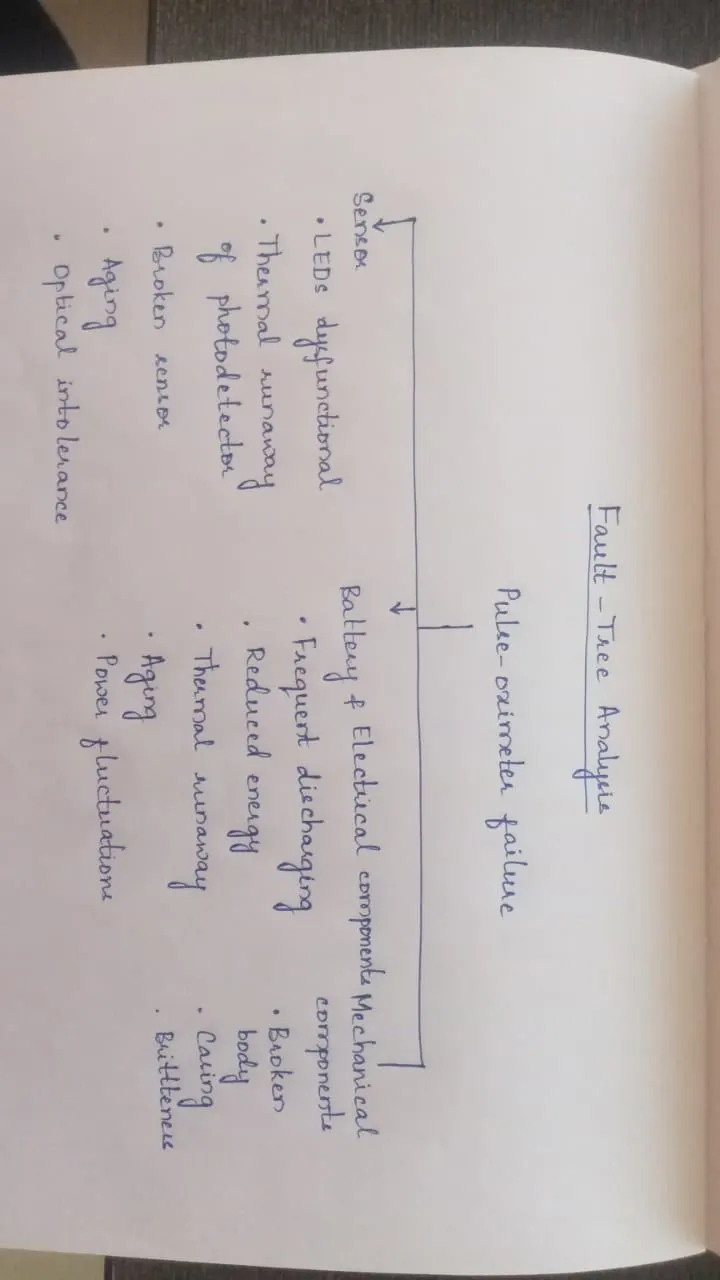
Fault tree analysis
- Improvements in design process
- Improved optics: Minimizing the number of LED bulbs and working on intensity will improve the optics by reducing the number of components. Also, optimizing distance between LEDs and photodetector will have a huge impact on the design and efficiency of the product. It also determines the size limitations o device
- improved material: choosing a material that is durable and sustainable
- low-current leakage: Using efficient LED bulbs and choosing right electronic components will overcome the current consumption
- overcoming motion artifacts: implementing noise cancellation and filtering will help in overcoming motion artifacts
- Automated emergency calling services: Program the algorithm to call emergency services if SpO2 levels fall below 85
- Less energy consumption
Cost estimation
- Sensors:
- 15 USD for disposable
- 70-250 USD for reusable sensors
- portable monitor
- 1000 USD
- additional costs
- roll stands USD 325-500
- Reference: https://hcpresources.medtronic.com/blog/how-much-does-pulse-oximetry-cost
Environmental impact
pulse oximeters have relatively low environmental impact than many other medical devices. They are made of plastic casing that can be recycled.
|
S.No |
product stage |
environmental impact |
ways to reduce the impact |
|
1 |
Material (Plastic) acquisition Pre-production |
Low as there are ways to recycle plastic |
prefer low thickness plastic that can be recycled |
|
2 |
Battery disposal Post-production |
very high as improper disposal ways leads to hazardous emissions that pollute the environment |
use better disposal ways or else minimize battery usage by implementing ways to recharge batteries thus reducing the number of batteries required. |
|
3 |
Transportation |
moderate |
Carbon emissions due to transportation of components can be reduced by choosing waterways or other alternative ways to transport |
prototype and manufacturing
- Sensor: pulse oximeter sensor consists of two LEDs and a photodetector that can be manufactured using injection molding or photolithography. In injection molding, a plastic resin is melted and injected into a mold that has a desirable shape. once the molten resin is cooled, excess material is trimmed away and sensor components are attached.
- Batteries: pulse oximeter batteries can be manufactured using various technologies like lithium-ion battery technology, nickel-metal hydride battery, alkaline batteries and zinc-air batteries. The method implemented for manufacturing depends on desired energy density, lifespan and cost
Prototypes:
analytical prototypes using CAD software enables us to explore various design sketches and choose the desired one.
3D printing would not be an efficient manufacturing process for producing pulse oximeters in large quantities. Injection molding is the most preferred manufacturing technique as it is an economical and faster process. However, considering the simple design of pulse oximeters, 3D printing is not a viable option.
in order to make it difficult to reverse engineer the design, choose an integral architecture or else provide advancements in terms of algorithms or software that cannot be hacked.