Project 1
Project 1
Multi-parameter monitoring system
1.Parameters
Muti-parameter monitoring systems are generally used clinical setting. Selection criteria for physiological parameters for design is that all the vital physiological parameters indicative of patient’s physiological condition. These vital parameters include-
- ECG- It is the measure of electrical activity of the heart. The waveform representation reflects the heart activity.
- Normal Heart rate: 70-100 bpm
- SpO2-It gives the saturated oxygen level. It gives the amount of oxygen in the blood. It reflects the oxygen carrying capacity of blood
- Normal range: 96 to 100
- Temperature- Body temperature reflects the internal homeostasis. It could be an early indicator of shock
- Normal range: 36.1-37.2℃
- Blood pressure- It is the pressure exerted by blood on the blood vessels. It reflects the vascular health
- Normal range: 50-140 mm Hg
- Respiration rate-It is the number of times person breathes per minute. It indicates the lungs health
- Normal range: 12-16 bpm
- Et Carbondioxide (End tidal carbondioxide)- It measures the amount of carbondioxide level. It indicates ventilation
- Normal range: 35-45 mm Hg
Specifications and Sensors intended for usage include
- Heart rate sensor- to detect heart rate
- ECG leads- Electrodes that record the heart activity
- Specifications
- Frequency: 0.05 to 145 Hz
- Amplitude: 0.1 to 1 mV
- SpO2 sensor-(Finger tip) Consists of red and infrared LED sources and photodetectors
- Specifications
- Measuring range: 70-100
- Specifications
- Temperature sensor-A thermistor probe
- Specifications
- Measuring range: 10-45℃
- Blood pressure sensor-A pressure sensor
- Specifications
- Measuring range: 0 to 250 mm Hg
- EtCO2 sensor: It is basically CO2 sensor
- Specifications
- Measuring range-30-320 mm Hg
- Respiration rate-Impedance method
- Specifications
- Normal range: 4 to 120 breaths per minute.
- Specifications
- Block diagram
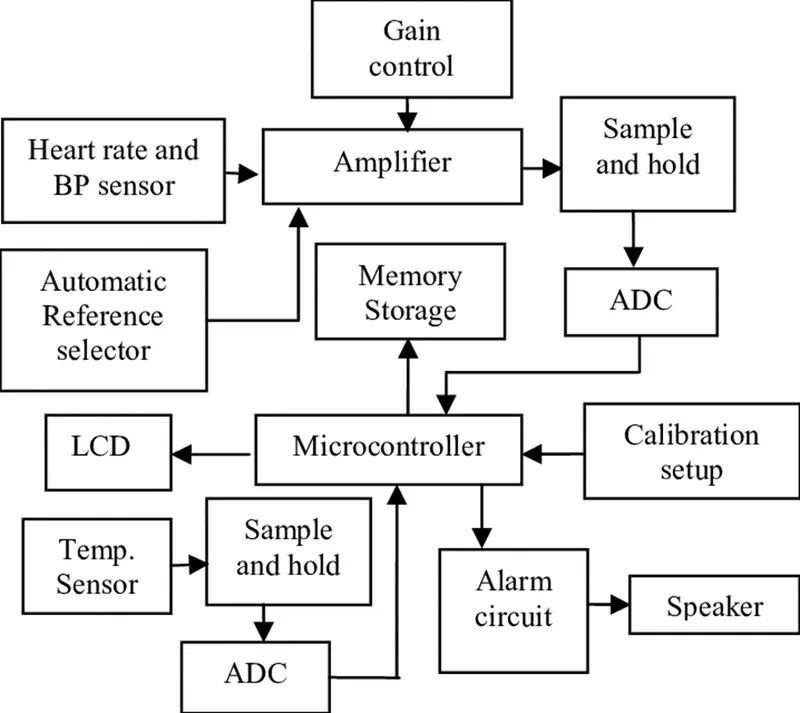
Heart rate and BP sensor: It senses the heart rate and blood pressure. The sensor senses the physiological parameters and then sent to pre-amplification.
Temperature sensor: It senses the body temperature (LM35)
Automatic Reference selector: It is used to supress DC component from weak biosignals.
Signal conditioning: This comprises of pre-processing, filtering and second stage amplification. It is described below:
- Instrumentation amplifier: It amplifies the biosignal with common mode rejection
- High pass and low pass filter: This cascade limit the signal in the desirable range
- Amplifier: it provides the second stage amplification with gain control
Sample and Hold: The highly amplified signal is sampled and stored.
ADC: Analog to digital converter converts the analog signal to digital form for further processing
Microcontroller: The sampled data is fed into microcontroller for processing
Memory storage: Patient data is stored for future use
Alarm: If any of the patient data exceeds the pre-set limits, alarm is buzzed
Speaker: When the alarm circuitry is on, these signals are perceived as audio signals by speaker
LCD: (Liquid Crystal Display)-The processed digital data from microcontroller is displayed on LCD.
Calibration setup: It is a provision to connect the simulator for calibrating the device.
- Types of processing requirements
Patient monitoring system consists of several sensors connected to patient and they communicate the data through processing units.
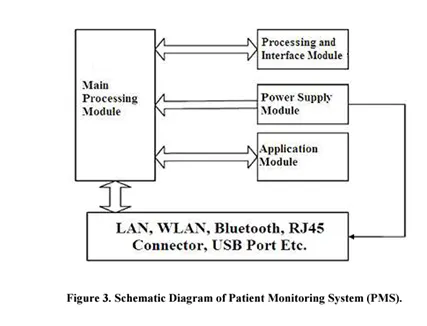
Central processing and interface module
It has interface board and central processing module, this has system memory, display, network circuit, input/output interface and USB.
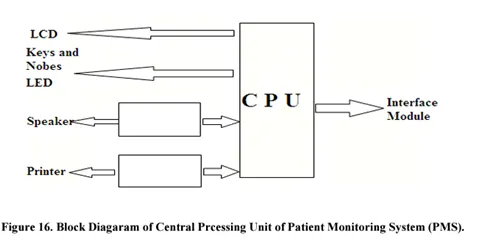
CPU
It is the core of main board. It connects to the peripherals via bus and I/O cables. CPU has output devices like printer, speaker (for heart sound), data recorder and input devices like keyboard.
Ethernet network controller
Ethernet is a set of frames based on networks for LAN. Ethernet controller links all the medical devices via Ethernet LAN.
- Patient safety requirements
The following should be catered in design while designing PMS(Patient Monitoring System)
General patient safety requirements like
- Protection from
- Electrical shocks
- Defibrillator circuitry
- Electromagnetic interference
- Automatic fire suppression
- Harm
- Global trigger tool
- Patient safety indicators
- Rates of surgical complications
- Reliability of safety critical processes
- Observation of safety critical behaviour
- Monitoring of stroke care bundles
- In case of PMS, safety features include
- Electrical safety testing
- Parameter accuracy
- For Blood pressure measurements, a built-in pressure pump to detect system leak and over pressure
- Default inflation pressure is limited to 135 mm Hg
- Maximum determination time: 2 mins
- Over pressure monitor: pressure ranges from 300 to 330 mmHg
- Safety requirements- These standards must be met by PMS. These aspects are to be taken care during designing
- IEC 60601-1: General requirements for basic safety and essential performance
- IEC 60601-1-2: Collateral standard-electromagnetic disturbances
- IEC 60601-1-6: collateral standard for usability
- IEC 60601-1-8: Collateral standard: General requirements, tests and guidance for alarm systems in medical electrical equipment
- IEC 60601-1-12:Collateral standard: Requirements for medical electrical systems for use in emergency services
- Device qualification
Medical device has to be registered in India under Central Drugs standard control organization for its qualification. Firstly, device has to be registered under Drugs and Cosmetics Act of 1940.
PMS has to be validated for intended use. For this to happen, verification of product features and its intended use is done. The following aspects are validated for device
- Sterilization and sterile packing
- Ambient conditions
- Aseptic filling
- Lyophilization- It is removal of water from product
- Heat treating, plating, welding, soldering, painting etc,.
- Visual inspection of PCBs
- Testing of wiring harnesses
Firstly, a validation team plans and defines the parameters to be validated, describe the process, perform quality analysis, create protocols and perform the tests and submit the reports. These are followed for device to be qualified for usage.
Device calibration
Device calibration for patient monitoring system can be done using patient monitor simulator. It simulates critical parameters like blood pressure, ECG, respiration, SpO2.
In addition to these, calibration is performed to check for the device accuracy.
Parameters tested include
- Electrical safety tests
- ECG
- Blood pressure
- Cardiac output
- Temperature
Procedure
- Firstly, enter the service mode
- ECG channels check
- ECG channels may be inaccurate due to hardware or software problems. It can be tested by square wave
- BP maintenance
- Accuracy tests, leakage test and calibration
- This is performed by simulator
- etCO2 calibration
- Accuracy test after warm up of 20 mins
- Temperature verification
- Tested using simulator
- SpO2 verification
- Tested using simulator
- Leakage current tests
- GUI layout-Screen layout
Graphical User Interface is a form of user interface that allows users to interact with electronic devices through graphical icons.
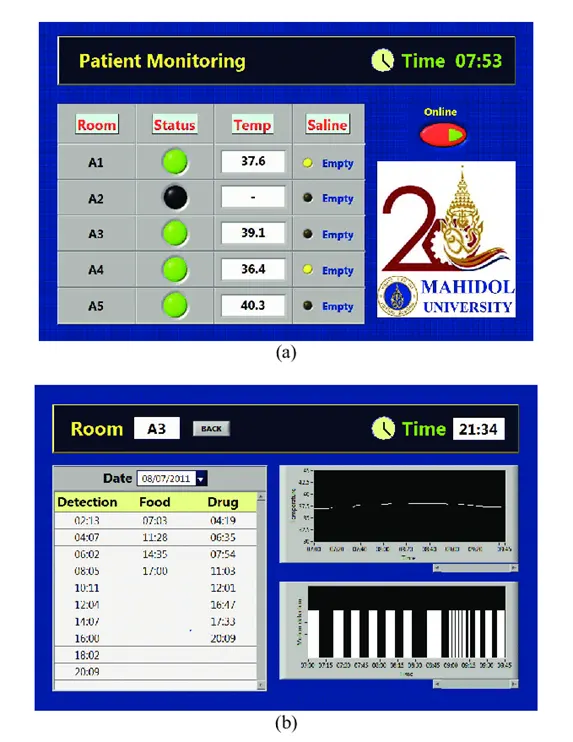
In the above GUI, the room number is displayed and its status is indicated in green if patient is present and vice-versa. It also has temperature and saline status on its display. This lets the nursing team at the central station know the current status at a single glance.
Layout
GUI layout has the following components namely-
- Virtual input device to represent position of device’s interface
- Commands are compiled together in menus and actions are performed with pointing device
- Window manager facilitates the interactions between windows and applications
- Multi-row and multi-column are images with fixed height but variable length
- Data acquisition and storage in database
Patient monitoring systems generate lot of data. They have to collected and stored appropriately to avoid loss of information.
Software architecture for patient monitoring includes lifestyle monitoring, medical sensing, sensor integration.
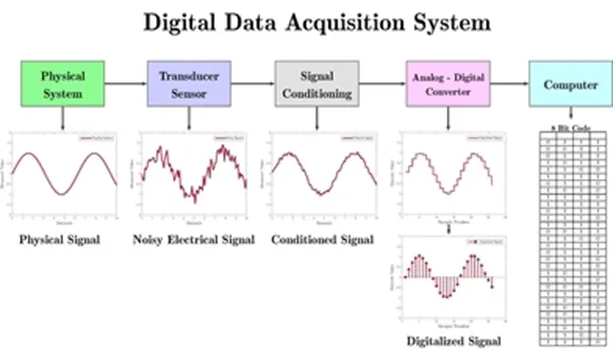
Data acquisition system acquires the signals, perform sampling and convert these signals into digital numeric values that are manipulated by computer. It includes following components-
Sensors- to acquire and convert the physiological signals to electrical form
Signal conditioning circuitry-It includes pre-processing, filtering, noise removal and second stage amplification
ADC- converts analog signals to digital form
Data storage
Integrated medical environment is a new open-source architecture that can be used for ICU settings. It provides 1. Real-time data acquisition using custom designed software. The data is stored in a local database and is then transferred to hospital storage using a secure data transfer protocol.
Data transmission protocols (LAN)
Half-duplex mode
In this mode, sender can send and receive the data. However, only one action at a time can be performed. It is like one way road
Full duplex mode
In this mode, sender can send and receive the data at the same time. It is two way road. This is the preferred mode of data transmission for fast transmission
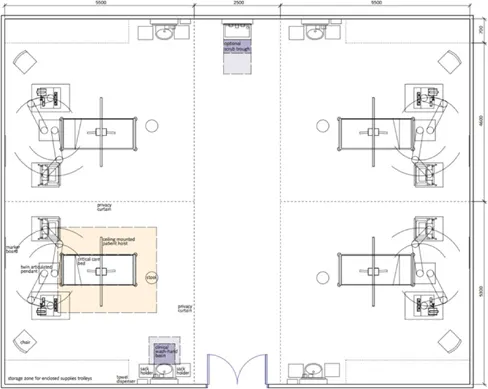
- Designing ICU with 8 beds and networking
- ICU should be geographically at a distinct area within hospital.
- There should be a single entry and single exit with provision for emergency exit
- It should be away from goods loading area
- It should have ambient ventilation
- Should be accessible for fast and easy transportation
- 150-200 sq.ft per open bed with 8 ft in between beds should be the bed space
- Should have access for outlets, storage, infusion pumps, IV drips, ventilator pumps, portable X-ray units, defibrillators, anesthesisa machines
- A central nursing station to monitor the all 8 beds
Networking
Since, only 8 beds are expected. They can be networked using single server based central patient monitoring
Central Nursing station
It is a medical information equipment used for consolidated monitoring. It consists of central monitoring software and high-performance computer. It constructs a monitoring network system by connecting multiple patient monitoring systems.
Central monitoring system is controlled by desktop that is equipped with connectivity and buses system. It performs following actions-
- System should have capability of real-time monitoring of 8 beds
- Monitor and display real-time physiological sign
- Signal interpretation and alarm beep
- Store data automatically in central system
- Transfer of data between central monitoring system to bed side monitors
- Should have wireless applications to enable remote monitoring.
9. Network connectivity for remote monitoring
Reference: https://doi.org/10.1109/ROBIO.2011.6181597
Remote monitoring of patient can be done by not being physically present near the patient. This can be done by wireless networking.
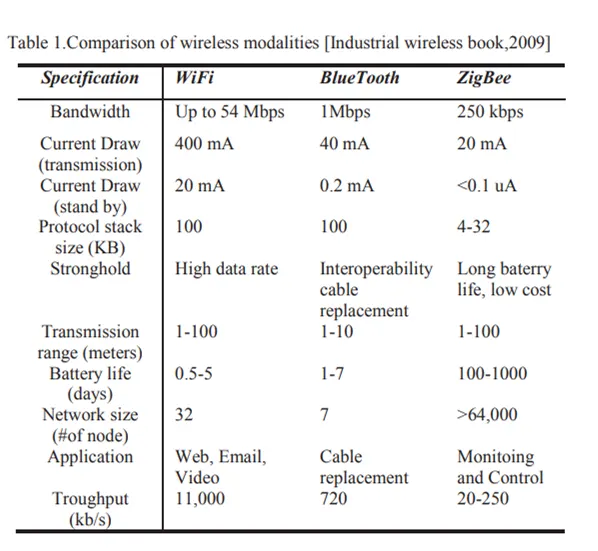
There are 3 types of wireless networking that are commonly used. They are WiFi (Wireless Fidelity), Bluetooth and Zigbee.
WiFi: It uses radiowaves for allowing devices to communicate with each other. It is the fastest mode and has high data rate.
Bluetooth: It is used for closed range data transmission from one digital device to another.
Zigbee: It is high-level communication protocol used to create the personal area networks with low power consumption. It is best suited for clinical setup.
- Alarm system
Alarms are set in the clinical setting to recognize that something parameter is out of the pre-defined values. The goals of alarm system are-
- Detection of life-threatening situations
- Device malfunction alarms
- Diagnostic alarms- These indicate pathophysiological situation
Alarm types
- Audio/ acoustic
- These alarms generate warning sound. Manufacturers distinguish the priority of alarm with different signals.
- Visual
- These involve flashing or color coding in eye-catching manner. For example, flashing of red color if the parameter crosses the limit.
Scheme
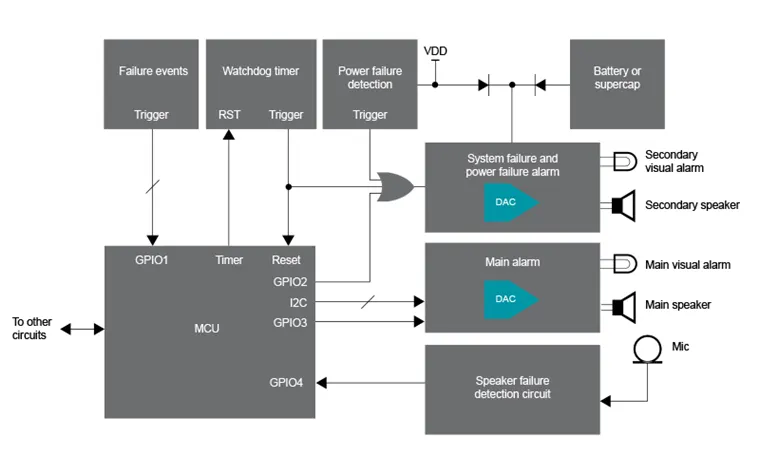
Alarms in patient monitoring system are generated for the below scenarios-
- Asystole
- Ventricular fibrillation
- Ventricular tachycardia
- Bradycardia
- Low SpO2
11.Data storage, retrieval and transmission methodology
ICU data directory is the default location for all ICU data. This directory is built into a shared library.
Data stream technologies
- It collects, stores and analyses the data. It consists of a software tool called as LabVIEW. It is used as an integrating platform for acquisition, processing and transmission.
- It also provides the graphical programming environment
Data storage and retrieval
It can be stored using permissioned block chains. Block chain is a shared database that can store data in structures called as blocks and links the new information securely together. Algorithms specifying the data path, file name are used to locate and retrive the data
Data transmission
Data can be transmitted in two ways-
- Single computer server
Here, the application server is used as database server.
File servers acquire information into the database server
Print server is used to retrieve data or take printouts
- Peer to peer networking with computer server
This type shares and stores data on each connected system on the network. This avoids the overload on server system.
Features:
This maintains the electronic record of patient by storing data
Patient can retrieve the information by gaining access to his registry
It is easy to monitor database using this type of transmission.